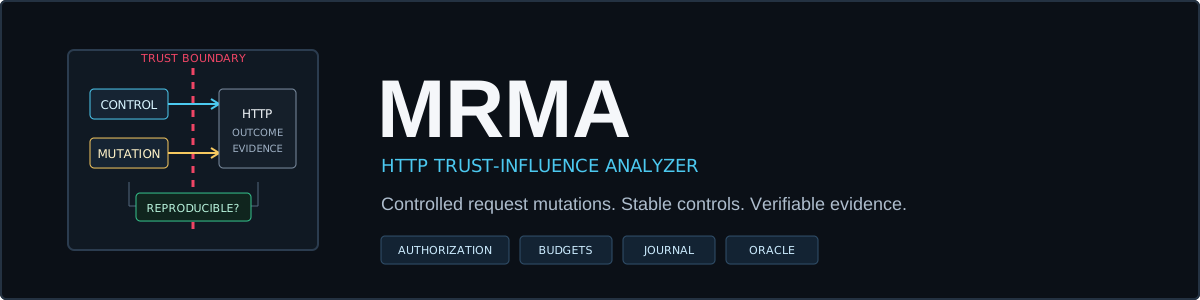


Does one authorized request change reproducibly alter an HTTP outcome?
MRMA answers that question with repeated controls, bounded mutations, and independently
verifiable evidence.
Current release: v0.4.5. MRMA uses semantic HTTP through HTTPX. It does not claim wire-exact replay, prove exploitability, assign severity, or identify a proprietary component from black-box behavior.
Security testing often observes that a request changed and a response changed. That alone does not establish influence. Dynamic content, connection state, retries, redirects, and unstable controls can produce the same appearance.
MRMA treats the task as a controlled experiment:
- Predeclare a baseline, one mutation, policies, bounds, and a fixed sample.
- Bracket mutations with controls or use a seeded balanced schedule.
- Reject unstable, incomplete, unauthorized, or resource-limited evidence.
- Return a narrow conclusion with the observations, limitations, and provenance needed to check it.
No HTTP attempt can bypass the shared runtime sequence.
Authorization decision
        |
        v
Final HTTPX request preparation
        |
        v
Budget reservation
        |
        v
Immediate authorization revalidation
        |
        v
Journaled attempt identity
        |
        v
Semantic HTTP send
        |
        v
Budget commit + bounded observation
        |
        v
Comparison + fixed-sample conclusion
| Boundary | Enforced behavior |
|---|---|
| Authorization | Exact ASCII host labels, target representation, CIDR, method, operation kind, path, query, authority, proxy, redirect, mutation, and expiry policy |
| Effective authority | URL, Host, TLS SNI, and proxy CONNECT are checked separately; duplicate Host fields are rejected |
| Redirects | Every hop is manually resolved, reauthorized, budgeted, and journaled |
| Cross-origin state | Caller fields are deny-by-default; the final HTTPX-built request also suppresses cookie-jar and explicit Cookie fields unless policy explicitly allows them |
| Budgets | The final prepared request and bounded response representation, including fields added by HTTPX, use one reserve/commit ledger with attempts, roles, redirects, retries, targets, origins, duration, depth, concurrency, and method risk |
| Evidence | Effective plan digest, result, journal, schema, benchmark, runtime data, and bundle file digests are cross-checked offline |
python -m pip install mrma==0.4.5
mrma --version
MRMA is tested on Python 3.10 and 3.13 across Linux, Windows, and macOS.
The published container supports Linux AMD64 and ARM64:
docker pull ghcr.io/0xmrma/mrma:0.4.5
docker run --rm ghcr.io/0xmrma/mrma:0.4.5 --versionRun the packaged 22-case loopback corpus:
mrma benchmark --out-json benchmark.jsonValidate the example authorization policy:
mrma authorization validate examples/authorization.local.json --jsonInspect the maximum experiment plan without sending a request:
mrma experiment \
  --url http://127.0.0.1:8000/ \
  --set-header "X-Probe: 1" \
  --assurance research \
  --authorization examples/authorization.local.json \
  --journal local-plan.journal.jsonl \
  --dry-run
Dry-run output includes a local deterministic approval-plan digest. The privacy-safe plan digest in shared evidence remains run-local and intentionally cannot correlate private request values across runs.
The example policy authorizes loopback only. Start a service on 127.0.0.1:8000, then execute the
same plan and produce a deterministic evidence bundle:
mrma experiment \
  --url http://127.0.0.1:8000/ \
  --set-header "X-Probe: 1" \
  --assurance research \
  --authorization examples/authorization.local.json \
  --journal local-run.journal.jsonl \
  --bundle local-run.zip \
  --json > local-run.json

mrma evidence verify local-run.zip --json
Authorization manifests are policy inputs, not proof of permission. Use a short-lived manifest issued under the target owner's actual approval process.
| Conclusion | Meaning |
|---|---|
INFLUENCE_DETECTED |
Controls were stable and the 95% lower bound for changed mutation pairs met the predeclared reproducibility threshold |
NO_INFLUENCE_OBSERVED |
Controls were stable and the 95% upper bound stayed below the predeclared no-influence threshold |
INCONCLUSIVE |
Sampling, controls, authorization, transport, policy, body evidence, or comparator resources did not support either conclusion |
These are experiment conclusions, not vulnerability or safety labels. Automation exit codes are
opt-in: 10 for influence and 11 for inconclusive under the selected --fail-on policy.
evidence.zip
|-- manifest.json       file set, sizes, and SHA-256 digests
|-- result.json         strict mrma.experiment/v9 document
|-- plan.json           privacy-safe effective plan + bound digest
|-- journal.jsonl       append-only hash-chained runtime events
|-- authorization.json  non-executable policy summary
|-- benchmark.json      packaged release baseline
|-- runtime.json        tool and dependency provenance
|-- schema.json         exact result schema
`-- REPLAY.md           offline verification instructions
mrma evidence verify checks the bundle manifest, exact schema, result cross-fields, effective-plan
digest, RUN_PLANNED linkage, journal chain/head/count, observation topology, authorization summary,
benchmark contract, aggregate statistics, confidence intervals, and final verdict. Integrity
verification does not prove who created an entirely new bundle; artifact authenticity is supplied
separately by GitHub release and OCI attestations.
| Interface | Role | Output |
|---|---|---|
experiment |
Confirmatory fixed-sample oracle | Strict v9 result and optional evidence bundle |
impact |
Exploratory candidate ranking | Candidate manifest for independent confirmation |
run, diff, discover, isolate, profiles, report |
Policy-guarded exploration | Bounded observations and journal events |
benchmark |
Deterministic local validation | Schema-validated 22-case result |
authorization validate |
Offline policy validation | Canonical policy summary and digest |
evidence verify |
Offline integrity verification | Typed verification result or integrity error |
All exploratory sends retain the immutable workflow baseline and apply the same header-mutation policy before networking. Exploratory output is not promoted to confirmatory evidence.
- Semantic HTTP only. HTTPX may normalize request syntax; no wire-byte equivalence is claimed.
- Response bodies are bounded. Truncation or comparator exhaustion becomes structured uncertainty.
- Default comparison does not mask identifier-shaped values. Explicit normalization can support a changed result, but cannot turn different complete body digests into a no-influence result.
- Standard and strict privacy use run-local HMAC fingerprints, while selected policy and journal identifiers remain deterministically linkable and are declared as such.
- The hash chain detects modification of an existing journal. It is not an author signature.
- Authorization v1 remains readable; new policies should use strict
mrma.authorization/v2. - Published schema versions remain packaged and byte-locked for compatibility.
| Topic | Document |
|---|---|
| Runtime structure | Architecture |
| Policy contract | Authorization |
| Request accounting | Budget model |
| Result and bundle integrity | Evidence model |
| Fixed-sample decisions | Statistical model |
| HTTP comparison rules | HTTP semantics |
| Security assumptions | Threat model |
| Reproducible corpus | Benchmark |
| Typed interfaces | Python API |
| Verification record | Validation |
| Artifact provenance | Release verification |
Releases use protected, SSH-signed annotated tags. GitHub Actions builds the wheel, source archive, and multi-platform OCI index, then publishes provenance attestations and an SBOM. Verification commands and trust boundaries are documented in Release verification.
Use MRMA only against targets and request effects explicitly authorized by the target owner. Keep methods, paths, redirect destinations, CIDRs, mutation names, rates, bytes, and expiry narrower than the experiment requires. Report defects through GitHub's private Security Advisory flow described in SECURITY.md.
Created by Mohamed Abdelaal / 0xMRMA. Released under the MIT License.