| title | Netflix's Tech Stack | ||
|---|---|---|---|
| description | Explore the technologies behind Netflix's streaming infrastructure. | ||
| image | https://assets.bytebytego.com/diagrams/0286-netflix-tech-stack.png | ||
| createdAt | 2024-03-15 | ||
| draft | false | ||
| categories |
|
||
| tags |
|
This post is based on research from many Netflix engineering blogs and open-source projects. If you come across any inaccuracies, please feel free to inform us.
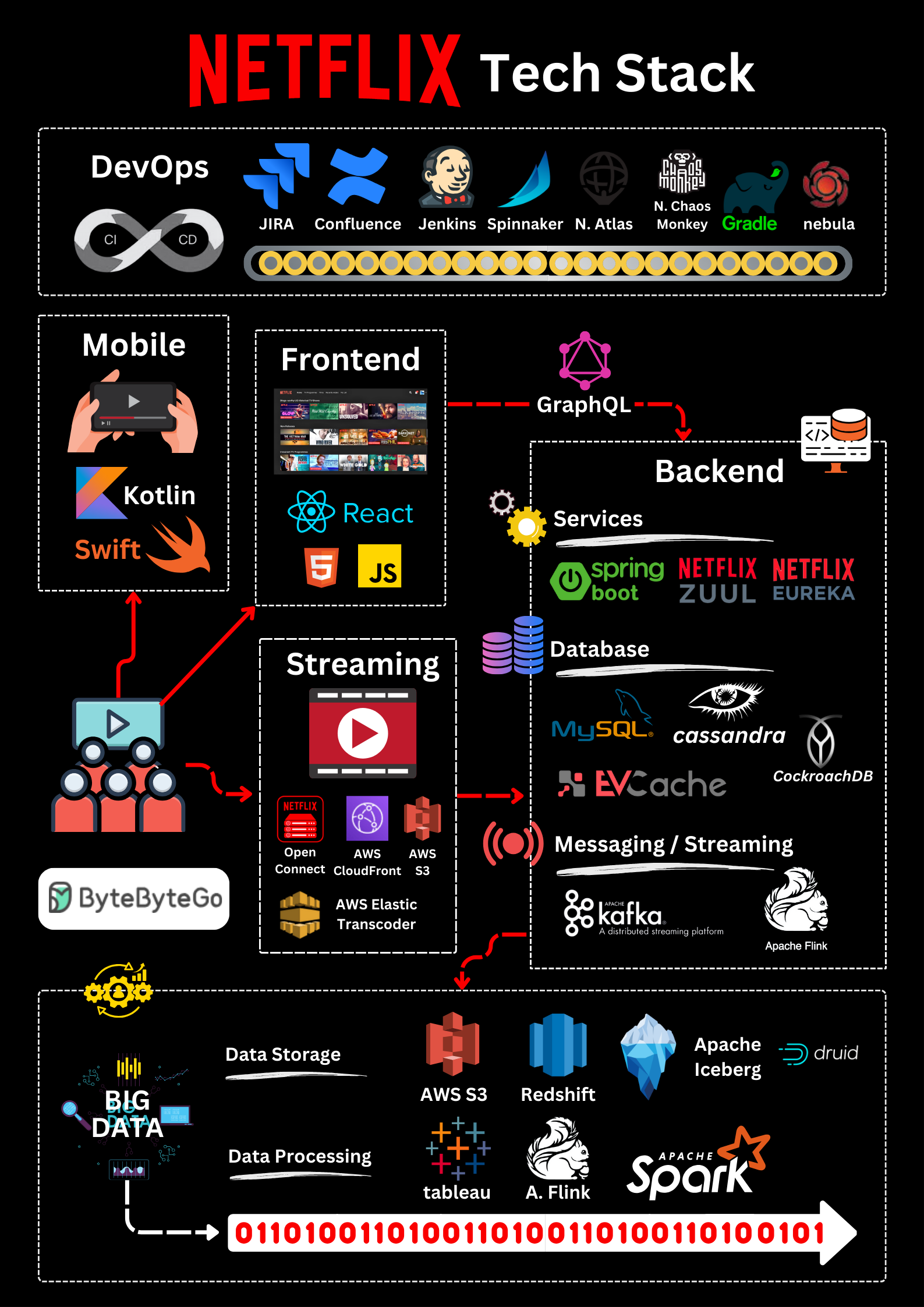
-
Mobile and web: Netflix has adopted Swift and Kotlin to build native mobile apps. For its web application, it uses React.
-
Frontend/server communication: GraphQL.
-
Backend services: Netflix relies on ZUUL, Eureka, the Spring Boot framework, and other technologies.
-
Databases: Netflix utilizes EV cache, Cassandra, CockroachDB, and other databases.
-
Messaging/streaming: Netflix employs Apache Kafka and Flink for messaging and streaming purposes.
-
Video storage: Netflix uses S3 and Open Connect for video storage.
-
Data processing: Netflix utilizes Flink and Spark for data processing, which is then visualized using Tableau. Redshift is used for processing structured data warehouse information.
-
CI/CD: Netflix employs various tools such as JIRA, Confluence, PagerDuty, Jenkins, Gradle, Chaos Monkey, Spinnaker, Altas, and more for CI/CD processes.