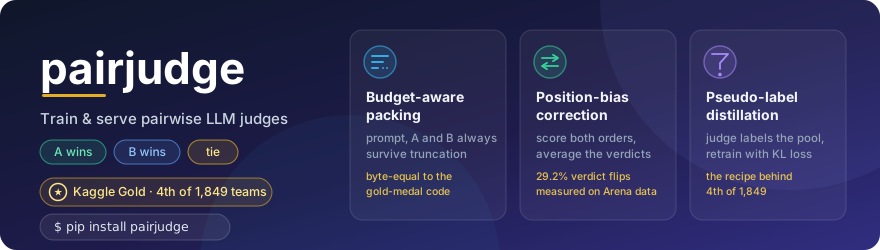



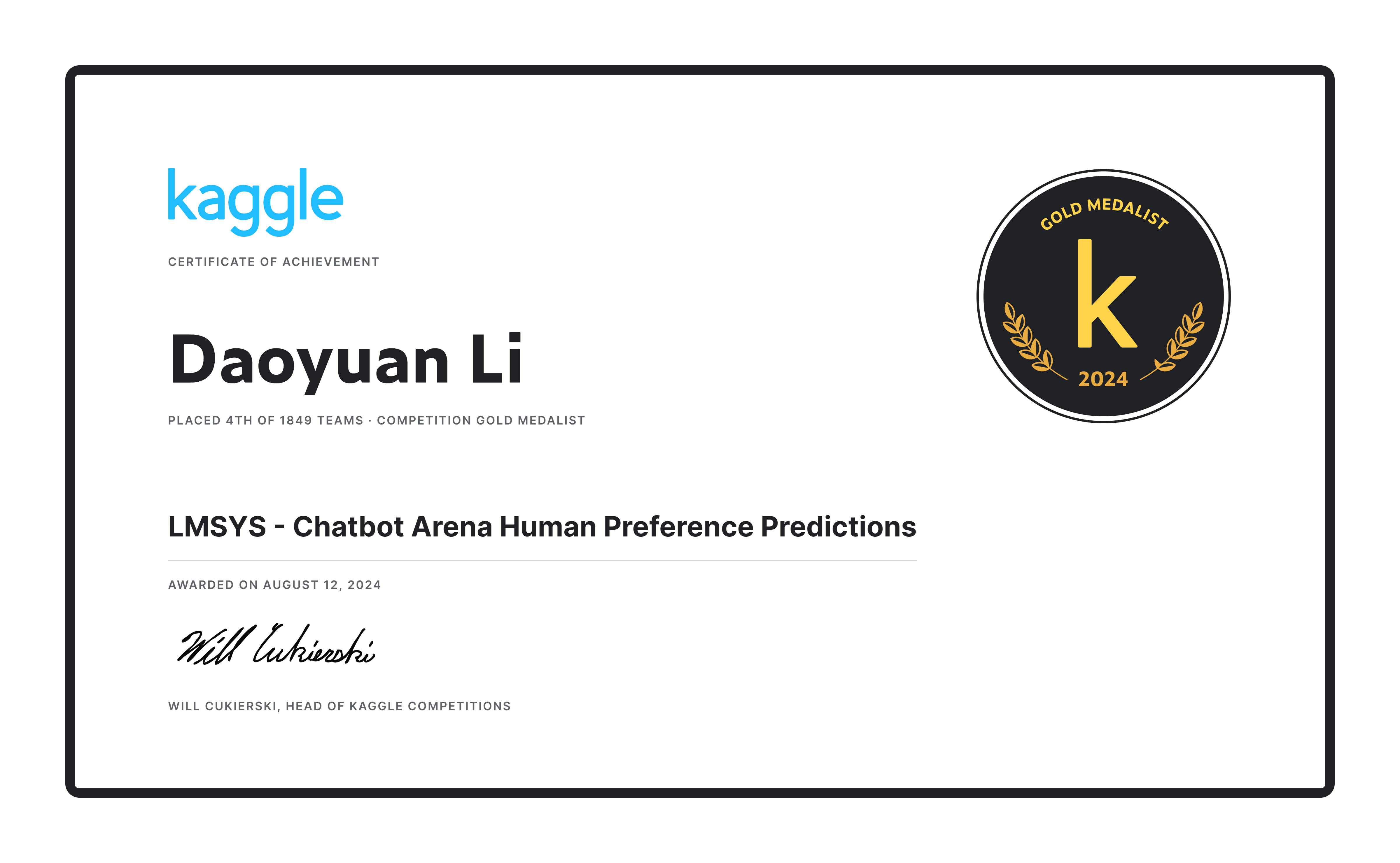
pairjudge is the generalized core of the 4th-place (gold medal) solution to Kaggle's LMSYS — Chatbot Arena Human Preference Predictions (1,849 teams), extracted into a small, tested library you can run on your own preference data with any Hugging Face backbone. The exact competition artifacts are preserved untouched in competition/, and a golden test pins the library's default behavior to the medal-winning code byte for byte.
Use it when you need a model that answers: given a prompt and two candidate responses, which one would a human prefer — or is it a tie? That model is the engine behind response reranking, A/B evaluation of fine-tunes, RLHF/RLAIF reward signals, and arena-style leaderboards.
Three problems show up the moment you train a pairwise judge on real conversations, and they are exactly what this library packages:
1. Truncation silently destroys the comparison.
A judge input holds a multi-turn conversation plus two responses per turn. With naive left- or right-truncation, long inputs routinely lose response B (or the prompt) entirely — the judge then learns position artifacts instead of preferences. PairPacker packs rounds greedily and, when the budget runs out, truncates the final round proportionally (default 20% prompt / 40% response A / 40% response B), marks every cut with an explicit ellipsis, and drops rounds that can't be shown honestly. Guarantee: never exceeds max_length, and every retained round shows all three fields.
One packed example — fixed max_length token budget |
|||||||
|---|---|---|---|---|---|---|---|
BOS |
Round 1 — fits in full | Round 2 — over budget → proportional truncation | verdict prompt + EOS |
||||
| prompt | response A | response B | prompt ……20% of remainder |
response A ……40% of remainder |
response B ……40% of remainder |
||
min_tail_budget (default 80) content tokens is dropped entirely, along with every later round; …… marks each cut. Response B can never be silently pushed out of the sequence.
2. Pairwise judges have position bias.
Swap A and B and a naive judge changes its verdict on a measurable fraction of pairs. PairwiseJudge.predict_proba(swap_debias=True) scores each pair in both orders and averages in the original frame — order-invariant by construction. position_flip_rate() measures how biased your judge is before you decide to pay the 2x compute.
3. Human preference labels are scarce and noisy.
The medal recipe is a two-phase semi-supervised loop: train on human labels → pseudo-label a large unlabeled pool with full probability distributions → retrain with soft-label KL distillation (label_mode: soft). Ties are a first-class third category throughout — real human preference data is full of them, and scalar Bradley–Terry reward models (e.g. TRL's RewardTrainer, num_labels=1) cannot represent them.
pip install -e .              # core: packing + data loaders (no torch needed)
pip install -e .[judge]       # + inference (torch, transformers)
pip install -e .[train] # + LoRA fine-tuning (peft, datasets, accelerate)from pairjudge import PairPacker, PackerConfig, from_pairs
# 1. Pack pairwise conversations into a token budget — any HF tokenizer.
from transformers import AutoTokenizer
tok = AutoTokenizer.from_pretrained("Qwen/Qwen2.5-0.5B-Instruct")
packer = PairPacker(tok, PackerConfig(max_length=2048))
packed = packer.pack(
prompts=["Explain quantum entanglement to a 10-year-old."],
responses_a=["Imagine two magic coins..."],
responses_b=["Quantum entanglement is a physical phenomenon..."],
)
packed.input_ids # <= 2048 tokens, prompt + BOTH responses guaranteed visible
packed.truncated # False — everything fit
# 2. Judge a pair with a trained model, position-bias-free.
from pairjudge import PairwiseJudge
judge = PairwiseJudge.from_pretrained("path/to/your/judge")
df = from_pairs(
prompts=["Explain quantum entanglement to a 10-year-old."],
responses_a=["Imagine two magic coins..."],
responses_b=["Quantum entanglement is a physical phenomenon..."],
)
judge.predict_proba(df, swap_debias=True) # [[p_a_wins, p_b_wins, p_tie]]
judge.position_flip_rate(df) # how order-sensitive is my judge?# Small judge on one consumer GPU (Qwen2.5-0.5B, ungated):
python -m pairjudge.training --cfg examples/configs/quickstart.yaml
# The competition setup (gemma-2-9b-it, 4x A100):
python -m pairjudge.training --cfg examples/configs/reproduce_competition.yamlInput is either an Arena-format CSV (the Kaggle competition schema) or a parquet with canonical columns — prompt / response_a / response_b as per-round string lists plus one-hot (or soft) winner_* columns. pairjudge.data ships loaders for Arena CSVs and UltraFeedback-style chosen/rejected data, plus from_pairs() for plain Python lists.
The full two-phase distillation loop:
flowchart LR
    H["human-labeled pairs<br>Arena 55k + 33k"] -- "phase 1 · CE loss" --> J1["judge v1<br>(LoRA fine-tune)"]
    U["unlabeled pool<br>UltraFeedback 30k"] --> P["pseudo-label with judge v1<br>keep full distributions"]
    J1 --> P
    H -- "phase 2" --> J2["judge v2 — final"]
    P -- "soft labels · KL loss" --> J2
    J2 -- "swap-debias TTA" --> O["order-invariant<br>predictions"]
# Phase 1: train on human labels
python -m pairjudge.training --cfg phase1.yaml                  # label_mode: hard

# Pseudo-label an unlabeled pool with the phase-1 judge (soft labels)
python -m pairjudge.pseudo_label \
    --model ./output/judge/merged \
    --data pool.parquet --out pool_pl.parquet --swap-debias

# Phase 2: retrain from scratch on human + soft labels with KL loss
python -m pairjudge.training --cfg phase2.yaml                  # label_mode: soft
In the competition, this loop (88k human-labeled + 30k pseudo-labeled UltraFeedback conversations) was a decisive part of the gap between a good model and a gold-medal one.
Two degenerate cases are worth handling outside the model — on competition data this was worth a measurable amount of log-loss:
from pairjudge import empty_and_identical_masks

a_empty, b_empty, identical = empty_and_identical_masks(raw_df)
proba[a_empty]  = [0.04, 0.88, 0.08]   # empty response loses — but never bet 1.0
proba[b_empty]  = [0.88, 0.04, 0.08]   # labels are noisy; log-loss punishes overconfidence
proba[identical] = [0.06, 0.06, 0.88] # identical responses are a tieTRL RewardTrainer |
pairjudge |
|
|---|---|---|
| Output | scalar reward (num_labels=1) |
3-class distribution (A / B / tie) |
| Loss | Bradley–Terry (logsigmoid of reward gap) | CE on human labels, KL on soft pseudo-labels |
| Ties | not representable | first-class |
| Multi-turn pair truncation | generic | proportional, all-fields-guaranteed |
| Position bias | n/a at inference (scores singletons) | swap-debias averaging + flip-rate diagnostic |
If you need a scalar reward for PPO-style RLHF, use TRL. If you need a judge that compares two concrete responses — for evaluation, reranking, data labeling, or arena prediction — and your data has ties, this is the recipe that placed 4th of 1,849 on exactly that task.
How big is position bias in practice? examples/position_bias_experiment.py trains a judge end to end through the library's public API and measures it on real data — Qwen2.5-0.5B-Instruct, LoRA, 16k training pairs from the public Arena 55k dataset, 2,000 held-out pairs, one RTX 4080 (16 GB), ~25 minutes:
The judge changes its verdict on 29.2% of pairs when the same two responses are presented in the opposite order.
| metric (2,000 held-out pairs) | single pass (A, B) | swap-debiased |
|---|---|---|
| log-loss | 1.0496 | 1.0462 |
| accuracy | 45.6% | 45.1% |
Swap debiasing improves the proper scoring metric (log-loss) and, by construction, makes the verdict independent of presentation order; top-1 accuracy stays flat within noise at this model scale. The same averaging was part of the gold-medal submission at 9B scale. Reproduce with:
pip install -e .[train] datasets
python examples/position_bias_experiment.py
Numbers above are from a small judge trained in 25 minutes — treat them as a bias measurement, not a quality ceiling; the competition configuration (gemma-2-9b-it, ~100k pairs, max_length 3072) is in examples/configs/reproduce_competition.yaml.
- The competition scripts, configs, inference notebook and certificate are preserved verbatim in
competition/, including the full original write-up. tests/test_packing.py::TestCompetitionEquivalencefuzzes 1,500 conversations against a verbatim copy of the competition tokenizer (tests/reference_impl.py) and asserts byte-identical output with default settings — the library is the medal-winning code, not a reimplementation of it.- Final leaderboard: 4th / 1,849 (gold medal, $20,000 prize).
@misc{li2024pairjudge,
  author = {Daoyuan Li},
  title  = {pairjudge: pairwise LLM judges with budget-aware packing and position-bias correction},
  year   = {2024},
  url    = {https://github.com/DaoyuanLi2816/pairjudge},
  note   = {Generalized from the 4th-place solution, Kaggle LMSYS Chatbot Arena Human Preference Predictions}
}MIT — see LICENSE.
Daoyuan Li — Kaggle (distiller) · lidaoyuan2816@gmail.com