Work in progress
The second triclinium built by Leo III, also known as the Aula Concilii ("Hall of the Council" or Sala del Concilio in Italian), was built in 800AD and was part of the Lateran palace.
It was a magnificent oblong hall (53 m long by 13 wide) with eleven apses, the major apse on one end and five on each side. The side apses had a diameter of 6.7 meters and were 2.34 meters apart, while the end ones were 4.47 meters away from the front and end walls. A large Porphyry fountain was placed in front of the main apse, spouting jets of water from pressurized pipes of the restored Aqua Claudia, a technical marvel meant to impress visitors. Each of the 10 lateral apses held accubita for banquets, on the model of the the reception hall of the 19 accubita in the Great Palace of Constantinople. The main apse was decorated with a mosaic showing Christ and Mary with Saints Peter and Paul and three other figures, while each of the ten lateral apses was decorated with frescoes depicting an apostle preaching to the gentiles. On the left of the main apse was a staircase that lead to the basilica. The hall was adorned with columns, pilasters, a floor in opus sectile.
SUMMARY
The plan of the room was rectangular (53 m long by 13 m), with one large apse on one end and five large apses on the sides (the other end had columns and doorways, but don't think this shows up in the CK3RC view since it is behind the viewer. To the left of the main apse there was a marble doorway.
The end wall and the large main apse had a mosaic with Christ and many figures (pictures below) while the side apse also were decorated with an apostle and figures (only the apse, not the wall - picture below). The side apses are perfect for pedestals and artifacts.
The walls were in marble, likely gray, until the heigt of the apses. Above the apses, it was likely bare wall (white or plaster) with some windows. The ceiling was wooden.
The throne was in the large main apse, it was relatively simple (picture below). The floor was in Cosmatesque. There was a large re porphyry fountain in the middle.
For grandeur: 1) decoration around the throne (see image below), ?maybe the apse decorations, ?maybe the Cosmatesque floor, ?maybe the fountain, ?the mensura Christi table
details expalantion and images:
PLAN
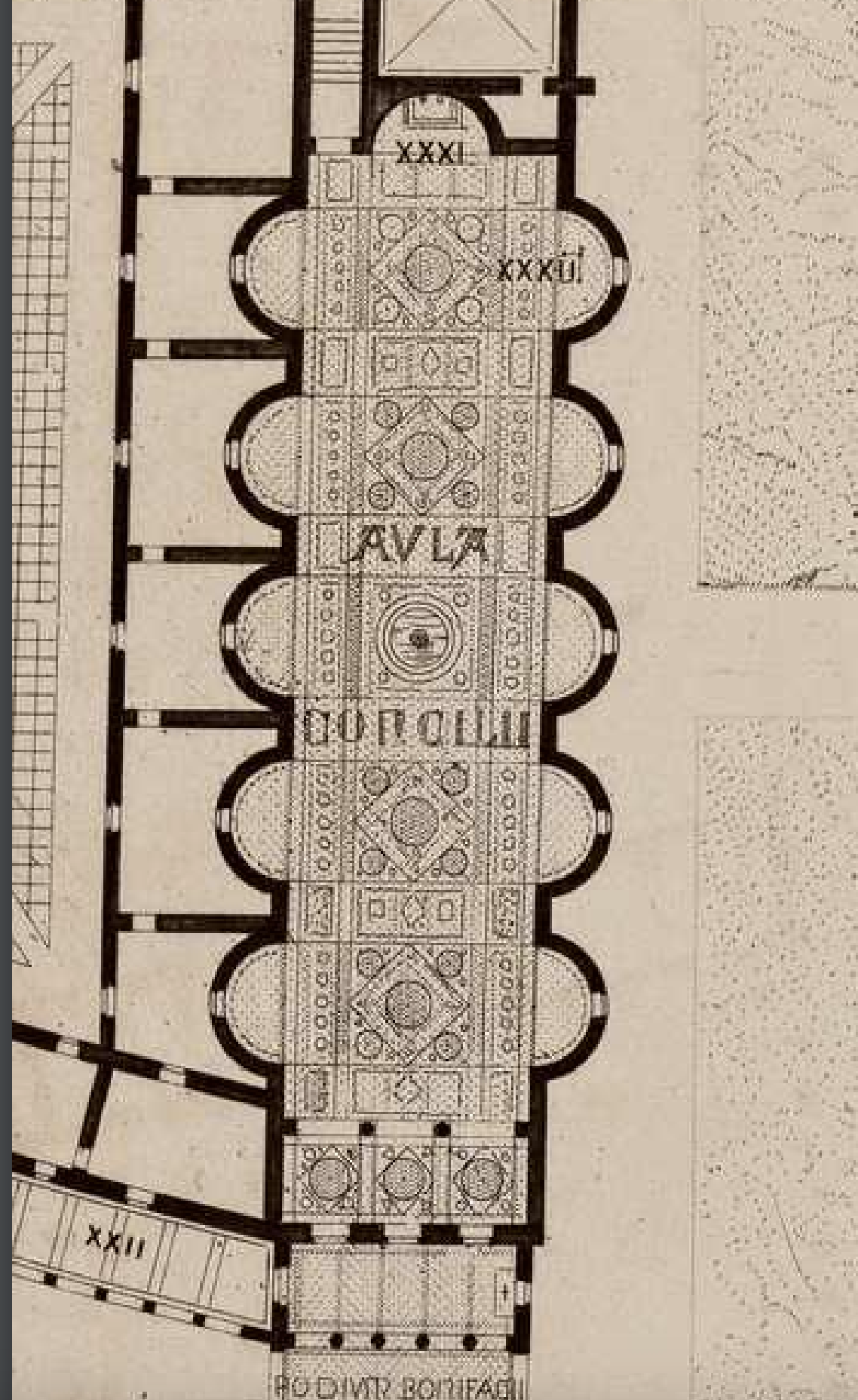
Shows the decoration of the floor (in marble)
From Le Latran au Moyen Âge, Fleury, Georges Rohault de, 1835-1905, http://dlib.biblhertz.it/ia/pdf/Dt2300-4770-2.pdf
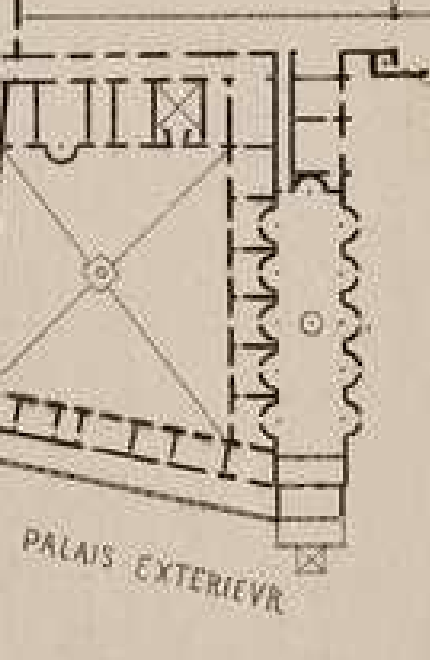
same as above, also shows the position of the large porphyry fountain
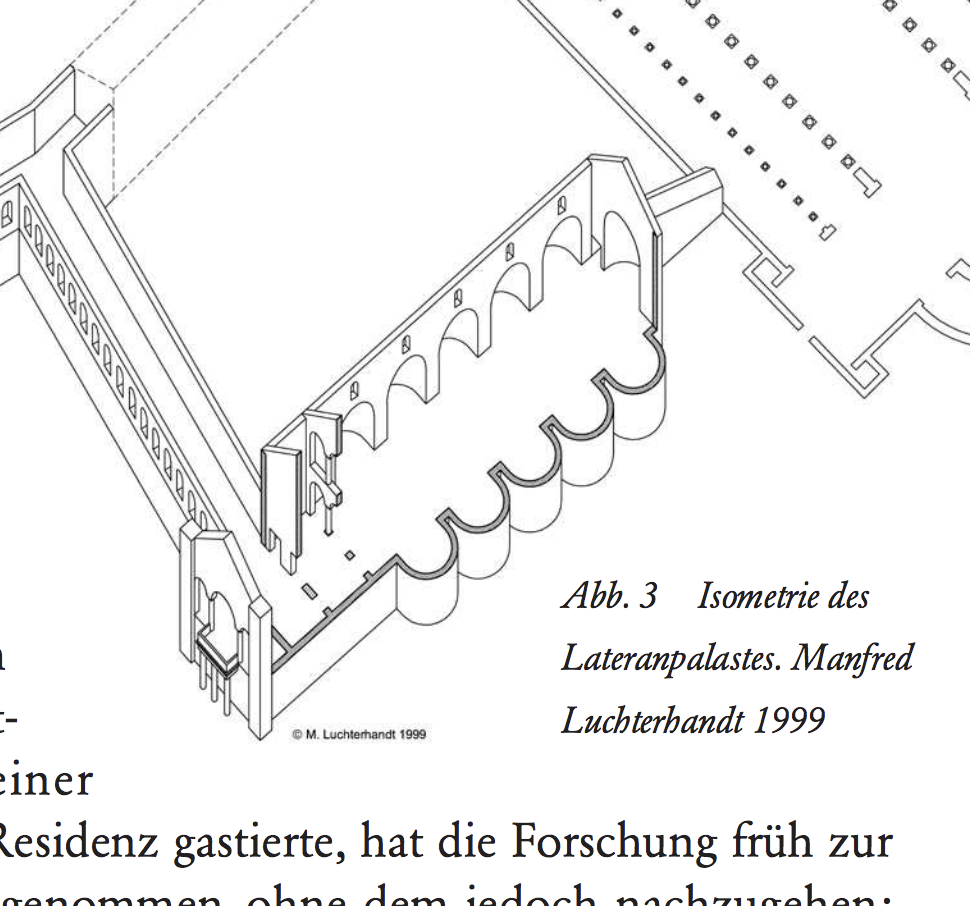
From Luchterhandt (2014)
Shows nicely the plan and the 11 apses. The entrance side instead had columns.
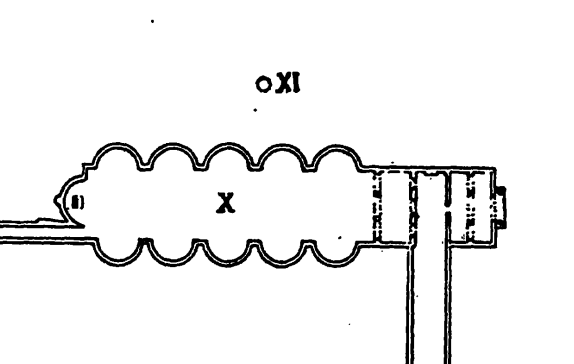
from BELTING, HANS (1978)
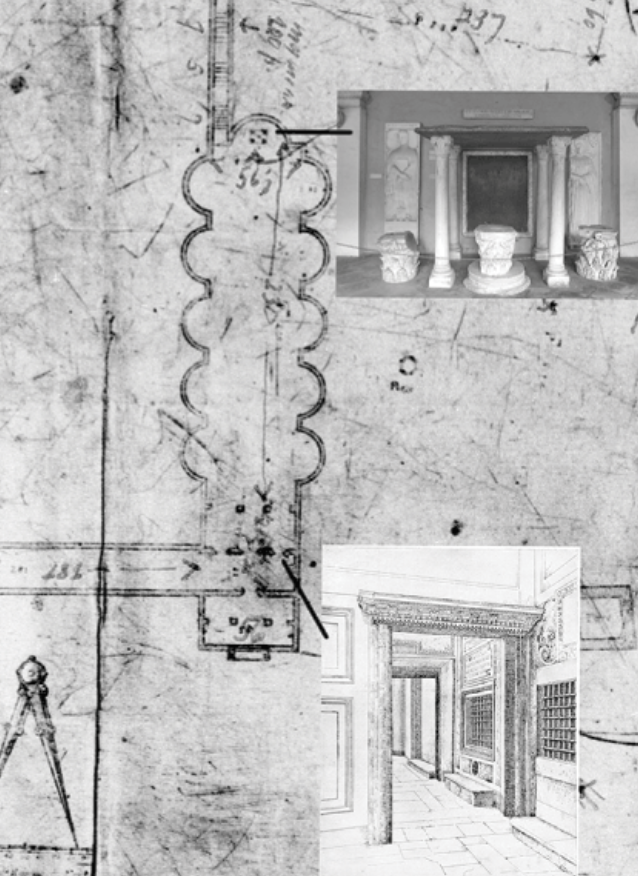
The ‘new relics’ marked in the so-called archive plan, workshop of Domenico Fontana (?), 1585-6, etching, Rome, Archivio Capitolare Lateranense. Found in Bosman (2020)
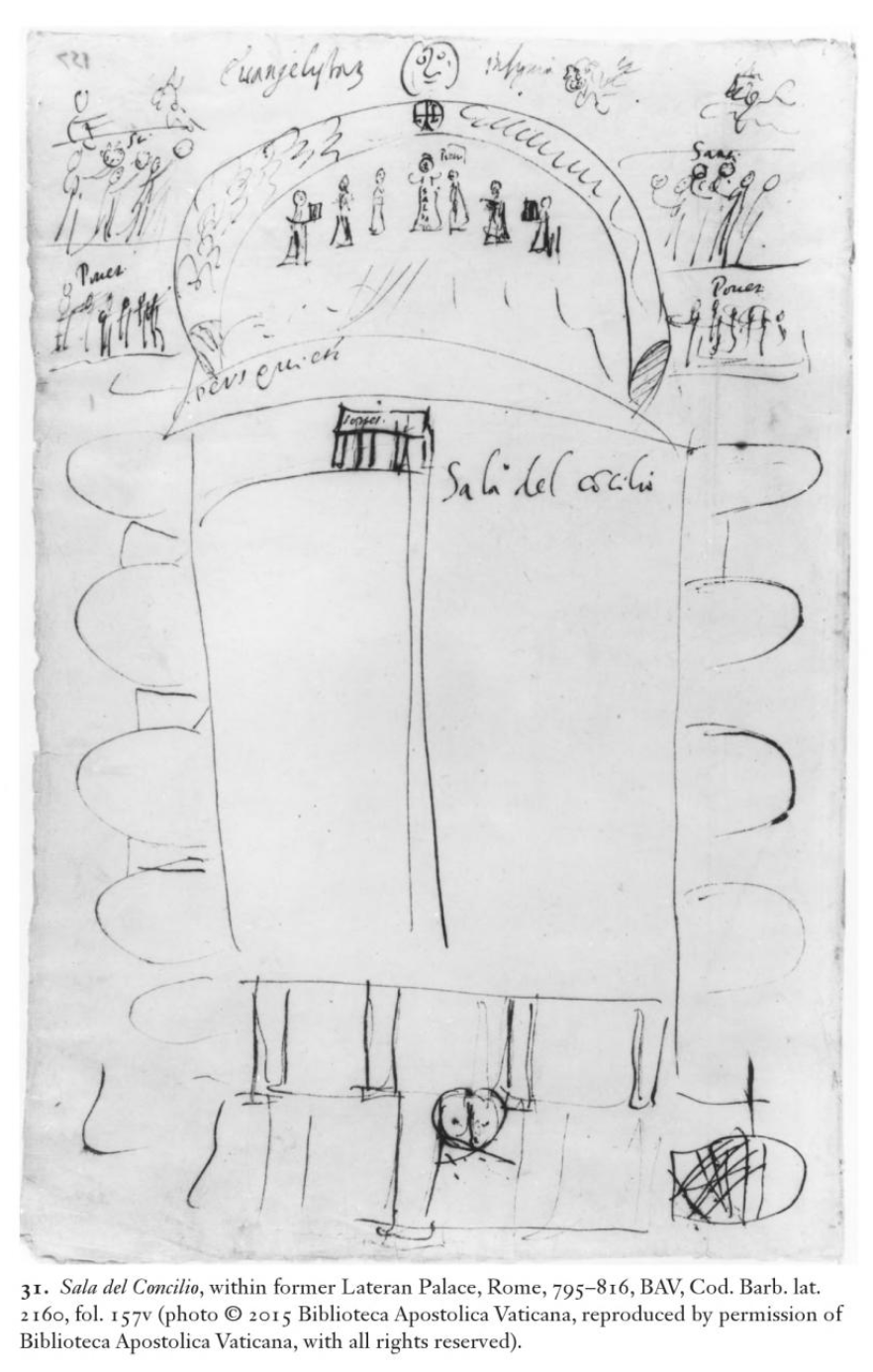
Pompeo Ugonio (1550 – 1614), Cod. Barb. lat. 2160
RENDERINGS
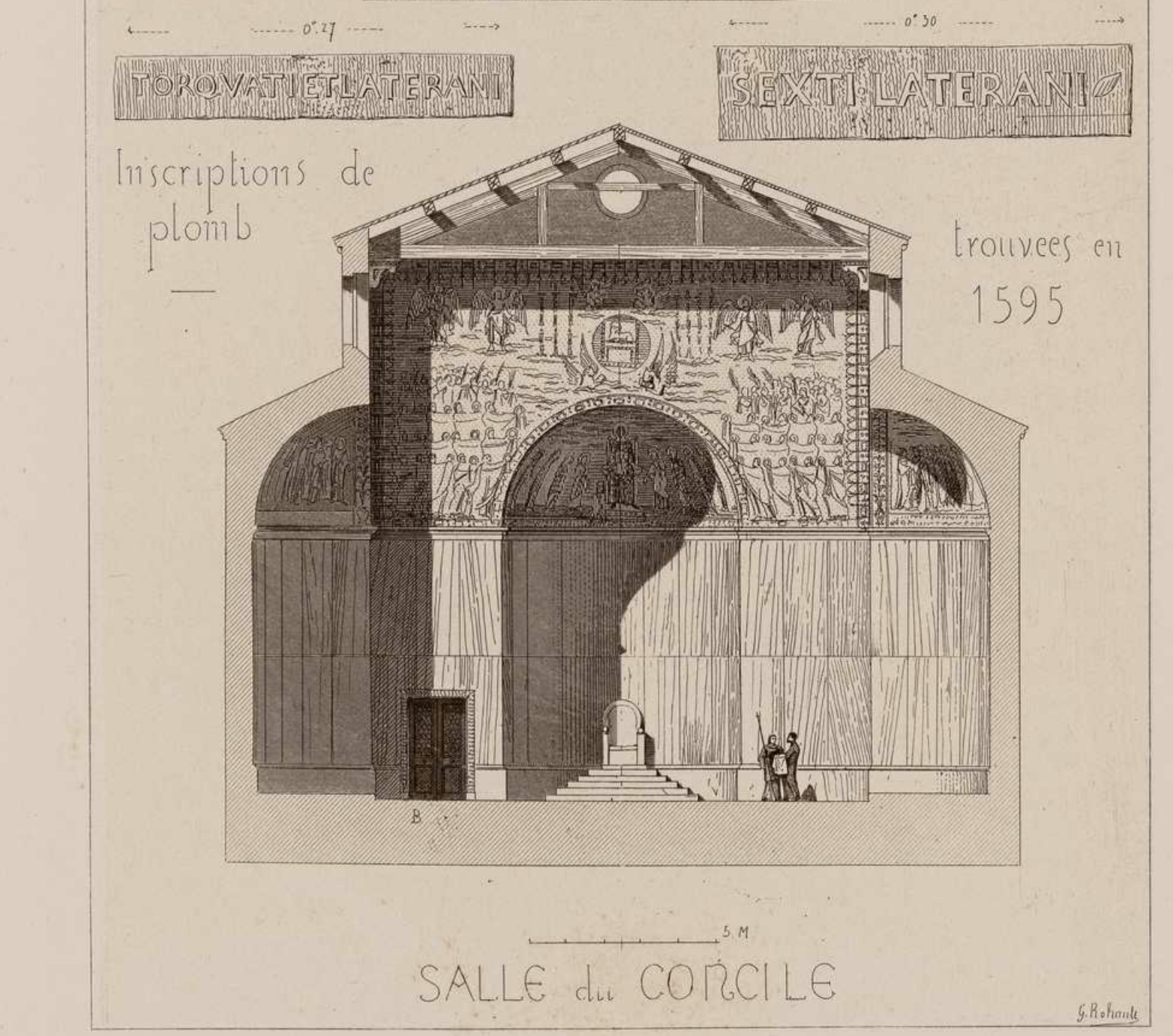
From Le Latran au Moyen Âge, Fleury, Georges Rohault de, 1835-1905, http://dlib.biblhertz.it/ia/pdf/Dt2300-4770-2.pdf
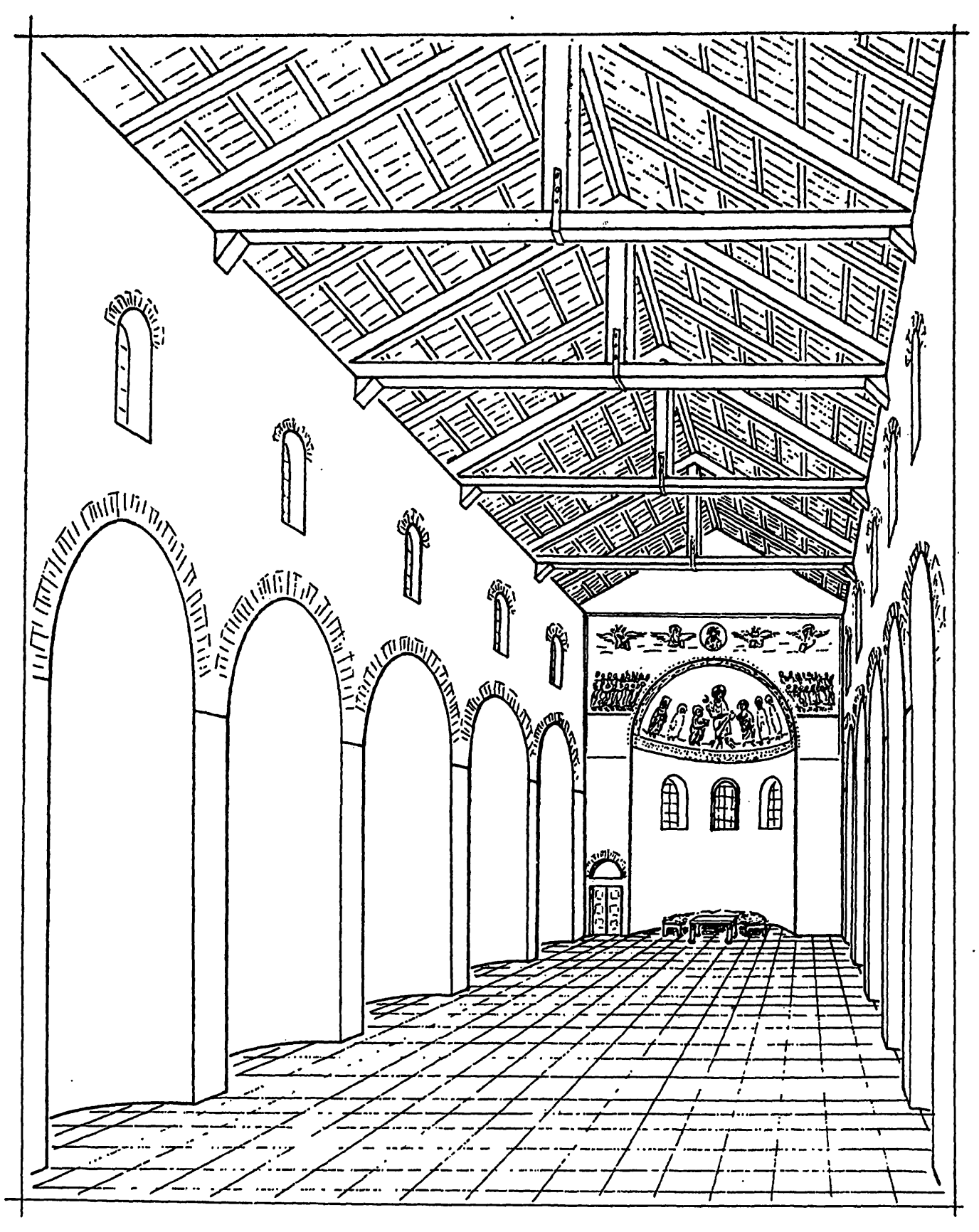
BELTING, HANS (1978).
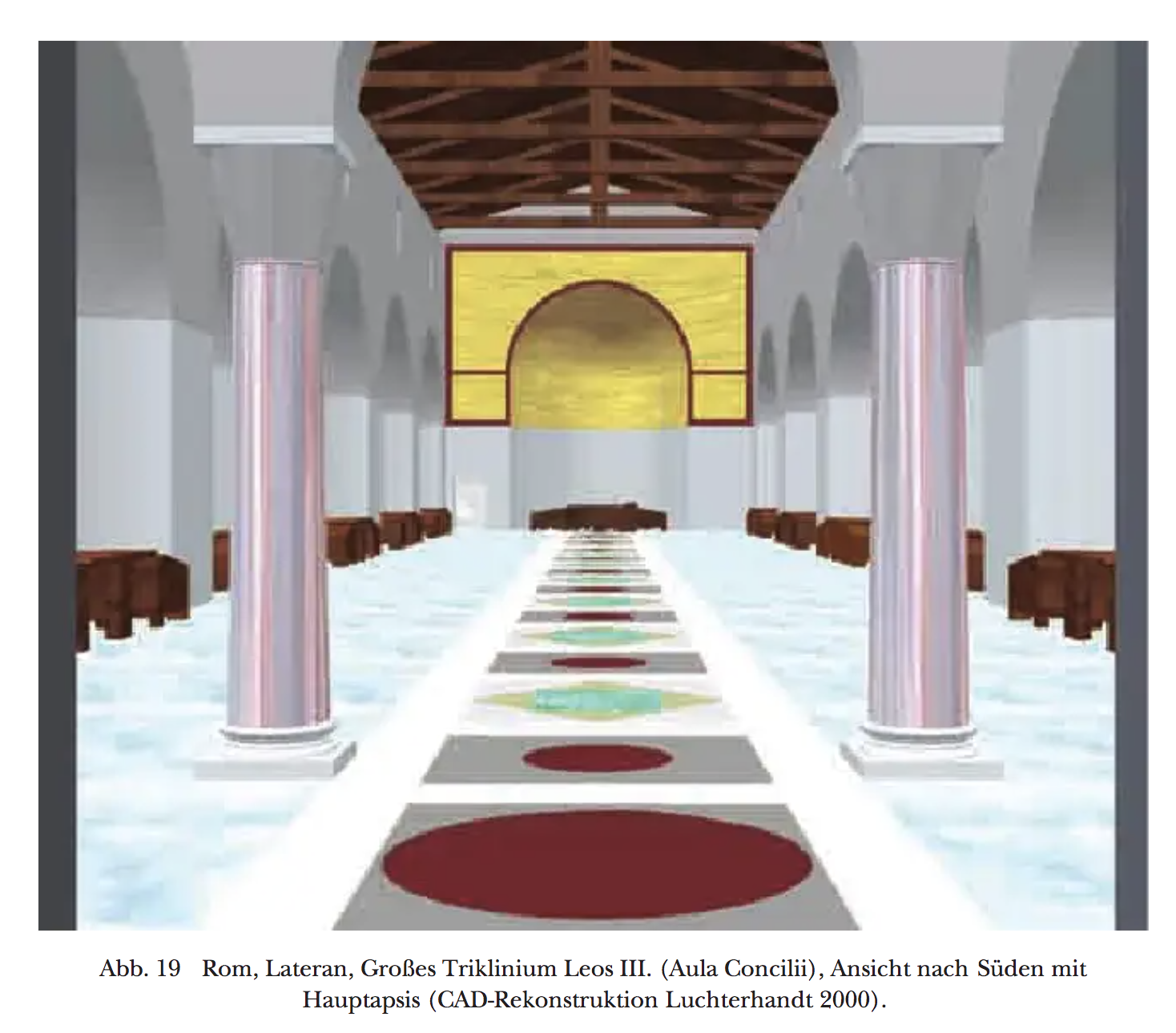
Front with main apse
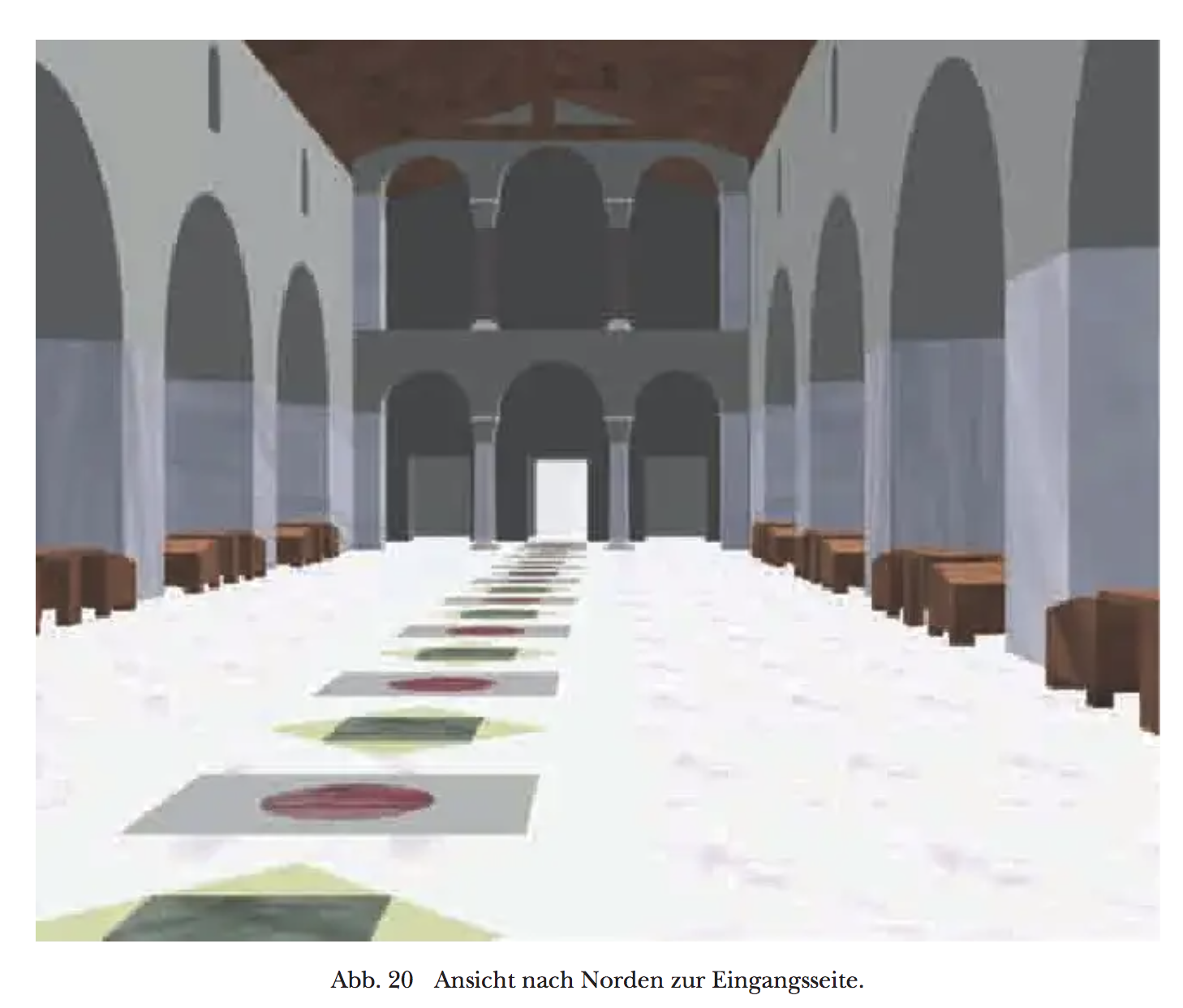
Backside with entrance
both from Luchterhandt (2006)
THE MOSAIC (in the main apse)
The end apse had a mosaic, here are reproductions of it.
The writings says: Deus cuius dextera Beatum Petrum ambulantem in fluctibus ne mergeretur erexit et
coapostolum eius Paulum ter naufragantem de profundo pelagi liberavit, tua sancta dextera protegat domum istam
et omnes fideles convivantes, qui de donis Apostoli tui hic laetantur
The mosaics do not survive, but many similar ones from that time and that style still survive. Examples of immages include: Lateran Triclinium, Santa Maria in Trastevere, San Clemente, Santa Prassede, San Marco al Campidoglio, The Euphrasian Basilica
You can actually see that both Fleury and Belting got inspiration from the Santa Prassede mosaic for their reconstructions (both basically copied the figures of men on each side, and Fleury also copied the evangelists and columns/lamb symbols from Santa Prassede and even the border decoration). We can do the same.
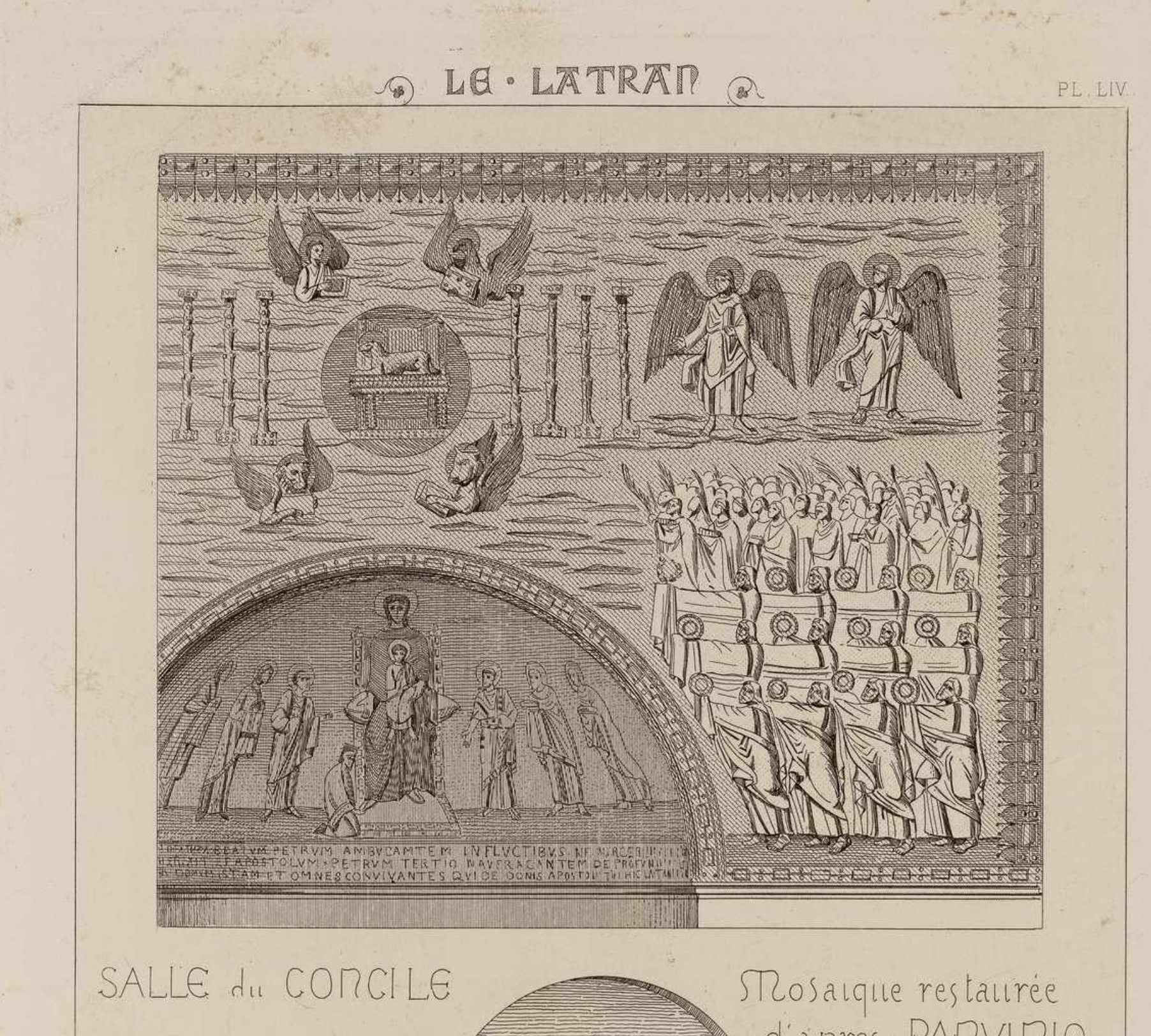
From Le Latran au Moyen Âge, Fleury, Georges Rohault de, 1835-1905, http://dlib.biblhertz.it/ia/pdf/Dt2300-4770-2.pdf
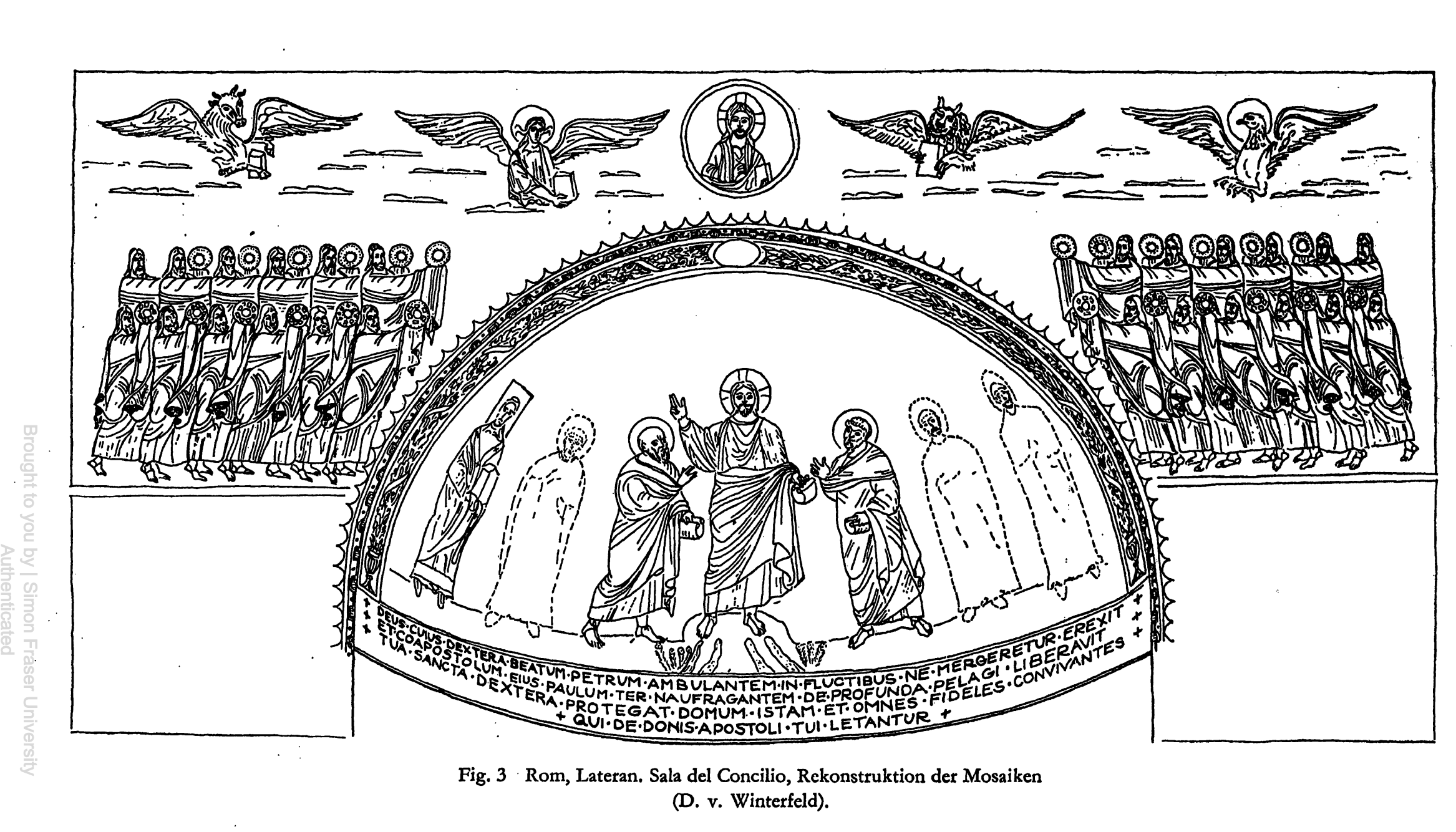
BELTING, HANS (1978).
FRESCOES (in the 10 lateral apses) - these could come with grandeur levels
The lateral apses had frescoes painted (not mosaics) and in each apse there was an apostle preaching to the gentiles (non-Christians). The image would be something like this, although this is a mosaic. The fresco style would be similar to
FLOOR
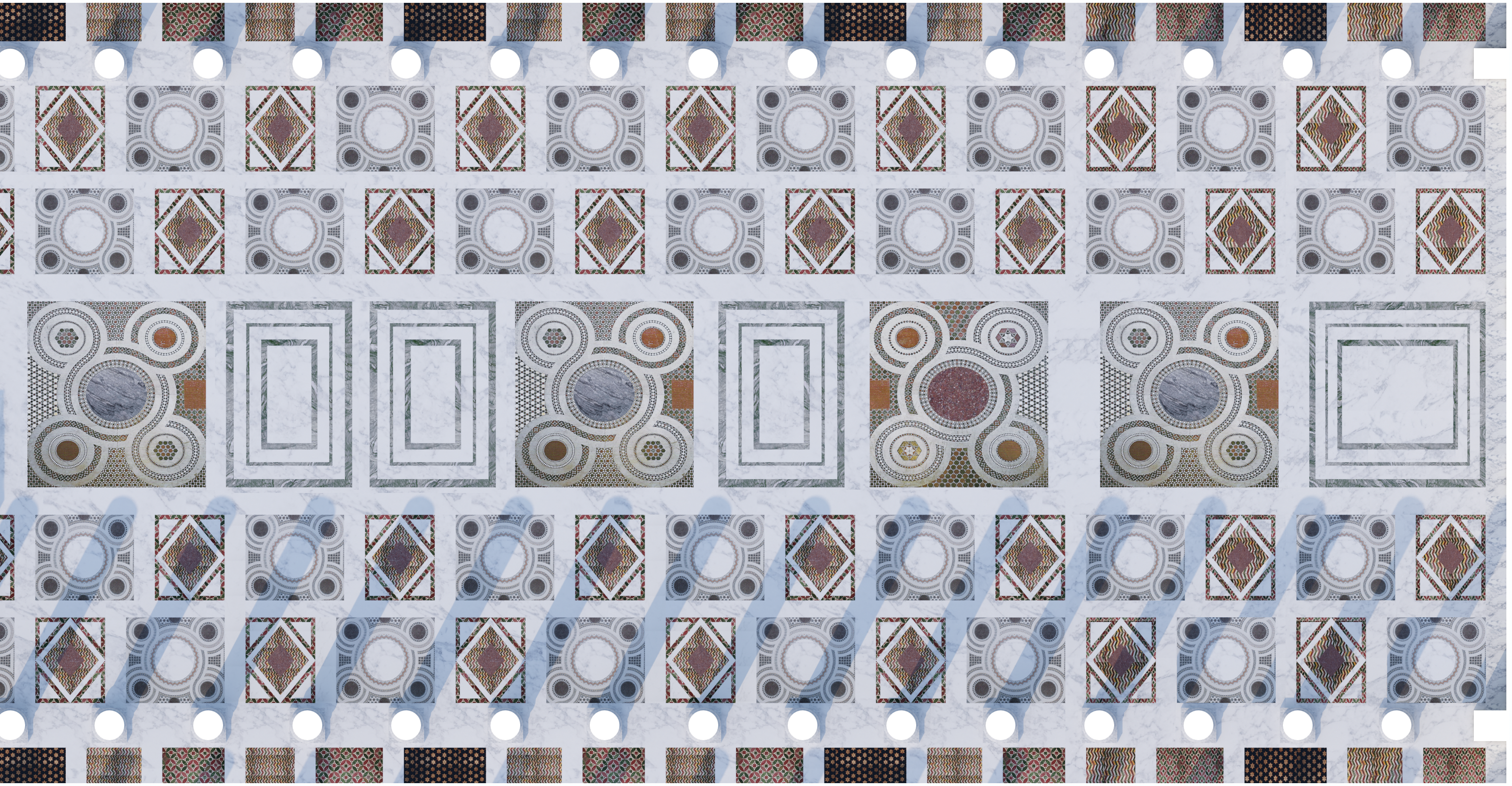
The floor was made of marbles, particularly in the Cosmatesque style. Fleury has a plan of the geometrical design in his maps (see here), although this is likely a possible reconstruction, not based on hard evidence. But it would have been something similar. Great examples to copy are here: Comstesque pavements in Rome
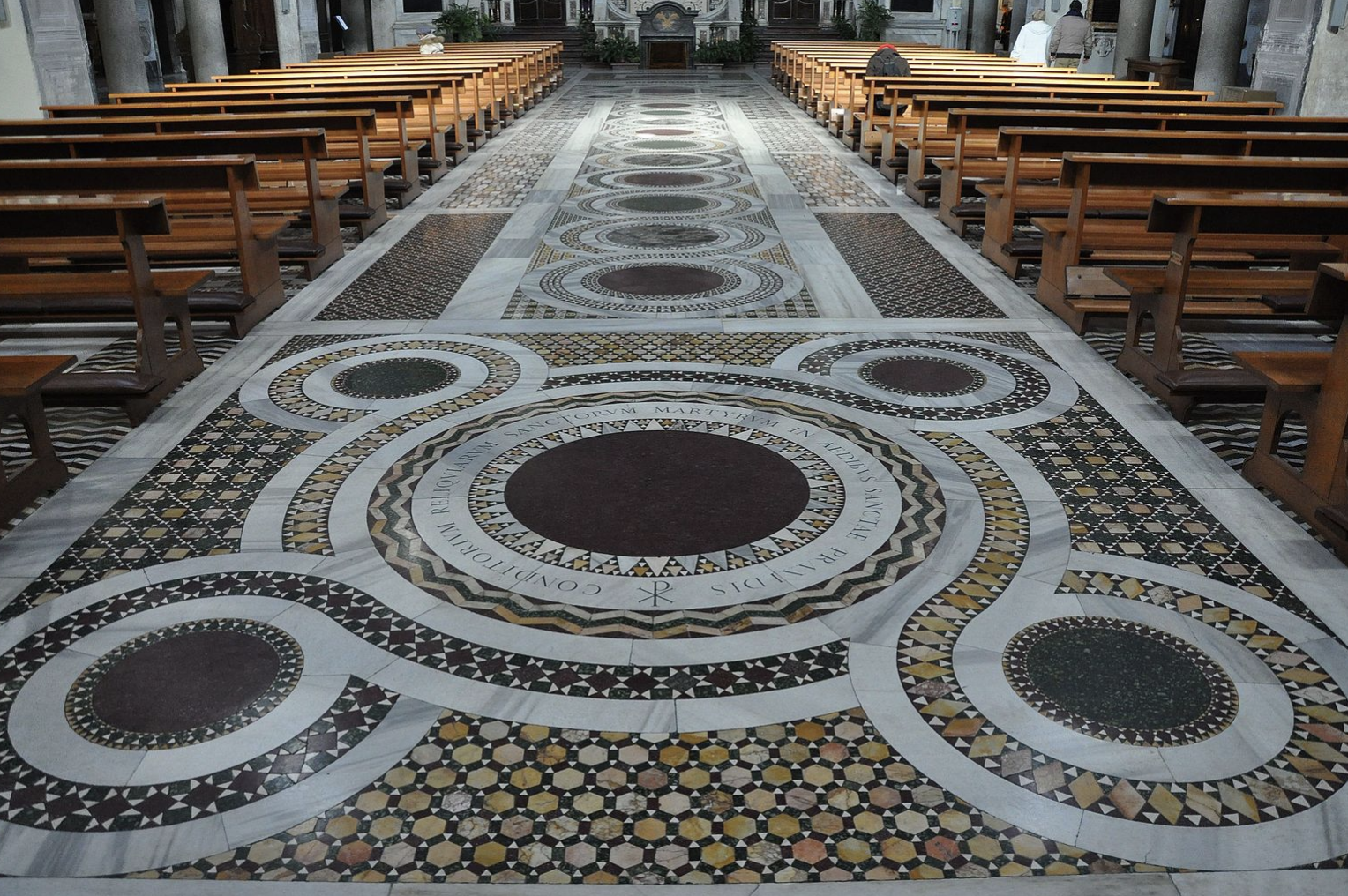
example from Santa Prassede
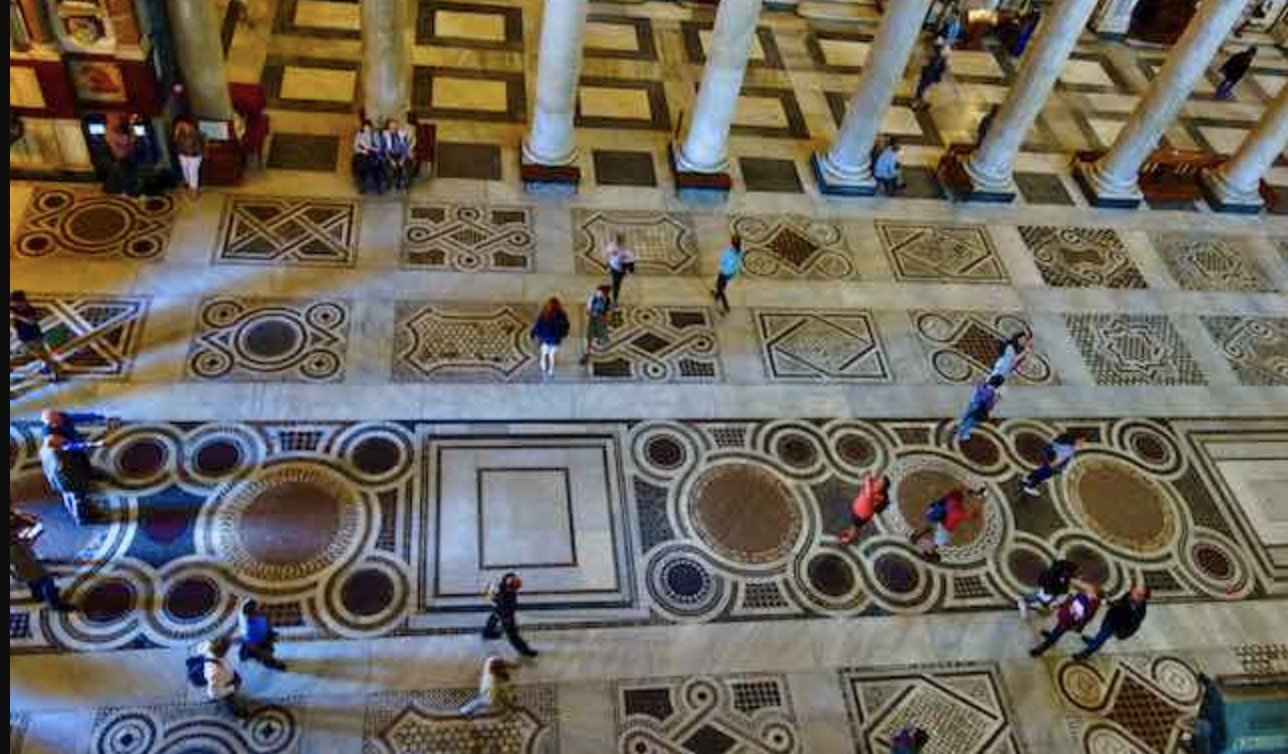
Example from Santa Maria Maggiore
THRONE
The throne that survives today actually dates to the 1200s, but it should be good enough. This was the throne that was in the basilica, not in the Aula Concilii. The Aula Concilii probably had a smaller simpler one (you can see what Fleury pictured here). But this was the official throne, so I think it fits well in the CFP model.
The trone in these pictures (and I the Geoges Fleury drawing) I think is perfect, it's pretty simple. The rich structure around and above it (with the two columns at the arch above it) is more gothic/richer and later. I think this could be perfect as grandeur 3 or 4.
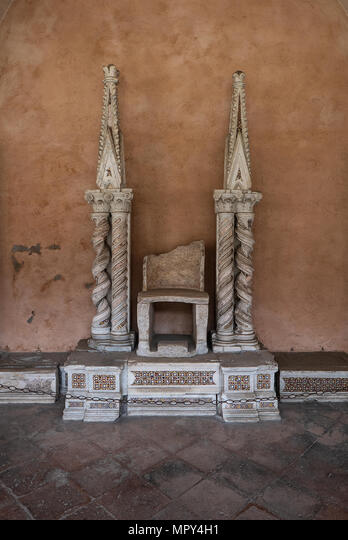
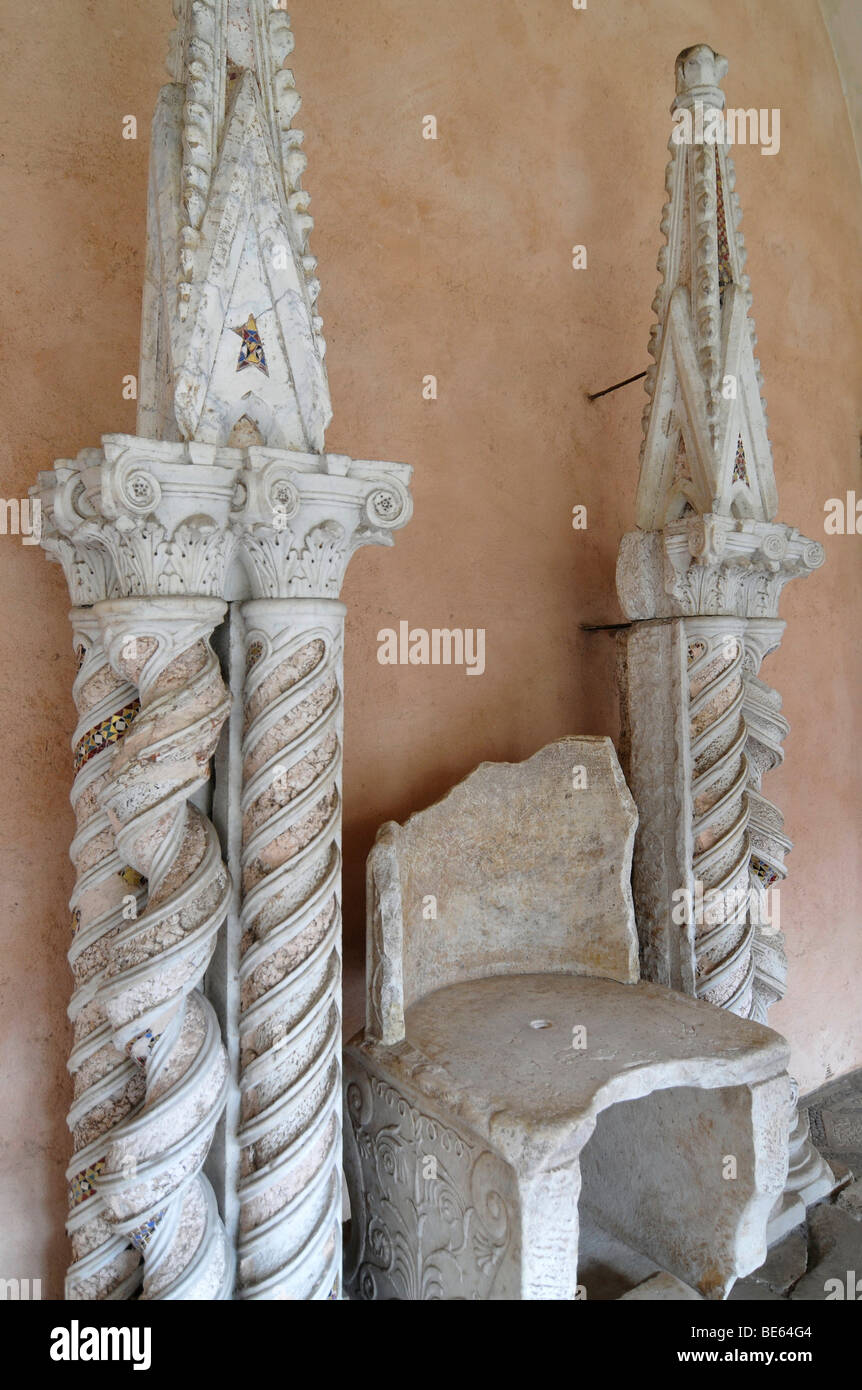
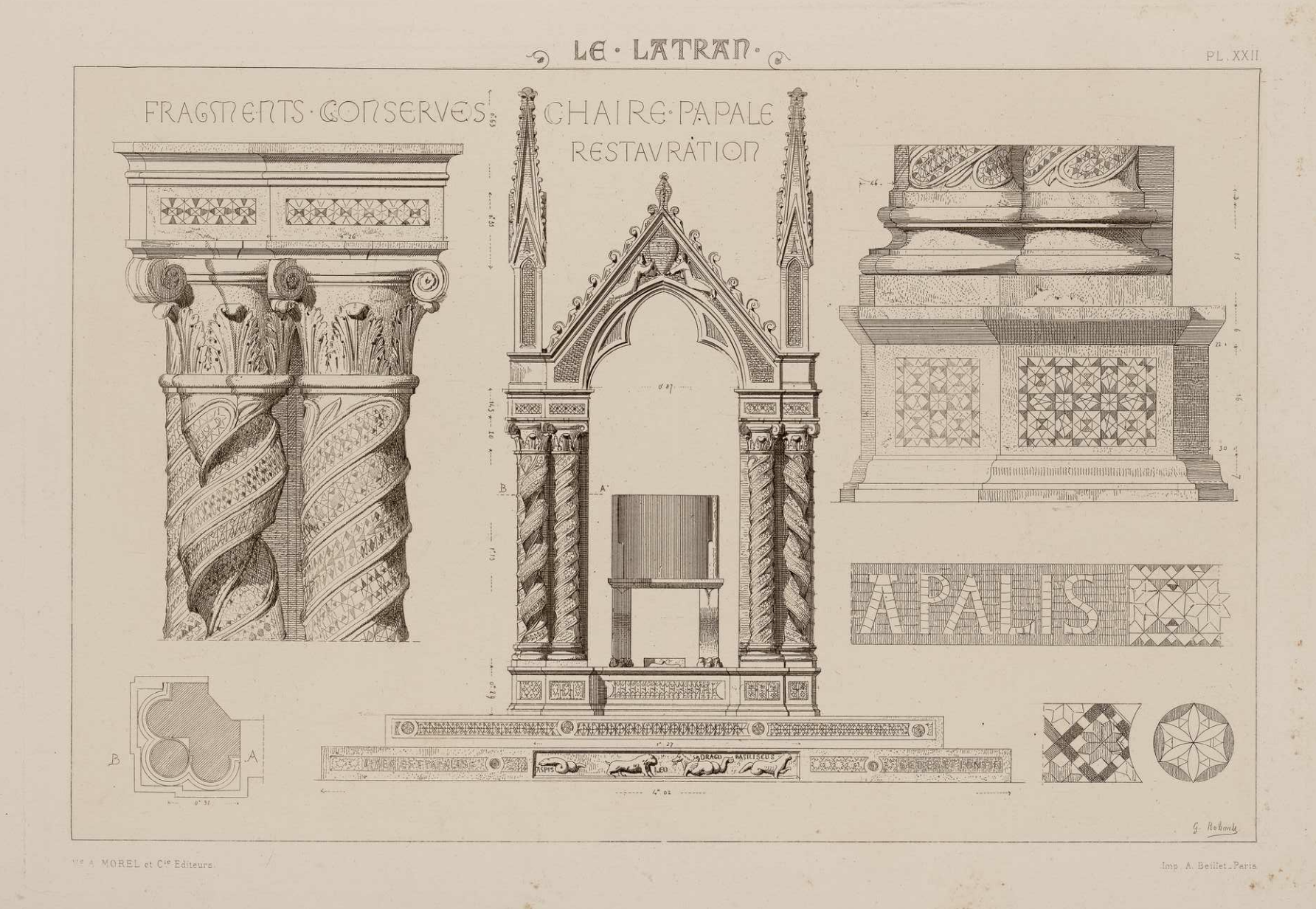
Fleury's reconstruction
Other option could be this, although this is from Saint Peters.
MATERIALS
The hall was decorated with marble walls, except for the wooden roof. Fleury gives a good idea. The mable was likely gray or gray/white, something like this.
DECORATIONS (these can be tied to grandeur levels)
The fountain There was a large red porphyry fountain in the middle or in front of the throne (I think in the middle makes sense). This actually had working water, which was a marvel for 800s Europe. It would have looked something like these: porphiry basin from the Vatican, from Constantinople, baptismal font of the Vatican, font from Saint Zeno in Verona, font from Milan Cathedral.
The mensura Christi image This table was once the pope's "high table" (literally) in the aula concilii. It was considred a relic of the Last Supper. The inscription (mensa Christi-table of Christ) was also misread as mensura Christi (measure of christ), so they thought Jesus was tall as the columns, almost 2 m.
SOURCES
BELTING, HANS (1978). Die beiden Palastaulen Leos III. im Lateran und die Entstehung einer päpstlichen Programmkunst. Frühmittelalterliche Studien, 12(1), –. doi:10.1515/9783110242119.55
Bosman, L., Haynes, I., & Liverani, P. (Eds.). (2020). The Basilica of Saint John Lateran to 1600 (British School at Rome Studies). Cambridge: Cambridge University Press. doi:10.1017/9781108885096
Luchterhandt (2014) Konvergenzen und Divergenzen im profanen Kulturaustausch des Frühmittelalters. Die Karolinger und der päpstliche Hof um 800, in: Aachener Kunstblätter 65, 2011/13 [2014], pp. 8-33.
Luchterhandt (2006) Stolz und Vorurteil: Der Westen und die byzantinische Hofkultur im Frühmittelalter, in: F. A. Bauer (ed.), Visualisierungen von Herrschaft, Istanbul 2006 (BYZAS 5), S.

Work in progress
The second triclinium built by Leo III, also known as the Aula Concilii ("Hall of the Council" or Sala del Concilio in Italian), was built in 800AD and was part of the Lateran palace.
It was a magnificent oblong hall (53 m long by 13 wide) with eleven apses, the major apse on one end and five on each side. The side apses had a diameter of 6.7 meters and were 2.34 meters apart, while the end ones were 4.47 meters away from the front and end walls. A large Porphyry fountain was placed in front of the main apse, spouting jets of water from pressurized pipes of the restored Aqua Claudia, a technical marvel meant to impress visitors. Each of the 10 lateral apses held accubita for banquets, on the model of the the reception hall of the 19 accubita in the Great Palace of Constantinople. The main apse was decorated with a mosaic showing Christ and Mary with Saints Peter and Paul and three other figures, while each of the ten lateral apses was decorated with frescoes depicting an apostle preaching to the gentiles. On the left of the main apse was a staircase that lead to the basilica. The hall was adorned with columns, pilasters, a floor in opus sectile.
SUMMARY
The plan of the room was rectangular (53 m long by 13 m), with one large apse on one end and five large apses on the sides (the other end had columns and doorways, but don't think this shows up in the CK3RC view since it is behind the viewer. To the left of the main apse there was a marble doorway.
The end wall and the large main apse had a mosaic with Christ and many figures (pictures below) while the side apse also were decorated with an apostle and figures (only the apse, not the wall - picture below). The side apses are perfect for pedestals and artifacts.
The walls were in marble, likely gray, until the heigt of the apses. Above the apses, it was likely bare wall (white or plaster) with some windows. The ceiling was wooden.
The throne was in the large main apse, it was relatively simple (picture below). The floor was in Cosmatesque. There was a large re porphyry fountain in the middle.
For grandeur: 1) decoration around the throne (see image below), ?maybe the apse decorations, ?maybe the Cosmatesque floor, ?maybe the fountain, ?the mensura Christi table
details expalantion and images:
PLAN
Shows the decoration of the floor (in marble)
From Le Latran au Moyen Âge, Fleury, Georges Rohault de, 1835-1905, http://dlib.biblhertz.it/ia/pdf/Dt2300-4770-2.pdf
same as above, also shows the position of the large porphyry fountain
From Luchterhandt (2014)
Shows nicely the plan and the 11 apses. The entrance side instead had columns.
from BELTING, HANS (1978)
The ‘new relics’ marked in the so-called archive plan, workshop of Domenico Fontana (?), 1585-6, etching, Rome, Archivio Capitolare Lateranense. Found in Bosman (2020)
Pompeo Ugonio (1550 – 1614), Cod. Barb. lat. 2160
RENDERINGS
From Le Latran au Moyen Âge, Fleury, Georges Rohault de, 1835-1905, http://dlib.biblhertz.it/ia/pdf/Dt2300-4770-2.pdf
BELTING, HANS (1978).
Front with main apse
Backside with entrance
both from Luchterhandt (2006)
THE MOSAIC (in the main apse)
The end apse had a mosaic, here are reproductions of it.
The writings says: Deus cuius dextera Beatum Petrum ambulantem in fluctibus ne mergeretur erexit et
coapostolum eius Paulum ter naufragantem de profundo pelagi liberavit, tua sancta dextera protegat domum istam
et omnes fideles convivantes, qui de donis Apostoli tui hic laetantur
The mosaics do not survive, but many similar ones from that time and that style still survive. Examples of immages include: Lateran Triclinium, Santa Maria in Trastevere, San Clemente, Santa Prassede, San Marco al Campidoglio, The Euphrasian Basilica
You can actually see that both Fleury and Belting got inspiration from the Santa Prassede mosaic for their reconstructions (both basically copied the figures of men on each side, and Fleury also copied the evangelists and columns/lamb symbols from Santa Prassede and even the border decoration). We can do the same.
From Le Latran au Moyen Âge, Fleury, Georges Rohault de, 1835-1905, http://dlib.biblhertz.it/ia/pdf/Dt2300-4770-2.pdf
BELTING, HANS (1978).
FRESCOES (in the 10 lateral apses) - these could come with grandeur levels
The lateral apses had frescoes painted (not mosaics) and in each apse there was an apostle preaching to the gentiles (non-Christians). The image would be something like this, although this is a mosaic. The fresco style would be similar to
FLOOR
The floor was made of marbles, particularly in the Cosmatesque style. Fleury has a plan of the geometrical design in his maps (see here), although this is likely a possible reconstruction, not based on hard evidence. But it would have been something similar. Great examples to copy are here: Comstesque pavements in Rome
example from Santa Prassede
Example from Santa Maria Maggiore
THRONE
The throne that survives today actually dates to the 1200s, but it should be good enough. This was the throne that was in the basilica, not in the Aula Concilii. The Aula Concilii probably had a smaller simpler one (you can see what Fleury pictured here). But this was the official throne, so I think it fits well in the CFP model.
The trone in these pictures (and I the Geoges Fleury drawing) I think is perfect, it's pretty simple. The rich structure around and above it (with the two columns at the arch above it) is more gothic/richer and later. I think this could be perfect as grandeur 3 or 4.
Fleury's reconstruction
Other option could be this, although this is from Saint Peters.
MATERIALS
The hall was decorated with marble walls, except for the wooden roof. Fleury gives a good idea. The mable was likely gray or gray/white, something like this.
DECORATIONS (these can be tied to grandeur levels)
The fountain There was a large red porphyry fountain in the middle or in front of the throne (I think in the middle makes sense). This actually had working water, which was a marvel for 800s Europe. It would have looked something like these: porphiry basin from the Vatican, from Constantinople, baptismal font of the Vatican, font from Saint Zeno in Verona, font from Milan Cathedral.
The mensura Christi image This table was once the pope's "high table" (literally) in the aula concilii. It was considred a relic of the Last Supper. The inscription (mensa Christi-table of Christ) was also misread as mensura Christi (measure of christ), so they thought Jesus was tall as the columns, almost 2 m.
SOURCES
BELTING, HANS (1978). Die beiden Palastaulen Leos III. im Lateran und die Entstehung einer päpstlichen Programmkunst. Frühmittelalterliche Studien, 12(1), –. doi:10.1515/9783110242119.55
Bosman, L., Haynes, I., & Liverani, P. (Eds.). (2020). The Basilica of Saint John Lateran to 1600 (British School at Rome Studies). Cambridge: Cambridge University Press. doi:10.1017/9781108885096
Luchterhandt (2014) Konvergenzen und Divergenzen im profanen Kulturaustausch des Frühmittelalters. Die Karolinger und der päpstliche Hof um 800, in: Aachener Kunstblätter 65, 2011/13 [2014], pp. 8-33.
Luchterhandt (2006) Stolz und Vorurteil: Der Westen und die byzantinische Hofkultur im Frühmittelalter, in: F. A. Bauer (ed.), Visualisierungen von Herrschaft, Istanbul 2006 (BYZAS 5), S.