This guide reviews common workflow and agent patterns.
- Workflows have predetermined code paths and are designed to operate in a certain order.
- Agents are dynamic and define their own processes and tool usage.
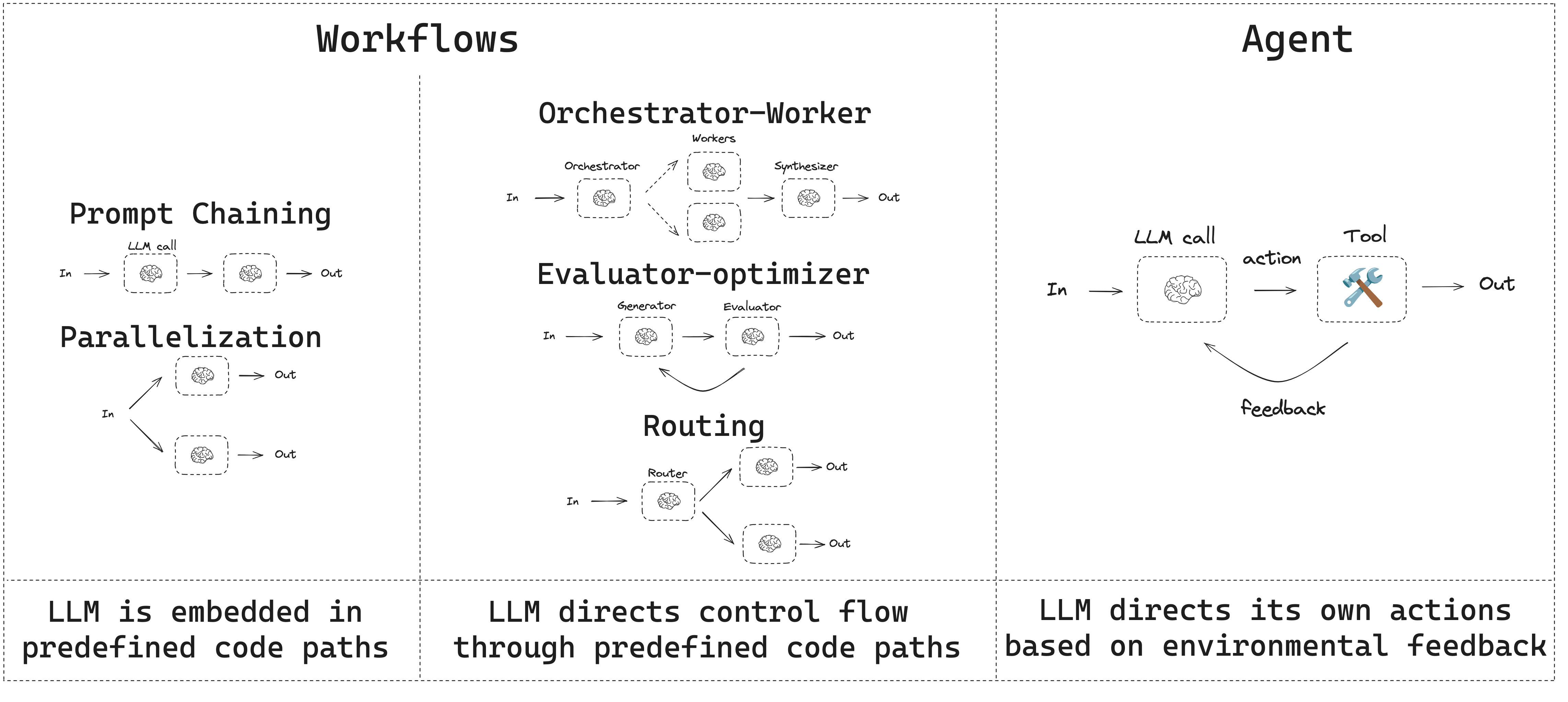
LangGraph offers several benefits when building agents and workflows, including persistence, streaming, and support for debugging as well as deployment.
To build a workflow or agent, you can use any chat model that supports structured outputs and tool calling. The following example uses Anthropic:
- Install dependencies:
pip install langchain_core langchain-anthropic langgraph- Initialize the LLM:
import os
import getpass

from langchain_anthropic import ChatAnthropic

def _set_env(var: str):
    if not os.environ.get(var):
        os.environ[var] = getpass.getpass(f"{var}: ")


_set_env("ANTHROPIC_API_KEY")

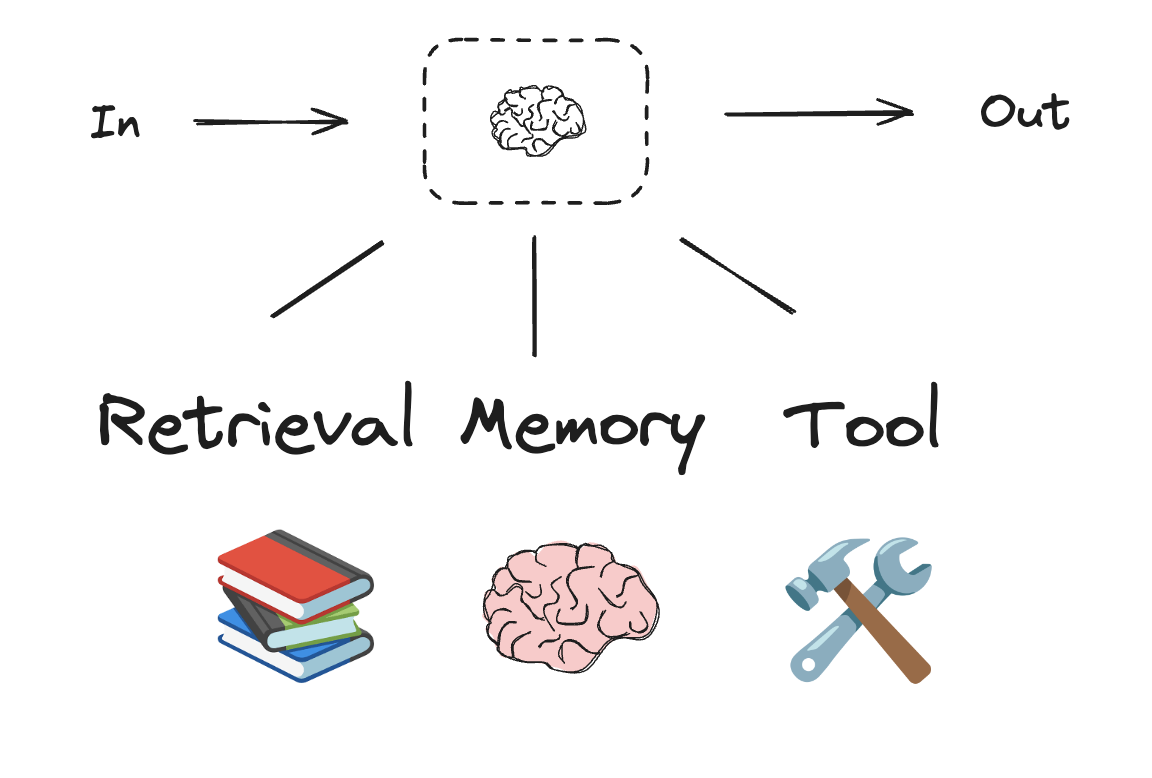
llm = ChatAnthropic(model="claude-sonnet-4-5-20250929")Workflows and agentic systems are based on LLMs and the various augmentations you add to them. Tool calling, structured outputs, and short term memory are a few options for tailoring LLMs to your needs.
# Schema for structured output
from pydantic import BaseModel, Field


class SearchQuery(BaseModel):
    search_query: str = Field(None, description="Query that is optimized web search.")
    justification: str = Field(
        None, description="Why this query is relevant to the user's request."
    )


# Augment the LLM with schema for structured output
structured_llm = llm.with_structured_output(SearchQuery)

# Invoke the augmented LLM
output = structured_llm.invoke("How does Calcium CT score relate to high cholesterol?")

# Define a tool
def multiply(a: int, b: int) -> int:
    return a * b

# Augment the LLM with tools
llm_with_tools = llm.bind_tools([multiply])

# Invoke the LLM with input that triggers the tool call
msg = llm_with_tools.invoke("What is 2 times 3?")

# Get the tool call
msg.tool_calls
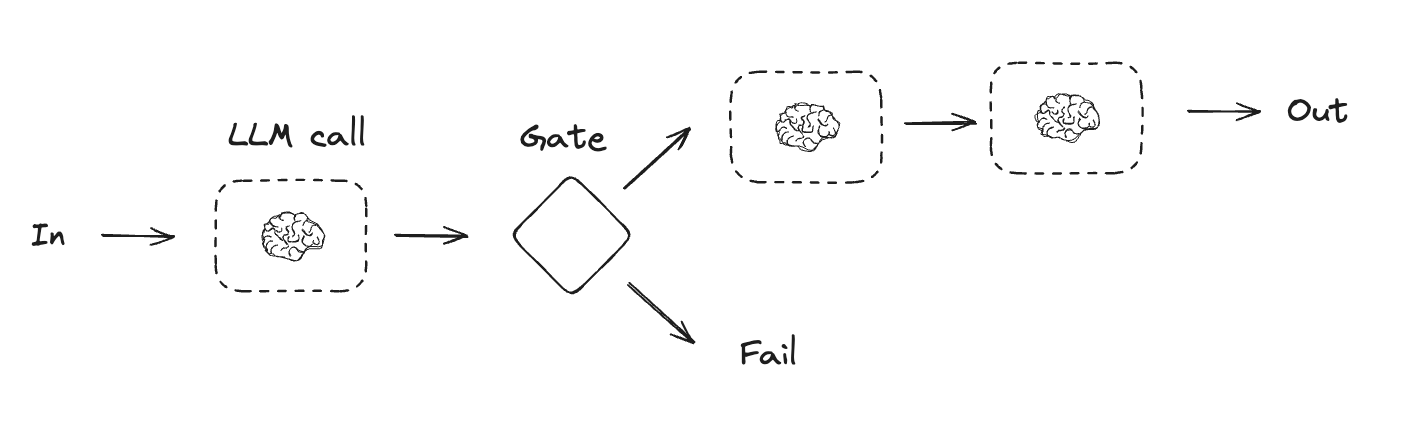
Prompt chaining is when each LLM call processes the output of the previous call. It's often used for performing well-defined tasks that can be broken down into smaller, verifiable steps. Some examples include:
- Translating documents into different languages
- Verifying generated content for consistency
class State(TypedDict): topic: str joke: str improved_joke: str final_joke: str
def generate_joke(state: State): """First LLM call to generate initial joke"""
  msg = llm.invoke(f"Write a short joke about {state['topic']}")
  return {"joke": msg.content}
def check_punchline(state: State): """Gate function to check if the joke has a punchline"""
  # Simple check - does the joke contain "?" or "!"
  if "?" in state["joke"] or "!" in state["joke"]:
      return "Pass"
  return "Fail"
def improve_joke(state: State): """Second LLM call to improve the joke"""
  msg = llm.invoke(f"Make this joke funnier by adding wordplay: {state['joke']}")
  return {"improved_joke": msg.content}
def polish_joke(state: State): """Third LLM call for final polish""" msg = llm.invoke(f"Add a surprising twist to this joke: {state['improved_joke']}") return {"final_joke": msg.content}
workflow = StateGraph(State)
workflow.add_node("generate_joke", generate_joke) workflow.add_node("improve_joke", improve_joke) workflow.add_node("polish_joke", polish_joke)
workflow.add_edge(START, "generate_joke") workflow.add_conditional_edges( "generate_joke", check_punchline, {"Fail": "improve_joke", "Pass": END} ) workflow.add_edge("improve_joke", "polish_joke") workflow.add_edge("polish_joke", END)
chain = workflow.compile()
display(Image(chain.get_graph().draw_mermaid_png()))
state = chain.invoke({"topic": "cats"}) print("Initial joke:") print(state["joke"]) print("\n--- --- ---\n") if "improved_joke" in state: print("Improved joke:") print(state["improved_joke"]) print("\n--- --- ---\n")
  print("Final joke:")
  print(state["final_joke"])
else: print("Final joke:") print(state["joke"])
```python Functional API theme={null}
from langgraph.func import entrypoint, task


# Tasks
@task
def generate_joke(topic: str):
    """First LLM call to generate initial joke"""
    msg = llm.invoke(f"Write a short joke about {topic}")
    return msg.content


def check_punchline(joke: str):
    """Gate function to check if the joke has a punchline"""
    # Simple check - does the joke contain "?" or "!"
    if "?" in joke or "!" in joke:
        return "Fail"

    return "Pass"


@task
def improve_joke(joke: str):
    """Second LLM call to improve the joke"""
    msg = llm.invoke(f"Make this joke funnier by adding wordplay: {joke}")
    return msg.content


@task
def polish_joke(joke: str):
    """Third LLM call for final polish"""
    msg = llm.invoke(f"Add a surprising twist to this joke: {joke}")
    return msg.content


@entrypoint()
def prompt_chaining_workflow(topic: str):
    original_joke = generate_joke(topic).result()
    if check_punchline(original_joke) == "Pass":
        return original_joke

    improved_joke = improve_joke(original_joke).result()
    return polish_joke(improved_joke).result()

# Invoke
for step in prompt_chaining_workflow.stream("cats", stream_mode="updates"):
    print(step)
    print("\n")
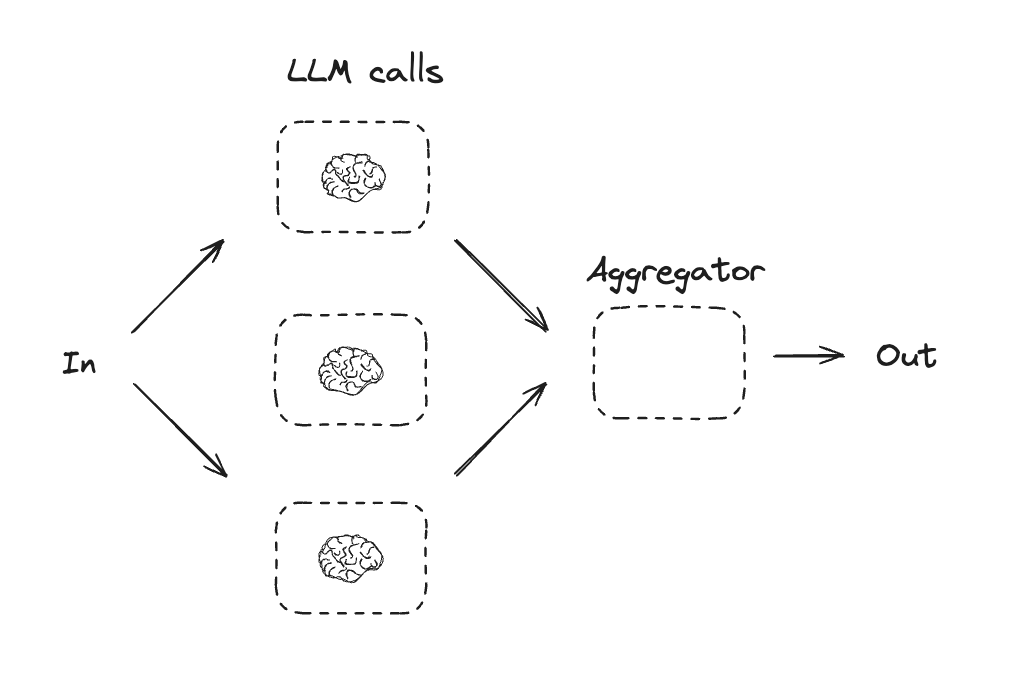
With parallelization, LLMs work simultaneously on a task. This is either done by running multiple independent subtasks at the same time, or running the same task multiple times to check for different outputs. Parallelization is commonly used to:
- Split up subtasks and run them in parallel, which increases speed
- Run tasks multiple times to check for different outputs, which increases confidence
Some examples include:
- Running one subtask that processes a document for keywords, and a second subtask to check for formatting errors
- Running a task multiple times that scores a document for accuracy based on different criteria, like the number of citations, the number of sources used, and the quality of the sources
def call_llm_1(state: State): """First LLM call to generate initial joke"""
  msg = llm.invoke(f"Write a joke about {state['topic']}")
  return {"joke": msg.content}
def call_llm_2(state: State): """Second LLM call to generate story"""
  msg = llm.invoke(f"Write a story about {state['topic']}")
  return {"story": msg.content}
def call_llm_3(state: State): """Third LLM call to generate poem"""
  msg = llm.invoke(f"Write a poem about {state['topic']}")
  return {"poem": msg.content}
def aggregator(state: State): """Combine the joke, story and poem into a single output"""
  combined = f"Here's a story, joke, and poem about {state['topic']}!\n\n"
  combined += f"STORY:\n{state['story']}\n\n"
  combined += f"JOKE:\n{state['joke']}\n\n"
  combined += f"POEM:\n{state['poem']}"
  return {"combined_output": combined}
parallel_builder = StateGraph(State)
parallel_builder.add_node("call_llm_1", call_llm_1) parallel_builder.add_node("call_llm_2", call_llm_2) parallel_builder.add_node("call_llm_3", call_llm_3) parallel_builder.add_node("aggregator", aggregator)
parallel_builder.add_edge(START, "call_llm_1") parallel_builder.add_edge(START, "call_llm_2") parallel_builder.add_edge(START, "call_llm_3") parallel_builder.add_edge("call_llm_1", "aggregator") parallel_builder.add_edge("call_llm_2", "aggregator") parallel_builder.add_edge("call_llm_3", "aggregator") parallel_builder.add_edge("aggregator", END) parallel_workflow = parallel_builder.compile()
display(Image(parallel_workflow.get_graph().draw_mermaid_png()))
state = parallel_workflow.invoke({"topic": "cats"}) print(state["combined_output"])
```python Functional API theme={null}
@task
def call_llm_1(topic: str):
    """First LLM call to generate initial joke"""
    msg = llm.invoke(f"Write a joke about {topic}")
    return msg.content


@task
def call_llm_2(topic: str):
    """Second LLM call to generate story"""
    msg = llm.invoke(f"Write a story about {topic}")
    return msg.content


@task
def call_llm_3(topic):
    """Third LLM call to generate poem"""
    msg = llm.invoke(f"Write a poem about {topic}")
    return msg.content


@task
def aggregator(topic, joke, story, poem):
    """Combine the joke and story into a single output"""

    combined = f"Here's a story, joke, and poem about {topic}!\n\n"
    combined += f"STORY:\n{story}\n\n"
    combined += f"JOKE:\n{joke}\n\n"
    combined += f"POEM:\n{poem}"
    return combined


# Build workflow
@entrypoint()
def parallel_workflow(topic: str):
    joke_fut = call_llm_1(topic)
    story_fut = call_llm_2(topic)
    poem_fut = call_llm_3(topic)
    return aggregator(
        topic, joke_fut.result(), story_fut.result(), poem_fut.result()
    ).result()

# Invoke
for step in parallel_workflow.stream("cats", stream_mode="updates"):
    print(step)
    print("\n")
Routing workflows process inputs and then directs them to context-specific tasks. This allows you to define specialized flows for complex tasks. For example, a workflow built to answer product related questions might process the type of question first, and then route the request to specific processes for pricing, refunds, returns, etc.
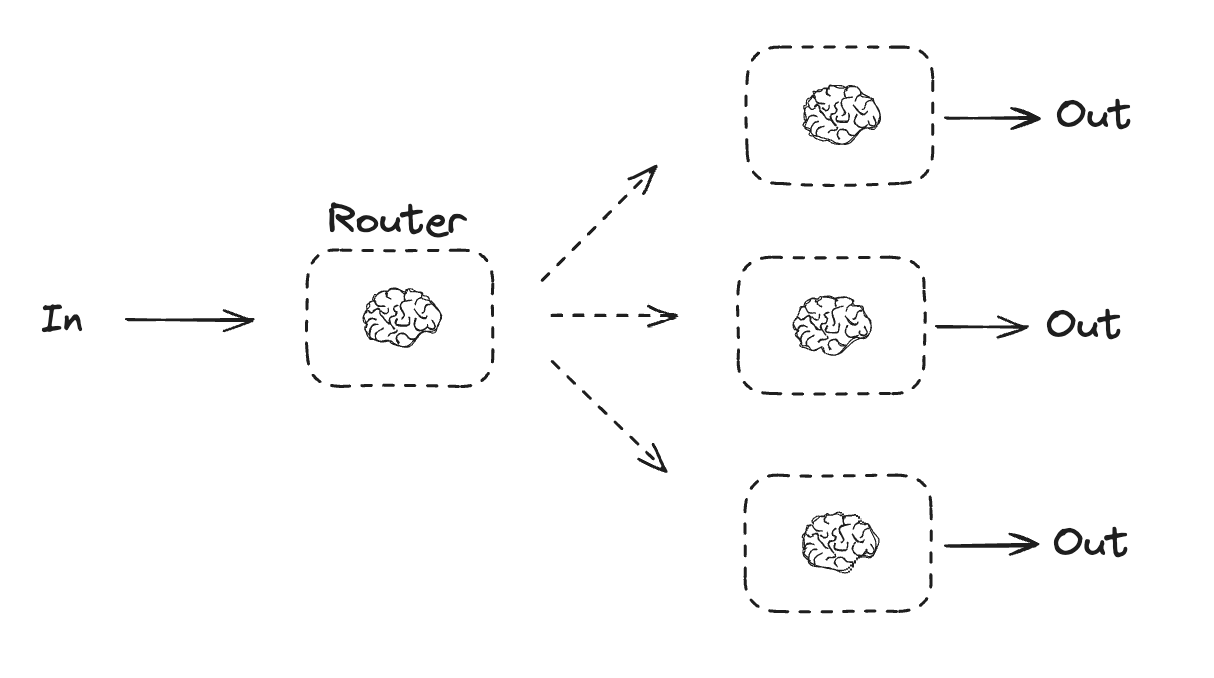
class Route(BaseModel): step: Literal["poem", "story", "joke"] = Field( None, description="The next step in the routing process" )
router = llm.with_structured_output(Route)
class State(TypedDict): input: str decision: str output: str
def llm_call_1(state: State): """Write a story"""
  result = llm.invoke(state["input"])
  return {"output": result.content}
def llm_call_2(state: State): """Write a joke"""
  result = llm.invoke(state["input"])
  return {"output": result.content}
def llm_call_3(state: State): """Write a poem"""
  result = llm.invoke(state["input"])
  return {"output": result.content}
def llm_call_router(state: State): """Route the input to the appropriate node"""
  # Run the augmented LLM with structured output to serve as routing logic
  decision = router.invoke(
      [
          SystemMessage(
              content="Route the input to story, joke, or poem based on the user's request."
          ),
          HumanMessage(content=state["input"]),
      ]
  )

  return {"decision": decision.step}
def route_decision(state: State): # Return the node name you want to visit next if state["decision"] == "story": return "llm_call_1" elif state["decision"] == "joke": return "llm_call_2" elif state["decision"] == "poem": return "llm_call_3"
router_builder = StateGraph(State)
router_builder.add_node("llm_call_1", llm_call_1) router_builder.add_node("llm_call_2", llm_call_2) router_builder.add_node("llm_call_3", llm_call_3) router_builder.add_node("llm_call_router", llm_call_router)
router_builder.add_edge(START, "llm_call_router") router_builder.add_conditional_edges( "llm_call_router", route_decision, { # Name returned by route_decision : Name of next node to visit "llm_call_1": "llm_call_1", "llm_call_2": "llm_call_2", "llm_call_3": "llm_call_3", }, ) router_builder.add_edge("llm_call_1", END) router_builder.add_edge("llm_call_2", END) router_builder.add_edge("llm_call_3", END)
router_workflow = router_builder.compile()
display(Image(router_workflow.get_graph().draw_mermaid_png()))
state = router_workflow.invoke({"input": "Write me a joke about cats"}) print(state["output"])
```python Functional API theme={null}
from typing_extensions import Literal
from pydantic import BaseModel
from langchain.messages import HumanMessage, SystemMessage


# Schema for structured output to use as routing logic
class Route(BaseModel):
    step: Literal["poem", "story", "joke"] = Field(
        None, description="The next step in the routing process"
    )


# Augment the LLM with schema for structured output
router = llm.with_structured_output(Route)


@task
def llm_call_1(input_: str):
    """Write a story"""
    result = llm.invoke(input_)
    return result.content


@task
def llm_call_2(input_: str):
    """Write a joke"""
    result = llm.invoke(input_)
    return result.content


@task
def llm_call_3(input_: str):
    """Write a poem"""
    result = llm.invoke(input_)
    return result.content


def llm_call_router(input_: str):
    """Route the input to the appropriate node"""
    # Run the augmented LLM with structured output to serve as routing logic
    decision = router.invoke(
        [
            SystemMessage(
                content="Route the input to story, joke, or poem based on the user's request."
            ),
            HumanMessage(content=input_),
        ]
    )
    return decision.step


# Create workflow
@entrypoint()
def router_workflow(input_: str):
    next_step = llm_call_router(input_)
    if next_step == "story":
        llm_call = llm_call_1
    elif next_step == "joke":
        llm_call = llm_call_2
    elif next_step == "poem":
        llm_call = llm_call_3

    return llm_call(input_).result()

# Invoke
for step in router_workflow.stream("Write me a joke about cats", stream_mode="updates"):
    print(step)
    print("\n")
In an orchestrator-worker configuration, the orchestrator:
- Breaks down tasks into subtasks
- Delegates subtasks to workers
- Synthesizes worker outputs into a final result
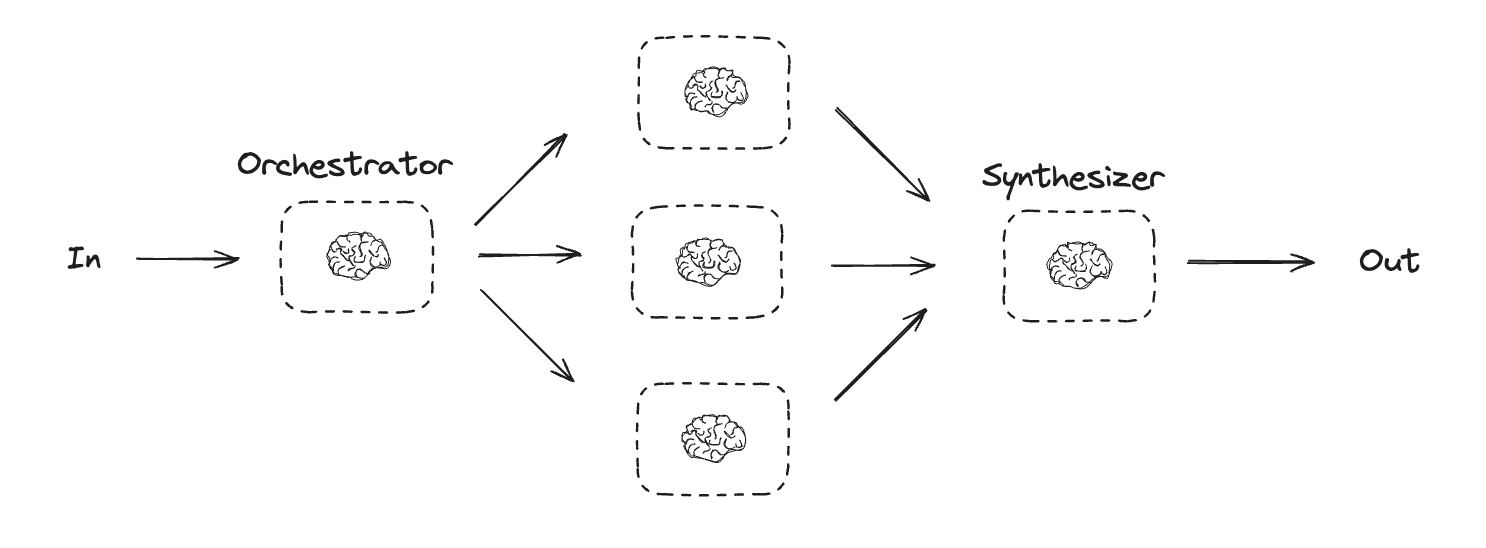
Orchestrator-worker workflows provide more flexibility and are often used when subtasks cannot be predefined the way they can with parallelization. This is common with workflows that write code or need to update content across multiple files. For example, a workflow that needs to update installation instructions for multiple Python libraries across an unknown number of documents might use this pattern.
```python Graph API theme={null} from typing import Annotated, List import operatorclass Section(BaseModel): name: str = Field( description="Name for this section of the report.", ) description: str = Field( description="Brief overview of the main topics and concepts to be covered in this section.", )
class Sections(BaseModel): sections: List[Section] = Field( description="Sections of the report.", )
planner = llm.with_structured_output(Sections)
```python Functional API theme={null}
from typing import List


# Schema for structured output to use in planning
class Section(BaseModel):
    name: str = Field(
        description="Name for this section of the report.",
    )
    description: str = Field(
        description="Brief overview of the main topics and concepts to be covered in this section.",
    )


class Sections(BaseModel):
    sections: List[Section] = Field(
        description="Sections of the report.",
    )


# Augment the LLM with schema for structured output
planner = llm.with_structured_output(Sections)


@task
def orchestrator(topic: str):
    """Orchestrator that generates a plan for the report"""
    # Generate queries
    report_sections = planner.invoke(
        [
            SystemMessage(content="Generate a plan for the report."),
            HumanMessage(content=f"Here is the report topic: {topic}"),
        ]
    )

    return report_sections.sections


@task
def llm_call(section: Section):
    """Worker writes a section of the report"""

    # Generate section
    result = llm.invoke(
        [
            SystemMessage(content="Write a report section."),
            HumanMessage(
                content=f"Here is the section name: {section.name} and description: {section.description}"
            ),
        ]
    )

    # Write the updated section to completed sections
    return result.content


@task
def synthesizer(completed_sections: list[str]):
    """Synthesize full report from sections"""
    final_report = "\n\n---\n\n".join(completed_sections)
    return final_report


@entrypoint()
def orchestrator_worker(topic: str):
    sections = orchestrator(topic).result()
    section_futures = [llm_call(section) for section in sections]
    final_report = synthesizer(
        [section_fut.result() for section_fut in section_futures]
    ).result()
    return final_report

# Invoke
report = orchestrator_worker.invoke("Create a report on LLM scaling laws")
from IPython.display import Markdown
Markdown(report)
Orchestrator-worker workflows are common and LangGraph has built-in support for them. The Send API lets you dynamically create worker nodes and send them specific inputs. Each worker has its own state, and all worker outputs are written to a shared state key that is accessible to the orchestrator graph. This gives the orchestrator access to all worker output and allows it to synthesize them into a final output. The example below iterates over a list of sections and uses the Send API to send a section to each worker.
from langgraph.types import Send


# Graph state
class State(TypedDict):
    topic: str  # Report topic
    sections: list[Section]  # List of report sections
    completed_sections: Annotated[
        list, operator.add
    ]  # All workers write to this key in parallel
    final_report: str  # Final report


# Worker state
class WorkerState(TypedDict):
    section: Section
    completed_sections: Annotated[list, operator.add]


# Nodes
def orchestrator(state: State):
    """Orchestrator that generates a plan for the report"""

    # Generate queries
    report_sections = planner.invoke(
        [
            SystemMessage(content="Generate a plan for the report."),
            HumanMessage(content=f"Here is the report topic: {state['topic']}"),
        ]
    )

    return {"sections": report_sections.sections}


def llm_call(state: WorkerState):
    """Worker writes a section of the report"""

    # Generate section
    section = llm.invoke(
        [
            SystemMessage(
                content="Write a report section following the provided name and description. Include no preamble for each section. Use markdown formatting."
            ),
            HumanMessage(
                content=f"Here is the section name: {state['section'].name} and description: {state['section'].description}"
            ),
        ]
    )

    # Write the updated section to completed sections
    return {"completed_sections": [section.content]}


def synthesizer(state: State):
    """Synthesize full report from sections"""

    # List of completed sections
    completed_sections = state["completed_sections"]

    # Format completed section to str to use as context for final sections
    completed_report_sections = "\n\n---\n\n".join(completed_sections)

    return {"final_report": completed_report_sections}


# Conditional edge function to create llm_call workers that each write a section of the report
def assign_workers(state: State):
    """Assign a worker to each section in the plan"""

    # Kick off section writing in parallel via Send() API
    return [Send("llm_call", {"section": s}) for s in state["sections"]]


# Build workflow
orchestrator_worker_builder = StateGraph(State)

# Add the nodes
orchestrator_worker_builder.add_node("orchestrator", orchestrator)
orchestrator_worker_builder.add_node("llm_call", llm_call)
orchestrator_worker_builder.add_node("synthesizer", synthesizer)

# Add edges to connect nodes
orchestrator_worker_builder.add_edge(START, "orchestrator")
orchestrator_worker_builder.add_conditional_edges(
    "orchestrator", assign_workers, ["llm_call"]
)
orchestrator_worker_builder.add_edge("llm_call", "synthesizer")
orchestrator_worker_builder.add_edge("synthesizer", END)

# Compile the workflow
orchestrator_worker = orchestrator_worker_builder.compile()

# Show the workflow
display(Image(orchestrator_worker.get_graph().draw_mermaid_png()))

# Invoke
state = orchestrator_worker.invoke({"topic": "Create a report on LLM scaling laws"})

from IPython.display import Markdown
Markdown(state["final_report"])In evaluator-optimizer workflows, one LLM call creates a response and the other evaluates that response. If the evaluator or a human-in-the-loop determines the response needs refinement, feedback is provided and the response is recreated. This loop continues until an acceptable response is generated.
Evaluator-optimizer workflows are commonly used when there's particular success criteria for a task, but iteration is required to meet that criteria. For example, there's not always a perfect match when translating text between two languages. It might take a few iterations to generate a translation with the same meaning across the two languages.
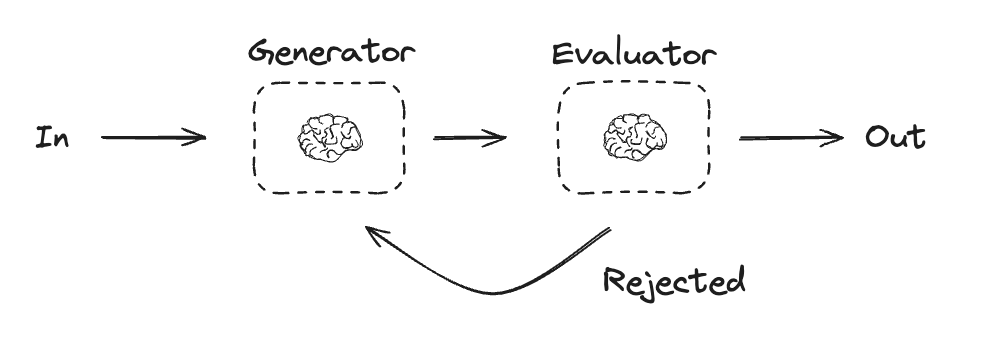
class Feedback(BaseModel): grade: Literal["funny", "not funny"] = Field( description="Decide if the joke is funny or not.", ) feedback: str = Field( description="If the joke is not funny, provide feedback on how to improve it.", )
evaluator = llm.with_structured_output(Feedback)
def llm_call_generator(state: State): """LLM generates a joke"""
  if state.get("feedback"):
      msg = llm.invoke(
          f"Write a joke about {state['topic']} but take into account the feedback: {state['feedback']}"
      )
  else:
      msg = llm.invoke(f"Write a joke about {state['topic']}")
  return {"joke": msg.content}
def llm_call_evaluator(state: State): """LLM evaluates the joke"""
  grade = evaluator.invoke(f"Grade the joke {state['joke']}")
  return {"funny_or_not": grade.grade, "feedback": grade.feedback}
Conditional edge function to route back to joke generator or end based upon feedback from the evaluator
def route_joke(state: State): """Route back to joke generator or end based upon feedback from the evaluator"""
  if state["funny_or_not"] == "funny":
      return "Accepted"
  elif state["funny_or_not"] == "not funny":
      return "Rejected + Feedback"
optimizer_builder = StateGraph(State)
optimizer_builder.add_node("llm_call_generator", llm_call_generator) optimizer_builder.add_node("llm_call_evaluator", llm_call_evaluator)
optimizer_builder.add_edge(START, "llm_call_generator") optimizer_builder.add_edge("llm_call_generator", "llm_call_evaluator") optimizer_builder.add_conditional_edges( "llm_call_evaluator", route_joke, { # Name returned by route_joke : Name of next node to visit "Accepted": END, "Rejected + Feedback": "llm_call_generator", }, )
optimizer_workflow = optimizer_builder.compile()
display(Image(optimizer_workflow.get_graph().draw_mermaid_png()))
state = optimizer_workflow.invoke({"topic": "Cats"}) print(state["joke"])
```python Functional API theme={null}
# Schema for structured output to use in evaluation
class Feedback(BaseModel):
    grade: Literal["funny", "not funny"] = Field(
        description="Decide if the joke is funny or not.",
    )
    feedback: str = Field(
        description="If the joke is not funny, provide feedback on how to improve it.",
    )


# Augment the LLM with schema for structured output
evaluator = llm.with_structured_output(Feedback)


# Nodes
@task
def llm_call_generator(topic: str, feedback: Feedback):
    """LLM generates a joke"""
    if feedback:
        msg = llm.invoke(
            f"Write a joke about {topic} but take into account the feedback: {feedback}"
        )
    else:
        msg = llm.invoke(f"Write a joke about {topic}")
    return msg.content


@task
def llm_call_evaluator(joke: str):
    """LLM evaluates the joke"""
    feedback = evaluator.invoke(f"Grade the joke {joke}")
    return feedback


@entrypoint()
def optimizer_workflow(topic: str):
    feedback = None
    while True:
        joke = llm_call_generator(topic, feedback).result()
        feedback = llm_call_evaluator(joke).result()
        if feedback.grade == "funny":
            break

    return joke

# Invoke
for step in optimizer_workflow.stream("Cats", stream_mode="updates"):
    print(step)
    print("\n")
Agents are typically implemented as an LLM performing actions using tools. They operate in continuous feedback loops, and are used in situations where problems and solutions are unpredictable. Agents have more autonomy than workflows, and can make decisions about the tools they use and how to solve problems. You can still define the available toolset and guidelines for how agents behave.
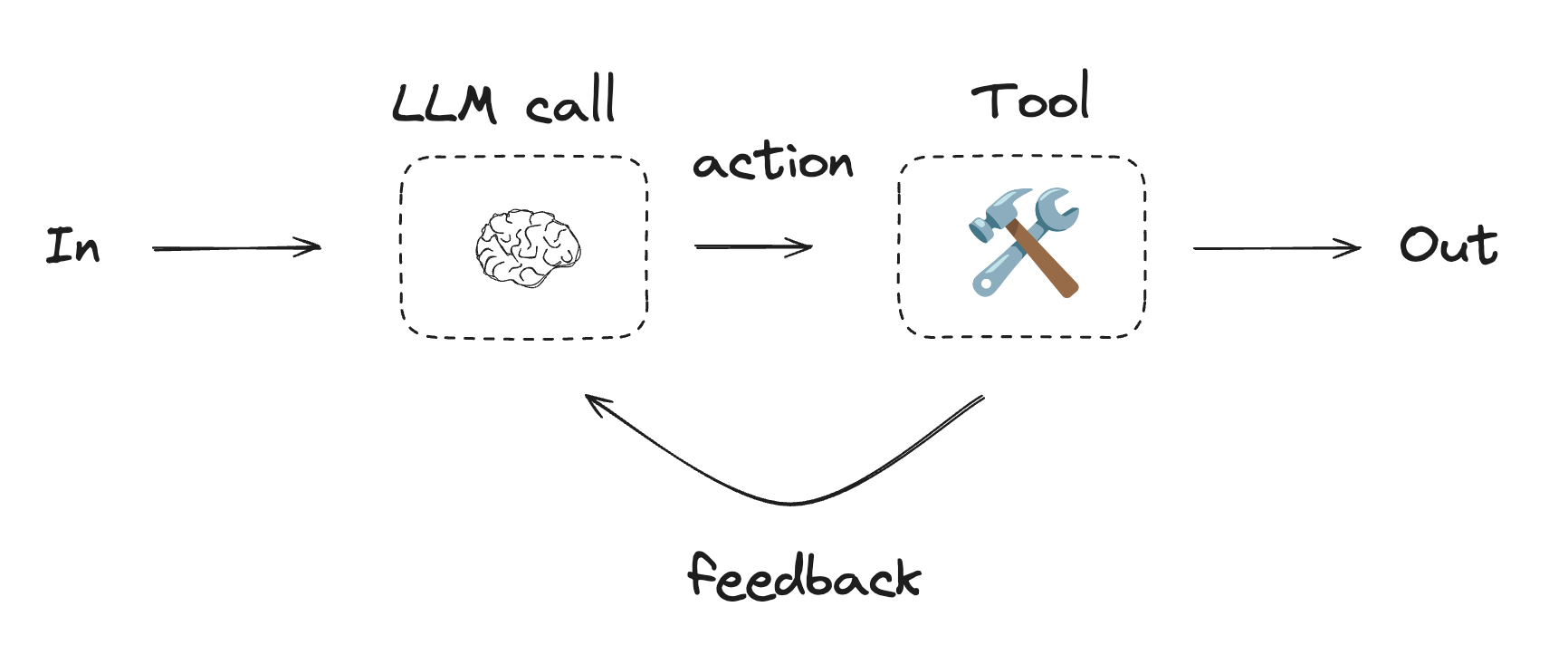
from langchain.tools import tool


# Define tools
@tool
def multiply(a: int, b: int) -> int:
    """Multiply `a` and `b`.

    Args:
        a: First int
        b: Second int
    """
    return a * b


@tool
def add(a: int, b: int) -> int:
    """Adds `a` and `b`.

    Args:
        a: First int
        b: Second int
    """
    return a + b


@tool
def divide(a: int, b: int) -> float:
    """Divide `a` and `b`.

    Args:
        a: First int
        b: Second int
    """
    return a / b


# Augment the LLM with tools
tools = [add, multiply, divide]
tools_by_name = {tool.name: tool for tool in tools}
llm_with_tools = llm.bind_tools(tools)def llm_call(state: MessagesState): """LLM decides whether to call a tool or not"""
  return {
      "messages": [
          llm_with_tools.invoke(
              [
                  SystemMessage(
                      content="You are a helpful assistant tasked with performing arithmetic on a set of inputs."
                  )
              ]
              + state["messages"]
          )
      ]
  }
def tool_node(state: dict): """Performs the tool call"""
  result = []
  for tool_call in state["messages"][-1].tool_calls:
      tool = tools_by_name[tool_call["name"]]
      observation = tool.invoke(tool_call["args"])
      result.append(ToolMessage(content=observation, tool_call_id=tool_call["id"]))
  return {"messages": result}
Conditional edge function to route to the tool node or end based upon whether the LLM made a tool call
def should_continue(state: MessagesState) -> Literal["tool_node", END]: """Decide if we should continue the loop or stop based upon whether the LLM made a tool call"""
  messages = state["messages"]
  last_message = messages[-1]

  # If the LLM makes a tool call, then perform an action
  if last_message.tool_calls:
      return "tool_node"

  # Otherwise, we stop (reply to the user)
  return END
agent_builder = StateGraph(MessagesState)
agent_builder.add_node("llm_call", llm_call) agent_builder.add_node("tool_node", tool_node)
agent_builder.add_edge(START, "llm_call") agent_builder.add_conditional_edges( "llm_call", should_continue, ["tool_node", END] ) agent_builder.add_edge("tool_node", "llm_call")
agent = agent_builder.compile()
display(Image(agent.get_graph(xray=True).draw_mermaid_png()))
messages = [HumanMessage(content="Add 3 and 4.")] messages = agent.invoke({"messages": messages}) for m in messages["messages"]: m.pretty_print()
```python Functional API theme={null}
from langgraph.graph import add_messages
from langchain.messages import (
    SystemMessage,
    HumanMessage,
    ToolCall,
)
from langchain_core.messages import BaseMessage


@task
def call_llm(messages: list[BaseMessage]):
    """LLM decides whether to call a tool or not"""
    return llm_with_tools.invoke(
        [
            SystemMessage(
                content="You are a helpful assistant tasked with performing arithmetic on a set of inputs."
            )
        ]
        + messages
    )


@task
def call_tool(tool_call: ToolCall):
    """Performs the tool call"""
    tool = tools_by_name[tool_call["name"]]
    return tool.invoke(tool_call)


@entrypoint()
def agent(messages: list[BaseMessage]):
    llm_response = call_llm(messages).result()

    while True:
        if not llm_response.tool_calls:
            break

        # Execute tools
        tool_result_futures = [
            call_tool(tool_call) for tool_call in llm_response.tool_calls
        ]
        tool_results = [fut.result() for fut in tool_result_futures]
        messages = add_messages(messages, [llm_response, *tool_results])
        llm_response = call_llm(messages).result()

    messages = add_messages(messages, llm_response)
    return messages

# Invoke
messages = [HumanMessage(content="Add 3 and 4.")]
for chunk in agent.stream(messages, stream_mode="updates"):
    print(chunk)
    print("\n")
[Edit this page on GitHub](https://github.com/langchain-ai/docs/edit/main/src/oss/langgraph/workflows-agents.mdx) or [file an issue](https://github.com/langchain-ai/docs/issues/new/choose). [Connect these docs](/use-these-docs) to Claude, VSCode, and more via MCP for real-time answers.
To find navigation and other pages in this documentation, fetch the llms.txt file at: https://docs.langchain.com/llms.txt