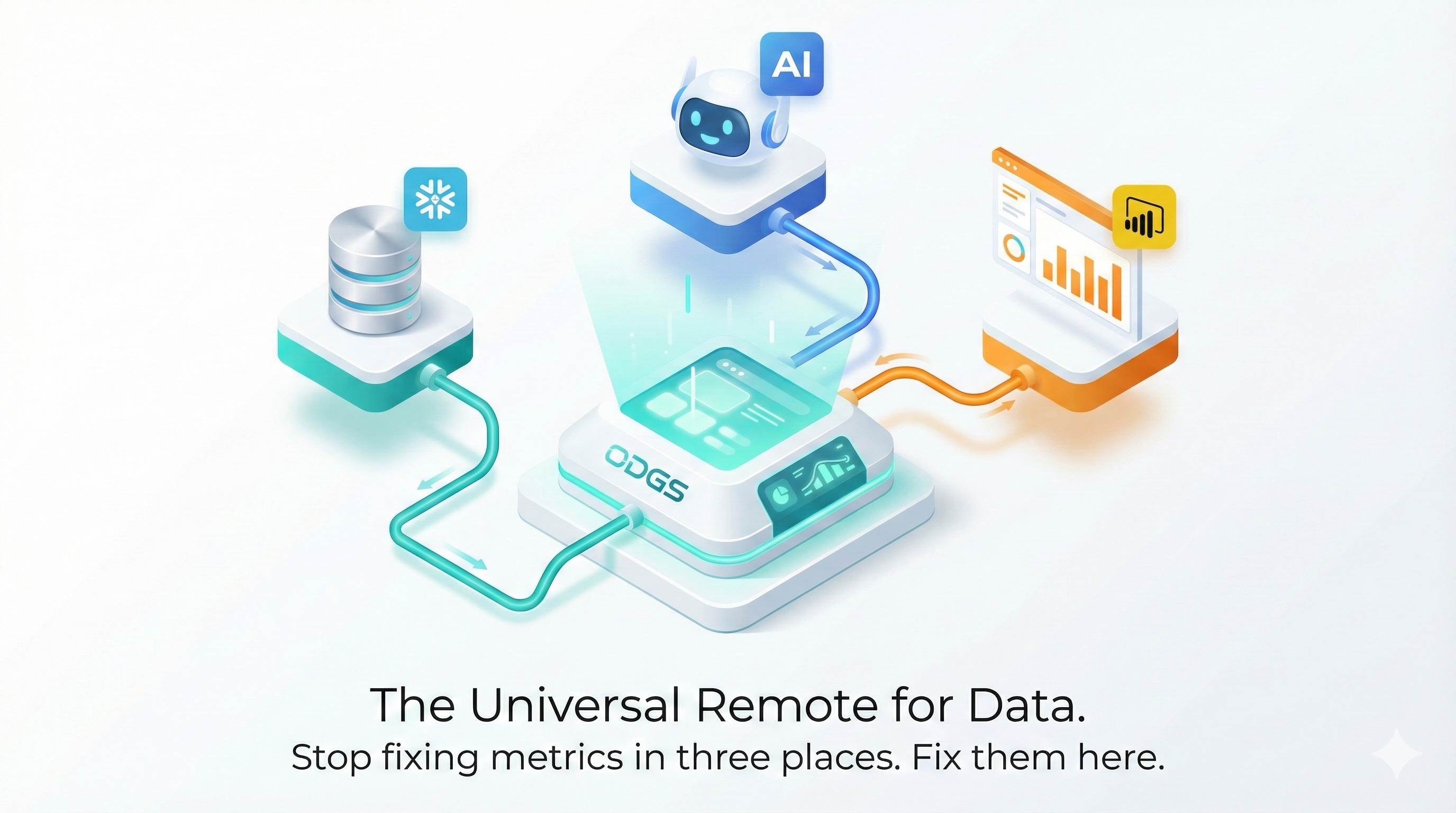



"The Protocol for Algorithmic Accountability"
Why This Protocol Matters
We have spent the last decade solving the Storage Problem. Thanks to Apache Iceberg and Delta Lake, we can now store petabytes of data cheaply and reliably.
But we are still failing at the Meaning Problem.
- Ask your Data Engineer for "Gross Churn" and you get one number.
- Ask your Tableau dashboard and you get another.
- Ask your Finance team and you get a third.
This is Metric Drift. In the traditional BI world, this was annoying—you had to have meetings to reconcile numbers. In the age of AI, Metric Drift is fatal.
If you feed conflicting definitions to a Large Language Model (LLM), you don't get "Business Intelligence"—you get confident hallucinations.
| Old Way (Coupled) | New Way (Headless) |
|---|---|
| Logic locked in dbt SQL | Logic defined in JSON Protocol |
| Logic hidden in Power BI DAX | Logic synced to Every Tool |
| AI guesses meaning (Hallucination) | AI looks up "Ground Truth" |
| Fragile & Siloed | Robust & Universal |
We believe AI is only as good as the rules you give it.
- Artificial Intelligence guesses the answer based on probability
- Authentic Intelligence knows the answer based on codified human expertise
ODGS captures the Authentic Intelligence of your domain experts—the nuances, the exceptions, the business rules—and codifies them into a standard that AI can respect.
"The Table Format War is over. The Semantic War has just begun. Don't build another silo. Build on the Standard."
ODGS is not a single product. It is a set of ingredients (JSON Schemas) that you can mix and match to build entirely different solutions.
Think of it like LEGO blocks for Data Governance.
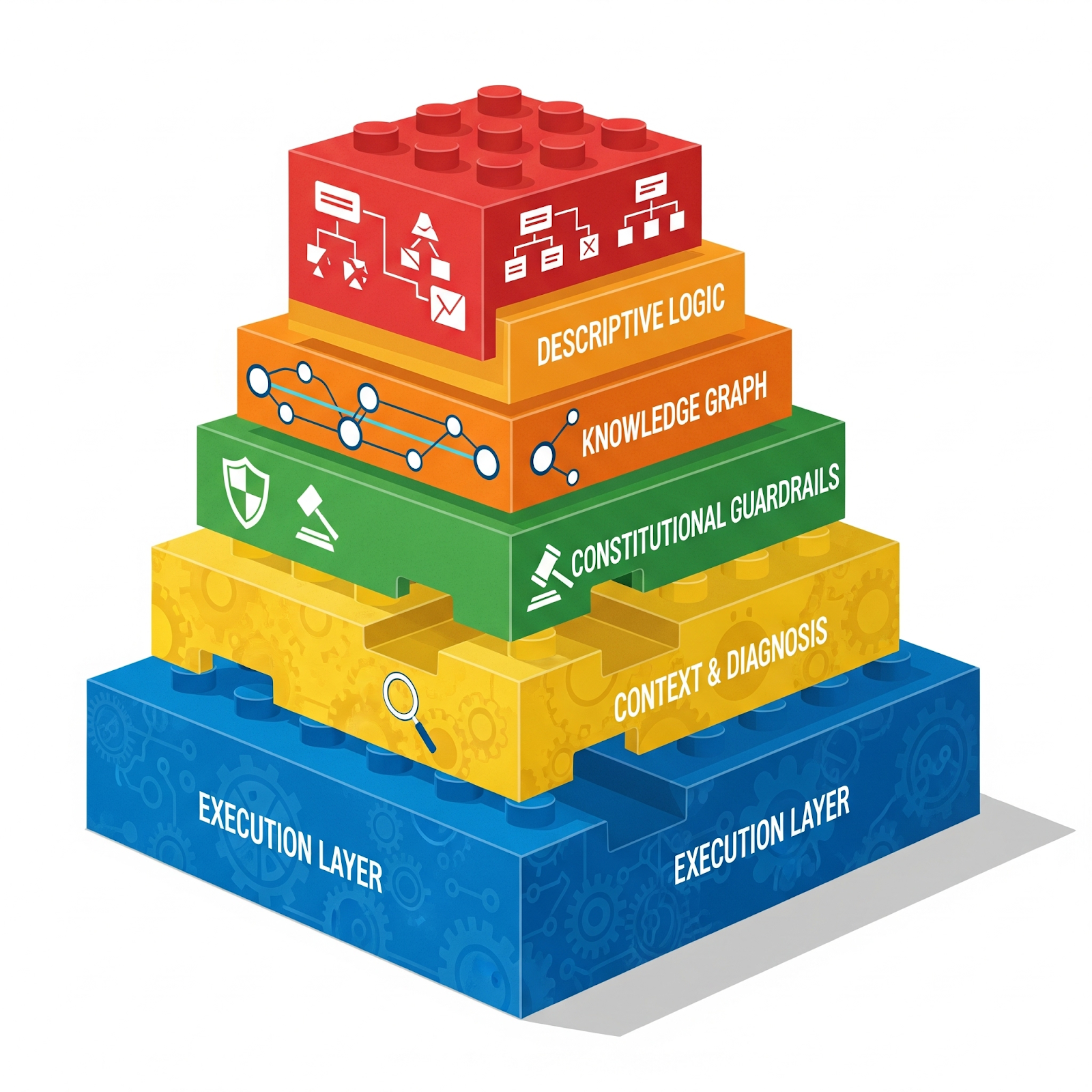
| Category | Concept | Analogy | Target Audience |
|---|---|---|---|
| 1. Open Metric | Universal standard for defining metrics | "Markdown for Metrics" | Analytics Engineers, CTOs |
| 2. Operational Intelligence | Link data quality to process failures | "Check Engine Light for Business" | COOs, Process Owners |
| 3. Definition Management | Central library for business terms | "GitHub for Business Logic" | Data Stewards, Governance Teams |
| 4. Algorithmic Accountability | Safety protocol for AI Agents | "FDA Label for AI Data" | AI Engineers, Regulators |
| Trend | The Problem | The ODGS Solution |
|---|---|---|
| Headless Semantic Layer | Metrics defined in 10 different tools | Serverless semantics—just a file, compiles to native code |
| Governance as Code | Governance stuck in PDFs or expensive tools | Terraform for Data Governance—managed in Git |
| AI Ground Truth | LLMs hallucinate ~20% of numerical queries | The Context Engine—structured, verified context for LLMs |
| Open Data Exchange | Sharing definitions with partners is error-prone | The PDF for Data—standard format for exchanging meaning |
"Snowflake/Databricks solved 'storage'. They haven't solved 'meaning'."
We are in the "Tower of Babel" phase of data:
- Snowflake stores the data
- dbt defines it in SQL
- Looker defines it in LookML
- Power BI defines it in DAX
Result: "Revenue" means four different things in four different tools.
The Opportunity: The winner of the next era won't be another storage engine. It will be the Rosetta Stone—the standard that translates meaning once and feeds it everywhere.
Why ODGS Wins: Existing solutions (Cube, AtScale) are Engines (software you buy and run). ODGS is a Standard (a schema you adopt). Standards usually beat proprietary engines in the long run:
- JSON beat XML
- Kubernetes beat Docker Swarm
- OpenTelemetry beat proprietary APM formats
Generative AI is a "Reasoning Engine," not a "Knowledge Base." It is great at syntax, but terrible at facts.
When an executive asks an AI Agent: "What was our Churn last month?"
- The AI scans your Data Warehouse
- It finds three columns:
churn_date,churn_flag,is_churned - It guesses
This is a Semantic Hallucination. The AI confidently returns a number, but it calculated it wrong because it didn't know your specific business rules (e.g., "Exclude trial customers from churn calculations").
ODGS provides the "Grounding".
It forces the AI to look up the human-codified definition first. It provides the Chain of Custody for your business logic, ensuring that every AI answer can be traced back to a specific, version-controlled definition in your Git repo.
How It Works:
- Define: You define "Churn" in
standard_metrics.json - Verify: You specify the exact logic (
COUNT(churn_flag) WHERE customer_type != 'Trial') - Enforce: The ODGS Protocol feeds this definition into the AI's Context Window
When the AI answers using ODGS, it isn't guessing. It's executing verified logic.
The EU AI Act (the world's first comprehensive AI law) classifies AI systems used in critical decisions (credit scoring, employment, insurance) as "High Risk."
Article 10 requires:
"Training, validation and testing data sets shall be subject to appropriate data governance and management practices."
If your AI Agent cannot prove why it gave a specific answer, you are non-compliant.
| Article | Requirement | ODGS Solution |
|---|---|---|
| Article 10 | Data Governance & Management | Codified lineage—every metric is version-controlled in Git |
| Article 13 | Transparency & Interpretability | Metric Provenance—AI cites the definition it used |
| Article 15 | Accuracy & Robustness | Constitutional Guardrails—prevents invalid queries |
ODGS is an Automated Compliance Protocol. It provides the standard for "Metric Provenance"—the only effective way to audit AI agents under the EU AI Act.
ODGS is more than software; it is a research initiative for Responsible AI.
We are aligning ODGS with the Responsible Innovation framework to provide a technical implementation for "Algorithmic Accountability." The goal is to verify that AI agents operating in high-stakes environments (logistics, finance) adhere to human-defined ethical boundaries.
As part of the Zuid-Holland AI Alliance, ODGS positions itself as a practical tool for compliance with the EU AI Act. We provide the "Audit Trail" required for High-Risk AI Systems.
Contributing to the "Responsible AI That Works" initiative by offering a concrete standard for data quality and provenance.
ODGS is designed to be Platform Agnostic. It doesn't compete with your existing stack; it enhances it.
For Data Platforms:
- Snowflake / Databricks: Use ODGS to manage "Comment" and "Tag" fields programmatically
- Microsoft Fabric: ODGS compiles directly to TMSL for Power BI automation
- dbt Cloud: Generate
semantic_models.ymlto standardize MetricFlow
Why Platforms Need This:
You have built the perfect storage engine. But your customers struggle to trust the meaning of the data stored within.
- Vendor Neutral: ODGS doesn't lock users into a specific catalog
- Governance as Code: Offer "Managed Compliance" layers on top of your compute
- AI Readiness: Become the safest place to run Enterprise AI Agents
We are not building a proprietary engine; we are ratifying the standard for Metric Provenance. We are actively collaborating with leading academic institutions and policy think tanks to align ODGS with the strictest interpretations of the EU AI Act.
For Different Stakeholders:
Join us in defining the "Physics of AI Trust." Contribute to the academic validation of ODGS as a formal protocol for Algorithmic Accountability.
Become a Design Partner. Secure your data stack against the EU AI Act before the enforcement deadline. Pilot ODGS to achieve Metric Provenance at scale.
Fork the repo. Build adapters for Looker, Qlik, or Sisense. Own the standard. Your contributions directly shape the future of data governance.
Stop buying "Semantic Layers" that lock you into a vendor. Adopt a Headless Standard that makes your definitions portable across every tool in your stack.
Don't let your agents fly blind. Give them the Context & Diagnosis layer they need to reason effectively and comply with regulations.
Demand "Glass Box" transparency. If an AI cannot cite the provenance of its answer, it should not be answering high-risk questions.
We are living in the "Tower of Babel" phase of data. We solved storage (Snowflake/Databricks), but we haven't solved meaning. Today, "Revenue" means four different things in four different tools, leading to broken dashboards and hallucinating AI agents.
The winner of the next era won't be another proprietary "Engine." It will be a Standard Protocol—a universal schema that translates meaning once and feeds it everywhere.
Just as:
- JSON replaced XML
- Kubernetes won the container war
- OpenTelemetry unified observability
ODGS will unify the semantic layer.
- AI is entering the enterprise, and hallucination is the #1 blocker
- The EU AI Act creates regulatory pressure for provenance
- Data teams are exhausted from copy-pasting SQL across 10 tools
By treating Governance not as a policy document, but as executable code, ODGS provides the missing link between Human Intent and AI Execution.
- We solved Storage (Snowflake)
- We solved Compute (Databricks)
- ODGS solves Trust
The ingredients are ready. The recipes are proven. It's time to stop building the tower, and start speaking the same language.