Jul 13, 2024
- Add full Strict Concurrency Checking and Swift 6 support
- Add
@MainActorannotation toImageLoadingOptions.shared - Fix image scale and orientation issue in thumbnail creation by @prabhuamol in kean#793
- Deprecate
ImagePipeline.Configuration.callbackQueue– this feature will be removed in Nuke 13 ImagePrefetcher.didCompleteclosure is now annotated with@MainActor @Sendable- Drop Xcode 14 support
Jun 19, 2024
- Fix “unrecognized selector sent to instance” crash in NukeExtensions in a cross-dissolve transition on iOS < 17 by @ejensen in kean#792
Jun 8, 2024
- Fix kean#789, an issue with
ImageProcessors.Resizefailing to resize images with packed pixel formats
May 30, 2024
- Fix fade transition in some scenarios by @ejensen in kean#786
- Remove
taskDescriptionfrom network tasks by @ejensen in kean#785 - Temporarily revert the change introduced in v12.6 that would skip decompression for some image types – more info in kean#788
May 18, 2024
This release contains major improvements to the Structured Concurrency support and ImagePipeline internals.
- Add
previews: AsyncStream<ImageResponse>,progress: AsyncStream<Progress>,image: PlatformImage asyncandresponse: ImageResponse asyncdirectly toImageTaskand deprecateAsyncImageTask. These APIs have zero cost unless you use them. - Add
ImageTask.Eventand addevents: AsyncStream<Event>toImageTaskfor observing all events associated with the image loading. - Improve the support for
AsyncStream: a new stream is created every time you access the respective property to make it easier to have multiple consumers. - Add
ImagePipelineDelegate/imageTask(:didReceiveEvent:pipeline:)and deprecate the previous methods it replaced (context: these methods were introduced in Nuke 11.0 as the initial and misguided attempt at Structured Concurrency support that tried to borrow from theURLSessionAPI design) - (Internal) Rework
ImagePipelinethat accumulated a lot of cruft after the introduction of data tasks, Combine, Async/Await, and AsyncStream support in the previous releases. - Deprecate
ImagePipeline/loadData(with:)andImagePipeline/data(with:)methods that acceptURLas parameters – use theImageRequestvariants instead (these are rarely used and low-level APIs that don't require convenience variants) - Remove
@discardableResultfromImagePipeline/data(with:) async throws– it was never meant to be there - Rename
ImageTask/progresstoImageTask/currentProgress(warning: this is a small breaking change in the API) - Fix some of the Strict Concurrency Checking & Swift 6 warnings preparing for the upcoming Swift releases
- Fix documentation for
AsyncImageTask/previewsthat was previously specifying that it was delivering the previews and the final image – it's only the previews. - Fix [#782], an issue with grayscale images (8 bpp) not being rendered correctly when
Resizeprocessor is used
Apr 23, 2024
- Fix an issue with an optimization that is supposed to skip decompression if one or more processors are applied
- Fix a
[Decompressor] Error -17102 decompressing image -- possibly corruptconsole error message when usingImagePipeline.Configuration.isUsingPrepareForDisplay(disabled by default). The pipeline will now skip decompression for.png. - Fix kean#705 with integration between thumbnail options (link) and original data caching: the original data is now stored without a thumbnail key
- Fix an issue where
.storeAlland.automaticcache policies would not store the thumbnail data - Fix kean#746 an issue with
ImageRequest.UserInfoKey.scaleKeynot interacting correctly with coalescing - Fix kean#763 SwiftUI Warning: Accessing StateObject's object without being installed on a View when using
onStart - Fix kean#758 by adding support for initializing
ImageProcessors.CoreImageFilterwithCIFilterinstances - Add support for disk cache lookup for intermediate processed images (as opposed to only final and original as before)
- Add an optimization that loads local resources with
fileanddataschemes quickly without usingDataLoaderandURLSession. If you rely on the existing behavior, this optimization can be turned off using theisLocalResourcesSupportEnabledconfiguration option. kean#779 - Deprecate
ImagePipeline.Configuration.dataCachingQueueand perform data cache lookups on the pipeline's queue, reducing the amount of context switching - Update the infrastructure for coalescing image-processing tasks to use the task-dependency used for other operations
Mar 23, 2024
- Fix Xcode 15.3 concurrency warnings when using
Screen.scaleby @jszumski in kean#766 - Add
showPlaceholderOnFailureparameter to show placeholder in case of image loading failure by @mlight3 in kean#764 - Fix image loading test on iOS 17 by @woxtu in kean#768
- Update thumbnail key value for `ImageRequest`` by @woxtu in kean#769
- Remove trailing whitespaces by @woxtu in kean#767
- Apply
if letshorthand syntax by @mlight3 in kean#762
Feb 10, 2024
- Enable visionOS support for all APIs by @zachwaugh in kean#752
- Update documentation by @tkersey in kean#747
Jan 6, 2024
- Add support for visionOS by @bobek-balinek in kean#743
Nov 23, 2023
- Add another file type signature for .m4v files by @leonid-shevtsov in kean#735
- Added the onStart callback to SwiftUI.LazyImage by @urbaneewe in kean#736
Aug 19, 2023
- Improve
ImageCacheperformance (20%) - Improve
NukeExtensionsperformance (5%) - Update the code to support future visionOS releases by switching to
canImportwhere possible
Jul 29, 2023
Jul 22, 2023
- Upgrade to
CryptoKitfromCommonCryptoand slightly optimize how cryptographic hashes are converted to strings (used as filenames forDataCache) - Deprecate
DataCache/isCompressionEnabled. It was initially added as a general-purpose feature, but it's not recommended to be used with most image formats. DataCachenow performs sweeps less frequently- Minor docs correction – kean#715 by @tdkn
Jul 10, 2023
- Fix kean#709:
LazyImagefails to perform memory cache lookup in some scenarios
Jun 25, 2023
Jun 22, 2023
- Fix kean#693:
ImageRequestcreated with an async function now executes it lazily - kean#708 by @khlopko - Fix kean#695:
byCroppingToSquare()always return square image – kean#696 by @zzmasoud - Update unit tests – kean#701 by @woxtu
- Fix upcoming warnings in Xcode 15
Mar 25, 2023
- Add
makeImageViewclosure toLazyImageViewto allow using custom views for rendering images - Add
onCompletionclosure toLazyImageandFetchImage - Fix an issue with
.videoAssetKeyvalue missing fromImageContainer - Fix an issue with
.gifbeing encoded as.jpegwhen.storeEncodedImagespolicy is used
Mar 4, 2023
Nuke 12 enhances the two main APIs introduced in the previous release: LazyImage and the async ImagePipeline methods. They are faster, more robust, and easier to use.
The migration guide is available to help with the update. The minimum requirements are unchanged from Nuke 11.
Redesign the concurrency APIs making them more ergonomic and fully Sendable compliant.
- Add
ImagePipeline/imageTask(with:)method that returns a new typeAsyncImageTask
let task = ImagePipeline.shared.imageTask(with: URL(string: "example.com"))
task.priority = .high
for await progress in task.progress {
    print("Updated progress: ", progress)
}
let image = try await task.image- The existing convenience
ImagePipeline/image(for:)method now returns an image instead ofImageResponse - Remove the
delegateparameter fromImagePipeline/image(for:)method to address the upcoming concurrency warnings in Xcode 14.3 - Remove
ImageTaskDelegateand move its methods toImagePipelineDelegateand add thepipelineparameter
NukeUI started as a separate repo, but the initial production version was released as part of Nuke 11. Let's call it NukeUI 1.0. The framework was designed before the AsyncImage announcement and had a few discrepancies that made it harder to migrate from AsyncImage. This release addresses the shortcomings of the original design and features a couple of performance improvements.
LazyImagenow usesSwiftUI.Imageinstead ofNukeUI.Imagebacked byUIImageViewandNSImageView. It eliminates any discrepancies betweenLazyImageandAsyncImagelayout and self-sizing behavior and fixes issues with.redacted(reason:),ImageRenderer, and other SwiftUI APIs that don't work with UIKIt and AppKit based views.- Remove
NukeUI.Imageso the name no longer clashes withSwiftUI.Image - Fix #669:
redactednot working forLazyImage - GIF rendering is no longer included in the framework. Please consider using one of the frameworks that specialize in playing GIFs, such as Gifu. It's easy to integrate, especially with
LazyImage. - Extract progress updates from
FetchImageto a separate observable object, reducing the number of body reloads LazyImagenow requires a single body calculation to render the response from the memory cache (instead of three before)- Disable animations by default
- Fix an issue where the image won't reload if you change only
LazyImageprocessorsorprioritywithout also changing the image source FetchImage/imagenow returnsImageinstead ofUIImage- Make
_PlatformImageViewinternal (was public) and remove more typealiases
- Add a new initializer to
ImageRequest.ThumbnailOptionsthat accepts the target size, unit, and content mode - #677 - ImageCache uses 20% of available RAM which is quite aggressive. It's an OK default on iOS because it clears 90% of the used RAM when entering the background to be a good citizen. But it's not a good default on a Mac. Starting with Nuke 12, the default size is now strictly limited to 512 MB.
ImageDecodernow defaults to scale1for images (configurable usingUserInfoKey/scaleKey)- Removes APIs deprecated in the previous versions
- Update the Performance Guide
Video playback can be significantly more efficient than playing animated GIFs. This is why the initial version of NukeUI provided support for basic video playback. But it is not something that the majority of the users need, so this feature was extracted to a separate module called NukeVideo.
There is now less code that you need to include in your project, which means faster compile time and smaller code size. With this and some other changes in Nuke 12, the two main frameworks – Nuke and NukeUI – now have 25% less code compared to Nuke 11. In addition to this change, there are a couple of improvements in how the precompiled binary frameworks are generated, significantly reducing their size.
- Move all video-related code to
NukeVideo - Remove
ImageContainer.asset. The asset is now added toImageContainer/userInfounder the new.videoAssetKey. - Reduce the size of binary frameworks by up to 50%
Feb 19, 2023
- Fix #671:
ImagePipeline/image(for:)hangs if you cancel the async Task before it is started
Feb 18, 2023
- Fix warnings in Xcode 14.3
Feb 9, 2023
- Fix an issue with static GIFs not rendered correctly – #667 by @Havhingstor
Feb 5, 2023
- Fix #653: ImageView wasn't calling
prepareForReuseon itsanimatedImageView
Jan 27, 2023
- Fix #579:
ImageEncoders.ImageIOlosing image orientation - #643 - Deprecate previously soft-deprecated
ImageRequestConvertible- #642 - Add
isCompressionEnabledoption toDataCachethat enables compression using Apple’s lzfse algorithm - Add
ExpressibleByStringLiteralconformance toImageRequest - Make compatible with Swift 6 mode
Jan 4, 2023
- Remove DocC files to address kean#609
Dec 25, 2022
- Fix
ImagePipeline.sharedwarning with Strit Concurrency Checking set to Complete - Fix an issue where
ImagePrefetcher/didCompletewasn't called in some scenarios ImagePrefetcher/didCompleteis now called on the main queue
Dec 17, 2022
DataLoader/delegatenow gets called for allURLSession/delegatemethods, not just the ones required by Pulse. It allows you to modifyDataLoaderbehavior in new ways, e.g. for handling authentication challenges.- Add new unit tests, thanks to @zzmasoud - #626
- Fix an issue with
ImagePrefetcher/didCompletenot being called when images are in the memory cache, thanks to @0xceed - #635 - Move .docc folders back to Sources/, so that the Nuke docs are now again available in Xcode
Dec 15, 2022
- Correct the release commit/branch
Dec 14, 2022
- Add
isVideoFrameAnimationEnabledoption to NukeUI views, thanks to @maciesielka
Oct 22, 2022
- Fix deprecated
withTaskCancellationHandlerusage - #614, thanks to @swasta - Fix xcodebuild & docc build issue on Xcode 14.0.1 - #609
Sep 17, 2022
- Add support for loading image into
TVPosterView(tvOS) - #602, thanks to @lukaskukacka
Sep 10, 2022
- Fix an issue with Mac Catalyst on Xcode 14.0
Sep 10, 2022
- Add support for Xcode 14.0
- Fix #595 – compilation issue on macOS
Aug 16, 2022
- Breaking Progressive decoding is now disabled by default as a way to mitigate #572
- Add
prefersIncrementalDeliverytoDataLoader. When progressive decoding is disabled, it now usesprefersIncrementalDeliveryonURLSessionTask, slightly increasing the performance - Fix an issue with placeholder not being shown by
LazyImagewhen the initial URL isnil– #586, thanks to @jeffreykuiken - Add convenience options to
ImageandLazyImage:resizingMode(_:),videoRenderingEnabled(_:),videoLoopingEnabled(_:),animatedImageRenderingEnabled(_:) - Fix an issue where
AVPlayerLayerwas created eagerly - Disable
prepareForDisplayby default and add a configuration option to enable it
Aug 7, 2022
- Add
DataLoaderdelegate for easy Pulse integration - #583 - Add missing content mode to NukeUI - #582, thanks to Ethan Pippin
Jul 24, 2022
- Fix an issue with cancellation of requests created with Combine publishers - #576, thanks to douknow
Jul 20, 2022
Nuke 11 embraces Swift Structured Concurrency with full feature parity with legacy completion-based APIs. NukeUI is now part of the main repo. Docs were completely rewritten using DocC and hosted on GitHub: Nuke, NukeUI, NukeExtensions.
There are no major source-breaking changes in this release. Instead, it adds dozens of API refinements to make the framework more ergonomic.
- Increase the minimum supported Xcode version to 13.3
- Increase minimum supported platforms: iOS 13.0, tvOS 13.0, watchOS 6.0, macOS 10.15
Extend Async/Await APIs to have complete feature parity with the existing completion-based APIs paving the road for its eventual deprecation and removal in the future major versions.
- Add
@MainActorto the following types:FetchImage,LazyImage,LazyImageView, NukeloadImage(into:)method - Add
Sendableto most of the Nuke types, includingImagePipeline,ImageRequest,ImageResponse,ImageContainer,ImageTask, and more - Add
ImageTaskDelegateto achieve complete feature-parity with completion-based APIs - #559 ImageRequestnow accepts async/await function to fetch data as a resource
Loading an image and monitoring download progress:
func loadImage() async throws {
    let response = try await pipeline.image(for: "https://example.com/image.jpeg", delegate: self)
}

func imageTaskCreated(_ task: ImageTask) {
    // You can capture the task instance here to change priority later, etc
}

func imageTask(_ task: ImageTask, didUpdateProgress progress: ImageTask.Progress) {
    // Update progress
}

func imageTask(_ task: ImageTask, didReceivePreview response: ImageResponse) {
    // Display progressively decoded image
}

// And more...
NukeUI is now part of the main repo and the existing UIKit and AppKit UI extensions were moved from the main module to NukeExtensions and soft-deprecated.
- Move NukeUI to the main Nuke repo
- Move
UIImageView/NSImageViewextensions to a separate targetNukeExtensionsand soft-deprecated them - #555 - Remove deprecated APIs from NukeUI
- Add
ImageResponsetypealias to NukeUI - Use new
ImageTask.Progressin NukeUI - NukeUI no longer exposes public Gifu dependency or its APIs
A complete overhaul of ImagePipeline.Error with many new cases covering every single point of failure in the pipeline.
- Add
throwsto "advanced"ImageProcessing - Add
throwstoImageDecoding - Add support for throwing processing in
ImageProcessors.CoreImageFilter - Add
ImageDecodinginstance,ImageDecodingContext, and underlying error to.decodingFailederror case - Add
ImageProcessingContextand underlying error to.processingFailederror case - Add
.dataMissingInCacheerror case for a scenario where data is missing in cache and download is disabled using.returnCacheDataDontLoad. - Add
.dataIsEmptyerror case for a scenario where the data loader doesn't report an error, but the response is empty. - Add
.decoderNotRegistered(context:)error case for a scenario where no decoders are registered for the downloaded data. This should never happen unless you remove the default decoder from the registry. - Add
.imageRequestMissingerror case for a scenario when the load image method is called with no image request. - Add
cacheTypetoImageDecodingContext
- Fix #511
OSAtomicdeprecation warnings - #573 - Add
ImageTask.State. Improve performance when canceling and changing priority of completed tasks. - Add
ImageTask.Progressto simplify progress reporting APIs - Add
ImageRequest.Options.skipDecompression - Add public
ImageCacheKeyinitializer withImageRequest - Add
imageCache(for:pipeline:)method toImagePipelineDelegate - Add automatic
hashableIdentifierimplementation toImageProcessingtypes that implementHashableprotocol - #563 - Add a way to customize decompression using
ImagePipelineDelegate - Add
ImageRequesttoImageResponse - Improve decompression performance by using
preparingForDisplayon iOS 15 and tvOS 15 - Add metrics reporting using
DataLoaderObservingprotocol - Add custom disk caching for requests backed by data publishers - #553
- Add
.pipelineInvalidatederror that is thrown for new requests started on the invalidated pipeline - Add public write access to
ImageDecodingContext,ImageProcessingContext,ImageResponseproperties - Add static
defaultandimageIOfunctions toImageEncodingprotocol for easy creating of encoders - Add
sizeLimittowithDataCacheImagePipeline.Configurationinitializer - Make
ImageCachettloptional instead of using0as a "never expires" indicator
- Soft-deprecate
ImageRequestConvertibleand useImageRequestandURLdirectly in all news APIs for better discoverability and performance - #567 - Deprecate
ImageDecoderRegistering - Deprecate
ImageCachingextension that works withImageRequest - Rename
isFinalinImageProcessingContexttoisCompletedto match the renaming APIs - Rename
ImagePipeline/Configuration/DataCachePolicytoImagePipeline/DataCachePolicy - Remove
ImageRequestConvertibleconformance fromString - Remove
ImageTaskEventand consolidate it with the newImageTaskDelegateAPI - #564 - Remove progress monitoring using
Foundation.Progress - Remove
WKInterfaceObjectsupport (in favor of SwiftUI) - Remove
ImageTypetypealias (deprecated in 10.5) - Remove
Cancellableconformance fromURLSessionTask - Remove public
ImagePublisherclass (make it internal)
- Automatically discover typos on CI - #549
- Remove
CocoaPodssupport
Jun 9, 2022
- Revert changes to the deployment targets introduced in Nuke 10.10.0
Jun 9, 2022
- Fix an issue with data not always being attached to an error when decoding fails
Jun 8, 2022
- Add associated
DatatoImagePipeline.Error.decodingFailed- #545, thanks to Shai Mishali
There are other major improvements to error reporting coming in Nuke 11
May 21, 2022
- Remove APIs deprecated in Nuke 10.0
- Increase minimum deployment targets
May 1, 2022
- Rename async/await
loadImage(with:)method toimage(for:), andloadData(with:)todata(for:) - Add
Sendableconformance to some of the types
Apr 24, 2022
- Add async/await support (requires Xcode 13.3) – #532
extension ImagePipeline {
    public func loadImage(with request: ImageRequestConvertible) async throws -> ImageResponse
    public func loadData(with request: ImageRequestConvertible) async throws -> (Data, URLResponse?)
}

extension FetchImage {
    public func load(_ action: @escaping () async throws -> ImageResponse)
}
Apr 23, 2022
- Remove code deprecated in Nuke 9.4.1
Jan 27, 2022
- Fix intermittent SwiftUI crash in NukeUI/FetchImage
Jan 24, 2022
- Fix M4V support – #523, thanks to Son Changwoo
- Make
ImagePrefetcherdidCompleteclosure public – #528, thanks to Winston Du - Rename internal
didEnterBackgroundselector - #531
Dec 27, 2021
- Remove async/await support
Dec 27, 2021
This release added async/await, but the change was reverted in 10.6.1 (for CocoaPods) and the release was deleted in GitHub.
Dec 2, 2021
- Revert
preparingForDisplaychanges made in #512 - Add URLSession & URLSessionDataTask descriptions - #517, thanks to Stavros Schizas
Oct 23, 2021
- Fix build for Catalyst
Oct 23, 2021
- Improve image decompressiong performance on iOS 15 and tvOS 15 by using preparingForDisplay() (requires Xcode 13) - #512
- On iOS 15, tvOS 15, image decompressiong now preserves 8 bits per pixel for grayscale images - #512
- Adopt extended static member lookup (SE-0299) (requires Xcode 13) - #513
// Before
ImageRequest(url: url, processors: [ImageProcessors.Resize(width: 320)])

// After
ImageRequest(url: url, processors: [.resize(width: 320)])ImageRequestnow takes a non-optional array of image processors in its initializers. This change is required to mitigate an Xcode issue where it won't suggest code-completion for SE-0299 - #513- Add
ImageDecoders.Video(registered by default)
Aug 30, 2021
- Fix build on watchOS (needs investigation why xcodebuild returns 0 for failed watchOS builds) - #505, thanks to David Harris
Aug 28, 2021
- Add an API for efficiently image thumbnails or retrieving existings ones - #503
- Fix an issue with scale (
ImageRequest.UserInfoKey.scaleKey) not being applied to progressively decoded images
Aug 26, 2021
- Fix an issue where if you pass incorrect strings (
String) in the request, the pipeline eventually start failing silently - #502
Aug 18, 2021
- Fix an issue with disk cache images being overwritten in some scenarios (with disk cache policies that enable encoding and storage of the processed images) - #500
Jul 30, 2021
- Add podspec
Jul 8, 2021
- Fix
ImagePublishercrash with some Combine operators combinations - #494, thanks to Tyler Nickerson
Jun 10, 2021
- Add
animationproperty toFetchImagethat significantly simplifies how to animate image appearance - Add
imageTypeparameter toImageDecoders.Empty - Add an option to override image scale (
ImageRequest.UserInfoKey.scaleKey)
Jun 6, 2021
See also Nuke 10.0 Release Notes
ImageDecoders.Defaultnow generates previews for GIF- Add
onSuccess,onFailure, and other callbacks toFetchImage - Add progressive previews in memory cache support to
FetchImage - Add a convenience property with an
ImageContainertoFechImage - Update
FetchImageloadImage()method that takes publisher to no longer require error to matchImagePipeline.Error - Add an option to set default processors via
FetchImage
Jun 3, 2021
- Enable progressive decoding by default – it can now be done without sacrificing performance in any meaningful way. To disable it, set
isProgressiveDecodingEnabledtofalse. - Enable storing progressively decoding previews in the memory cache by default (
isStoringPreviewsInMemoryCache) - Add
isAsynchronousproperty toImageDecodingthat allows slow decoders (such as custom WebP decoder) to be executed on a dedicated operation queue (the existingimageDecodingQueue), while allows fast decoders to be executed synchronously - Add
entryCostLimitproperty toImageCachethat specifies the maximum cost of a cache entry in proportion to thecostLimit.0.1, by default.
Jun 1, 2021
- Fix watchOS target
Jun 1, 2021
Nuke 10 is extreme in every way. It is faster than the previous version (up to 30% improvement to some operations), more powerful, more ergonomic, and is even easier to learn and use. It brings big additions to the caching infrastructure, great SwiftUI and Combine support, and more ways to adjust the system to fit your needs.
This release is also a massive step-up in the general quality of the framework. It has many improvements to the docs (for example, a complete rewrite of the caching guide), more inline comments, more unit tests (Nuke now has ~100% test coverage with 2x number of lines of code in the test target compared to the main target). It's as reliable as it gets.
Migration. The compiler will assist you with the migration, but if something isn't clear, there is a comprehensive migration guide available.
Switching. Switching from Kingfisher? There is now a dedicated guide available to assist you. There is also one for migrating from SDWebImage.
- Add
DataCachePolicyto replace deprecatedDataCacheOptions.storedItems. The new policy fixes some of the inefficiencies of the previous model and provides more control. For example, one of the additions is an.automaticpolicy: for requests with processors, encode and store processed images; for requests with no processors, store original image data. You can learn more about the policies and other caching changes in "Caching: Cache Policy." - Add
ImagePipeline.Cachewith a whole range of convenience APIs for managing cached images: read, write, remove images from all cache layers. - Add
ImagePipeline.Configuration.withDataCache(aggressive disk cache enabled) andwithURLCache(HTTP disk cache enabled) to make it easier to set up a pipeline with a configuration you want. Learn more in "Caching: Configuration." - Add
removeAll()method toImageCachingandDataCachingprotocols - Add
containsData(for:)method toDataCachingandDataCachewhich checks if the data exists without bringing it to memory - Add
ImageResponse.CacheTypeto address #361 and #435. It defines the source of the retrieved image. - The pipeline no longer stores images fetched using file:// and data:// schemes in the disk cache
ImageCachingprotocols now works with a newImageCacheKeytype (an opaque container) instead ofImageRequest. If you are providing a custom implementation of theImageCachingprotocol, it needs to be updated. It is now easier because there is no need to come up with a key.
NukeUI is a new Swift package. It is a comprehensive solution for displaying lazily loaded images on Apple platforms.
It uses Nuke for loading images and has all customization options you can possibly imagine. It also supports animated GIFs rendering thanks to Gifu and caching and displayng short videos as a more efficient alternative to GIF.
The library contains two types:
LazyImagefor SwiftUILazyImageViewfor UIKit and AppKit
Both views have an equivalent sets of APIs.
struct ContainerView: View {
    var body: some View {
        LazyImage(source: "https://example.com/image.jpeg")
            .placeholder { Image("placeholder") }
            .transition(.fadeIn(duration: 0.33))
    }
}Nuke now has first-class SwiftUI support with FetchImage which is now part of the main repo, no need to install it separately. It also has a couple of new additions:
- Add
resultproperty (previously you could only access the loaded image) - Add
AnyPublishersupport via a newfunc load<P: Publisher>(_ publisher: P) where P.Output == ImageResponse, P.Failure == ImagePipeline.Errormethod. You can use it with a custom publisher created by combining publishers introduced in Nuke 9.6. - Add
ImageRequestConvertiblesupport
Nuke 10 goes all-in on Combine. ImagePublisher was initially introduced in the previous release, Nuke 9.6, and now Combine is supported across the framework.
ImageRequestnow supports Combine Publisher via a new initializerImageRequest(id:data:)wheredatais aPublisher. It can be used in a variety of scenarios, for example, loading data using `PhotosKit.- As mentioned earlier,
FetchImagenow also supports publishers. So when you create a publisher chain, there is now an easy way to display it.
Nuke 10 has a reworked ImageRequest.Options option set replacing removed ImageRequestOptions. The name is similar, but the options are slightly different. The new approach has more options while being optimized for performance. ImageRequest size in memory reduced from 176 bytes to just 48 bytes (3.7x smaller).
- Deprecate
ImageRequest.CachePolicywhich is now part of the newImageRequest.Optionsoption set - Remove
filteredURL, you can now pass it usinguserInfoand.imageIdKeykey instead. It's a rarely used option, and this is why it is now less visible. - Remove
cacheKeyandloadKey(hopefully, nobody is using it because these weren't really designed properly). You can now use the new methods ofImagePipeline.Delegatethat allows customizing the keys. - Add more options for granular control over caching and loading. For example,
ImageRequest.Optionshas a new.disableDiskCacheoption. - Move
userInfodirectly toImageRequest. It's now easier to pass and it allows the framework to perform some additional optimizations. userInfonow usesImageRequest.UserInfoKeywrapper for keys replacingAnyHashable. The new approach is faster and adds type-safety.
- Add
ImagePipeline.Delegatewith a variety of advanced per-request customization options that were previously not possible. For example, withdataCache(for:pipeline:)method you can specify a disk cache for each request. WithwillCache(data:image:for:pipeline:completion:)you can disable caching per-request or modify the cached data. And there are more. - Deprecated
ImagePipelineObservingprotocol is now fully covered byImagePipeline.Delegate
ImageRequestsize in memory reduced from 176 bytes to just 48 bytes (3.7x smaller), which is due to the OptionSet usage and also reordering of properties to take advantage of gaps in memory stride. The size of other types was also reduced, but not as dramatically. For example,ImageTaskandImagePipeline.Configurationnow also take a bit less memory- Coalescing now supports even more scenarios. For example, setting
ImageRequestoptionswith a cache policy no longer prevents coalescing of data tasks. - The pipeline now performs memory cache lookup of intermediate (not all processors are applied) progressive image previews and apply the remaining processors on demand
- Extend fast track decoding to the disk cache lookup
- For cache policies that require image encoding, encode decompressed images instead of uncompressed ones
NukeBuilder is a package that adds a convenience API for creating image requests inspired by SwiftUI. It was updated with support Nuke 10 and some quality-of-life improvements.
- Rename package to NukeBuilder
- Update to Nuke 10.0
- Add
ImageRequestConvertiblesupport which means it now supports more types:URLRequestandString - Add Combine support
- Add
ImagePipelinetypealias for convenience – you only need to importNukeBuilderin many cases
- Increase minimum required Xcode version to 12; no changes to the supported platforms
- New releases now come with a pre-compile XCFramework
Nuke.loadImage()methods now work with optional image requests. If the request isnil, it handles the scenario the same way as failure.ImageRequestnow also works with optionalURLStringnow also conforms toImageRequestConvertible, closes #421- Optional
URLnow also conforms toImageRequestConvertible - Streamline pipeline callback closures
- Pass failing processor to
ImagePipeline.Error.processingFailed - Add type-safe
ImageContainer.UserInfoKeyandImageRequest.UserInfoKey - Pass additional parameter
Data?tonuke_display(ImageView extensions) ImagePrefetchernow always sets the priority of the requests to its priorityImagePrefetchernow works withImageRequestConvertible, adding support forURLRequestandStringImagePipelinecan now be invalidated withinvalidate()method
There are deprecation warnings in place to help guide you through the migration process.
- Deprecate
ImageRequestOptions, useImageRequest.Optionsinstead (it's not just the name change) - Deprecate
ImagePipelineObserving, useimageTask(_:,didReceiveEvent)fromImagePipeline.Delegateinstead - Rename
isDeduplicationEnabledtoisTaskCoalescingEnabled - Deprecate
animatedImageDataassociated object for platform images. Usedataproperty ofImageContainerinstead.animatedImageDatawas initially soft-deprecated in Nuke 9.0. - Deprecate the default
processorsinImagePipeline; use the newprocessorsoptions inImageLoadingOptionsinstead - Deprecate
ImageEncoderandImageDecodertypealiases.
May 24, 2021
- Remove some risky
DataLoaderoptimizations
May 2, 2021
- Add
ImageRequest.CachePolicy.returnCacheDataDontLoad, #456 - Add
ImagePublisher(Combine extensions) - Add a convenience
dataLoadingErrorproperty toImagePipeline.Error - Remove APIs deprecated in versions 9.0-9.1
- Add a note on
waitsForConnectivityin Nuke Docs - Add "Low Data Mode" in Nuke Docs
Apr 28, 2021
- Update to Xcode 12.5. Fixes #454.
Apr 3, 2021
- Add
priorityproperty toImagePrefetcherwhich changes the priority of both new and outstanding tasks. By default,.low. Use-case: reducing the priority to.veryLowwhen moving to a new screen. - Further
ImagePrefetcherperformance improvements: one less allocation per request,ImageRequestinstances are now created in background, reduce closure capture lists, optimize cancellation ImagePrefetchernow automatically sets the proper request priority even when you start prefetching withImageRequest
Mar 27, 2021
- Shorter names for parameters in
loadImage()andloadDatamethods to improve ImagePipeline APIs ergonomics - Rename
ImagePreheatertoImagePrefetcher(via deprecation) - Rewrite
ImagePrefetcherdocumentation
Mar 26, 2021
- Reduce the number of context switches in
ImagePrefetcherandDataLoader - Atomics are back, improves direct
ImagePipelineusage performance - Fast-track default decoding operations
- Reduce the number of allocations per task
- Deprecate typealiases for progress and completion closures to improve auto-completion
- You can now toggle
ImagePipeline.Configuration.isSignpostLoggingEnabledwhile the app is running and without re-creating the pipeline, #443 - Add convenience
subscriptthat takesURLtoImageCachingprotocol as extension
Mar 21, 2021
- Fix
DataCachetrim ratio, previously was applying size limit too aggressively. - Deprecate
DataCache.countLimit. The default limit is nowInt.max. - Move demo project to a separate repo. Fixes #442.
Feb 22, 2021
- Improve ImagePipeline background performance by ~40% (measuring after taking out system calls)
- Reduce number of allocations per task
- Improve Task infrastructure, make ImagePipeline vastly easier to read and understand
- Add more performance and unit tests. Tests are now clocking at 6000 lines of code.
- Add infrastructure for automated memory management testing
Jan 16, 2021
- Add support for image orientation in
ImageProcessors.Resize- #429
Dec 30, 2020
- Fix regression introduced in Nuke 9.2.1 where some image processors would not render transparent background correctly - #424
Dec 26, 2020
- Deprecate
cropparameter inImageProcessors.Resizeinit(height:)andinit(width:)initializers (crop doesn't make sense in with these parameters)
Dec 15, 2020
- Fix
CGBitmapContextCreate: unsupported parameter combinationwarnings - #416
Nov 28, 2020
- Add an option to remove an image from all cache layers
pipeline.removeCachedImage(for:) - Add
ImageRequest.CachePolicytoImageRequest. Use.reloadIgnoringCachedDatato reload the image ignoring all cached data - #411 - Add support for extended color spaces - #408
- Add
ImageProcessors.CircleandImageProcessors.RoundedCornerson macOS - #410 - Add
ImageProcessors.CoreImageandImageProcessors.GaussianBluron macOS - #413 - Add
ImageType.webp. WebP is natively supported by the latest Apple platforms - #412
- Introduce
ImageRequestConvertibleprotocol to narrow the number of public APIs. For example, if you typeImagePipeline.shared.loadImage..., it's now going to suggest twice fewer options. - Remove
Imagetypealias deprecated in Nuke 8.4 - Remove public
CGSize: Hashableconformance - #410 - Decompression and resizing now preserve image color space and other parameters. For example, grayscale images with 8 bits per component stay images with 8 bits per component.
- Switch from Travis to GitHub Actions - #409
- Fix "Backward matching of the unlabeled trailing closure is deprecated" warnings
Nov 17, 2020
- Fix an issue where HTTP range for resumable requests would sometimes be sent incorrectly - #389
- Fix compile time warnings in Xcode 12
Aug 25, 2020
- Fix an issue with
ImageCachememory pressure monitoring where it was clearing it when memory pressure changes tonormallevel - #392 by Eric Jensen
June 19, 2020
- Fix how
RateLimiterclamps the delay – #374 by Tangent - Fix an issue where
ImageTaskwould stay in memory indefinitely in certain situations - #377 by Ken Bongort - Fix an issue in a demo project where "Rate Limiter" demo would use incorrect cell size on first draw
June 1, 2020
ImageCachenow usesDispatchSourceMemoryPressureinsteadUIApplication.didReceiveMemoryWarningNotificationto improve watchOS support - #370, by Dennis Oberhoff- Add
tintColoroption toImageLoadingOptions- #371 by Basem Emara - Minor documentation fixes and improvements
May 20, 2020
Nuke 9 is the best release so far with refinements across the entire framework and some exciting new additions.
SwiftUI · Combine · Task builder API · New advanced set of core protocols for power-users · HEIF · Transcoding images in disk cache · Progressive decoding performance improvements · Improved resizing APIs · Automatic registering of decoders · SVG · And More
Most of the Nuke APIs are source compatible with Nuke 8. There is also a Nuke 9 Migration Guide to help with migration.
The primary focus of this release was to build on top the infrastructure introduced in Nuke 8 to deliver more advanced features while keeping the easy things easy. To achieve this, in Nuke 9, all core protocols, like ImageProcessing, ImageEncoding, ImageDecoding, now have a basic subset of methods that you must implement, and then there are new advanced methods which are optional and give you full control over the pipeline.
Along with Nuke 9, three new amazing Swift packages were introduced:
- FetchImage which makes it easy to use Nuke with SwiftUI
- ImagePublisher with Combine publishers for Nuke
- And finally ImageTaskBuilder which introduces a new fun and convenient way to use Nuke. I really love this package. Just look at these APIs:
ImagePipeline.shared.image(with: URL(string: "https://")!)
    .resize(width: 320)
    .blur(radius: 10)
    .priority(.high)
    .load { result in
        print(result)
    }
I would also like to highlight a few other changes to improve documentation.
First, there is a completely new API Reference available generated using SwiftDoc, a new package for generating documentation for Swift projects.
There is a completely new README and two new guides:
- Image Pipeline Guide with a detailed description of how the pipeline delivers images
- Image Formats Guide with an overview of the improved decoding/encoding infrastructure and information how to support variety of image formats: GIF, HEIF, SVG, WeP, and more.
There is also a new Troubleshooting Guide.
Another small but delightful change the demo project which can now be run by simply clicking on the project and running it, all thanks to Swift Package Manager magic.
- Bump minimum platform version requirements. The minimum iOS version is now iOS 11 which is a 64-bit only system. This is great news if you are installing your dependencies using Carthage as Nuke is now going to compile twice as fast: no need to compile for
i386andarmv7anymore.
- Rewrite most of the README
- Add a completely new API Reference available generated using SwiftDoc, a new package for generating documentation for Swift projects
- Add a completely new Image Pipeline Guide which describes in detail how the pipeline works.
- Add a new Image Formats Guide
There are now two levels of image processing APIs. For the basic processing needs, implement the following method:
func process(_ image: UIImage) -> UIImage? // NSImage on macOSIf your processor needs to manipulate image metadata (ImageContainer), or get access to more information via the context (ImageProcessingContext), there is now an additional method that allows you to do that:
func process(_ container: ImageContainer, context: ImageProcessingContext) -> ImageContainer?- All image processors are now available
ImageProcessorsnamespace so it is now easier to find the ones you are looking for. Unrelated types were moved toImageProcessingOption. - Add
ImageResponsetoImageProcessingContext - New convenience
ImageProcessors.Resize.init(width:)andImageProcessors.Resize.init(height:)initializers
- Add a new way to register the decoders in
ImageDecoderRegistrywithImageDecoderRegisteringprotocol.public func register<Decoder: ImageDecoderRegistering>(_ decoder: Decoder.Type)- #354
/// An image decoder which supports automatically registering in the decoder register.
public protocol ImageDecoderRegistering: ImageDecoding {
    init?(data: Data, context: ImageDecodingContext)
    // Optional
    init?(partiallyDownloadedData data: Data, context: ImageDecodingContext)
}- The default decoder now implements
ImageDecoderRegisteringprotocol - Update the way decoders are created. Now if the decoder registry can't create a decoder for the partially downloaded data, the pipeline will no longer create (failing) decoding operation reducing the pressure on the decoding queue
- Rework
ImageDecodingprotocol - Nuke now supports decompression and processing of images that require image data to work
- Deprecate
ImageResponse.scanNumber, the scan number is now passed inImageContainer.userInfo[ImageDecodert.scanNumberKey](this is a format-specific feature and that's why I made it non-type safe and somewhat hidden). Previously, it was also only working for the defaultImageDecoders.Default. Now any decoder can pass scan number, or any other information usingImageContainer.userInfo - All decoders are now defined in
ImageDecodersnamespace - Add
ImageDecoders.Empty - Add
ImageTypestruct
#353 - There are now two levels of image encoding APIs. For the basic encoding needs, implement the following method:
func encode(_ image: UIImage) -> UIImage? // NSImage on macOSIf your encoders needs to manipulate image metadata (ImageContainer), or get access to more information via the context (ImageEncodingContext), there is now an additional method that allows you to do that:
func encode(_ container: ImageContainer, context: ImageEncodingContext) -> Data?- All image encoders are now available
ImageEncodersnamespace so it is now easier to find the ones you are looking for. - Add
ImageEncoders.ImageIOwith HEIF support - #344 - The default adaptive encoder now uses
ImageEncoders.ImageIOunder the hood and can be configured to support HEIF
- You can now opt-in to store progressively generated previews in the memory cache by setting the pipeline option
isStoringPreviewsInMemoryCachetotrue. All of the previews haveisPreviewflag set totrue. - $352
Improved Cache For Processed Images - #345
Nuke 9 revisits data cache for processed images feature introduced in Nuke 8.0 and fixes all the rough edges around it.
There are two primary changes.
1. Deprecate isDataCachingForOriginalImageDataEnabled and isDataCachingForProcessedImagesEnabled properties.
These properties were replaced with a new DataCacheOptions.
public struct DataCacheOptions {
    /// Specifies which content to store in the `dataCache`. By default, the
    /// pipeline only stores the original image data downloaded using `dataLoader`.
    /// It can be configured to encode and store processed images instead.
    ///
    /// - note: If you are creating multiple versions of the same image using
    /// different processors, it might be worse enabling both `.originalData`
    /// and `.encodedImages` cache to reuse the same downloaded data.
    ///
    /// - note: It might be worth enabling `.encodedImages` if you want to
    /// transcode downloaded images into a more efficient format, like HEIF.
    public var storedItems: Set<DataCacheItem> = [.originalImageData]
}

public enum DataCacheItem {
    /// Original image data.
    case originalImageData
    /// Final image with all processors applied.
    case finalImage
}
Now we no longer rely on documentation to make sure that you disable data cache for original image data when you decide to cache processed images instead.
The primary reason for deprecation is a significantly changed behavior of data cache for processed images.
The initial version introduced back in Nuke 8.0 never really made sense. For example, only images for requests with processors were stored, but not the ones without. You can see how this could be a problem, especially if you disable data cache for original image data which was a recommended option.
The new behavior is much simpler. You set configuration.dataCacheOptions.storedItems to [. finalImage], and Nuke encodes and stores all of the downloaded images, regardless of whether they were processed or not.
DataCache Improvements - #350
Nuke 9 realized the original vision for DataCache. The updated staging/flushing mechanism now performs flushes on certain intervals instead of on every write. This makes some of the new DataCache features possible.
flushnot performs synchronously- Add
flush(for:)methods which allows to flush changes on disk only for the given key - Add public property
let queue: DispatchQueue - Add public method
func url(for key: Key) -> URL?
This release introduces ImageContainer type. It is integrated throughout the framework instead of PlatformImage.
Reasoning
- Separate responsibility.
ImageResponse- result of the current request with information about the current request, e.g.URLResponsethat was received.ImageContainer- the actual downloaded and processed image regardless of the request - Stop relying on Objective-C runtime which
animatedImageDatawas using - Stop relying on extending Objective-C classes like
UIImage - Add type-safe way to attach additional information to downloaded images
Changes
- Update
ImageCachingprotocol to storeImageContainerinstead ofImageResponse.ImageResponseis a result of the individual request, it should not be saved in caches.
public protocol ImageCaching: AnyObject {
    subscript(request: ImageRequest) -> ImageContainer?
}- Update
ImagePipeline.cachedImage(for:)method to returnImageContainer - Deprecate
PlatformImage.animatedImageData, please useImageContainer.datainstead - Deprecated
ImagePipelineConfiguration.isAnimatedImageDataEnabled, the defaultImageDecodernow setImageContainer.dataautomatically when it recognizes GIF format
ImagePreheaternow automatically cancels all of the outstanding tasks on deinit - #349ImagePipelinenow hasfunc cacheKey(for request: ImageRequest, item: DataCacheItem) -> Stringmethod which return a key for disk cache- Change the type of
ImageRequest.userInfofromAny?to[AnyHashable: Any] - Remove
DFCachefrom demo - #347 - Remove
FLAnimatedImageand Carthage usage from demo - #348 - Migrate to Swift 5.1 - #351
- Add
ImageType.init(data:) - Add
ImageLoadingOptions.isProgressiveRenderingEnabled - Add public
ImageContainer.map - Add "Rendering Engines" section in image-formats.md
ImageDecodernow attachesImageTypeto the imageImageProcessingOptions.Bordernow accepts unit as a parameter
- Fix how
ImageProcesors.Resizecompares size when different units are used - Fix an issue with
ImageProcessors.ResizeString identifier being equal with different content modes provided - Fix TSan warnings - #365, by Luciano Almeida
March 19, 2020
- Podspec now explicitly specifies supported Swift versions - 340, Richard Lee
- Fix a memory leak when the URLSession wasn't deallocated correctly - 336
There are two new Swift packages available in Nuke ecosystem:
- FetchImage that makes it easy to download images using Nuke and display them in SwiftUI apps. One of the notable features of
FetchImageis support for iOS 13 Low Data mode. - ImagePublisher that provides Combine publishers for some of the Nuke APIs.
Both are distributed exclusively via Swift Package Manager. And both are API previews. Please, try them out, and feel free to contact me with any feedback that you have.
November 17, 2019
- Fix an issue with
RoundedCornersimage processor not respecting theBorderparameter – 327, Eric Jensen - Add an optional
borderparameter to theCircleprocessor – 327, Eric Jensen - Add
ImagePipelineObservingandDataLoaderObservingprotocols to allow users to tap into the internal events of the subsystems to enable logging and other features – 322 - Deprecate
Nuke.Imageto avoid name clashes withSwiftUI.Imagein the future , addPlatformImageinstead – 321 - Make
ImagePipelinemore readable – 320 - Update demo project to use Swift Package Manager instead of CocoaPods – 319
October 26, 2019
October 06, 2019
- Add
processorsoption toImagePipeline.Configuration– 300, Alessandro Vendruscolo - Add
queueoption toloadImageandloadDatamethods ofImagePipeline– 304 - Add
callbackQueueoption toImagePipeline.Configuration– 304
September 20, 2019
- Add support for Mac Catalyst – #299, Jonathan Downing
September 1, 2019
- Switch to a versioning scheme which is compatible with Swift Package Manager
August 25, 2019
- Configure dispatch queues with proper QoS – #291, Michael Nisi
- Remove synchronization points in
ImageDecoderwhich is not needed starting from iOS 10 – #277 - Add Swift Package Manager to Installation Guides
- Improve Travis CI setup: run tests on multiple Xcode versions, run thread safety tests, run SwiftLint validations, build demo project, validate Swift package – #279, #280, #281, #284, #285
July 21, 2019
- Remove synchronization in
ImageDecoderwhich is no longer needed – #277
July 8, 2019
Nuke 8 is the most powerful, performant, and refined release yet. It contains major advancements it some areas and brings some great new features. One of the highlights of this release is the documentation which was rewritten from the ground up.
Cache processed images on disk · New built-in image processors · ImagePipeline v2 · Up to 30% faster main thread performance ·
Resulttype · Improved deduplication ·os_signpostintegration · Refined ImageRequest API · Smart decompression · Entirely new documentation
Most of the Nuke APIs are source compatible with Nuke 7. There is also a Nuke 8 Migration Guide to help with migration.
ImagePipeline now supports caching of processed images on disk. To enable this feature set isDataCacheForProcessedDataEnabled to true in the pipeline configuration and provide a dataCache. You can use a built-in DataCache introduced in Nuke 7.3 or write a custom one.
Image cache can significantly improve the user experience in the apps that use heavy image processors like Gaussian Blur.
Nuke now ships with a bunch of built-in image processors including:
ImageProcessor.ResizeImageProcessor.RoundedCornersImageProcessor.CircleImageProcessor.GaussianBlurImageProcessor.CoreImageFilter
There are also ImageProcessor.Anonymous to create one-off processors from closures and ImageProcessor.Composition to combine two or more processors.
Previously Nuke offered multiple different ways to add processors to the request. Now there is only one, which is also better than all of the previous versions:
let request = ImageRequest(
    url: URL(string: "http://..."),
    processors: [
        ImageProcessor.Resize(size: CGSize(width: 44, height: 44), crop: true),
        ImageProcessor.RoundedCorners(radius: 16)
    ]
)
Processors can also be set using a respective mutable
processorsproperty.
Notice that
AnyImageProcessoris gone! You can simply useImageProcessingprotocol directly in places where previously you had to use a type-erased version.
In the previous versions, decompression was part of the processing API and ImageDecompressor was the default processor set for each image request. This was mostly done to simplify implementation but it was confusing for the users.
In the new version, decompression runs automatically and it no longer a "processor". The new decompression is also smarter. It runs only when needed – when we know that image is still in a compressed format and wasn't decompressed by one of the image processors.
Decompression runs on a new separate imageDecompressingQueue. To disable decompression you can set a new isDecompressionEnabled pipeline configuration option to false.
The pipeline avoids doing any duplicated work when loading images. Now it also avoids applying the same processors more than once. For example, let's take these two requests:
let url = URL(string: "http://example.com/image")
pipeline.loadImage(with: ImageRequest(url: url, processors: [
    ImageProcessor.Resize(size: CGSize(width: 44, height: 44)),
    ImageProcessor.GaussianBlur(radius: 8)
]))
pipeline.loadImage(with: ImageRequest(url: url, processors: [
    ImageProcessor.Resize(size: CGSize(width: 44, height: 44))
]))
Nuke will load the image data only once, resize the image once and apply the blur also only once. There is no duplicated work done at any stage. If any of the intermediate results are available in the data cache, they will be used.
Nuke 8 introduced a major new iteration of the ImagePipeline class. The class was introduced in Nuke 7 and it contained a lot of incidental complexity due to addition of progressive decoding and some other new features. In Nuke 8 it was rewritten to fully embrace progressive decoding. The new pipeline is smaller, simpler, easier to maintain, and more reliable.
It is also faster.
The image pipeline spends even less time on the main thread than any of the previous versions. It's up to 30% faster than Nuke 7.
Add a new ImagePipeline method to fetch original image data:
@discardableResult
public func loadData(with request: ImageRequest,
                     progress: ((_ completed: Int64, _ total: Int64) -> Void)? = nil,
                     completion: @escaping (Result<(data: Data, response: URLResponse?), ImagePipeline.Error>) -> Void) -> ImageTask
This method now powers ImagePreheater with destination .diskCache introduced in Nuke 7.4 (previously it was powered by a hacky internal API).
The rarely used options were extracted into the new ImageRequestOptions struct and the request initializer can now be used to customize all of the request parameters.
You can now provide a filteredURL to be used as a key for caching in case the URL contains transient query parameters:
let request = ImageRequest(
    url: URL(string: "http://example.com/image.jpeg?token=123")!,
    options: ImageRequestOptions(
        filteredURL: "http://example.com/image.jpeg"
    )
)Adopt the Result type introduced in Swift 5. So instead of having a separate response and error parameters, the completion closure now has only one parameter - result.
public typealias Completion = (_ result: Result<ImageResponse, ImagePipeline.Error>) -> VoidApart from the general performance improvements Nuke now also offers a great way to measure performance and gain visibility into how the system behaves when loading images.
Integrate os_signpost logs for measuring performance. To enable the logs set ImagePipeline.Configuration.isSignpostLoggingEnabled (static property) to true before accessing the shared pipeline.
With these logs, you have visibility into the image pipeline. For more information see WWDC 2018: Measuring Performance Using Logging which explains os_signpost in a great detail.

All the documentation for Nuke was rewritten from scratch in Nuke 8. It's now more concise, clear, and it even features some fantastic illustrations:
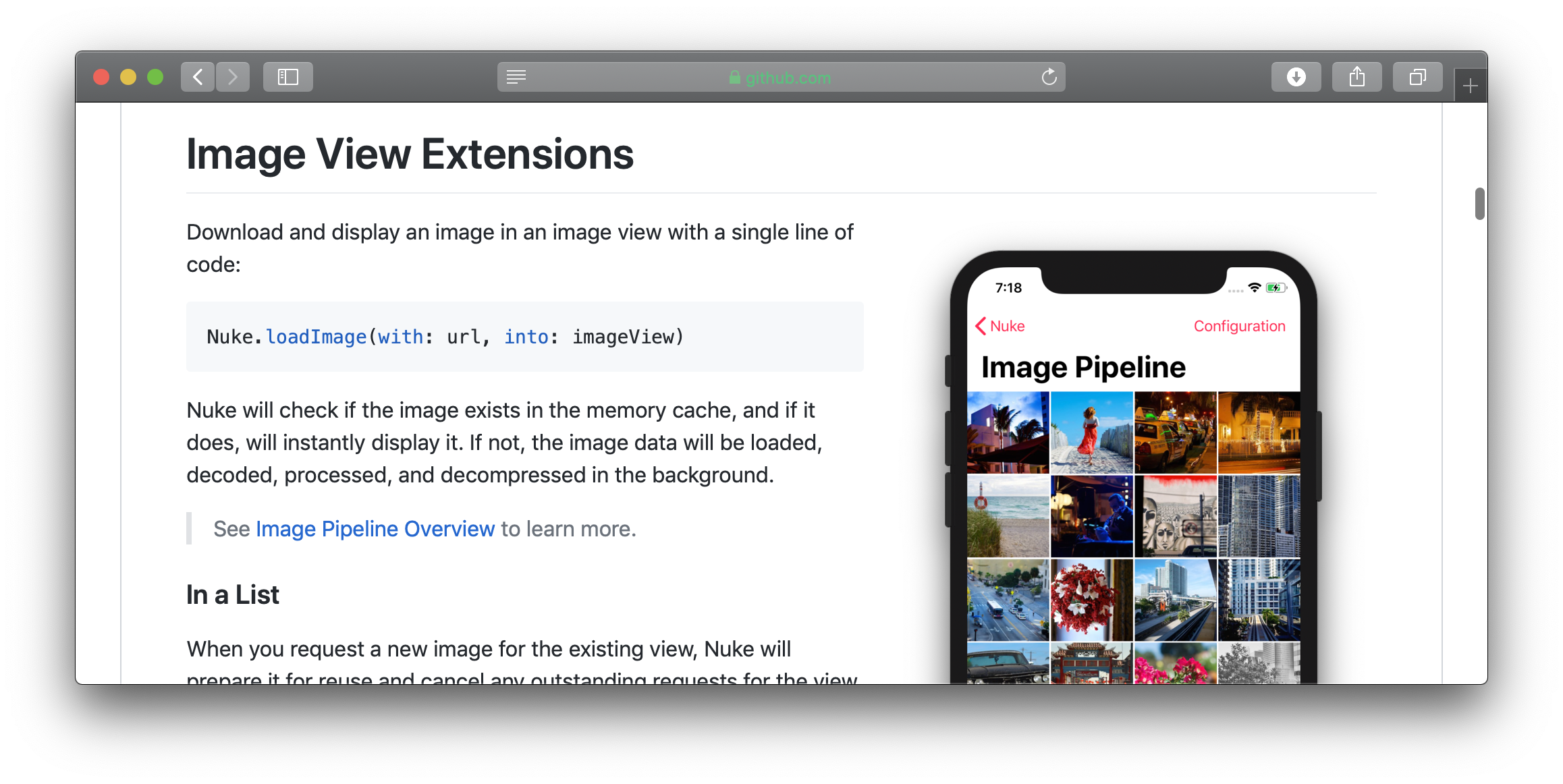
The screenshots come the the reworked demo project. It gained new demos including Image Processing demo and also a way to change ImagePipeline configuration in runtime.
- Add a cleaner way to set
ImageTaskpriority using a newpriorityproperty – #251 - [macOS] Implement image cost calculation for
ImageCache– #236 - [watchOS] Add
WKInterfaceImagesupport - Future-proof Objective-C
ImageDisplayingprotocol by addingnuke_prefixes to avoid clashes in Objective-C runtime - Add convenience
func decode(data: Data) -> Image?method with a defaultisFinalargument toImageDecodingprotocol – e3ca5e - Add convenience
func process(image: Image) -> Image?method toImageProcessingprotocol DataCachewill now automatically re-create its root directory if it was deleted underneath it- Add public
flushmethod toDataCache
May 1, 2019
- Fix #226
ImageTask.setPriority(_:)sometimes crashes
Apr 24, 2019
- Fix Thread Sanitizer warnings. The issue was related to
unfair_lockusage which was introduced as a replacement forOSAtomicfunctions in Nuke 7.6. In order to fix the issue,unfair_lockwas replaced with simpleNSLock. The performance hit is pretty insignificant and definitely isn't worth introducing this additional level of complexity.
Apr 13, 2019
- Fix SwiftPM 5.0 support by adding explicit platform version requirements – Vadim Shpakovski in #220
- Update Nuke 7 Migration Guide
Apr 7, 2019
- Add Swift 5.0 support – Daniel Storm in #217
- Add SwiftPM 5.0 support – Vadim Shpakovski in #219
- Remove Swift 4.0 and Swift 4.1 support
- Remove iOS 9, tvOS 9, watchOS 2.0, macOS 10.10 and macOS 10.11 support
- Add a single
Nuketarget which can build the framework for any platform - Replace deprecated
OSAtomicfunctions withunfair_lock, there are no performance regressions
Dec 26, 2018
- [macOS] Fix
Nuke.loadImageimage is not displayed when.fadeIntransition is used – #206 - Add
.alwaysTransitionflag toImageLoadingOptions– @gabzsa in #201
Nov 8, 2018
- Update Swift version in pbxproj to Swift 4.2, #199
- Update demo to Swift 4.2
Oct 21, 2018
- #193 Add an option to
ImageDecompressorto allow images to upscale, thanks to @drkibitz - #197 Add a convenience initializer to
ImageRequestwhich takes an image processor (ImageProcessing) as a parameter, thanks to @drkibitz
- Add a guarantee that if you cancel
ImageTaskon the main thread, you won't receive any more callbacks (progress, completion) - Improve internal
Operationperformance, images are loading up to 5% faster
Nuke 7 had a lot of API changes, to make the migration easier it shipped with Deprecated.swift file (536 line of code) which enabled Nuke 7 to be almost 100% source-compatible with Nuke 6. It's been 6 months since Nuke 7 release, so now it's finally a good time to remove all of this code.
Oct 1, 2018
- #174 Fix an issue with an
ImageViewreuse logic where in rare cases a wrong image would be displayed, thanks to @michaelnisi
Sep 25, 2018
- Disable automatic
stopPreheatingwhich was causing some issues
Sep 22, 2018
- Add an
ImagePreheater.Destinationoption toImagePreheater. The default option is.memoryCachewhich works exactly the wayImagePreheaterused to work before. The more interesting option is.diskCache. The preheater with.diskCachedestination will skip image data decoding entirely to reduce CPU and memory usage. It will still load the image data and store it in disk caches to be used later. - Add convenience
func startPreheating(with urls: [URL])function which creates requests with.lowrequests for you. ImagePreheaternow automatically cancels all of the managed outstanding requests on deinit.- Add
UICollectionViewDataSourcePrefetchingdemo on iOS 10+. Nuke still supports iOS 9 so Preheat is also still around.
- #187 Fix an issue with progress handler reporting incorrect progress for resumed (206 Partial Content) downloads
- Remove
enableExperimentalAggressiveDiskCachingfunction fromImagePipeline.Configuration, please useDataCachedirectly instead - Update Performance Guide
Jul 29, 2018
- #178 Fix TSan warning being triggered by performance optimization in
ImageTask.cancel()(false positive) - Fix an issue where a request (
ImageRequest) with a default processor and a request with the same processor but set manually would have different cache keys
Jul 20, 2018
ImagePipelinenow updates the priority of shared operations when the registered tasks get canceled (was previously only reacting to added tasks)- Fix an issue where
didFinishCollectingMetricsclosure wasn't called for the tasks completed with images found in memory cache and the tasks canceled before they got a chance to run. Now every created tasks gets a correspondingdidFinishCollectingMetricscall.
Jun 29, 2018
This release introduces new DataCache type and features some other improvements in custom data caching.
- Add new
DataCachetype - a cache backed by a local storage with an LRU cleanup policy. This type is a reworked version of the experimental data cache which was added in Nuke 7.0. It's now much simpler and also faster. It allows for reading and writing in parallel, it has a simple consistent API, and I hope it's going to be a please to use.
Migration note: The storage format - which is simply a bunch of files in a directory really - is backward compatible with the previous implementation. If you'd like the new cache to continue working with the same path, please create it with "com.github.kean.Nuke.DataCache" name and use the same filename generator that you were using before:
try? DataCache(name: "com.github.kean.Nuke.DataCache", filenameGenerator: filenameGenerator)
-
#160
DataCachenow has a defaultFilenameGeneratoron Swift 4.2 which usesSHA1hash function provided byCommonCrypto(CommonCryptois not available on the previous version of Swift). -
#171 Fix a regression introduced in version 7.1. where experimental
DataCachewould not perform LRU data sweeps. -
Update
DataCachingprotocol. To store data you now need to implement a synchronous methodfunc cachedData(for key: String) -> Data?. This change was necessary to make the data cache fit nicely inImagePipelineinfrastructure where each stage is managed by a separateOperationQueueand each operation respects the priority of the image requests associated with it. -
Add
dataCachingQueueparameter toImagePipeline.Configuration. The defaultmaxConcurrentOperationCountis2. -
Improve internal
Operationtype performance.
Jun 18, 2018
Nuke's roadmap is now publicly available. Please feel free to contribute!
This update addresses tech debt introduces in version 7.1 and 7.2. All of the changes made in these version which improved deduplication are prerequisites for implementing smart prefetching which be able to skip decoding, load to data cache only, etc.
- Simpler and more efficient model for managing decoding and processing operations (including progressive ones). All operations now take the request priority into account. The processing operations are now created per processor, not per image loading session which leads to better performance.
- When subscribing to existing session which already started processing, pipeline will try to find existing processing operation.
- Update
DFCacheintegration demo to use newDataCachingprotocol - Added "Default Image Pipeline" section and "Image Pipeline Overview" sections in README.
- Update "Third Party Libraries" guide to use new
DataCachingprotocol
Jun 12, 2018
- #163 Add
DataCachingprotocol which can be used to implement custom data cache. It's not documented yet, the documentation going to be updated in 7.2.1.
- Initial iOS 12.0, Swift 4.2 and Xcode 10 beta 1 support
- #167
ImagePipelinenow usesOperationQueueinstead ofDispatchQueuefor decoding images. The queue now respectsImageRequestpriority. If the task is cancelled the operation added to a queue is also cancelled. The queue can be configured viaImagePipeline.Configuration. - #167
ImagePipelinenow updates processing operations' priority.
- Fix a regression where in certain deduplication scenarios a wrong image would be saved in memory cache
- Fix MP4 demo project
- Improve test coverage, bring back
DataCache(internal) tests
May 27, 2018
- Improve deduplication. Now when creating two requests (at roughly the same time) for the same images but with two different processors, the original image is going to be downloaded once (used to be twice in the previous implementation) and then two separate processors are going to be applied (if the processors are the same, the processing will be performed once).
- Greatly improved test coverage.
- Fix an issue when setting custom
loadKeyfor the request, thehashValueof the default key was still used. - Fix warnings "Decoding failed with error code -1" when progressively decoding images. This was the result of
ImageDecodertrying to decode incomplete progressive scans. - Fix an issue where
ImageDecodercould produce a bit more progressive scans than necessary.
May 16, 2018
- Add a section in README about replacing GIFs with video formats (e.g.
MP4,WebM) - Add proof of concept in the demo project that demonstrates loading, caching and displaying short
mp4videos using Nuke
- #161 Fix the contentModes not set when initializing an ImageLoadingOptions object
May 10, 2018
Nuke 7 is the biggest release yet. It has a lot of massive new features, new performance improvements, and some API refinements. Check out new Nuke website to see quick videos showcasing some of the new features.
Nuke 7 is almost completely source-compatible with Nuke 6.
Add support for progressive JPEG (built-in) and WebP (build by the Ryo Kosuge). See README for more info. See demo project to see it in action.
Add new ImageProcessing protocol which now takes an extra ImageProcessingContext parameter. One of its properties is scanNumber which allows you to do things like apply blur to progressive image scans reducing blur radius with each new scan ("progressive blur").
If the data task is terminated (either because of a failure or a cancellation) and the image was partially loaded, the next load will resume where it was left off. In many use cases resumable downloads are a massive improvement to user experience, especially on the mobile internet.
Resumable downloads require the server support for HTTP Range Requests. Nuke supports both validators (ETag and Last-Modified).
The resumable downloads are enabled by default. The resumable data is automatically stored in efficient memory cache. This is a good default, but future versions might add more customization options.
Add a new set of powerful methods to load images into views. Here's one of those methods:
@discardableResult
public func loadImage(with request: ImageRequest,
                      options: ImageLoadingOptions = ImageLoadingOptions.shared,
                      into view: ImageDisplayingView,
                      progress: ImageTask.ProgressHandler? = nil,
                      completion: ImageTask.Completion? = nil) -> ImageTask?
You can now pass progress and completion closures as well as new ImageLoadingOptions struct which offers a range of options:
public struct ImageLoadingOptions {
    public static var shared = ImageLoadingOptions()
    public var placeholder: Image?
    public var transition: Transition?
    public var failureImage: Image?
    public var failureImageTransition: Transition?
    public var isPrepareForReuseEnabled = true
    public var pipeline: ImagePipeline?
    public var contentModes: ContentModes?

    /// Content modes to be used for each image type (placeholder, success, failure).
    public struct ContentModes {
        public var success: UIViewContentMode
        public var failure: UIViewContentMode
        public var placeholder: UIViewContentMode
    }

    /// An animated image transition.
    public struct Transition {
        public static func fadeIn(duration: TimeInterval, options: UIViewAnimationOptions = [.allowUserInteraction]) -> Transition
        public static func custom(_ closure: @escaping (ImageDisplayingView, Image) -> Void) -> Transition
    }
}
ImageView will now also automatically prepare itself for reuse (can be disabled via ImageLoadingOptions)
Instead of an ImageTarget protocol we now have a new simple ImageDisplaying protocol which relaxes the requirement what can be used as an image view (it's UIView & ImageDisplaying now). This achieves two things:
- You can now add support for more classes (e.g.
MKAnnotationViewby implementingImageDisplayingprotocol - You can override the
display(image:method inUIImageViewsubclasses (e.g.FLAnimatedImageView)
The previous Manager + Loading architecture (terrible naming, responsibilities are often confusing) was replaced with a new unified ImagePipeline class. ImagePipeline was built from the ground-up to support all of the powerful new features in Nuke 7 (progressive decoding, resumable downloads, performance metrics, etc).
There is also a new ImageTask class which feels the gap where user or pipeline needed to communicate between each other after the request was started. ImagePipeline and ImageTask offer a bunch of new features:
- To cancel the request you now simply need to call
cancel()on the task (ImageTask) which is a bit more user-friendly than previousCancellationTokenSourceinfrastructure. ImageTaskoffers a new way to track progress (in addition to closures) - nativeFoundation.Progress(created lazily)ImageTaskcan be used to dynamically change the priority of the executing tasks (e.g. the user opens a new screen, you lower the priority of outstanding tasks)- In
ImagePipeline.Configurationyou can now provide custom queues (OperationQueue) for data loading, decoding and processing (separate queue for each stage). - You can set a custom shared
ImagePipeline.
Add built-in support for animated images (everything expect the actual rendering). To enable rendering you're still going to need a third-party library (see FLAnimatedImage and Gifu plugins). The changes made in Nuke dramatically simplified those plugins making both of them essentially obsolete - they both now have 10-30 lines of code, you can just copy this code into your project.
- Add new
ImageCachingprotocol for memory cache which now works with a newImageResponeclass. You can do much more intelligent things in your cache implementations now (e.g. make decisions on when to evict image based on HTTP headers). - Improve cache write/hit/miss performance by 30% by getting rid of AnyHashable overhead.
ImageRequestcacheKeyandloadKeyare now optional. If you use them, Nuke is going to use them instead of built-in internalImageRequest.CacheKeyandImageRequest.LoadKey. - Add
TTLsupport inImageCache
Add a completely new custom LRU disk cache which can be used for fast and reliable aggressive data caching (ignores HTTP cache control). The new cache lookups are up to 2x faster than URLCache lookups. You can enable it using pipeline's configuration:
When enabling disk cache you must provide a keyEncoder function which takes image request's url as a parameter and produces a key which can be used as a valid filename. The demo project uses sha1 to generate those keys.
$0.enableExperimentalAggressiveDiskCaching(keyEncoder: {
    guard let data = $0.cString(using: .utf8) else { return nil }
    return _nuke_sha1(data, UInt32(data.count))
})
The public API for disk cache and the API for using custom disk caches is going to be available in the future versions.
Existing API already allows you to use custom disk cache by implementing
DataLoadingprotocol, but this is not the most straightforward option.
When optimizing performance, it's important to measure. Nuke collects detailed performance metrics during the execution of each image task:
ImagePipeline.shared.didFinishCollectingMetrics = { task, metrics in
    print(metrics)
}
(lldb) po metrics

Task Information {
    Task ID - 1
    Duration - 22:35:16.123 – 22:35:16.475 (0.352s)
    Was Cancelled - false
    Is Memory Cache Hit - false
    Was Subscribed To Existing Session - false
}
Session Information {
    Session ID - 1
    Total Duration - 0.351s
    Was Cancelled - false
}
Timeline {
    22:35:16.124 – 22:35:16.475 (0.351s) - Total
    ------------------------------------
    nil – nil (nil)                      - Check Disk Cache
    22:35:16.131 – 22:35:16.410 (0.278s) - Load Data
    22:35:16.410 – 22:35:16.468 (0.057s) - Decode
    22:35:16.469 – 22:35:16.474 (0.005s) - Process
}
Resumable Data {
    Was Resumed - nil
    Resumable Data Count - nil
    Server Confirmed Resume - nil
}
ImagePreheaternow checksImageCachesynchronously before creating tasks which makes it slightly more efficient.RateLimiternow uses the same sync queue as theImagePipelinereducing a number of dispatched blocks- Smarter
RateLimiterwhich no longer attempt to execute pending tasks when the bucket isn't full resulting in idle dispatching of blocks. I've used a CountedSet to see how well it works in practice and it's perfect. Nice small win. - Add
ImageDecoderRegistryto configure decoders globally. - Add
ImageDecodingContextto provide as much information as needed to select a decoder. ImageTask.Completionnow containsImageResponse(image + URLResponse) instead of just plain image.
CancellationToken,CancellationTokenSource- continued to be used internally, If you'd like to continue using cancellation tokens please consider copying this code into your project.DataDecoding,DataDecoder,DataDecoderComposition- replaced by a new image decoding infrastructure (ImageDecoding,ImageDecoder,ImageDecodingRegistryetc).Requestrenamed toImageRequest.- Deprecate
Resulttype. It was only used in a single completion handler so it didn't really justify its existence. More importantly, I wasn't comfortable providing a publicResulttype as part of the framework.
Apr 9, 2018
- Lower macOS deployment target to 10.10. #156.
- Improve README: add detailed Image Pipeline section, Performance section, rewrite Usage guide
Feb 24, 2018
- Add
Request.Prioritywith 5 available options ranging from.veryLowto.veryHigh. One of the use cases ofRequest.Priorityis to lower the priority of preheating requests. In case requests get deduplicated the task's priority is set to the highest priority of registered requests and gets updated when requests are added or removed from the task.
- Fix warnings on Xcode 9.3 beta 3
Loaderimplementation changed a bit, it is less clever now and is able to accommodate new features like request priorities- Minor changes in style guide to make codebase more readable
- Switch to native
NSLock, there doesn't seem to be any performance wins anymore when usingpthread_mutexdirectly
- #146 fix disk cache path for macOS, thanks to @willdahlberg
Dec 23, 2017
About 8 months ago I finally started using Nuke in production. The project has matured from a playground for experimenting with Swift features to something that I rely on in my day's job.
There are three main areas of improvements in Nuke 6:
- Performance. Nuke 6 is fast! The primary
loadImage(with:into:)method is now 1.5x faster thanks to performance improvements ofCancellationToken,Manager,RequestandCachetypes. And it's not just main thread performance, many of the background operations were also optimized. - API refinements. Some common operations that were surprisingly hard to do are not super easy. And there are no more implementation details leaking into a public API (e.g. classes like
Deduplicator). - Fixes some inconveniences like Thread Sanitizer warnings (false positives!). Improved compile time. Better documentation.
- Implements progress reporting kean#81
- Scaling images is now super easy with new convenience
Requestinitialisers (Request.init(url:targetSize:contentMode:andRequest.init(urlRequest:targetSize:contentMode:) - Add a way to add anonymous image processors to the request (
Request.process(key:closure:)andRequest.processed(key:closure:)) - Add
Loader.Optionswhich can be used to configureLoader(e.g. change maximum number of concurrent requests, disable deduplication or rate limiter, etc).
- Improve performance of
CancellationTokenSource,Loader,TaskQueue - Improve
Managerperformance by reusing contexts objects between requests - Improve
Cacheby ~30% for most operations (hits, misses, writes) Requestnow stores all of the parameters in the underlying reference typed container (it used to store just reference typed ones). TheRequeststruct now only has a single property with a reference to an underlying container.- Parallelize image processing for up to 2x performance boost in certain scenarios. Might increase memory usage. The default maximum number of concurrent tasks is 2 and can be configured using
Loader.Options. Loadernow always call completion on the main thread.- Move
URLResponsevalidation fromDataDecodertoDataLoader - Make use of some Swift 4 feature like nested types inside generic types.
- Improve compile time.
- Wrap
Loaderprocessing and decoding tasks intoautoreleasepoolwhich reduced memory footprint.
- Get rid of Thread Sanitizer warnings in
CancellationTokenSource(false positive) - Replace
Foundation.OperationQueue& customFoundation.Operationsubclass with a newQueuetype. It's simpler, faster, and gets rid of pesky Thread Sanitizer warnings kean#141
- Remove global
loadImage(...)functions kean#142 - Remove static
Request.loadKey(for:)andRequest.cacheKey(for:)functions. The keys are now simply returned inRequest'sloadKeyandcacheKeyproperties which are also no longer optional now. - Remove
Deduplicatorclass, make this functionality part ofLoader. This has a number of benefits: reduced API surface, improves performance by reducing the number of queue switching, enables new features like progress reporting. - Remove
Scheduler,AsyncScheduler,Loader.Schedulers,DispatchQueueScheduler,OperationQueueScheduler. This whole infrastructure was way too excessive. - Make
RateLimiterprivate. DataLoadernow works withURLRequest, notRequest
Sep 1, 2017
Add support for both Swift 3.2 and 4.0.
Jun 11, 2017
- Fix Swift 4 warnings
- Add
DataDecoder.sharedUrlCacheto easy access for sharedURLCacheobject - Add references to RxNuke
- Minor improvements under the hood
Feb 23, 2017
- De facto
Managerhas already implementedLoadingprotocol in Nuke 5 (you could use it to load images directly w/o targets). Now it also conforms toLoadingprotocols which gives access to some convenience functions available inLoadingextensions. - Add
static func targetSize(for view: UIView) -> CGSizemethod toDecompressor - Simpler, faster
Preheater - Improved documentation
Feb 2, 2017
- #116
Managercan now be used to load images w/o specifying a target Preheateris now initialized withManagerinstead of object conforming toLoadingprotocol
Feb 1, 2017
Nuke 5 is a relatively small release which removes some of the complexity from the framework.
One of the major changes is the removal of promisified API as well as Promise itself. Promises were briefly added in Nuke 4 as an effort to simplify async code. The major downsides of promises are compelex memory management, extra complexity for users unfamiliar with promises, complicated debugging, performance penalties. Ultimately I decided that promises were adding more problems that they were solving.
- Remove promisified API, use simple closures instead. For example,
Loadingprotocol's methodfunc loadImage(with request: Request, token: CancellationToken?) -> Promise<Image>was replaced with a method with a completion closurefunc loadImage(with request: Request, token: CancellationToken?, completion: @escaping (Result<Image>) -> Void). The same applies toDataLoadingprotocol. - Remove
Promiseclass - Remove
PromiseResolution<T>enum - Remove
Responsetypealias - Add
Result<T>enum which is now used as a replacement forPromiseResolution<T>(for instance, inTargetprotocol, etc)
- Remove memory cache from
Loader Managernow not only reads, but also writes toCacheManagernow has new methods to load images w/o target (Nuke 5.0.1)
The reason behind this change is to reduce confusion about Cache usage. In previous versions the user had to pass Cache instance to both Loader (which was both reading and writing to cache asynchronously), and to Manager (which was just reading from the cache synchronously). In a new setup it's clear who's responsible for managing memory cache.
Those two types were included in Nuke to make integrating third party caching libraries a bit easier. However, they were actually not that useful. Instead of using those types you could've just wrapped DataLoader yourself with a comparable amount of code and get much more control. For more info see Third Party Libraries: Using Other Caching Libraries.
Loaderconstructor now provides a default value forDataDecodingobjectDataLoadingprotocol now works with aNuke.Requestand notURLRequestin case some extra info fromURLRequestis required- Reduce default
URLCachedisk capacity from 200 MB to 150 MB - Reduce default
maxConcurrentOperationCountofDataLoaderfrom 8 to 6 - Shared objects (like
Manager.shared) are now constants. Preheateris now initialized withManagerinstead ofLoadingobject- Add new Third Party Libraries guide.
- Improved documentation
Oct 22, 2016
Bunch of improvements in built-in Promise:
Promisenow also uses newLock- faster creation, faster locking- Add convenience
isPending,resolution,valueanderrorproperties - Simpler implementation migrated from Pill.Promise*
*Nuke.Promise is a simplified variant of Pill.Promise (doesn't allow throws, adds completion, etc). The Promise is built into Nuke to avoid fetching external dependencies.
Oct 4, 2016
- Fix deadlock in
Cache- small typo, much embarrassment 😄 (kean/Nuke-Alamofire-Plugin#8)
Oct 4, 2016
Nuke 4.1 is all about performance. Here are some notable performance improvements:
loadImage(with:into:)method with a default config is 6.3x fasterCacheoperations (write/hit/miss) are from 3.1x to 4.5x faster
Nuke 4.0 focused on stability first, naturally there were some performance regressions. With the version 4.1 Nuke is again the fastest framework out there. The performance is ensured by a new set of performance tests.

If you're interested in the types of optimizations that were made check out recent commits. There is a lot of awesome stuff there!
Nuke 4.1 also includes a new Performance Guide and a collection of Tips and Tricks.
- Add convenience method
loadImage(with url: URL, into target: AnyObject, handler: @escaping Handler)(more useful than anticipated). - #88 Add convenience
cancelRequest(for:)function - Use
@discardableResultinPromisewhere it makes sense - Simplified
Loaderimplementation Cachenodes are no longer deallocated recursively onremoveAll()anddeinit(I was hitting stack limit in benchmarks, it's impossible in real-world use).- Fix: All
Cachepublictrim()methods are now thread-safe too.
Sep 19, 2016
Nuke 4 has fully adopted the new Swift 3 changes and conventions, including the new API Design Guidelines.
Nuke 3 was already a slim framework. Nuke 4 takes it a step further by simplifying almost all of its components.
Here's a few design principles adopted in Nuke 4:
- Protocol-Oriented Programming. Nuke 3 promised a lot of customization by providing a set of protocols for loading, caching, transforming images, etc. However, those protocols were vaguely defined and hard to implement in practice. Protocols in Nuke 4 are simple and precise, often consisting of a single method.
- Single Responsibility Principle. For example, instead of implementing preheating and deduplicating of equivalent requests in a single vague
ImageManagerclass, those features were moved to separate classes (Preheater,Deduplicator). This makes core classes much easier to reason about. - Principle of Least Astonishment. Nuke 3 had a several excessive protocols, classes and methods which are all gone now (
ImageTask,ImageManagerConfigurationjust to name a few). Those features are much easier to use now. - Simpler Async. Image loading involves a lot of asynchronous code, managing it was a chore. Nuke 4 adopts two design patterns (Promise and CancellationToken) that solve most of those problems.
The adoption of those design principles resulted in a simpler, more testable, and more concise code base (which is now under 900 slocs, compared to AlamofireImage's 1426, and Kingfisher's whopping 2357).
I hope that Nuke 4 is going to be a pleasure to use. Thanks for your interest 😄
You can learn more about Nuke 4 in an in-depth Nuke 4 Migration Guide.
Nuke 4 features a new custom LRU memory cache which replaced NSCache. The primary reason behind this change was the fact that NSCache is not LRU]. The new Nuke.Cache has some other benefits like better performance, and more control which would enable some new advanced features in future versions.
There is a known problem with URLSession that it gets trashed pretty easily when you resume and cancel URLSessionTasks at a very high rate (say, scrolling a large collection view with images). Some frameworks combat this problem by simply never cancelling URLSessionTasks which are already in .running state. This is not an ideal solution, because it forces users to wait for cancelled requests for images which might never appear on the display.
Nuke has a better, classic solution for this problem - it introduces a new RateLimiter class which limits the rate at which URLSessionTasks are created. RateLimiter uses a token bucket algorithm. The implementation supports quick bursts of requests which can be executed without any delays when "the bucket is full". This is important to prevent the rate limiter from affecting "normal" requests flow. RateLimiter is enabled by default.
You can see RateLimiter in action in a new Rate Limiter Demo added in the sample project.
Make sure to check out new Toucan plugin which provides a simple API for processing images. It supports resizing, cropping, rounded rect masking and more.
Sep 8, 2016
- Swift 2.3 support
- Preheating is now thread-safe #75
Jul 17, 2016
#72 Fix synchronization issue in ImageManager loader:task:didFinishWithImage... method
Jul 14, 2016
- #71 ImageViewLoadingController now cancels tasks synchronously, thanks to @adomanico
Jun 7, 2016
- Demo project update to support CocoaPods 1.0
- #69 Bitcode support for Carthage builds, thanks to @vincentsaluzzo
Apr 15, 2016
- #64 Fix a performance regression: images are now decoded once per DataTask like they used to
- #65 Fix an issue custom on-disk cache (
ImageDiskCaching) was calledsetData(_:response:forTask:)method when the error wasn't nil - Add notifications for NSURLSessionTask state changes to enable activity indicators (based on kean/Nuke-Alamofire-Plugin#4)
Mar 26, 2016
- Update for Swift 2.2
- Move
ImagePreheatControllerto a standalone package Preheat - Remove deprecated
suspendmethod fromImageTask - Remove
ImageFilterGaussianBlurand Core Image helper functions which are now part of Core Image Integration Guide - Cleanup project structure (as expected by SPM)
Managerconstructor now has a default value for configurationnk_setImageWith(URL:)method no longer resizes images by default, because resizing is not effective in most cases- Remove
nk_setImageWith(request:options:placeholder:)method, it's trivial ImageLoadingViewdefault implementation no longer implements "Cross Dissolve" animations, useImageViewLoadingOptionsinstead (seeanimationsorhandlerproperty)- Remove
ImageViewDefaultAnimationDuration, useImageViewLoadingOptionsinstead (seeanimationsproperty) ImageDisplayingViewprotocol now has a singlenk_displayImage(_)method instead of ank_imageproperty- Remove
nk_targetSizeproperty fromUI(NS)Viewextension
Mar 19, 2016
- #60 Add custom on-disk caching support (see
ImageDiskCachingprotocol) - Reduce dynamic dispatch
Mar 11, 2016
ImageTasksuspendmethod is deprecated, implementation does nothingImageLoadernow limits a number of concurrentNSURLSessionTasks- Add
maxConcurrentSessionTaskCountproperty toImageLoaderConfiguration - Add
taskReusingEnabledproperty toImageLoaderConfiguration - Add Swift Package Manager support
- Update documentation
Feb 27, 2016
- #57
ImageDecompressornow usesCGImageAlphaInfo.NoneSkipLastfor opaque images - Add
ImageProcessorWithClosurethat can be used for creating anonymous image filters ImageLoaderensures thread safety of image initializers by running decoders on aNSOperationQueuewithmaxConcurrentOperationCount=1. However,ImageDecoderclass is now also made thread safe.
Feb 10, 2016
- #53 ImageRequest no longer uses NSURLSessionTaskPriorityDefault, which requires CFNetwork that doesn't get added as a dependency automatically
Feb 6, 2016
Nuke now has an official website!
- #48 Update according to Swift API Design Guidelines. All APIs now just feel right.
- Add
UIImageextension with helper functions forCore Image:nk_filter(_:), etc. - Add
ImageFilterGaussianBluras an example of a filter on top ofCore Imageframework - Add
ImageRequestMemoryCachePolicyenum that specifies the wayManagerinteracts with a memory cache;NSURLRequestCachePolicyno longer affects memory cache - #17 Add
prioritytoImageRequest - Add
removeResponseForKey()method toImageMemoryCachingprotocol and the corresponding method toManager - Implement congestion control for
ImageLoaderthat preventsNSURLSessiontrashing - Simplify
ImageLoaderDelegateby combining methods that were customizing processing in a single high-level method:imageLoader(_:processorFor:image:). Users now have more control over processing - Add
NSURLResponse?parameter todecodemethod fromImageDecodingprotocol DataLoadingprotocol no longer hasisLoadEquivalentRequest(_:toRequest)andisCacheEquivalentRequest(_:toRequest). Those methods are now part ofImageLoaderDelegateand they have default implementationImageResponseInfois now a struct- Improved error reporting (codes are now stored in enum, more codes were added, error is now created with a failure reason)
- Move
nk_ImageTask(_:didFinishWithResponse:options)method toImageLoadingViewprotocol, that's really where it belongs to - Add
handlerproperty toImageViewLoadingOptionsthat allows you to completely override display/animate logic inImageLoadingView - Remove
nk_prepareForReusemethod fromImageLoadingViewextensions (useless) - Remove
placeholderfromImageViewLoadingOptions, move it to a separate argument which is only available onImageDisplayingViews - Add
animated,userInfotoImageViewLoadingOptions ImageViewLoadingOptionsis now nonull everywhere- Add
setImageWith(task:options:)method toImageViewLoadingController
- If you add a completion handler for completed task, the response is now marked as
isFastResponse = true - Fix an issue that allowed incomplete image downloads to finish successfully when using built-in networking
equivalentProcessors(rhs:lhs:)function is now private (and it also is renamed)- Remove public
isLoadEquivalentToRequest(_:)andisCacheEquivalentToRequest(_:)methods fromImageRequestextension - Add
ImageTaskProgressstruct that represents load progress, movefractionCompletedproperty fromImageTasktoImageTaskProgress - Remove public helper function
allowsCachingfromImageRequestextension - Remove deprecated
XCPSetExecutionShouldContinueIndefinitelyfrom playground
Jan 9, 2016
- #46 Add option to disable memory cache storage, thanks to @RuiAAPeres
Dec 7, 2015
- Add Core Image Integration Guide
- Fill most of the blanks in the documentation
- #47 Fix target size rounding errors in image downscaling (Pyry Jahkola @pyrtsa)
- Add
imageScaleproperty toImageDecoderclass that returns scale to be used when creatingUIImage(iOS, tvOS, watchOS only) - Wrap each iteration in
ProcessorCompositionin anautoreleasepool
Nov 15, 2015
- #20 Add preheating for UITableView (see ImagePreheatControllerForTableView class)
- #41 Enhanced tvOS support thanks to @joergbirkhold
- #39 UIImageView: ImageLoadingView extension no available on tvOS
- Add factory method for creating session tasks in DataLoader
- Improved documentation
Oct 30, 2015
- #35 ImageDecompressor now uses
32 bpp, 8 bpc, CGImageAlphaInfo.PremultipliedLastpixel format which adds support for images in an obscure formats, including 16 bpc images. - Improve docs
Oct 23, 2015
- #25 Add tvOS support
- #33 Add app extensions support for OSX target (other targets were already supported)
Oct 18, 2015
- #30 Add new protocols and extensions to make it easy to add full featured image loading capabilities to custom UI components. Here's how it works:
extension MKAnnotationView: ImageDisplayingView, ImageLoadingView {
    // That's it, you get default implementation of all the methods in ImageLoadingView protocol
    public var nk_image: UIImage? {
        get { return self.image }
        set { self.image = newValue }
    }
}- #30 Add UIImageView extension instead of custom UIImageView subclass
- Back to the Mac! All new protocol and extensions for UI components (#30) are also available on a Mac, including new NSImageView extension.
- #26 Add
getImageTaskWithCompletion(_:)method to Manager - Add essential documentation
- Add handy extensions to ImageResponse
Oct 13, 2015
Nuke is now available almost everywhere. Also got rid of CocoaPods subspecs.
- CocoaPods, Nuke, watchOS
- CocoaPods, Nuke, OSX
- CocoaPods, NukeAlamofirePlugin, watchOS
- CocoaPods, NukeAlamofirePlugin, OSX
- Carthage, Nuke, watchOS
- Carthage, Nuke, OSX
- Carthage, NukeAlamofirePlugin, iOS
- Carthage, NukeAlamofirePlugin, watchOS
- Carthage, NukeAlamofirePlugin, OSX
- Remove Nuke/Alamofire subspec, move sources to separate repo Nuke-Alamofire-Plugin
- Remove Nuke/GIF subspec, move sources to separate repo Nuke-AnimatedImage-Plugin
- #9, #19 ImageTask now has a closure for progress instead of NSProgress
- Rename ImageLoadingDelegate to ImageLoadingManager
- Add ImageLoaderDelegate with factory method to construct image decompressor, and
shouldProcessImage(_:)method - Make ImageRequest extensions public
- Make ImageTask constructor public; Annotate abstract methods.
Oct 9, 2015
This is a pre-1.0 version, first major release which is going to be available soon.
- #18 ImageTask can now be suspended (see
suspend()method). AddsuspendLoadingForImageTask(_:)method toImageLoadingprotocol - #24 ImageRequest can now be initialized with NSURLRequest. ImageDataLoading
imageDataTaskWithURL(_:progressHandler:completionHandler:)method changed toimageDataTaskWithRequest(_:progressHandler:completionHandler:). First parameter is ImageRequest, return value change from NSURLSessionDataTask to NSURLSessionTask. - ImageLoader no longer limits number of concurrent NSURLSessionTasks (which had several drawbacks)
- Add base ImagePreheatingController class
- Multiple preheating improvements: significantly simplified implementation; visible index paths are now subtracted from preheat window; performance improvements.
- BUGFIX: When subscribing to an existing NSURLSessionTask user was receiving progress callback with invalid totalUnitCount
- Add public
equivalentProcessors(lhs:rhs:) -> Boolfunction that works on optional processors - Add essential documentation
Oct 4, 2015
- Make ImageLoading protocol and ImageLoader class public
- Make ImageManager
cachedResponseForRequest(_:)andstoreResponse(_:forRequest:)methods public - Make ImageRequestKey class and ImageRequestKeyOwner protocol public
- Remove unused ImageManaging and ImagePreheating protocols
- #13 BUGFIX: Crash on 32-bit iOS simulator on Mac with 16Gb+ of RAM (@RuiAAPeres)
- BUGFIX: Processing operation might not get cancelled in certain situations
- ImageProcessing protocol now provides default implementation for
isEquivalentToProcessor(_:)method including separate implementation for processors that also conform to Equatable protocol. - Add identifier: Int property to ImageTask
- ImageRequestKey now relies on Hashable and Equatable implementation provided by NSObject
- ImageMemoryCaching protocol now works with ImageRequestKey class
- Adopt multiple Swift best practices (tons of them in fact)
- ImageManager is now fully responsible for memory caching and preheating, doesn't delegate any work to ImageLoader (simplifies its implementation and limits dependencies)
- Remove ImageRequestKeyType enum
- Rename ImageManagerLoader to ImageLoader
- Simply ImageManagerLoader (now ImageLoader) implementation
- Add multiple unit tests
Sep 22, 2015
#10 Fix Carthage build
Sep 21, 2015
- ImageTask now acts like a promise
- ImageManager.shared is now a property instead of a method
- ImageTask progress is now created lazily
- Add maxConcurrentTaskCount to ImageManagerConfiguration
- Move taskWithURL method to ImageManaging extension
- Add ImagePreheating protocol
- Multiple improvements across the board
Sep 20, 2015
- Add limited Carthage support (doesn't feature FLAnimatedImage and Alamofire integration yet, you'll have to stick with CocoaPods for that)
- ImageTask resume() and cancel() methods now return Self
- ImageTask completion property is now public
- Minor implementation improvements
Sep 19, 2015
- Add ImageCollectionViewPreheatingController (yep)
- Add Image Preheating Guide
- Add preheating demo
Sep 18, 2015
- Optional Alamofire integration via 'Nuke/Alamofire' subspec
- Optional FLAnimatedImage integration via 'Nuke/GIF' subspec
- More concise API
- Add image filters to ImageRequest
- Add ImageManaging protocol
- Add ImageDecoderComposition
- Add ImageProcessorComposition
- watchOS
- Add convenience functions that forward calls to the shared manager
- Use ErrorType
- Add removeAllCachedImages method
- ImageRequest userInfo is now Any? so that you can pass anything including closures
- ImageResponseInfo now has userInfo: Any? property
- ImageResponseInfo is now a struct
- CachedImageResponse renamed to ImageCachedResponse; userInfo is now Any?
- Multiple improvements across the board
Mar 11, 2015
- Initial commit