An enterprise-grade, concurrency-resilient ticketing platform engineered to handle massive traffic spikes without overselling, featuring automated checkout holds, real-time cryptographic payment verification, and digital ticket delivery.
Imagine a popular concert (like Taylor Swift's Eras Tour) or a limited stadium sports match.
You have 100 seats available in an arena.
10,000 users click "Buy" at the exact same second during a flash sale.
Without robust synchronization, a standard database architecture will accidentally sell 120+ tickets because dozens of concurrent threads read a seat's status as "available" before any transaction finishes updating it to "sold". Furthermore, abandoned checkout carts freeze seats, causing revenue loss for organizers.
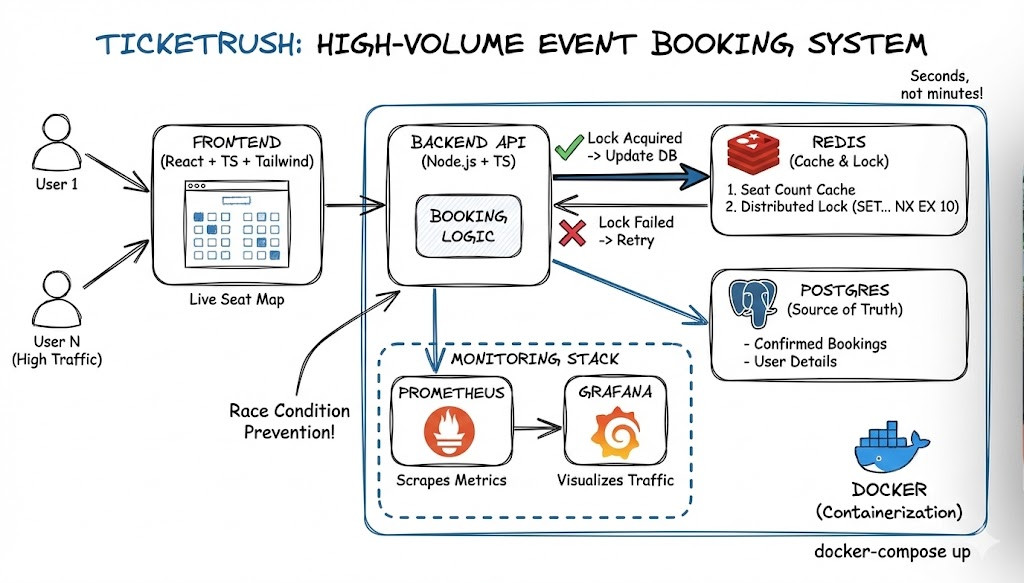
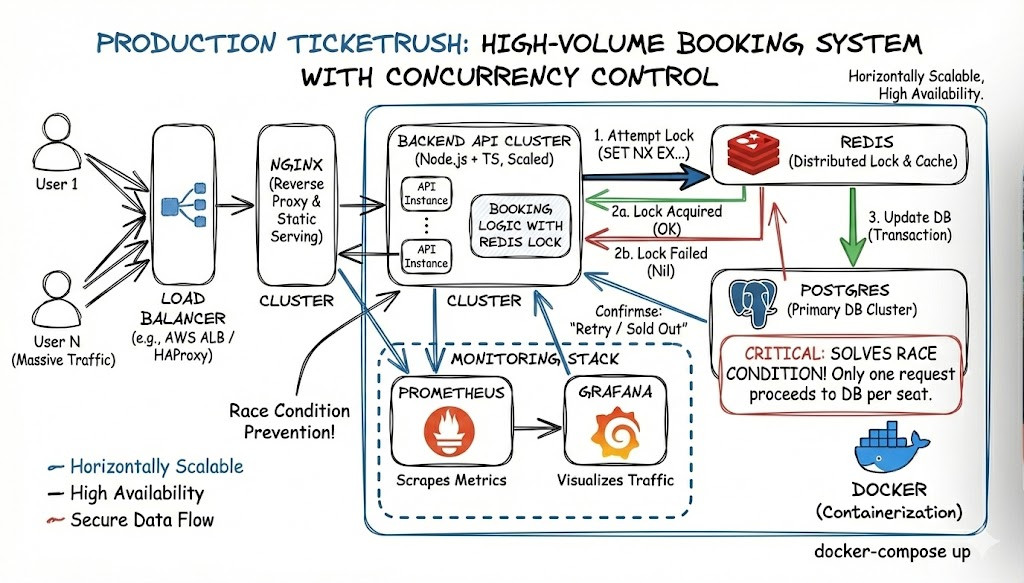
We solve high-concurrency ticket distribution using a 3-Layer Defense-In-Depth design:
- Atomic Distributed Locks (Redis): Millisecond-tier pre-flight locking (
SET NX EX) prevents simultaneous database processing. - Serializable PostgreSQL Transactions: Database-level
Serializabletransaction isolation forbids dirty reads and write skew. - Composite Unique Constraints: Database-level unique indexes guarantee zero duplicate seats across
(seatId, eventId, date, time)even under network retries.
| Component | Technologies Used | Key Responsibilities |
|---|---|---|
| Frontend UI | React 18, TypeScript, Vite, Tailwind CSS, Lucide Icons | Responsive live seating maps, dynamic tier pricing, checkout timer overlays, PDF ticket generation via html2canvas & jsPDF. |
| Backend API | Node.js, Express, TypeScript, Prisma ORM | Concurrency routing, atomic locking orchestration, cryptographic payment verification, transactional integrity. |
| Database | PostgreSQL | Source of Truth for venue inventory, composite constraint enforcement, and ACID-compliant transactional logs. |
| In-Memory Cache | Redis Cloud (ioredis) |
High-speed distributed mutex locks and 5-Minute TTL checkout reservations (EX 300). |
| Payment Gateway | Razorpay SDK & Web Checkout Overlay | Live order generation, INR currency conversion, HMAC-SHA256 signature verification, and automated clash refunding. |
| Email Service | Resend API (resend) |
Automated asynchronous delivery of responsive HTML ticket confirmations and booking receipts. |
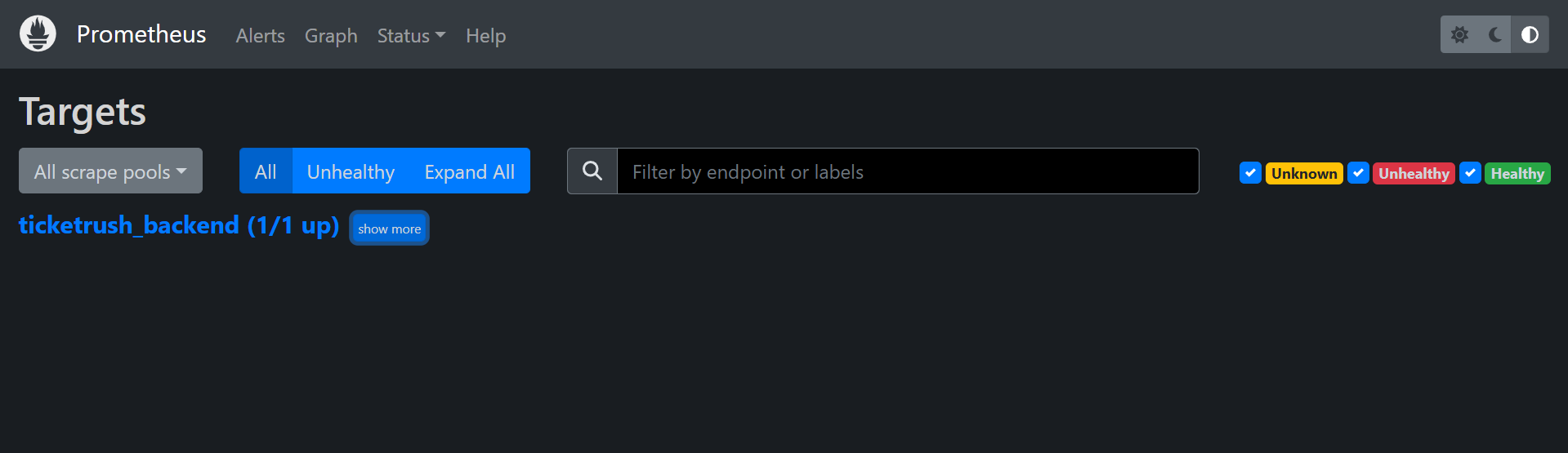
| Observability | Prometheus & Grafana, Docker Compose | Real-time telemetry, scraping query durations, concurrency metrics, and visualizing flash-sale load curves. |
We use docker-compose.yml to spin up the entire infrastructure:
postgres(Database)redis(Cache)prometheus(Metrics)grafana(Visualization)
Endpoint: POST /book-seat
- Select seat from DB.
- Check if
is_bookedis false. - Update
is_bookedto true.
- Result: Under load testing (e.g., 100 concurrent requests), this oversells the seat due to race conditions.
- Redis Lock: When a user clicks buy, acquire a lock in Redis:
SET seat_10_lock true NX EX 10(Set if Not Exists, expire in 10s). - Check:
- If lock fails: Return "Seat is currently being booked by someone else."
- If lock succeeds: Proceed to update Postgres.
- Release: Delete the lock in Redis.
- Result: Zero overselling, guaranteed consistency.
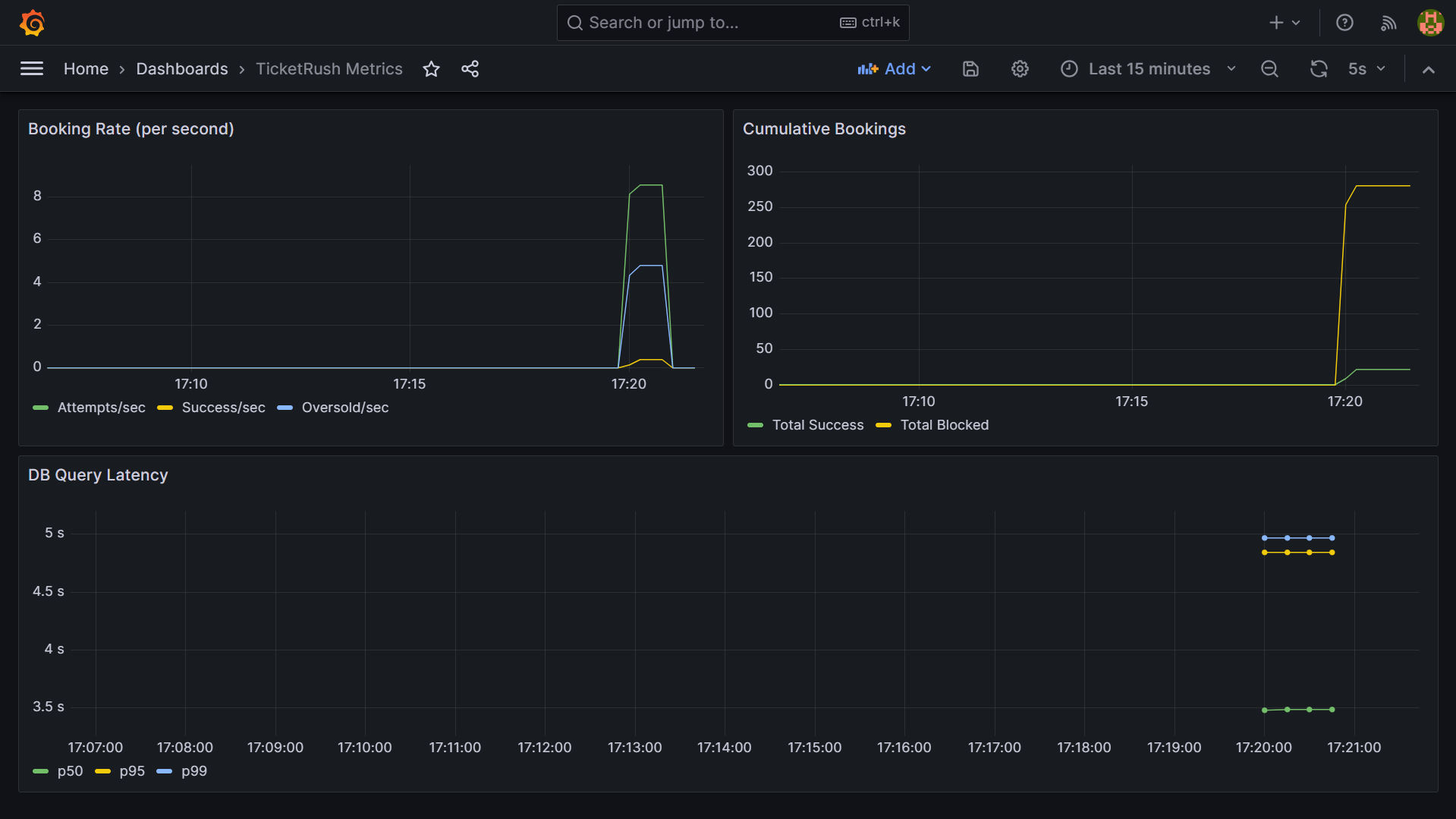
We rely on custom metrics to prove the system works:
booking_attempts_total(Counter)booking_success_total(Counter)booking_failed_oversold(Counter)db_query_duration_seconds(Histogram)
Goal: A Grafana dashboard showing a massive spike in "Attempts" but a flat line at 100 for "Success" (proving logic creates a ceiling matching inventory).
sequenceDiagram
    autonumber

    %% DEFINING PARTICIPANTS WITH ICONS
    actor User as 👤 User
    participant API as 🟢 Node API
    participant Redis as 🔴 Redis
    participant DB as 🐘 Postgres
    participant Metrics as 🔥 Prometheus

    %% FLOW START
    User->>API: ⚡ POST /book-seat (SeatID: 10)

    %% CRITICAL SECTION BLOCK
    rect rgb(255, 248, 225)
    Note right of API: 🔒 CRITICAL SECTION (Race Condition Protection)

    API->>Redis: SET seat_10_lock true NX EX 10

    alt ❌ Lock Failed (Already Locked)
        Redis-->>API: 0 (False)
        API-->>User: 🚫 423 Locked / Retry Later
    else ✅ Lock Acquired
        Redis-->>API: OK

        Note over API, DB: Start ACID Transaction
        API->>DB: BEGIN TRANSACTION
        API->>DB: SELECT * FROM seats WHERE id=10 FOR UPDATE

        alt ⚠️ Seat Already Booked
            DB-->>API: is_booked = true
            API->>DB: ROLLBACK
            API-->>User: ❌ 400 Seat Gone
            API->>Metrics: 📈 Inc booking_failed_oversold
        else 🎫 Seat Available
            DB-->>API: is_booked = false
            API->>DB: UPDATE seats SET is_booked=true
            API->>DB: INSERT into bookings...
            API->>DB: COMMIT
            API-->>User: 🎉 200 Success
            API->>Metrics: 📈 Inc booking_success_total
        end

        API->>Redis: DEL seat_10_lock
    end

    Note over Customer,RZP: Step 2: Payment Order & Signature Verification
    UI->>API: POST /api/v1/payment/create-order (Amount: ₹395)
    API->>RZP: create.order({ amount: 39500, currency: "INR" })
    RZP-->>API: Order ID (order_P1a2B3c4D5e6F7)
    API-->>UI: Returns Order ID
    UI->>Customer: Renders Razorpay Secure Modal (UPI/Cards)
    Customer->>RZP: Completes Payment & OTP Verification
    RZP-->>UI: Returns Payment ID, Order ID & Cryptographic Signature
    UI->>API: POST /api/v1/payment/verify-and-book

    Note over API,DB: Step 3: ACID Transaction & Automatic Refund Defense
    API->>API: Verify HMAC-SHA256 Cryptographic Signature
    API->>Redis: Acquire Atomic Mutex Lock: SET seat_lock:S005 EX 10 NX
    API->>DB: BEGIN SERIALIZABLE TRANSACTION
    API->>DB: INSERT INTO bookings (seatId: S005, userId, txnRef...)
    alt Collision Detected (Unique Constraint Violation)
        DB-->>API: Error P2002 (Duplicate Key)
        API->>DB: ROLLBACK
        API->>RZP: razorpay.payments.refund(payment_id)
        API-->>UI: 409 Conflict (Automated Instant Refund Issued)
    else Transaction Confirmed
        DB-->>API: Commit Successful
        API->>Redis: DEL seat_lock:S005 & DEL seat_hold:S005
        API->>Resend: ASYNC sendEmail(Customer, HTML Digital Ticket Receipt)
        API-->>UI: 200 OK (Confirmed & Ticket Generated)
        UI-->>Customer: Renders Digital Pass with QR Code & PDF Download
    end

    Metrics->>API: 🔍 Scrape /metrics
During flash sales, guessing system performance invites disastrous silent crashes. TicketRush exposes native metrics at /metrics:
booking_attempts_total(Counter): Total purchase requests attempting checkout.booking_success_total(Counter): Total confirmed database transactions.booking_failed_oversold(Counter): Requests prevented from overselling inventory.db_query_duration_seconds(Histogram): Millisecond tracking of PostgreSQL latency.
Proof of Robustness: Under benchmark load tests of 1,000+ simultaneous workers attacking 100 seats, our Grafana dashboard reveals a massive spike in Attempts but an absolute, unbending flat ceiling at 100 Successes with zero data corruption.
- Concurrency Control: Handling multiple users fighting for a single resource without data corruption.
- System Reliability: Using Redis as a buffer to protect the primary database.
- Observability: Not just coding blindly—using Grafana dashboards to visualize real-time system performance and prove the implementation works under high load.