难度:中等
你需要设计一个包含验证码的验证系统。每一次验证中,用户会收到一个新的验证码,这个验证码在 currentTime 时刻之后 timeToLive 秒过期。如果验证码被更新了,那么它会在 currentTime (可能与之前的 currentTime 不同)时刻延长 timeToLive 秒。
请你实现 AuthenticationManager 类:
AuthenticationManager(int timeToLive)构造AuthenticationManager并设置timeToLive参数。generate(string tokenId, int currentTime)给定tokenId,在当前时间currentTime生成一个新的验证码。renew(string tokenId, int currentTime)将给定tokenId且 未过期 的验证码在currentTime时刻更新。如果给定tokenId对应的验证码不存在或已过期,请你忽略该操作,不会有任何更新操作发生。countUnexpiredTokens(int currentTime)请返回在给定currentTime时刻,未过期 的验证码数目。
如果一个验证码在时刻 t 过期,且另一个操作恰好在时刻 t 发生(renew 或者 countUnexpiredTokens 操作),过期事件 优先于 其他操作。
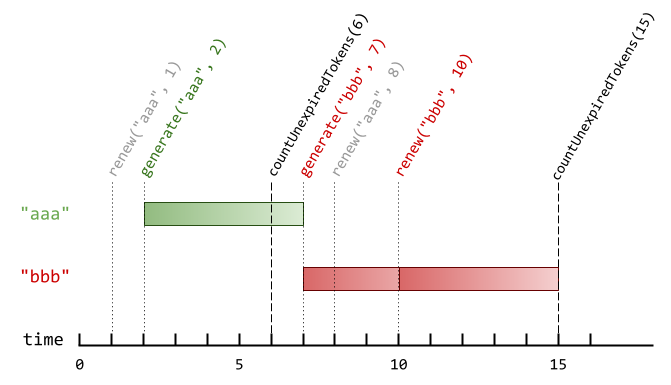
输入:
["AuthenticationManager", "renew", "generate", "countUnexpiredTokens", "generate", "renew", "renew", "countUnexpiredTokens"]
[[5], ["aaa", 1], ["aaa", 2], [6], ["bbb", 7], ["aaa", 8], ["bbb", 10], [15]]
输出:
[null, null, null, 1, null, null, null, 0]

解释:
AuthenticationManager authenticationManager = new AuthenticationManager(5); // 构造 AuthenticationManager ,设置 timeToLive = 5 秒。
authenticationManager.renew("aaa", 1); // 时刻 1 时,没有验证码的 tokenId 为 "aaa" ,没有验证码被更新。
authenticationManager.generate("aaa", 2); // 时刻 2 时,生成一个 tokenId 为 "aaa" 的新验证码。
authenticationManager.countUnexpiredTokens(6); // 时刻 6 时,只有 tokenId 为 "aaa" 的验证码未过期,所以返回 1 。
authenticationManager.generate("bbb", 7); // 时刻 7 时,生成一个 tokenId 为 "bbb" 的新验证码。
authenticationManager.renew("aaa", 8); // tokenId 为 "aaa" 的验证码在时刻 7 过期,且 8 >= 7 ,所以时刻 8 的renew 操作被忽略,没有验证码被更新。
authenticationManager.renew("bbb", 10); // tokenId 为 "bbb" 的验证码在时刻 10 没有过期,所以 renew 操作会执行,该 token 将在时刻 15 过期。
authenticationManager.countUnexpiredTokens(15); // tokenId 为 "bbb" 的验证码在时刻 15 过期,tokenId 为 "aaa" 的验证码在时刻 7 过期,所有验证码均已过期,所以返回 0 。
1 <= timeToLive <= 1081 <= currentTime <= 1081 <= tokenId.length <= 5tokenId只包含小写英文字母。- 所有
generate函数的调用都会包含独一无二的tokenId值。 - 所有函数调用中,
currentTime的值 严格递增 。 - 所有函数的调用次数总共不超过
2000次。
/* eslint-disable @typescript-eslint/no-unused-vars */
export class AuthenticationManager {
  private timeToLive: number // 过期时间 秒
  private tokens: string[]

  constructor(timeToLive: number) {
    this.timeToLive = timeToLive
    this.tokens = []
  }

  private delExpiredTokens(currentTime: number) {
    const unExporedTokens = this.tokens.filter((token) => {
      const [_tokenId, tokenTime] = token.split('.')
      return currentTime - Number(tokenTime) < this.timeToLive
    })
    this.tokens = unExporedTokens
  }

  private getToken(tokenId: string, currentTime: number): string | null {
    this.delExpiredTokens(currentTime)
    const targetToken = this.tokens.find((token) => {
      const [_tokenId, tokenTime] = token.split('.')
      if (tokenId === _tokenId && currentTime - Number(tokenTime) < this.timeToLive)
        return true

      return false
    })
    return targetToken || null
  }

  generate(tokenId: string, currentTime: number): void {
    // 生成Token
    const newToken = `${tokenId}.${currentTime}`
    const _token = this.getToken(tokenId, currentTime)
    if (!_token)
      this.tokens.push(newToken)
  }

  renew(tokenId: string, currentTime: number): void {
    this.delExpiredTokens(currentTime)
    this.tokens.map((token, index) => {
      const [_tokenId, tokenTime] = token.split('.')
      if (tokenId === _tokenId)
        this.tokens[index] = `${tokenId}.${currentTime}`
      return this.tokens[index]
    })
  }

  countUnexpiredTokens(currentTime: number): number {
    this.delExpiredTokens(currentTime)
    return this.tokens.length
  }
}

/**
 * Your AuthenticationManager object will be instantiated and called as such:
 * var obj = new AuthenticationManager(timeToLive)
 * obj.generate(tokenId,currentTime)
 * obj.renew(tokenId,currentTime)
 * var param_3 = obj.countUnexpiredTokens(currentTime)
 */