
The design tool for authentication flows
A canvas editor that speaks auth natively, backed by an open, typed DSL.
Flows are data: validated structurally, walked with scenarios, versioned in your repo.
Open the editor · Website · DSL spec


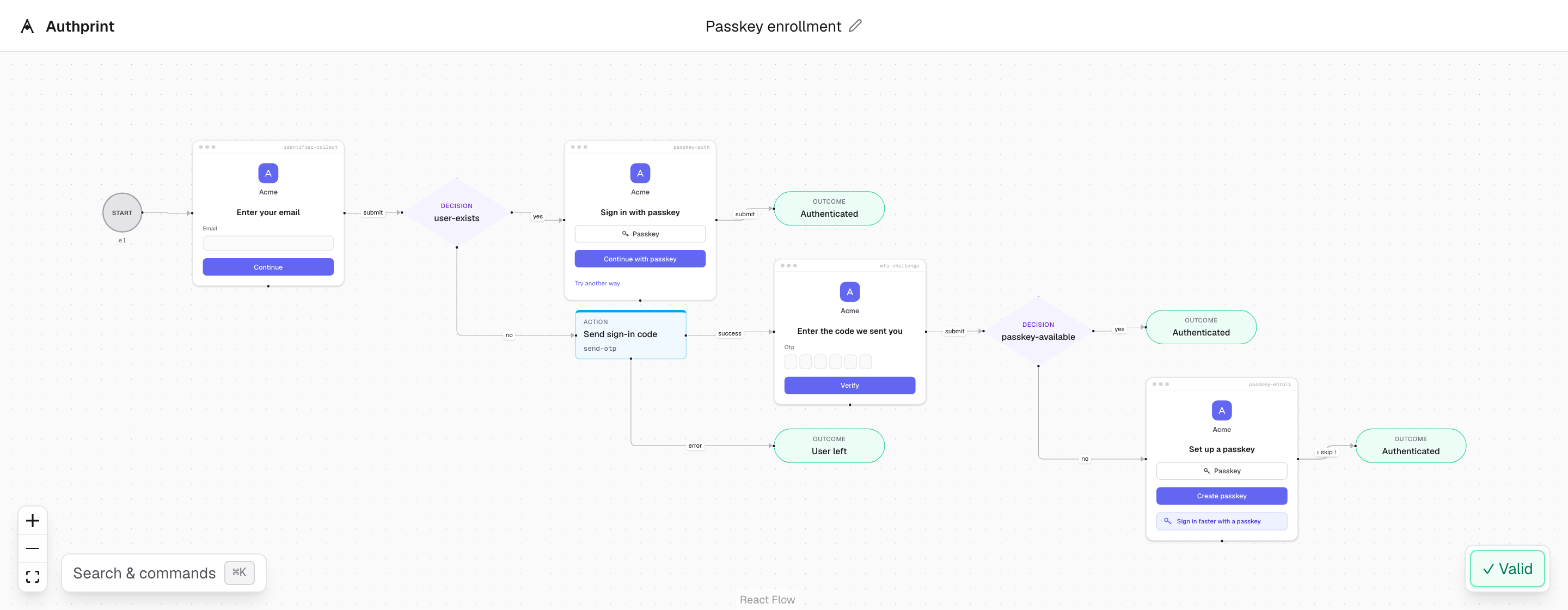
Built for Identity PMs, Solutions Architects, and UX designers who need to model auth journeys as typed state machines, not generic diagrams.
Status (2026-07-03): the editor works end-to-end locally (create, connect, edit, undo/redo, save/load
.authprint, live validation, screen mockups by fidelity tier, scenario walk-throughs) and is live at editor.authprint.app. No account needed; flows stay on your machine.
Prerequisites: Bun (workspace package manager + test runner).
bun install
bun run dev          # http://localhost:3000, blank canvas (entry node only)
bun test             # workspace tests (207+)
bun run typecheck
bun run lint
Try it: open the app → ⌘K → Open example (Demo Flow Zero, passkey enrollment, magic-link sign-in). Create nodes via per-handle + or drag-from-handle. Save flow downloads a bundled .authprint (semantic flow + optional inline layout:).
Dev overlay: ⌘0 shows branch, worktree, and commit SHA (dev only).
| Path | Package | License | Role |
|---|---|---|---|
apps/web/ |
@authprint/web |
MIT | Next.js editor + hosted product |
packages/dsl/ |
@authprint/dsl |
MIT | DSL types, YAML parser, serializer, validate() |
packages/dsl-spec/ |
@authprint/dsl-spec |
CC-BY 4.0 | Grammar, vocabulary, semantics, example flows |
| Doc | Read when… |
|---|---|
AGENTS.md / CLAUDE.md |
Working on the code (human or AI): commands, architecture map, conventions, gotchas |
packages/dsl-spec/ |
Understanding the .authprint format: grammar, vocabulary, semantics, ADRs |
secrets/README.md |
Local-dev secrets without .env files (1Password refs) |
Product planning and infrastructure for the hosted service live in a private companion repo; this repo is self-contained for building and running the editor.
| Command | What it does |
|---|---|
bun run dev |
Next.js dev server |
bun run build |
Production build (all packages) |
bun run lint |
Biome + Next.js ESLint |
bun run typecheck |
Typecheck all workspace packages |
bun test |
Bun test runner |
bun run storybook |
Storybook component workbench |
bun run test:visual |
Visual-regression vs committed PNG baselines |
bun run test:visual:update |
Re-bless baselines after intentional visual changes |
bun run op:run -- <cmd> |
Run <cmd> with secrets from 1Password (no .env on disk) |
Visual baselines live under apps/web/__snapshots__/visual/. They are local-only for now (font/OS-dependent; CI wiring deferred).
Secrets (local dev): no plaintext in .env files; use secrets/README.md. Copy secrets/op.env.tpl.example → secrets/op.env.tpl, add op:// references, then bun run op:run -- bun run dev.
Example flows (.authprint): packages/dsl-spec/examples/. Demo Flow Zero is the canonical auth spec for a future hosted product.
- Canvas: React Flow (
@xyflow/react) + elkjs auto-layout; runtime: YjsY.Doc(collab-ready, local-only v0) - DSL: YAML 1.2 strict + Zod;
.authprintextension - Tooling: Bun workspaces, Biome, Lefthook, GitHub Actions CI
Accounts and cloud persistence are planned. The current iteration is local file-based (no accounts): flows autosave to your browser and export as .authprint files.
No trademark. Personal / open-source project, not affiliated with any employer.