Reproducing Lucas' Graph Partitioning Example #15


-
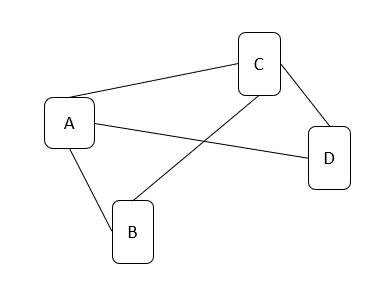
I have been trying to wrap my head around how to formulate other problems into an Ising model so that it can be solved using the simulated bifurcation algorithm. Thus, I started going through each section of Lucas' paper to see if I could solve each type of problem. I was successful with the Number Partitioning problem (section 2.1), which seemed quite straightforward. However, I am now stuck on the Graph Partitioning problem (section 2.2) as it isn't at all clear how to generate the required inputs for SB (namely, the where, and From what I can understand, For a more concrete example, let's say we start with the following graph,
According to Lucas, we ask:
I recognize that given the 4 vertices (A, B, C, D), the objective is to split vertices into two separate groups and where each group is represented by either a positive spin Any suggestions or guidance as to how I'd proceed to formulate this for SB would be greatly appreciated. Thanks in advance! |

Beta Was this translation helpful? Give feedback.
Replies: 2 comments 6 replies

-
Derivation of
|
Beta Was this translation helpful? Give feedback.

-
|
@BusyBeaver-42 Thank you for your detailed response! I am slowly working my way through the details and I have a question. In Lucas' paper, it was stated that Though, it isn't clear to me what constant value
I definitely will. For now, I'm trying to familiarize myself with how everything works and to develop a better basic understanding of the underlying SB mechanics. I really appreciate you taking the time and I hope that I can contribute back to the community in the future! |
Beta Was this translation helpful? Give feedback.
-
|
By the way, at first I did not pay attention but in Lucas' paper, the set of edges Denote by |
Beta Was this translation helpful? Give feedback.
-
|
Ahh, now that I've re-read it and thought about it, I comprehend what you mean when you said that
Since the constant term itself cannot be minimized (its constant!) and so the only thing that is left is the summation involving |
Beta Was this translation helpful? Give feedback.
-
|
@BusyBeaver-42 I'm having some trouble understanding the derivation of I am failing to grasp how: I don't know how to interpret what is actually happening with this summation? What does |
Beta Was this translation helpful? Give feedback.

-
|
The notation The equality comes from the definition of the matrix-vector produt. |
Beta Was this translation helpful? Give feedback.
-
|
Thanks for the clarification @BusyBeaver-42. Perhaps I'm overthinking/overanalyzing this but I'd like to just talk through it out loud. At the end of the day,
If the resulting multiplication is |
Beta Was this translation helpful? Give feedback.
-
|
Yes, this is exactly the interpretation of the |
Beta Was this translation helpful? Give feedback.


Derivation of$H_A$
Let$\unicode{x1D7D9}$ be the vector of size $N$ whose entries are all $1$ 's and let $s$ be a spin vector. First start by rewriting the sum as a dot product:
Then using the associativity and the linearity of the matrix product: