Project info
Title: CleanBibImpact: Do papers with a Citation Diversity Statement have more diverse citations?
Project lead: Kendra Oudyk (Twitter: @koudyk Mattermost: @kendra.oudyk
Project collaborators: You? :)
(collaborators not at this hackathon: Jennifer Stiso, Dale Zhou, Jordan Dworkin, Danielle Bassett)
Registered Brainhack Global 2020 Event: Montreal, Canada
Project Description:
Gender imbalance is a big problem in academic research, and it is even reflected in our citation behavior. Our goal is to assess the 'impact' of the cleanBib tool, which was created to make researchers more aware of this problem. This tool can be used to assess the gender balance of authors in a reference list. Specifically, we want to find papers that cite the cleanBib code/paper/preprint, and see whether those citing papers have better gender balance in their reference lists than papers that do not.
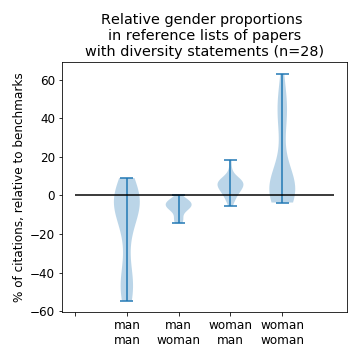
Here's a preliminary figure we made by manually searching for citing papers, up to October 2021. Our Goal 0 (see below) is to update this manual figure up to January 2021. Our Goals 1-5 are mean to automate this process.
 .
.
Data to use:
Link to project repository/sources:
https://github.com/koudyk/cleanBibImpact
Goals for Brainhack Global 2020:
Few skills needed:
Here we'd benefit from skills in Python, working with APIs, and causality (we'll do these steps in order):
Good first issues:
- Update our manually collected info on the citation diversity statements of papers citing the cleanBib code/paper/preprint. This would involve searching for citing papers on, e.g., Google Scholar, opening the papers, and copy&pasting information into a spreadsheet (DOI, authors, citation diversity statement, etc.)
- Review our gender-related language in our documentation / presentations to ensure we're discussing these issues in an appropriate way.
Skills:
Techy skills that would be helpful (but not necessary)
- Familiarity with APIs that can be used to automatically gather info about papers (e.g., the NCBI's Entrez Programming Utilities, Crossref)
- Python skills: interacting with APIs, packaging, testing, continuous integration
- Git/GitHub: commit, push, branch, pull request
Non-techy skills
- Using Google Scholar, manually searching papers to find diversity statements and other information, and copy&pasting info into a spreadsheet
- Familiarity with gender theory, to help us discuss our project using sensitive/accurate language
- Familiarity with causal analyses
Tools/Software/Methods to Use:
- Python
- Git
- We'll probably use these Python packages: pandas, numpy, matplotlib, re, habanero, requests
Communication channels:
Mattermost channel: cleanBibImpact
Project labels
Project Submission
Submission checklist
Once the issue is submitted, please check items in this list as you add under ‘Additional project info’
Optionally, you can also include information about:
We would like to think about how you will credit and onboard new members to your project. If you’d like to share your thoughts with future project participants, you can include information about:

Project info
Title: CleanBibImpact: Do papers with a Citation Diversity Statement have more diverse citations?
Project lead: Kendra Oudyk (Twitter: @koudyk Mattermost: @kendra.oudyk
Project collaborators: You? :)
(collaborators not at this hackathon: Jennifer Stiso, Dale Zhou, Jordan Dworkin, Danielle Bassett)
Registered Brainhack Global 2020 Event: Montreal, Canada
Project Description:
Gender imbalance is a big problem in academic research, and it is even reflected in our citation behavior. Our goal is to assess the 'impact' of the cleanBib tool, which was created to make researchers more aware of this problem. This tool can be used to assess the gender balance of authors in a reference list. Specifically, we want to find papers that cite the cleanBib code/paper/preprint, and see whether those citing papers have better gender balance in their reference lists than papers that do not.
Here's a preliminary figure we made by manually searching for citing papers, up to October 2021. Our Goal 0 (see below) is to update this manual figure up to January 2021. Our Goals 1-5 are mean to automate this process.
 .
.
Data to use:
Link to project repository/sources:
https://github.com/koudyk/cleanBibImpact
Goals for Brainhack Global 2020:
Few skills needed:
Here we'd benefit from skills in Python, working with APIs, and causality (we'll do these steps in order):
Good first issues:
Skills:
Techy skills that would be helpful (but not necessary)
Non-techy skills
Tools/Software/Methods to Use:
Communication channels:
Mattermost channel: cleanBibImpact
Project labels
Project Submission
Submission checklist
Once the issue is submitted, please check items in this list as you add under ‘Additional project info’
Optionally, you can also include information about:
We would like to think about how you will credit and onboard new members to your project. If you’d like to share your thoughts with future project participants, you can include information about: