English | 简体中文
patchbay_cli is Patchbay's consumer-neutral command line client. It connects to a running
Dart/Flutter app and invokes commands based on the catalog that app actually returns — with no
dependency on consumer code and no local copy of the domain commands.
For the protocol, lifecycle, and transport boundaries see
../patchbay/README.md; for the Flutter UI control plane see
../patchbay_flutter/README.md.
Install the CLI from pub.dev and pin the version used by the app:
$ dart pub global activate patchbay_cli 0.5.0
$ export PATH="$PATH":"$HOME/.pub-cache/bin"   # it installs here, but that is not on PATH by default
$ patchbay --help
For the trade-offs between the three installation forms — including prebuilt release binaries,
their runtime requirements, and the trap that running
dart run patchbay_cli:patchbay inside a consumer's repository directory resolves to the version
that repo pins — see the installation section of the usage guide
(currently in Chinese). When changing the CLI itself, dart run tool/build_cli.dart compiles the
current working tree into an AOT executable, with the output landing in build/.
The examples below consistently write dart run bin/patchbay.dart (the in-package development
form); after a global install, substitute patchbay for it.
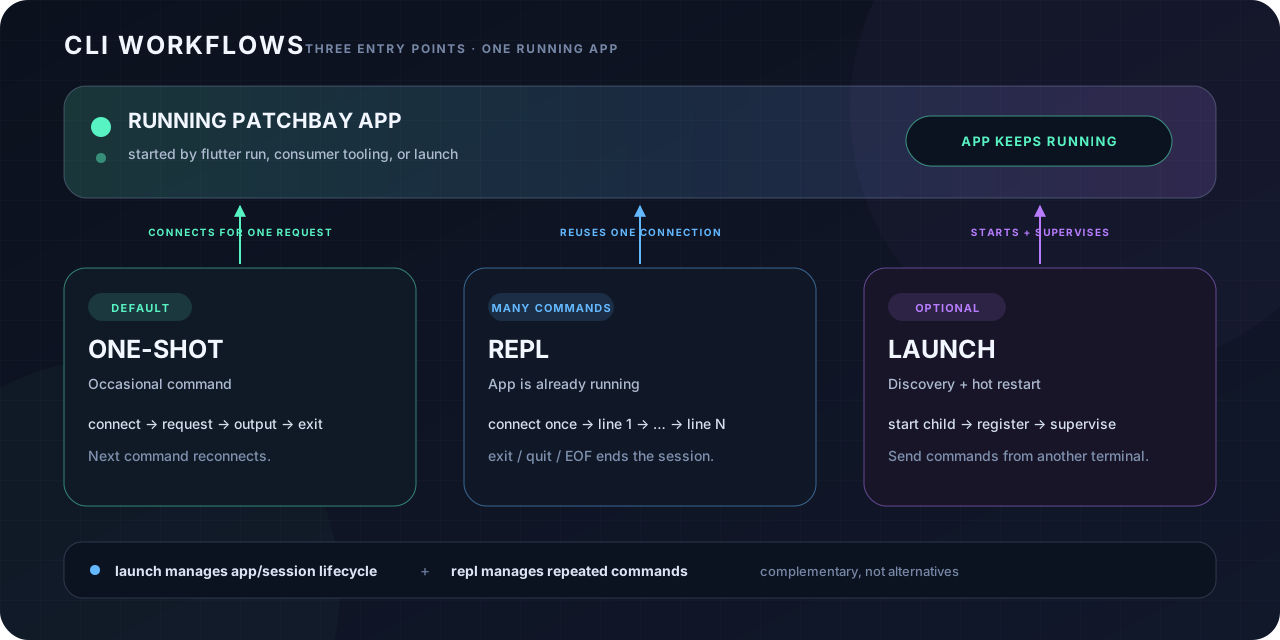
The app and CLI have separate lifecycles: ordinary commands make one request and exit while the app
keeps running; repl only reuses a connection; launch only starts, discovers, and supervises the
app/session. launch and repl are complementary. logs tail is also a bounded long-poll, not an
endless tail -f.
The exact choices, exit conditions, and two-terminal example have one source of truth: Choose a workflow. This package README deliberately does not duplicate that table.
The stable way to drive Patchbay is the executable plus --json. Two small Dart libraries exist
for the cases where a process boundary is genuinely in the way, and together they are the whole
public source surface of this package — everything else lives under lib/src/ and is an
implementation detail that changes without notice.
// Run one CLI invocation in-process and read its exit code.
import 'package:patchbay_cli/patchbay_cli.dart'; // runPatchbayCli, PatchbayExitCode

// Hold a connection open from Dart instead of shelling out per command.
import 'package:patchbay_cli/patchbay_client.dart';
// PatchbayClient, PatchbaySnapshotDiffClient, PatchbayRuntimeIdentity,
// PatchbayProtocolException, PatchbayTransportException, PatchbaySnapshotRequest,
// connectPatchbayVmService, connectPatchbayDirect
Launcher, session, trace, doctor, repl, manifest and permission-driver implementations are not
importable: drive them through CLI commands and their stable JSON. An app started outside
patchbay launch registers its session with patchbay session register instead of writing the
session record itself.
Viewing help does not discover sessions, connect to the app, or read a bearer / sensitive stdin:
dart run bin/patchbay.dart --help
dart run bin/patchbay.dart help
dart run bin/patchbay.dart help navigation
dart run bin/patchbay.dart help job
dart run bin/patchbay.dart help ui
dart run bin/patchbay.dart logs --help
dart run bin/patchbay.dart ui widget-tree --help
dart run bin/patchbay.dart help navigation.go     # protocol names from the catalog are topics too
dart run bin/patchbay.dart help ui.wait           # lists every command sharing one protocol name
dart run bin/patchbay.dart help navigate          # alias spelling, expands to the existing path
A help topic accepts three spellings: the CLI path (ui wait), the catalog protocol name
(navigation.go, ui.semantics.tap), and aliases (navigate / nav / wait / tap / text /
semantics, plus condition names in the ui wait <condition> form). Aliases are just another
spelling of an existing declaration — they add no commands and change no stable name; a protocol
name that no declaration ships is still an unknown help topic.
This table describes syntax shipped by this CLI. Protocol-backed rows come from repository descriptors; client and local rows remain explicit CLI declarations. It is not the runtime capability catalog; use patchbay catalog for actual availability.
| CLI syntax | Declaration source | Protocol command |
|---|---|---|
patchbay blob get <blob-id> --output <path> |
client CLI declaration | blob.metadata |
patchbay blob metadata <blob-id> |
client CLI declaration | blob.metadata |
patchbay capture diff <before-blob-id> <after-blob-id> |
client CLI declaration | ui.capture.diff |
patchbay capture root --output <path> |
protocol descriptor | ui.capture |
patchbay capture target <target-id> <generation> --output <path> |
protocol descriptor | ui.capture |
patchbay catalog |
client CLI declaration | — |
patchbay describe <service-command> |
local CLI declaration | — |
patchbay doctor |
local CLI declaration | — |
patchbay doctor permission |
local CLI declaration | — |
patchbay exec <service-command> |
client CLI declaration | — |
patchbay identity |
client CLI declaration | — |
patchbay job cancel <job-id> |
client CLI declaration | patchbay.job.cancel |
patchbay job get <job-id> |
client CLI declaration | patchbay.job.get |
patchbay launch -- <consumer command> |
local CLI declaration | — |
patchbay logs export --output <path> |
client CLI declaration | logs.export |
patchbay logs query |
client CLI declaration | logs.query |
patchbay logs tail |
client CLI declaration | logs.tail |
patchbay navigation back [--revision <revision>] |
protocol descriptor | navigation.back |
patchbay navigation catalog |
protocol descriptor | navigation.catalog |
patchbay navigation current |
protocol descriptor | navigation.current |
patchbay navigation go <destination-id> [--revision <revision>] |
protocol descriptor | navigation.go |
patchbay navigation push <destination-id> [--revision <revision>] |
protocol descriptor | navigation.push |
patchbay net profile |
client CLI declaration | — |
patchbay perf profile [--duration-ms <ms>] [--sample-limit <events>] |
client CLI declaration | — |
patchbay permission capabilities |
local CLI declaration | — |
patchbay permission exercise <permission> --decision <decision> |
local CLI declaration | — |
patchbay permission fail <permission> --state <state> |
local CLI declaration | — |
patchbay permission normalize <permission> --state <state> |
local CLI declaration | — |
patchbay permission reset <permission> |
local CLI declaration | — |
patchbay permission status <permission> |
local CLI declaration | — |
patchbay repl |
client CLI declaration | — |
patchbay session register --ws-uri <uri> --application-id <id> --device-id <id> --process-id <pid> [<session-id>] |
local CLI declaration | — |
patchbay session unregister <session-id> |
local CLI declaration | — |
patchbay session use <session-id> | --clear |
local CLI declaration | — |
patchbay sessions list |
local CLI declaration | — |
patchbay sessions prune |
local CLI declaration | — |
patchbay snapshot [--path <dot.path>] |
client CLI declaration | — |
patchbay snapshot diff --from <revision> |
client CLI declaration | — |
patchbay snapshot wait <dot.path> --until <condition> [<json-value>] |
client CLI declaration | — |
patchbay trace diff <before-trace-id> <after-trace-id> |
local CLI declaration | — |
patchbay trace export <trace-id> --output <directory> |
local CLI declaration | — |
patchbay trace mark <note> |
local CLI declaration | — |
patchbay trace prune [--dry-run] |
local CLI declaration | — |
patchbay trace show <trace-id> |
local CLI declaration | — |
patchbay trace start --name <name> [--activate] [--pin] |
local CLI declaration | — |
patchbay trace stop [trace-id] |
local CLI declaration | — |
patchbay ui action <identifier> <generation> <action> [text] |
protocol descriptor | ui.semantics.actionByIdentifier |
patchbay ui focus-tree [--output <path>] [--force] [--max-inline-bytes <n>] |
client CLI declaration | — |
patchbay ui gesture drag <identifier> <generation> --start <json> --gesture-path <json> [--duration-ms <ms>] |
protocol descriptor | ui.gesture.drag |
patchbay ui gesture fling <identifier> <generation> --start <json> --velocity <json> [--duration-ms <ms>] |
protocol descriptor | ui.gesture.fling |
patchbay ui gesture press-hold <identifier> <generation> --start <json> [--duration-ms <ms>] |
protocol descriptor | ui.gesture.pressHold |
patchbay ui gesture tap <identifier> <generation> [--start <json>] |
protocol descriptor | ui.gesture.tap |
patchbay ui inspect off |
protocol descriptor | ui.inspect.select |
patchbay ui inspect on [--ttl-ms <ms>] |
protocol descriptor | ui.inspect.select |
patchbay ui inspect status |
protocol descriptor | ui.inspect.status |
patchbay ui keep-awake off |
protocol descriptor | ui.keepAwake.set |
patchbay ui keep-awake on [--lease-ms <ms>] |
protocol descriptor | ui.keepAwake.set |
patchbay ui keep-awake status |
protocol descriptor | ui.keepAwake.status |
patchbay ui render-tree [--output <path>] [--force] [--max-inline-bytes <n>] |
client CLI declaration | — |
patchbay ui reveal <identifier> [--container <identifier>] [--direction <forward|backward|both>] [--max-steps <n>] [--timeout-ms <ms>] |
protocol descriptor | ui.reveal |
patchbay ui semantics action <node-id> <generation> <action> [text] |
protocol descriptor | ui.semantics.action |
patchbay ui semantics tree [--output <path>] [--force] [--max-inline-bytes <n>] |
protocol descriptor | ui.semantics.tree |
patchbay ui tap <identifier> [--generation <generation>] |
protocol descriptor | ui.semantics.tap |
patchbay ui targets --emit-manifest |
local CLI declaration | — |
patchbay ui text enter <target-id> <generation> [text] |
protocol descriptor | ui.text.enter |
patchbay ui text set <target-id> <generation> [text] |
protocol descriptor | ui.text.set |
patchbay ui verify-manifest <manifest-file> [--navigate] [--continue-on-error] [--restore] |
local CLI declaration | — |
patchbay ui wait destination <destination-id> |
protocol descriptor | ui.wait |
patchbay ui wait frame-revision <revision> |
protocol descriptor | ui.wait |
patchbay ui wait semantics-mounted <identifier> |
protocol descriptor | ui.wait |
patchbay ui wait semantics-unmounted <identifier> |
protocol descriptor | ui.wait |
patchbay ui wait semantics-value <identifier> <value> |
protocol descriptor | ui.wait |
patchbay ui wait tree-revision <revision> |
protocol descriptor | ui.wait |
patchbay ui widget-tree [--output <path>] [--force] [--max-inline-bytes <n>] |
client CLI declaration | — |
Once the app is launched by the flutter run --machine launcher, the CLI discovers the unique
current session from the user's temp directory by default:
dart run bin/patchbay.dart --json identity
dart run bin/patchbay.dart --json catalog
dart run bin/patchbay.dart --json snapshot
dart run bin/patchbay.dart --json exec <namespace.command>
To make startup and recovery one bounded operation, launch an integrated consumer through the CLI:
dart run bin/patchbay.dart launch -- flutter run --vmservice-out-file .dart_tool/patchbay/vmservice.txt
dart run bin/patchbay.dart --keep-awake launch -- flutter run ...
PATCHBAY_KEEP_AWAKE=true dart run bin/patchbay.dart launch -- flutter run ...
dart run bin/patchbay.dart --no-keep-awake launch -- flutter run ...
The child reads PATCHBAY_SESSION_DIR, PATCHBAY_LAUNCH_ID, and
PATCHBAY_LAUNCH_OWNER_PID with PatchbayLaunchContext.tryFromEnvironment, then writes the full
pending record using pendingRecord and adds its transport with withTransport. The launcher does
not invent application/device metadata: the child must pass the real consumer/App processId,
which is distinct from the launcher ownerPid. It also does not parse a private stdout frame. It supervises only a record
whose launch ID and owner PID both match; a child that does not declare one fails in bounded time as
sessionNotDeclared. Machine frames stay on stdout and child/human output is forwarded to stderr.
Stable live sessions are observed every five seconds; a disconnect restarts recovery at the initial
200 ms backoff, and each identity probe is bounded by both child exit and the remaining budget.
The screen-awake policy is off by default. Global --keep-awake, or a local
PATCHBAY_KEEP_AWAKE=true/on/1, acquires the existing ten-minute lease only after the launcher is
live and renews it at half-lease through the existing health observation. --no-keep-awake
overrides that local default. Successful one-shot / REPL commands may renew under the same policy,
while explicit ui keep-awake on|off|status commands never trigger a second implicit operation.
Terminal paths and signal cancellation attempt release; on disconnect the machine frame / JSON says
releaseUnconfirmed or renewalUnconfirmed, with App-side lease expiry remaining the final fallback.
When any of the steps above does not work, run the health check first — it dials out itself, so a failed connection is one of its findings rather than the end of the command:
dart run bin/patchbay.dart doctor          # session / connection / catalog / lifecycle, item by item
dart run bin/patchbay.dart --json doctor
The four items are checked in dependency order, each giving "symptom → possible cause → suggested
action", and once one fails the rest are marked skipped. The exit code takes the category of the
first failure (session / connection 3, catalog 4, lifecycle 5); with warnings only it is 0.
It also reads a snapshot once, and on finding any boolean active set to true it prints the path
and advises against force-stop / kill — there may be a live business session on the device. For
the full semantics see ../../docs/guide.md (currently in Chinese).
With several apps or worktrees running at once, it does not guess by PID, timestamp, or current
directory. The CLI fails closed with sessionAmbiguous and prints the session IDs without URIs;
the caller must choose explicitly:
dart run bin/patchbay.dart --session <session-id> --json identity
--ws-uri remains the recovery path for when the launcher record is lost:
dart run bin/patchbay.dart --ws-uri <uri> --json identity
dart run bin/patchbay.dart --ws-uri <uri> --json catalog
dart run bin/patchbay.dart --ws-uri <uri> --json snapshot

# Compare the current full snapshot with a retained host-observed revision.
dart run bin/patchbay.dart --ws-uri <uri> --json snapshot diff --from 7
dart run bin/patchbay.dart --ws-uri <uri> --json exec <namespace.command>
<generation> comes from the most recent catalog or Semantics tree. It changes when a target
remounts; a write carrying a stale value is rejected stably, so a command cannot land on a new
instance that happens to share the name.
When --revision is omitted from navigation go|push|back, the CLI first calls
navigation.current to read the current revision, then dispatches, and the result carries
revisionSource: navigation.current. The fence is unchanged: the revision still goes out with the
request, and if navigation moved between the read and the dispatch, the app still blocks it with a
stable rejection. An explicit --revision keeps the original behavior — no extra read, and no such
marker.
The ui wait <subcommand> names deliberately differ from the condition in the payload
(semantics-mounted ↔ semanticsMounted, destination ↔ navigationDestination). Both spellings
can be typed directly, and the mapping table is in patchbay help ui wait; neither set of names
will change, because they are wire contracts.
perf profile samples the connected VM Service for 10 seconds by default and emits only the
stable patchbay.performanceProfile.v1 summary: build/raster frame durations and 16 ms jank counts,
two heap observations, and new/old-generation GC counts. --duration-ms is limited to 1..60000 and
--sample-limit to 1..10000. At most 10000 events and 8 MiB of processed event data contribute to
one result; either limit sets sampling.truncated=true and reports the dropped count. Timeline
events are reduced as public VM stream batches arrive, and the subscription is cancelled at the
first limit; raw events are never retained or copied into Patchbay output, logs, or artifacts. The command temporarily enables
the public VM timeline streams it needs and restores the previous stream set on success or failure.
This is a VM observation (factSource=uiObserved), not an App catalog command. Direct HTTP returns
the stable profilingVmServiceRequired code rather than fabricating equivalent facts. Older VMs
that do not expose the required public RPCs/streams return performanceProfilingUnavailable.
net profile currently returns networkProfilingUnavailable without collecting anything. In the
reviewed vm_service 15.2.0 API, the public HTTP profile response already contains bodies, headers,
cookies, and query values before the caller can filter it. Collecting that response and redacting
afterwards would violate Patchbay's collection-time privacy boundary, so no network capability is
published until a public pre-filtered RPC or an injected privacy-safe collector exists.
ui tap <identifier> is a one-step replacement for ui semantics tree + ui semantics action:
resolution, generation checking, and dispatch all happen in one pass on the app side, so the CLI
neither constructs a nodeId nor supplies a default generation. --generation is optional; passing
it makes it the caller's own up-front fence, and omitting it leaves the fence to the generation the
bridge pins before the gates. Misses, ambiguity, and stale generations are all stable rejections
with details (respectively: the list of mounted identifiers, the candidate list, and
expected/current), so an empty rejection never pushes the caller back to a whole-tree dump.
ui action <identifier> <generation> <action> [text] provides the same one-request resolution for
the other public Semantics actions. Here the caller generation is required and is checked before
and after policy/gate evaluation. The command exposes only tap, focus, four-direction scroll, and
setText; it never accepts latest or retries against a replacement node. Sensitive setText input
uses the global --stdin flag.
ui verify-manifest <file> reads a JSON or YAML manifest maintained by the consumer and reconciles
catalogTarget entries against the catalog's uiTargets and semanticsIdentifier entries against
the existing live ui.semantics.tree, reporting three classes of discrepancy: declaredNotMounted,
mountedNotDeclared, and propertyMismatch. The comparison happens entirely on the CLI side: it
adds no wire command and uses only the existing catalog/tree surfaces; when a destination appears in the manifest, it
additionally reads navigation.current once for scope filtering. For the schema, field semantics,
destination filtering rules, and the "not mounted ≠ missing" boundary, see the
usage guide (currently in Chinese); the
example file is at
docs/examples/ui-targets-manifest.json.
Full agreement exits 0; any class of discrepancy in the report exits 7 — the app side answered
everything normally, so it is neither a rejection (5) nor a typed failure (6). An unreadable or
invalid manifest fails closed with exit code 64, and --json gives manifestInvalid /
manifestUnreadable plus a details.field pointing at the exact location. Input format is selected
only by a lowercase .json, .yaml, or .yml extension; unknown extensions are not sniffed. YAML
uses safe parsing without recovery, aliases, or explicit tags, and both formats share the 1 MiB,
64-level, and 200,000-node parser budgets (mapping keys included). Syntax errors include one-based line / column without
echoing file content. Human-readable output
lists the discrepancy entries directly; inside repl each line takes only one line and reports
counts.
--navigate is the explicit side-effecting walkthrough mode. It visits v2 destinations in manifest
order, asks only for destination ids declared by navigation.catalog, confirms each arrival with the
closed ui.wait navigationDestination condition, and then runs the same reconciliation. Per-screen
and total budgets default to 5 s and 120 s (--screen-timeout-ms, max 120 s;
--total-timeout-ms, max 10 min). It stops after the first failure unless
--continue-on-error is present. --restore makes a bounded best-effort return to the initial
destination; a restore failure is a machine-readable notice and never replaces the walkthrough exit
code. The JSON report preserves visited, passed, failed, skipped, per-screen reasonCode, and
finalDestination. Hosts without the complete declared navigation surface retain current-screen
verification and report navigationMode: unavailable; the CLI never probes support by interpreting
an error shape.
Manifest v2 keeps the namespaces independent: kind / sensitive are valid only for
catalogTarget, while semanticsIdentifier stores only its stable identifier. A unique live match
reports the observed nodeId, generation, and tree revision; no match is declaredNotMounted, and
multiple matches fail closed as uiSemanticsIdentifierAmbiguous. Missing capability, truncated tree,
and malformed tree payloads have distinct stable protocol codes. ui targets --emit-manifest
includes unique live identifiers when the App declares the tree capability, but refuses ambiguous or
cross-namespace IDs instead of inventing a representative.
dart run bin/patchbay.dart --ws-uri <uri> --json repl <<'EOF'
identity
describe ui.capture
ui semantics tree
ui tap login.submit
EOF
repl opens one connection and then executes typed commands line by line, with exactly the same
syntax as one-shot invocations. Each line's output carries its own exitCode (under --json, one
JSON envelope per line; otherwise [n] exit=<code> <summary>): a process exit code cannot carry
per-line results, so the session code describes only the session itself — 0 for a clean run, or
the category of the error that terminated it.
describe <service-command> can run inside the session to read the live catalog row without
invoking the command it describes.
A rejected or typed-failure line does not end the session; transport / protocol / session errors do, because they mean the reused connection or the peer is no longer the one the operator selected, and the CLI will not silently reconnect.
The following fail closed inside repl rather than being silently ignored: connection options and
--json (they belong to the session, and honoring them per line would require reconnecting),
--stdin (the command stream already occupies stdin, leaving no no-echo channel), and a nested
repl. Direct mode does not enter repl at all: the bearer token would compete with the command
stream for the same stdin. Blank lines and lines starting with # are skipped, and exit / quit
or closing stdin ends the session.
PatchbayFriendlyCommand is the CLI's single command table: path resolution, argument
construction, dispatch, and help are all derived from it. Each declaration picks one
PatchbayCommandTarget, and runPatchbayCli switches over that enum with no default, so a new
command cannot be wired for execution while missing its help. exec's protocol name comes from the
caller's argument; identity / catalog / snapshot and the three diagnostic trees go through
transport methods rather than catalog commands, and those differences are written into the
declarations too.
Every command (including exec, job, ui text, ui semantics, and the three diagnostic trees)
fails closed on irrelevant options: passing an option that command does not accept reports
--<name> is not valid for <command> with exit code 64 instead of ignoring it silently.
A friendly command is only a generic argument mapping onto a stable protocol name — not a second
capability list. The CLI still reads the app's current catalog on every execution; when the catalog
and the invoke result contradict each other it returns catalogInvocationDrift (with details
carrying the host's own catalog violation reason, so you need not run catalog again just to learn
which command name was invalid), and a missing command still preserves the app's
commandNotRegistered rejection and exit code 4. The CLI never infers capabilities from the
number of commands. The full command name remains the protocol identity, and arbitrary consumer
commands continue to use exec <namespace.command>.
describe <namespace.command> reads that catalog only; it never invokes the command. Its JSON
answer contains the complete command row, schemaMode, and the closed retryEligibility value
eligible, notDeclared, or notExternal. When an external row declares a valid retryPolicy,
the CLI retries only transport-unavailable/timeout failures, reusing one requestId for every
attempt. App rejections, protocol failures, and any provider response are final and are never
retried.
Every RPC round trip has a budget, 30 seconds by default, adjustable with
--transport-timeout-ms and applying to both transports; on exhaustion it fails with exit code 3
and the stable code appUnresponsive plus a remediation hint. --timeout-ms is the business wait
budget sent to the app, and a request that declares it widens this RPC's budget to "the declared
wait plus one round trip" so it is not cut short by the default.
Log filtering supports --cursor, --direction, --limit, comma-separated --levels/
--categories, and ISO-8601 --since/--until. Capture supports --pixel-ratio,
--after-frames (1..120 Patchbay-observed Flutter frames), and --timeout-ms. If the host does
not declare captureAfterFrames, the CLI omits that field and labels the response
captureMode=legacyImmediate; it never guesses support from an error. capture diff compares two
retained capture blob IDs of the same size and pixel format and returns counts plus a ratio, not a
pass/fail verdict. Every artifact download first writes a temp file in the same directory and
validates blob metadata, offsets, base64, total length, and SHA-256 chunk by chunk, renaming only
after everything passes; an existing output is refused by default and replaced only with an
explicit --force. Expiry, rejection, out-of-order chunks, hash errors, and interruptions never
leave a partial file under the final output name.
--ws-uri may contain VM Service authentication material:
- take it only from trusted launcher output or the current debug session;
- never write it into scripts, logs, snapshots, or anything you commit;
- CLI errors report only the error category, never echoing the full URI.
The participating child first writes a provisional record via atomic replace, then fills in the URI
once its own toolchain discovers it; only after the launcher connects and reads ext.patchbay.identity are
appInstanceId and isolateId filled in. A complete record binds the session schema,
applicationId, appInstanceId, isolateId, launcher PID, wsUri, build mode, creation time,
worktree, and device ID. Records live in the current user's system temp directory by default, and
PATCHBAY_SESSION_DIR can override that. patchbay launch forwards child stdout/stderr as human
output on stderr; stdout remains a stream of stable launcher machine frames.
A live PID only means the launcher may still be running — it does not prove the app instance is
still the same one. A dead PID or schema/identity mismatch invalidates the record; a temporarily
unreachable endpoint remains available for bounded recovery. On hot restart the launcher observes
the changed App instance and re-pins the record before reuse. An explicit --ws-uri runs the same
schema/isolate/appInstance identity check. The launcher deletes only pending records it owns on
exit. On POSIX the directory and files are tightened to
0700 and 0600 respectively, and ordinary output, errors, and selection lists never contain a
URI or token.
The current command execution path does not itself call ADB. On Android, however, if the URI came
from flutter run, Flutter's own launch, install, and port forwarding may still use ADB
indirectly — so the VM Service path cannot claim to be end-to-end ADB-free.
The CLI can also connect to a patchbay_transport direct host that the consumer started
explicitly. A direct host performs no discovery, so the caller must obtain the endpoint, runtime
identity, and short-lived bearer through a trusted out-of-band channel; the token can only be read
from no-echo stdin, as the CLI provides no argv/env/query entry point for it:
dart run bin/patchbay.dart \
  --direct-endpoint http://192.0.2.10:12345/patchbay/direct/v1 \
  --direct-token-stdin \
  --direct-application-id dev.example.app \
  --direct-app-instance-id <instance-id> \
  --json identity
# here the CLI reads one line from the current TTY without echoing it
The example above is the interactive TTY shape; do not put a bearer literal into shell history. The CLI turns echo off automatically while reading a bearer. Direct LAN is experimental plaintext HTTP: the bearer provides authentication but not confidentiality, cannot prevent passive listening or replay on the same network segment, and must not be called a secure channel. Enable it explicitly only on a trusted, isolated network with a short TTL. The Flutter SDK's widget/render/focus diagnostic extensions still exist only on the VM Service path.
Ordinary structured arguments are passed as a JSON object via --args, and --stdin reads one
no-echo line from stdin. The two can be used together: the JSON object from stdin is merged with
--args, with stdin winning on shared keys, so readable arguments stay on the command line and
only secrets go through the no-echo channel. Using --stdin without --args is still valid (the
degenerate case of that merge), and stdin content that is not a JSON object still errors as before.
Parameters a descriptor marks as sensitive can only come from stdin: if one appears in --args,
the CLI refuses to send with exit code 64, nothing goes on the wire, and the error names only the
parameter without echoing its value. Output retains only redacted metadata. When stdin takes over a
real TTY, the CLI temporarily turns off terminal echo and restores it afterwards; if echo cannot be
turned off, it fails closed with terminalEchoControlFailed. Piped input does not modify terminal
modes.
admission=accepted only means the app has accepted the request, not that the side effect is
complete. Long-running work returns a jobId:
--waitkeeps reading until a terminal state;job getreads the current snapshot;job cancelrequests cancellation, but the cancellation outcome is still whatever job state the app returns.
The stable location for jobId is the top level of the response: both the admission envelope
and the --wait terminal result give the job admitted for that command at the top level.
payload.jobId is a field the app's own job snapshot carries; both are preserved, and scripts
should read the top-level one.
The CLI generates and sends a requestId for every invoke, and both the VM Service and direct
paths require the response to echo the same value; a mismatch exits as a protocol error, so a
concurrent or late response cannot be attributed to the wrong command. An explicitly empty
requestId also fails closed.
--wait waits at most 60 seconds by default; when the descriptor/admission carries
suggestedWaitTimeoutMs, the consumer's suggested observation window is used instead. BLE pairing,
for example, suggests 150 seconds to cover its 120-second activation terminal state. A timeout
means the app accepted the request but produced no terminal state within the observation window,
and is classified as a typed operation failure (exit code 6), not a connection failure.
When the host catalog has patchbay.job.wait, the CLI does a bounded long poll with
afterSequence and marks the result waitMode=serverLongPoll. Against an older host without that
command, it falls back to compatibility polling on patchbay.job.get, with the result explicitly
marked waitMode=legacyPolling plus a waitNotice — it does not pose as a server-side wait. An
outcome=timedOut from logs tail is a successful long-poll observation and still exits 0,
rather than being misreported as a transport error.
JSON output preserves fact sources, rejection codes, job event sequences, and capability warnings. The CLI does not reinterpret these fields as proof that the device executed successfully, that pixels are correct, or that system UI was operated.
With --json, stdout contains exactly one JSON document: the response envelope, or an error
envelope
{"error": {"code": "sessionAmbiguous", "details": {"sessions": ["…"]}}}whose shape matches the app's rejection envelope (a stable code plus free-form details). The
code for a usage error is usageError, with the sentence in details.message; session /
protocol / transport / sensitive-input / waitTimeout errors use their own stable codes, and the
fallback error exposes only the exception type name, never echoing a URI or token. Human-readable
text still goes only to stderr. Without --json, behavior is unchanged.
That count is per one-shot command. Three commands stream instead, and a script reads them one line
at a time rather than as a single document: repl emits one envelope per line, logs tail emits
NDJSON, and launch emits launcher machine frames.
The count also describes stdout on its own. Human sentences go to stderr, and so does whatever
wrapper the command runs under — just, npm, a shell function — when it announces a non-zero
exit. Merging the two with 2>&1 appends that prose to a document that was already well formed,
and the parser then reports trailing data, which reads like a second document and is not one.
Redirect stderr to a file when you want to keep it; never into the stream being parsed.
The chunk size for artifact downloads is taken from the default limit of blob.read in the
catalog (capped by the CLI default of 64 KiB) rather than hard-coded: when a consumer lowers
maxChunkBytes, downloads still work instead of being killed by blobInvalidChunkLimit.
| Exit code | Meaning |
|---|---|
0 |
The request completed, or the app returned a parseable non-error result |
3 |
Session discovery, connection, transport, or VM Service RPC failed |
4 |
Incompatible schema/identity, or the command is absent from the catalog |
5 |
The app adapter or Flutter bridge refused admission |
6 |
An admitted operation returned outcome=failed, a job failed or was cancelled, or waiting for a terminal state timed out |
7 |
Local reconciliation (ui verify-manifest) completed and the report contains discrepancies; every request to the app was answered normally |
64 |
The command form, arguments, or local input were invalid (including a manifest file that could not be read) |
Callers should read the JSON envelope as well; exit codes do not carry device-level completion.
The Widget/Render/Focus commands are read-only proxies onto the Flutter SDK's diagnostic
extensions. Their output carries schema=flutterSdkPassthrough and its fields change with the
Flutter SDK; when the corresponding extension is absent in profile, they return
flutterDiagnosticUnavailable stably. Stable automation should consume the Patchbay schema of
ui semantics tree.
Navigation, wait, capture, structured logs, and direct are available only when actually registered by the runtime catalog / consumer host. The CLI does not paper over missing capabilities via ADB, coordinate taps, or guessing from widget text, and it will not start a direct listener or distribute a bearer on the app's behalf. Logs are app records the consumer has already redacted; capture proves only the composited result of Flutter repaint boundaries, excludes system permission dialogs, and may be missing PlatformViews.
System permission orchestration is opt-in through an explicit external driver; unsupported device,
runner, signing, and language conditions fail closed. See
platform permission drivers.
For the stable commands, passthrough boundaries, and exit conditions of the three trees and
actions, see
../patchbay_flutter/doc/ui-inspection-and-actions.md
(currently in Chinese).