Organizing Strategies for OpenLab
Tools and parts are marked as needed with a color code to quickly identify the right tool for a job. Nail polish can make it quick and easy to label an item on the fly. The most frequently used tools get a coat of paint and it occassionaly chips which is not a problem, as the color coding still works and saves a great deal of time. The part is identified by it's last digit such as 13 and 23mm size has the same color (green) as 3mm items. Below, some of the color coded tools are shown and the box of Testors enamel paints which can be bought individually with a huge number of color choices available online.


The color codes give a simple way to mark tools and quickly identify size. The color code is as follows:
- ⬛ 0 is black
- ⬜ 1 is white
- 🟦 2 is blue
- 🟩 3 is green
- 🟧 4 is orange
- 🟥 5 is red
- 🪙 6 is silver
- 🟨 7 is yellow
- 🟪 8 is purple (grape)
- 🪙 9 is gold
Click for details on color codes.
Notes from the designer of this color code system:
- Alliteration is intentional. The base colors each have a rhyme or alliteration like "two is blue" so english-speakers can recall the matching size when they see a color. It really works.
- Minimizing colors: having only 10 colors, this system has fewer colors than most. Compared with Wiha's color-coded hex keys, we omitted the "red-orange" or "dark yellow" options for simplicity.
- Accessible colors: if we include more colors then the supplies become more expensive. More paints, supplies for mixing, and more effort to clean brushes or adjust the work to get it right. (I've tried this).
- Wide color gap: It's desirable that users can choose any brand available to make their mark. The group of "blue + green" is very distinct but "blue + green + teal + light green" becomes less obvious. When I purchased paint pens, one brand included a green that has a slightly teal hue, and we want a system that still makes use of this color. Now, this pen fits in the green category without confusion.
- Avoid Sequencing: If the color codes require a sequence like multiple bands in resistors, then the upside-down tool becomes hard to recognize. Some tools have no "front and back" so the users cannot be sure which band comes first.
- Fastest Marking: with no bands or sequences, marks can be made rapidly if you are in a rush. A quick blot of yellow gets applied to a bolt during an engine disassembly project. The yellow mark says "use the 17mm wrench" and saves time grabbing the wrong wrench in the middle of a complex project. Marks can be made in any visible position and a "nice paint job" can be done later if there is time.
- Errors are obvious: If I purchase a set of allens that come with colored rubberized grips, it does not cause confusion. It's easy to notice these are factory colored and no action is needed.
- Half-sizes are handled: Both size 2mm and 2.5mm are blue, 4mm and 4.5mm allen keys are orange. It's only on rare occasions the half-size tool is needed, and even more rare they both are used at the same project. The invention of the half-sizes are more often implemented to create a match by manufacturers for a previously Imperial screw choice. As your toolbox expands, half-sizes rarely appear above 6mm and thus do not create trouble in the system.
- Real work proves the system: This color coding effort was tested and adjusted for over 8 years. Several anticipated issues did not prove relevant. For example, if you handle precise drill bits they will have every tenth of a milimeter such as 2.6, 2.7mm. These types of tools always come in their own sorted case, and they have plastic rings with text or other solutions embedded for ease of use. There is no need to paint these finely indexed types of tools.
Color code is applied to items like sockets and hex drivers. The final digit determines the color, so the sockets of 12mm and 22mm are both blue. It's easy to identify the size difference of 10 milimeters larger.
- buy Enamel paints kit by Testors containing 8 colors, $23 on Amazon 2026.05
- find Unique colors like purple and other shades at your local Michaels or Hobby Lobby (in USA) only about $3/color
- buy Clear coat Nail paint product on amazon, $2.58 per 2-pack, 0.41oz each
- buy LA colors bright green on amazon, at $2 each, best value I found for individual paints with brush cap.
Modifications for toolboxes and more
The selected toolboxes are model number CMST-98268-BK and a couple of similar variations. Since 2010, these boxes held a consistent form factor with minor changes, so the modifications shared here are suitable for plenty of Craftsman models as well as Kobalt, Husky, US General, and more.
Wood Tops are easily built from pine 2x4s, bonded with wood glue & (optionally) sealed with 2-part epoxy.
Swinging Frames add tool hanging space on the sides, but don't protrude & take floor space.
Upper Frames create a workspace for an easy DIY station like soldering or electrical testing.
Keys are bonded in a round housing to work like a removable knob. This prevents snags and bent keys.
- Download this toolbox CAD Model to design your own attachments or see how this box fits in your space.
- Watch this youtube video for drilling holes in toolboxes or other material.
- Watch this youtube short for insertion of threaded inserts
- Download this PDF manual for the toolbox containing diagrams, assembly instructions, and other notes by David M
- download my design markup docs by David M including hole drilling locations & fabrication notes.
Below, see photos for the wood top, swinging frame, and other mods.


Key Caps are 3D printable designs and open sourced as usual. There are two designs: KeyCap.sldprt for a cabinet key and keyGrip.sldprt for the rolling tool chest.
- Download CAD Models on grabCAD (posted 2026.04)


Fasteners have been narrowed down from all of the world's fasteners to a smaller collection of preferred choices. Essentially the most common fasteners in devices all around you are the most preferred fastener choices in OpenLab and the ones which take the main spaces in our parts bins. The "hardware bins" in the tour tab show most of the fasteners inventoried.
One tip for gathering and organizing your fasteners is to eliminate less-common sizes but maintain the option to produce them in a pinch. Consider for example the 35mm screw as undesirable for inventory: we only stock 30mm and 40mm length. Then, we choose 30 or 40mm length preferrably in our designs for assemblies. In the special case the design cannot accomodate the 30mm screw, we have a need for 35mm length and we simply cut this screw down from the 40mm length option. Usually, around 30mm we have control of enough bulk material to choose washers and nuts variations to keep only desired screws in the designs. Then, the inventory becomes simpler, the designs have a guiding preference, and all processes become simpler, including assembly.
- See the short video Build your own Metric Screws describes the concept.
Horizontal hooks are fantastic versatile hanging features. Several kinds of parts bins are adapted to hang on hooks for better accessibility compared with drawers and reduced demand for shelving and bulky furnishings.
TiltMount is used for mounting a horizontal 20mm beam on a wall, with a gentle slope upward so that straight hooks are viable for holding materials without slipping. The below images show how this 3D printed bracket is integrated into a storage system.
- download tiltmount CAD model posted 2026.04 on grabcad
- buy compatible hooks for $28 on amazon - this is a multipack from Triton manufacturer
- Use M5x10mm fasteners to join the hooks to extrusions.


See-through Storage are chosen strategically and they are Sterilite Clearview bins, which have been distributed for over a decade without changes and they appear at Target as well as industrial distributors. Supplies to be grouped in a smaller space, the zipper pouch (like pencil bag) are useful, with hooks that allow hanging
- Sterilite 6quart 12 pack on Amazon for $42
- Sterilite 15-quart 12 pack on Amazon for $53
- Pouches, zipper pouch 6-pack for $10
See the linked product images below for sterilite clearview bins, and the economical "pencil pouch" zippered bags.


The next photos show all of the most common bin types in the lab. These include small divided clear bins all the way to the large storage tote with handles and lid integrated.


Divider bins are industrial products, only found at industrial suppliers. These are used for more critical inventory storage than the clearview selections.
See Divider Bin on GrabCAD to jump straight to my CAD models, true to the measured dimensions. These designs are intended for design of mating parts such as bin racks, and covers. The upload includes more photos and design notes.
The bins deserve a dedicated section since these are part of several projects, and multiple labs. Each bin is usually $15 each or higher, but they're industrial and intended to last forever. Options are available at many reputable distributors for the following options:
- transparent top covers that are load-bearing
- interlocking dividers in gray and black
- Electrostatic dissipating variants, with grounding connector
Here are three different suppliers that have near-matching bin dimensions. They are compatible enough to stack on one another, but you may measure more closely in order to design your own covers and dividers. We have ordered and validated the ones from Grainger and Uline. They're also offered at McMaster (we have not compared this option) and the Lewisbins brand is listed here because the company was kind enough to publish accurate CAD models that we can work with.
[Distributors]
- BRAND | Distributor | Link
- Akro-Mils | Grainger | product
- Uline | Uline | product
- LewisBins | Global Industrial | bin product
- LewisBins | Global Industrial | lid product


Latching Bins or Plano bins hold the small OTS parts arrays. These clear, latching boxes store small parts that populate all of the hardware in our designs. One bin holds all of the M5 fasteners, another bin for all M2.5 and M3 fasteners, and so on. One bin has as many as 50 different unique components. The M5 Hardware bin will have the machine screw, washer, and nut all ready to pick at a glance. One latching bin should have every different component type but not a huge quantity of any part. If the fasteners are sourced in a pack of 100, there maybe overflow from its place in the latching bin. Overflow of hardware gets moved to a "storage" position in the larger, opaque divider bins.
Each latching bin then holds a full category of parts and half of them are stored flat and upright while the remaining ones can hang. Vertical hanging is reserved for lighter collections of parts like fuses or plastic retaining clips, so the hanging hooks are not overloaded nor the pegboard hooks. Lifting a heavy bin from a hanging position is too likely to cause drops and spills. The small type (3500 series) have smaller overall dimensions and they are always hung vertically on a pegboard hook.
- Plano Prolatch 3500 Series, 5x9 inches.
- Plano Prolatch 3700 Series, 9x14 inches.
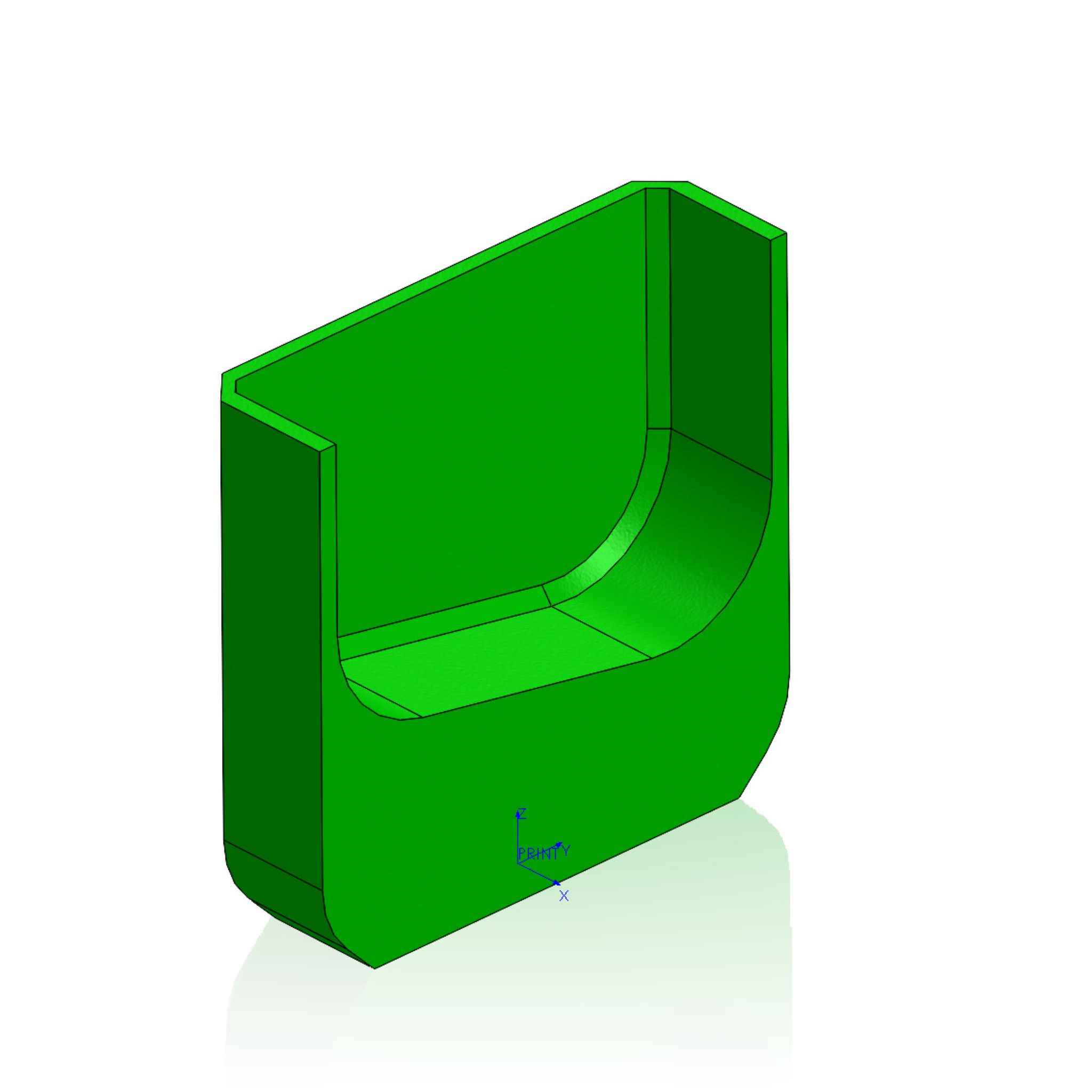
- Metabin fits inside the plano 3700 download CAD on grabCAD
- for info on variations & corresponding Part Numbers in the Plano Boxes PDF
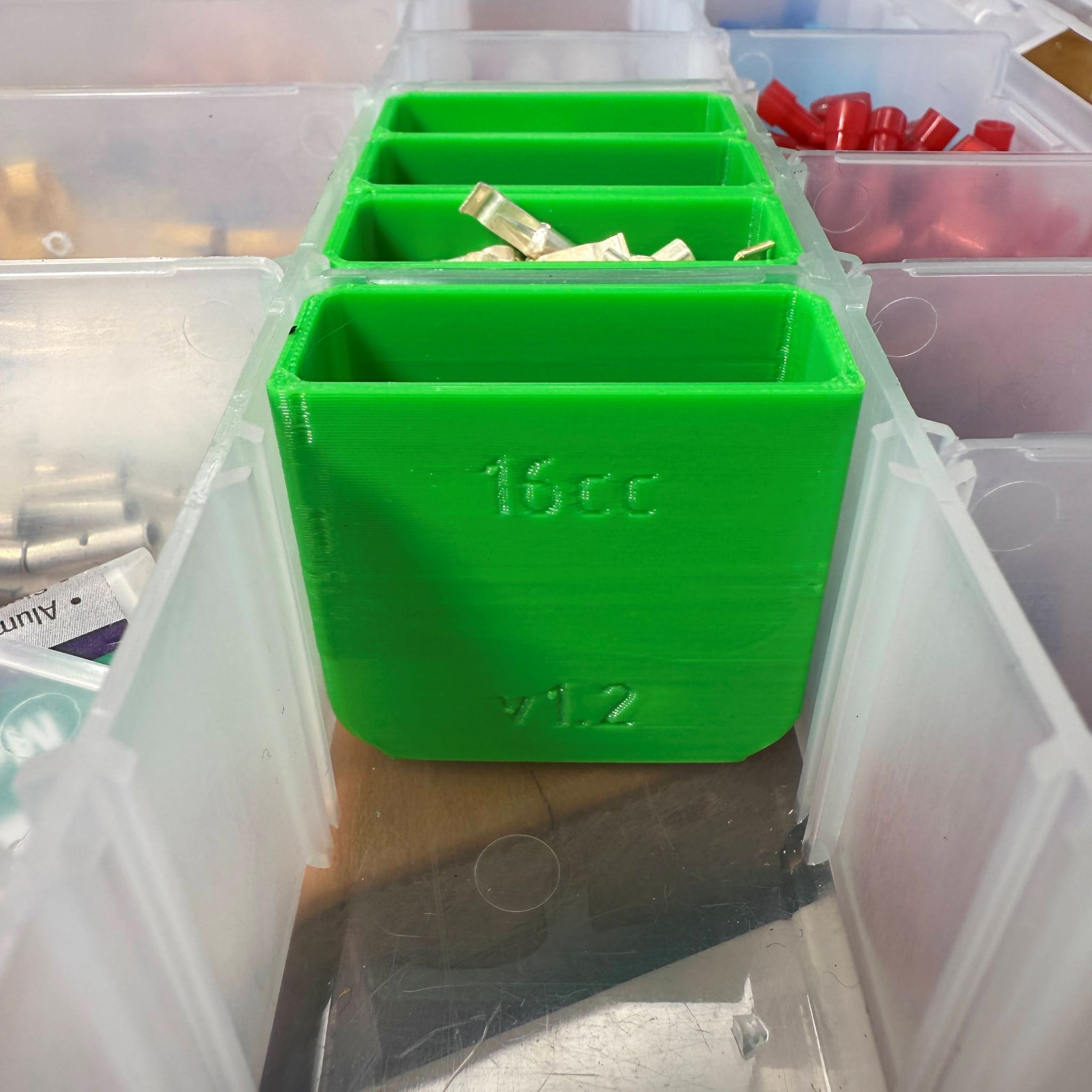
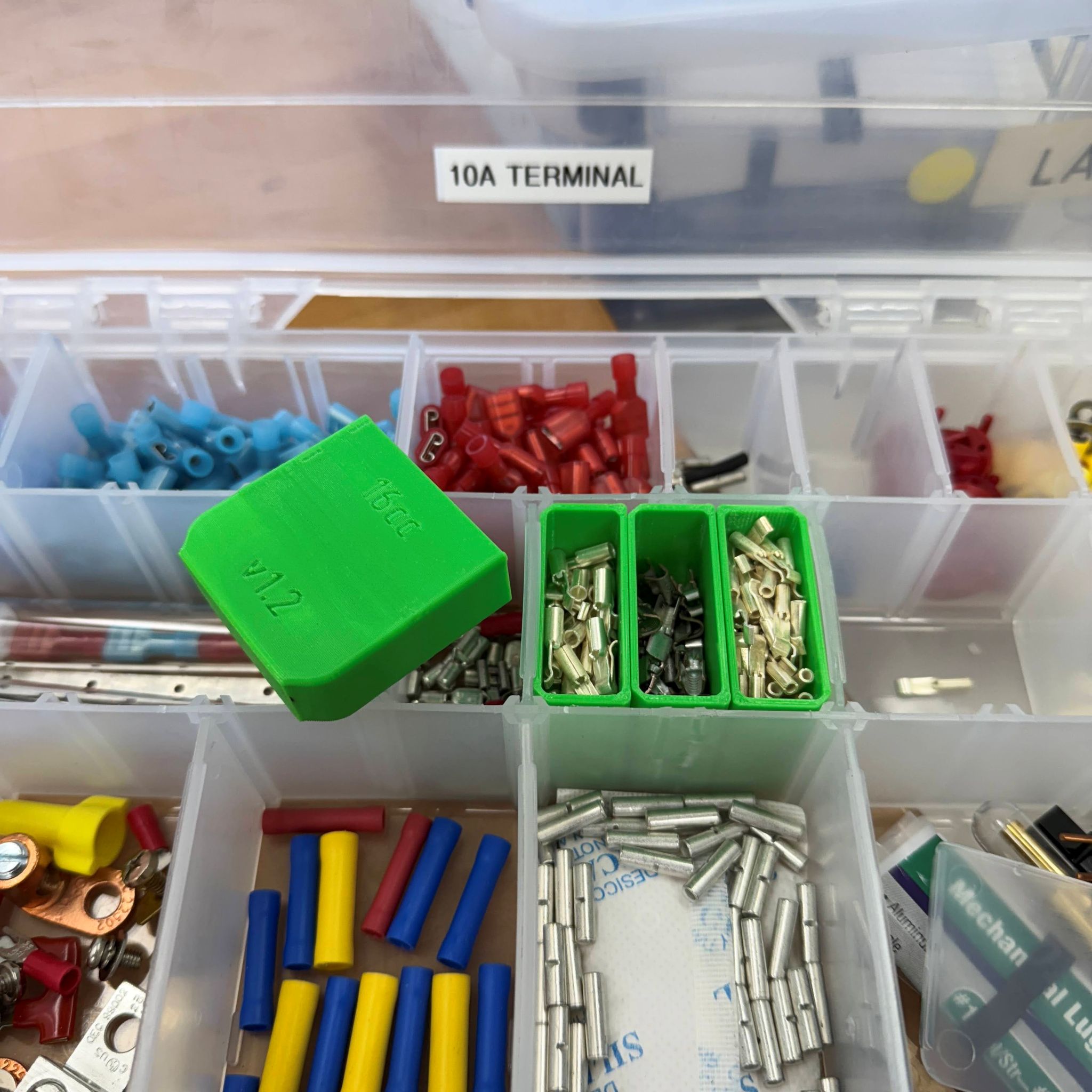
Images below show the Metabin inside Plano Bins. The metabin has a shallow and deep variant (16cc) with the volume reduced for accessing tiny parts.
These designs accomodate our interchangeable tool bits like hex drive bits and classic sockets.
- Hex rack stores common hex bits on DIN rail, bits size 1/4in for standard drills & drivers, for easy reach.
- Socket Hanger mates with standard socket rails, adjustable for balancing weight and vertical hanging.
- Bit Box is a component of the OpenBox Project series of designs, fits in the handybox & stores bulk quantity of hex bits.