Name
AI驱动的动态波动率适应型趋势突破交易策略-AI-Driven-Dynamic-Volatility-Adaptive-Trend-Breakout-Trading-Strategy
Author
ianzeng123
Strategy Description
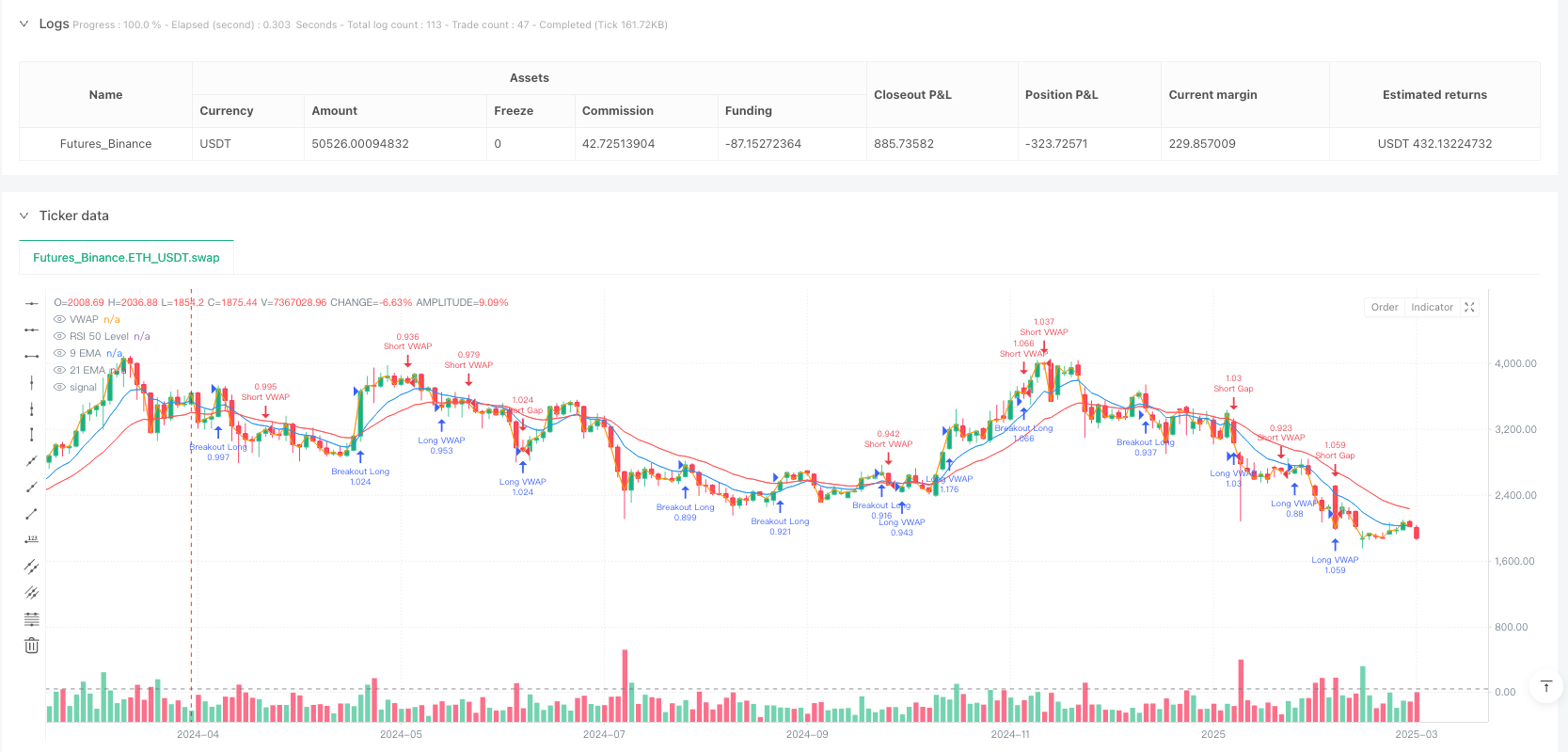
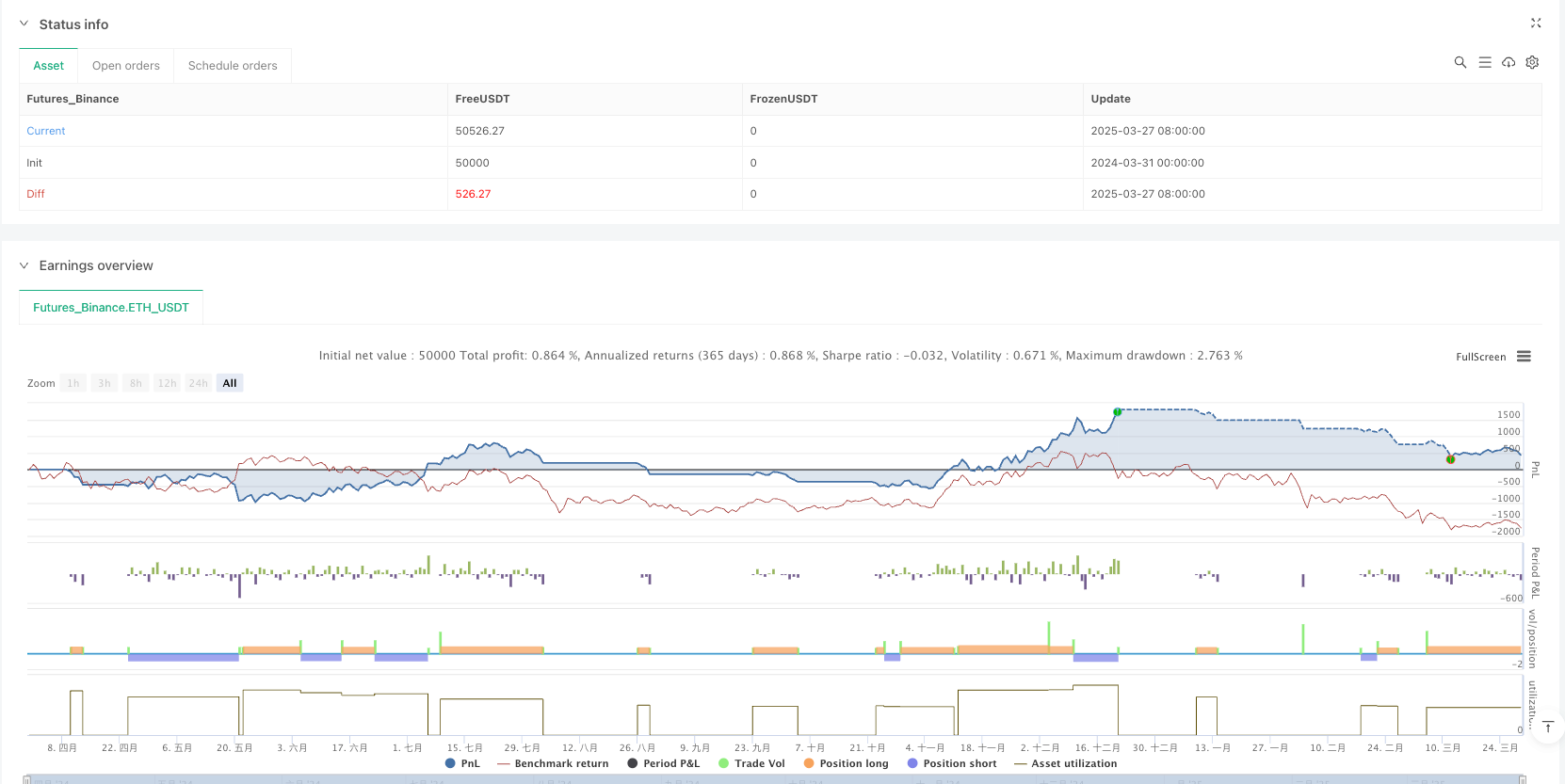
[trans]
该策略是一个AI增强型交易系统,结合了多重市场条件分析和动态风险管理功能。它主要利用EMA(指数移动平均线)、VWAP(成交量加权平均价格)和波动率指标ATR(真实波动幅度均值)来识别市场趋势和潜在的交易机会。策略融合了缺口回补交易、VWAP动量交易以及波动率压缩突破交易三种核心交易逻辑,并通过AI辅助的风险管理工具动态调整仓位大小,以适应不同的市场环境。
该策略的核心原理是通过多维度的市场分析来识别高胜率的交易机会,同时实施智能化的风险控制。具体来说,策略包含以下几个关键组件:
-
AI风险管理工具:通过比较当前ATR与其10日简单移动平均线的关系来评估市场波动性,并据此动态调整仓位大小。在高波动性环境下减小仓位,在低波动性环境下增加仓位,实现自适应风险控制。
-
市场状态检测:策略使用50日EMA与200日EMA之间的差值以及14日RSI指标来判断市场是处于上升趋势、下降趋势还是横盘整理状态,为后续交易决策提供市场环境参考。
-
波动率预测:通过监测ATR变化率是否超过当前ATR的50%来预判可能出现的显著价格波动,为交易决策提供前瞻性指导。
-
三种交易逻辑:
- 缺口回补交易:当出现较大缺口并且价格相对于VWAP处于特定位置时,策略会寻求均值回归机会。
- VWAP动量交易:当价格突破或跌破VWAP时,策略会跟随这一动量信号进行交易。
- 波动率压缩突破交易:当市场经历低流动性压缩后出现突破时,策略会捕捉这一爆发性机会。
-
智能止损止盈:基于ATR的倍数设置动态止损和止盈水平,使风险管理适应当前市场波动性。
深入分析该策略的代码实现,可以总结出以下显著优势:
-
多维度市场分析:结合技术指标、波动率分析和市场状态检测,全方位评估市场条件,提高信号质量。
-
自适应风险管理:通过AI辅助的动态仓位调整机制,有效应对不同波动率环境,在保持收益潜力的同时控制风险。
-
多元化交易逻辑:整合缺口、VWAP和波动率压缩三种不同的交易逻辑,使策略能够适应多种市场环境,不受单一市场条件限制。
-
前瞻性波动预测:通过ATR变化率监测潜在的大幅波动,为交易决策提供预警,有助于避开高风险时期或捕捉大行情。
-
可视化市场状态:策略提供直观的市场状态标签显示,帮助交易者快速了解当前市场环境,辅助决策。
-
精确的动态止损止盈:基于ATR的止损止盈设置确保风险回报比始终保持在合理水平,且能适应市场波动性的变化。
尽管该策略设计精密,但仍存在以下潜在风险和挑战:
-
假突破风险:在波动率压缩后的突破交易中,可能面临假突破问题,导致不必要的亏损。解决方法是增加确认指标,如成交量突破或多时间框架确认。
-
参数敏感性:EMA和ATR的周期设置对策略性能有显著影响,不同市场环境可能需要不同参数设置。建议通过回测在不同市场条件下优化参数。
-
缺口风险:依赖前一收盘价计算缺口大小可能在某些市场条件下不准确,特别是在重大新闻或周末发生重要事件后。可以考虑结合更多时间框架数据来提高缺口评估的准确性。
-
市场状态误判:在市场转换期,趋势强度指标可能滞后,导致市场状态判断不准确。可以引入额外的趋势确认指标减少误判。
-
波动率突变风险:在极端市场事件中,波动率可能突然剧增,超出策略预期范围,影响风险控制效果。建议设置绝对风险限制,无论ATR计算结果如何,都确保最大风险在可控范围。
基于对代码的深入分析,该策略可以在以下几个方向进行优化:
-
加入机器学习模型:将现有的AI概念升级为真正的机器学习模型,通过历史数据训练,优化对市场状态的判断和波动率预测的准确性。这样做的原因是当前的"AI"部分主要是基于规则的计算,引入机器学习可以捕捉更复杂的市场模式。
-
整合更多时间框架:在决策过程中考虑多个时间框架的信号,以减少假信号和提高交易精度。通过高时间框架确认低时间框架信号,可以显著提高策略的稳健性。
-
引入成交量分析:将成交量数据作为额外的确认因素,特别是在突破交易中,成交量突破通常能提供更可靠的信号。这样优化能减少假突破带来的损失。
-
优化市场状态检测:使用更复杂的算法(如自适应马尔科夫模型)来检测市场状态,取代简单的EMA差值判断,提高市场状态识别的准确性和及时性。
-
止损策略优化:实现跟踪止损功能,在趋势行情中保护已获利润,同时避免因市场噪音导致的过早出场。这种优化可以提高策略的盈亏比。
-
增加风险平衡机制:根据不同交易信号的历史表现动态调整资金分配,对历史上表现更好的信号类型分配更多资金。这种方法可以自适应地优化资金使用效率。
-
加入季节性分析:对于特定交易产品,考虑其历史季节性模式,在特定时期调整策略参数或信号阈值。这一优化可以利用市场的周期性特征提高胜率。
这个AI驱动的动态波动率适应型趋势突破交易策略是一个综合性的交易系统,通过整合多种技术指标、市场状态分析和动态风险管理,为交易者提供了一个全面的决策框架。它的核心优势在于自适应能力—无论是适应不同的市场状态还是波动率环境,策略都能做出相应调整。
策略结合了三种不同的交易逻辑,使其能够在不同市场条件下寻找机会,而AI辅助的风险管理确保了在追求收益的同时有效控制风险。通过实施建议的优化措施,特别是引入真正的机器学习模型、多时间框架分析和高级风险管理技术,该策略有潜力成为更加稳健和高效的交易工具。
对于希望在市场中建立系统化交易方法的交易者来说,这个策略提供了一个坚实的起点,其模块化设计允许根据个人交易风格和风险偏好进行定制和扩展。值得注意的是,虽然策略包含"AI"元素,但要充分发挥其潜力,还需要进一步整合真正的机器学习技术,以实现更精确的市场分析和预测。 ||
This strategy is an AI-enhanced trading system that combines multiple market condition analyses with dynamic risk management capabilities. It primarily utilizes EMA (Exponential Moving Average), VWAP (Volume Weighted Average Price), and the volatility indicator ATR (Average True Range) to identify market trends and potential trading opportunities. The strategy integrates three core trading logics: gap fill trading, VWAP momentum trading, and volatility compression breakout trading, while using AI-assisted risk management tools to dynamically adjust position sizes to adapt to different market environments.
The core principle of this strategy is to identify high-probability trading opportunities through multi-dimensional market analysis while implementing intelligent risk control. Specifically, the strategy includes the following key components:
-
AI Risk Management Tool: Evaluates market volatility by comparing the current ATR with its 10-day simple moving average, and dynamically adjusts position sizes accordingly. It reduces positions in high-volatility environments and increases them in low-volatility environments, achieving adaptive risk control.
-
Market Regime Detection: The strategy uses the difference between the 50-day EMA and 200-day EMA, along with the 14-day RSI indicator, to determine whether the market is in an uptrend, downtrend, or ranging state, providing market context for subsequent trading decisions.
-
Volatility Forecasting: Predicts significant price movements by monitoring whether the ATR change rate exceeds 50% of the current ATR, providing forward-looking guidance for trading decisions.
-
Three Trading Logics:
- Gap Fill Trading: When a significant gap occurs and the price is at a specific position relative to VWAP, the strategy seeks mean reversion opportunities.
- VWAP Momentum Trading: When the price breaks above or below VWAP, the strategy follows this momentum signal for trading.
- Volatility Compression Breakout Trading: When the market experiences a breakout after low liquidity compression, the strategy captures this explosive opportunity.
-
Intelligent Stop-Loss and Take-Profit: Sets dynamic stop-loss and take-profit levels based on ATR multiples, adapting risk management to current market volatility.
Analyzing the code implementation of this strategy, the following significant advantages can be summarized:
-
Multi-dimensional Market Analysis: Combines technical indicators, volatility analysis, and market regime detection to comprehensively evaluate market conditions and improve signal quality.
-
Adaptive Risk Management: Effectively handles different volatility environments through AI-assisted dynamic position adjustment mechanisms, controlling risk while maintaining profit potential.
-
Diversified Trading Logic: Integrates three different trading logics—gap, VWAP, and volatility compression—enabling the strategy to adapt to various market environments without being limited to a single market condition.
-
Forward-looking Volatility Prediction: Monitors potential large fluctuations through ATR change rates, providing early warnings for trading decisions, helping to avoid high-risk periods or capture major market moves.
-
Visualization of Market State: Provides intuitive market state label displays, helping traders quickly understand the current market environment to aid decision-making.
-
Precise Dynamic Stop-Loss and Take-Profit: ATR-based stop-loss and take-profit settings ensure that risk-reward ratios always remain at reasonable levels and can adapt to changes in market volatility.
Despite its sophisticated design, the strategy still faces the following potential risks and challenges:
-
False Breakout Risk: In breakout trading after volatility compression, there may be false breakouts leading to unnecessary losses. The solution is to add confirmation indicators, such as volume breakouts or multi-timeframe confirmation.
-
Parameter Sensitivity: EMA and ATR period settings significantly impact strategy performance, and different market environments may require different parameter settings. It is recommended to optimize parameters through backtesting under different market conditions.
-
Gap Risk: Relying on the previous closing price to calculate gap size may be inaccurate under certain market conditions, especially after major news or important weekend events. Consider incorporating data from multiple timeframes to improve the accuracy of gap assessment.
-
Market Regime Misjudgment: During market transitions, trend strength indicators may lag, leading to inaccurate market state judgments. Additional trend confirmation indicators can be introduced to reduce misjudgments.
-
Volatility Mutation Risk: In extreme market events, volatility may suddenly increase dramatically, exceeding the expected range of the strategy and affecting the effectiveness of risk control. It is advisable to set absolute risk limits to ensure maximum risk remains controllable regardless of ATR calculation results.
Based on in-depth analysis of the code, the strategy can be optimized in the following directions:
-
Incorporate Machine Learning Models: Upgrade the existing AI concepts to true machine learning models, trained on historical data, to optimize the accuracy of market state judgment and volatility prediction. This is because the current "AI" portions are primarily rule-based calculations; introducing machine learning can capture more complex market patterns.
-
Integrate Multiple Timeframes: Consider signals from multiple timeframes in the decision-making process to reduce false signals and improve trading precision. Confirming lower timeframe signals with higher timeframe analysis can significantly enhance the robustness of the strategy.
-
Introduce Volume Analysis: Use volume data as an additional confirmation factor, especially in breakout trading, as volume breakouts typically provide more reliable signals. This optimization can reduce losses from false breakouts.
-
Optimize Market Regime Detection: Use more complex algorithms (such as adaptive Markov models) to detect market states, replacing simple EMA difference judgments to improve the accuracy and timeliness of market state recognition.
-
Stop-Loss Strategy Optimization: Implement trailing stop-loss functionality to protect profits in trending markets while avoiding premature exits due to market noise. This optimization can improve the strategy's profit-to-loss ratio.
-
Add Risk Balancing Mechanism: Dynamically adjust capital allocation based on the historical performance of different signal types, allocating more capital to historically better-performing signal types. This approach can adaptively optimize capital utilization efficiency.
-
Add Seasonality Analysis: For specific trading products, consider their historical seasonal patterns to adjust strategy parameters or signal thresholds during specific periods. This optimization can leverage market cyclical characteristics to improve win rates.
This AI-driven dynamic volatility-adaptive trend breakout trading strategy is a comprehensive trading system that provides traders with a complete decision-making framework by integrating multiple technical indicators, market state analysis, and dynamic risk management. Its core advantage lies in its adaptability—whether adapting to different market states or volatility environments, the strategy can make corresponding adjustments.
The strategy combines three different trading logics, allowing it to find opportunities under different market conditions, while AI-assisted risk management ensures effective risk control while pursuing returns. By implementing the suggested optimization measures, especially introducing true machine learning models, multi-timeframe analysis, and advanced risk management techniques, the strategy has the potential to become a more robust and efficient trading tool.
For traders looking to establish systematic trading methods in the market, this strategy provides a solid starting point, with its modular design allowing for customization and expansion according to personal trading styles and risk preferences. It is worth noting that although the strategy contains "AI" elements, to fully realize its potential, further integration of true machine learning technology is needed to achieve more precise market analysis and prediction.[/trans]
Source (PineScript)
/*backtest
start: 2024-03-31 00:00:00
end: 2025-03-29 08:00:00
period: 2d
basePeriod: 2d
exchanges: [{"eid":"Futures_Binance","currency":"ETH_USDT"}]
*/

//@version=6
strategy("AI-Enhanced NKD CME Trading Strategy", overlay=true)

// ? Input Parameters
fastEMA = input(9, title="Fast EMA Length")
slowEMA = input(21, title="Slow EMA Length")
atrMultiplierSL = input(1.5, title="ATR Multiplier for Stop Loss")
atrMultiplierTP = input(3, title="ATR Multiplier for Take Profit")
atrLen = input(14, title="ATR Length")

// ? AI-Based Risk Management Tool
// Adjusts position sizes dynamically based on volatility
riskFactor = ta.sma(ta.atr(14), 10) / ta.atr(14)
positionSize = 1 / riskFactor  // Smaller size in high volatility, larger in low volatility

// ? AI-Powered Market Regime Detection
// Detects if the market is trending, ranging, or mean-reverting
trendStrength = ta.ema(close, 50) - ta.ema(close, 200)
rsiTrend = ta.rsi(close, 14)
marketRegime = trendStrength > 0 ? "Trending Up" : trendStrength < 0 ? "Trending Down" : "Range"

// ? AI-Powered Volatility Forecasting
// Uses ATR spikes to detect upcoming high-impact moves
volatilitySpike = ta.change(ta.atr(atrLen)) > ta.atr(atrLen) * 0.5  // ATR jump > 50% indicates potential spike

// ? Indicators Calculation
emaFast = ta.ema(close, fastEMA)
emaSlow = ta.ema(close, slowEMA)
vw = ta.vwap(close)
atr = ta.atr(atrLen)

// ? Gap Resolution Trade Logic
preMarketClose = request.security(syminfo.tickerid, "30", close[1])
gapSize = math.abs(close - preMarketClose)

// Long Entry: Gap Down Mean Reversion
longGapCondition = close > emaFast and gapSize > 50 and close < vw
shortGapCondition = close < emaFast and gapSize > 50 and close > vw

// ? VWAP Momentum Trade Logic
longVWAPCondition = ta.crossover(close, vw)
shortVWAPCondition = ta.crossunder(close, vw)

// ? Volatility Compression Squeeze
lowLiquidityCondition = ta.lowest(low, 10) == low and gapSize < 30
breakoutCondition = ta.highest(high, 10) == high and gapSize > 30

// ? Risk Management (AI-Driven)
longStopLoss = close - (atrMultiplierSL * atr)
longTakeProfit = close + (atrMultiplierTP * atr)

shortStopLoss = close + (atrMultiplierSL * atr)
shortTakeProfit = close - (atrMultiplierTP * atr)

// ? Strategy Execution with AI Risk Management
if longGapCondition and positionSize > 0
    strategy.entry("Long Gap", strategy.long, qty=positionSize)
    strategy.exit("Exit Long", from_entry="Long Gap", stop=longStopLoss, limit=longTakeProfit)

if shortGapCondition and positionSize > 0
    strategy.entry("Short Gap", strategy.short, qty=positionSize)
    strategy.exit("Exit Short", from_entry="Short Gap", stop=shortStopLoss, limit=shortTakeProfit)

if longVWAPCondition and positionSize > 0
    strategy.entry("Long VWAP", strategy.long, qty=positionSize)
    strategy.exit("Exit Long VWAP", from_entry="Long VWAP", stop=longStopLoss, limit=longTakeProfit)

if shortVWAPCondition and positionSize > 0
    strategy.entry("Short VWAP", strategy.short, qty=positionSize)
    strategy.exit("Exit Short VWAP", from_entry="Short VWAP", stop=shortStopLoss, limit=shortTakeProfit)

if breakoutCondition and positionSize > 0
    strategy.entry("Breakout Long", strategy.long, qty=positionSize)
    strategy.exit("Exit Breakout", from_entry="Breakout Long", stop=longStopLoss, limit=longTakeProfit)

// ? Visualization (Fixed xloc.bar issue)
plot(emaFast, color=color.blue, title="9 EMA")
plot(emaSlow, color=color.red, title="21 EMA")
plot(vw, color=color.orange, title="VWAP")
hline(50, "RSI 50 Level", color=color.gray)

// ✅ Fix for xloc.bar Issue
// Pine Script does not allow labels or text to be drawn using xloc.bar, so we use a regular label with dynamic updates
var label marketLabel = label.new(x=bar_index, y=high, text="", color=color.white, textcolor=color.black, size=size.small)
label.set_text(marketLabel, "Market Regime: " + marketRegime)
label.set_x(marketLabel, bar_index)
label.set_y(marketLabel, high)
Detail
https://www.fmz.com/strategy/488865
Last Modified
2025-03-31 13:17:17