Name
ATR均线突破策略-ATR-Average-Breakout-Strategy
Author
ChaoZhang
Strategy Description
[trans]
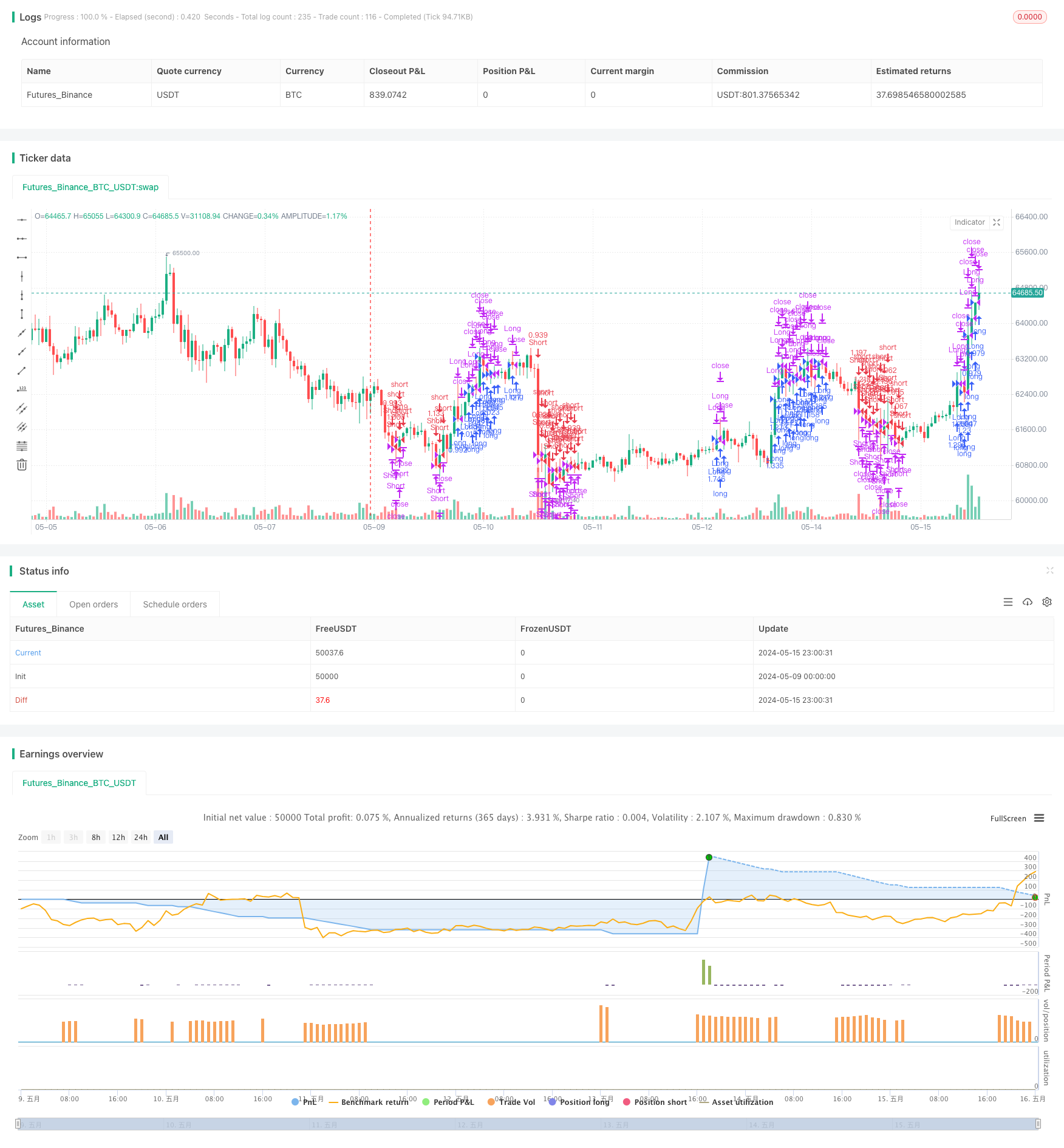
该策略主要利用ATR(Average True Range,平均真实波动范围)和SMA(Simple Moving Average,简单移动平均线)两个指标来判断市场的整理和突破,从而进行交易。策略的主要思路是:当价格突破ATR上下轨时,认为市场发生突破,进行开仓;当价格回到ATR轨道内时,认为市场进入整理,平仓离场。同时,策略还使用了风险控制和仓位管理,以控制每笔交易的风险和仓位大小。
- 计算ATR指标和SMA指标,ATR用于判断市场的波动性,SMA用于判断市场的平均价格水平。
- 根据ATR和SMA计算上下轨,上轨为SMA + ATR * multiplier,下轨为SMA - ATR * multiplier,multiplier为用户自定义的倍数。
- 判断市场是否处于整理状态,当最高价低于上轨且最低价高于下轨时,认为市场处于整理状态。
- 判断市场是否发生突破,当最高价突破上轨时,认为发生向上突破;当最低价跌破下轨时,认为发生向下突破。
- 根据突破情况进行开仓,向上突破开多仓,向下突破开空仓。
- 根据止损和止盈条件进行平仓,当价格触及止损价格(SMA - ATR * stop_loss_percentage)或止盈价格(SMA + ATR * take_profit_percentage)时,平仓离场。
- 根据用户自定义的风险比例(risk_percentage)计算每笔交易的风险金额(risk_per_trade),然后根据ATR计算仓位大小(position_size)。
- 策略逻辑清晰,易于理解和实现。
- 使用ATR指标判断市场波动性,能够适应不同的市场状况。
- 使用SMA指标判断市场平均价格水平,能够跟踪市场的主要趋势。
- 在开仓时考虑了市场的整理状态,能够避免在震荡市场中频繁交易。
- 使用了止损和止盈,能够有效控制每笔交易的风险。
- 使用了仓位管理,能够根据账户资金和风险比例自动调整仓位大小。
- 策略在震荡市场中表现可能不佳,因为频繁的突破和整理可能导致频繁的开仓和平仓,从而增加交易成本。
- 策略的参数设置对策略表现有很大影响,不同的参数可能导致完全不同的结果,因此需要仔细调试和优化参数。
- 策略的止损和止盈设置可能不够灵活,固定的百分比止损和止盈可能无法适应不同的市场状况。
- 策略的仓位管理可能过于简单,没有考虑市场趋势和波动性等因素,可能导致在某些情况下仓位过大或过小。
- 可以考虑添加趋势过滤条件,例如只在趋势向上时开多仓,在趋势向下时开空仓,以避免在震荡市场中频繁交易。
- 可以考虑使用更加灵活的止损和止盈方式,例如根据ATR或者市场波动性动态调整止损和止盈距离,以适应不同的市场状况。
- 可以考虑使用更加复杂的仓位管理方法,例如根据市场趋势和波动性调整仓位大小,以控制风险和提高收益。
- 可以考虑添加其他过滤条件,例如交易量、波动率等,以进一步提高策略的可靠性和稳定性。
该策略使用ATR和SMA两个简单的指标,通过判断价格突破和整理来进行交易,同时使用了风险控制和仓位管理来控制每笔交易的风险和仓位大小。策略逻辑清晰,易于理解和实现,但是在实际应用中可能存在一些问题,例如在震荡市场中表现不佳,参数设置对策略表现影响很大,止损和止盈设置不够灵活,仓位管理过于简单等。因此,在实际应用中需要根据具体情况进行优化和改进,例如添加趋势过滤条件,使用更加灵活的止损和止盈方式,使用更加复杂的仓位管理方法,添加其他过滤条件等,以提高策略的可靠性和稳定性。
||
This strategy mainly uses two indicators, ATR (Average True Range) and SMA (Simple Moving Average), to determine the consolidation and breakout of the market and make trades accordingly. The main idea of the strategy is: when the price breaks through the upper or lower ATR channel, it is considered a breakout and a position is opened; when the price returns to the ATR channel, it is considered a consolidation and the position is closed. At the same time, the strategy also uses risk control and position management to control the risk and position size of each trade.
- Calculate the ATR and SMA indicators. ATR is used to determine the volatility of the market, while SMA is used to determine the average price level of the market.
- Calculate the upper and lower bounds based on ATR and SMA. The upper bound is SMA + ATR * multiplier, and the lower bound is SMA - ATR * multiplier, where multiplier is a user-defined multiple.
- Determine whether the market is in a consolidation state. When the highest price is lower than the upper bound and the lowest price is higher than the lower bound, the market is considered to be in a consolidation state.
- Determine whether a breakout has occurred in the market. When the highest price breaks above the upper bound, it is considered an upward breakout; when the lowest price breaks below the lower bound, it is considered a downward breakout.
- Open positions based on the breakout situation. Open a long position for an upward breakout and a short position for a downward breakout.
- Close positions based on stop-loss and take-profit conditions. When the price reaches the stop-loss price (SMA - ATR * stop_loss_percentage) or the take-profit price (SMA + ATR * take_profit_percentage), close the position.
- Calculate the risk amount (risk_per_trade) for each trade based on the user-defined risk percentage (risk_percentage), and then calculate the position size (position_size) based on ATR.
- The strategy logic is clear and easy to understand and implement.
- The use of the ATR indicator to determine market volatility allows the strategy to adapt to different market conditions.
- The use of the SMA indicator to determine the average price level of the market allows the strategy to track the main trend of the market.
- The consideration of the consolidation state of the market when opening positions helps avoid frequent trading in a choppy market.
- The use of stop-loss and take-profit effectively controls the risk of each trade.
- The use of position management allows for automatic adjustment of position size based on account funds and risk percentage.
- The strategy may not perform well in a choppy market because frequent breakouts and consolidations may lead to frequent opening and closing of positions, thereby increasing trading costs.
- The parameter settings of the strategy have a significant impact on its performance. Different parameters may lead to completely different results, so careful debugging and optimization of parameters are required.
- The stop-loss and take-profit settings of the strategy may not be flexible enough. Fixed percentage stop-loss and take-profit may not be able to adapt to different market conditions.
- The position management of the strategy may be too simple and does not consider factors such as market trend and volatility, which may lead to oversized or undersized positions in some cases.
- Consider adding trend filtering conditions, such as only opening long positions when the trend is up and short positions when the trend is down, to avoid frequent trading in a choppy market.
- Consider using more flexible stop-loss and take-profit methods, such as dynamically adjusting the stop-loss and take-profit distances based on ATR or market volatility, to adapt to different market conditions.
- Consider using more complex position management methods, such as adjusting position size based on market trend and volatility, to control risk and increase profit.
- Consider adding other filtering conditions, such as trading volume and volatility, to further improve the reliability and stability of the strategy.
This strategy uses two simple indicators, ATR and SMA, to make trades by determining price breakouts and consolidations, while using risk control and position management to control the risk and position size of each trade. The strategy logic is clear and easy to understand and implement, but there may be some problems in actual application, such as poor performance in a choppy market, significant impact of parameter settings on strategy performance, inflexible stop-loss and take-profit settings, and overly simple position management. Therefore, in actual application, it is necessary to optimize and improve based on specific situations, such as adding trend filtering conditions, using more flexible stop-loss and take-profit methods, using more complex position management methods, adding other filtering conditions, etc., to improve the reliability and stability of the strategy. [/trans]
Source (PineScript)
/*backtest
start: 2024-05-09 00:00:00
end: 2024-05-16 00:00:00
period: 1h
basePeriod: 15m
exchanges: [{"eid":"Futures_Binance","currency":"BTC_USDT"}]
*/

//@version=5
strategy("Consolidation Breakout Strategy", overlay=true)

// Input Parameters
length = input.int(20, "Length", minval=1)
multiplier = input.float(2.0, "Multiplier", minval=0.1, maxval=10.0)
risk_percentage = input.float(1.0, "Risk Percentage", minval=0.1, maxval=10.0)
stop_loss_percentage = input.float(1.0, "Stop Loss Percentage", minval=0.1, maxval=10.0)
take_profit_percentage = input.float(2.0, "Take Profit Percentage", minval=0.1, maxval=10.0)

// ATR calculation
atr_value = ta.atr(length)

// Average price calculation
average_price = ta.sma(close, length)

// Upper and lower bounds for consolidation detection
upper_bound = average_price + multiplier * atr_value
lower_bound = average_price - multiplier * atr_value

// Consolidation detection
is_consolidating = (high < upper_bound) and (low > lower_bound)

// Breakout detection
is_breakout_up = high > upper_bound
is_breakout_down = low < lower_bound

// Entry conditions
enter_long = is_breakout_up and not is_consolidating
enter_short = is_breakout_down and not is_consolidating

// Exit conditions
exit_long = low < (average_price - atr_value * stop_loss_percentage) or high > (average_price + atr_value * take_profit_percentage)
exit_short = high > (average_price + atr_value * stop_loss_percentage) or low < (average_price - atr_value * take_profit_percentage)

// Risk calculation
risk_per_trade = strategy.equity * (risk_percentage / 100)
position_size = risk_per_trade / atr_value

// Strategy
if (enter_long)
    strategy.entry("Long", strategy.long, qty=position_size)
if (enter_short)
    strategy.entry("Short", strategy.short, qty=position_size)

if (exit_long)
    strategy.close("Long")
if (exit_short)
    strategy.close("Short")
Detail
https://www.fmz.com/strategy/451698
Last Modified
2024-05-17 10:22:11