
Welcome to the Great Northwest Baking Show!
For the first time ever, the global baking competition phenomenon is going local with a season focusing on the amateur bakers of the Pacific Northwest region of the United States.
Everything was lined up to make this season a smash-hit. With a gorgeous shooting location of Lakewood, WA’s Thornewood Castle and a superstar judging lineup that included of Baking Show legend Paul Holyroot, this was going to be the best season of the Baking Show yet.
At least, that was the plan. Alas, late on the night before the finale was to be shot, Paul Holyroot was discovered dead in his personal dressing room by one of his co-hosts. The blood splattered across the room left little room for doubt – this was a murder.
The detectives have been called.
The crime scene has been locked down.
Now day is breaking and one thing has been made clear – no one is leaving here until the murderer has been found.
The Great Northwest Baking Show is a murdery mystery party designed to be played socially-distanced over video chat. A murder has occurred at the filming location of the new season of the hit baking competition show, and the players are all suspects in that murder! Each player must prove their innocence by exploring a digital crime scene, collecting clues, and building a case against the true killer. At the end of the game, the players will vote to determine who they believe the murderer to be -- if they catch the real killer, the killer is arrested and everyone who voted for them wins. If not, an innocent person is sent to jail, and the murderer wins instead.
By customizing the included Twine project and uploading it somewhere on the web, you can run this unique mystery experience for your own friends.
- The Great Northwest Baking Show is designed for 6-8 players plus a moderator.
- The game takes around 3 hours to play in total.
- The game is run over group video chat. We used Discord, and this documentation will assume you are too, but it should convert cleanly to other popular video chat platforms (Zoom, etc.).
- You will need somewhere to upload your Twine project so that your players can explore your customized crime scene.
- The Great Northwest Baking Show is designed to be played by adults -- think a light R or 15 film rating. It features swearing, textual descriptions of dead bodies and blood, along with themes of substance abuse, infidelity, and suicidal ideation related to certain characters. Please ensure that all of your players are informed and comfortable with this content before playing this mystery. Improv and roleplaying games (such as murder mystery parties) can be very intense for players, and you don't want to spring potentially triggering content on people unawares.
- Much of the game's structure is based on the excellent Korean investigative game show Crime Scene, which I highly recommend you check out if you're a fan of mystery games.
All of the players investigate the crime scene together, searching for clues, presenting the evidence that they discover, and running interrogations to try to poke holes in each other’s alibis.
The goal of the innocent suspects is to discover the killer’s true identity and successfully arrest them via a plurality vote at the end of the game. If the murderer is arrested at the end of the game, all of the players who voted for the murderer win the game.
The goal of the murderer is to avoid suspicion and ultimately get an innocent suspect arrested instead. If someone other than the murderer is arrested at the end of the game, the murderer wins.
There is one key rule that is important to keep in mind: only the murderer is allowed to lie.
While there is only one murderer, innocent suspects may also have personal secrets that they would prefer remain hidden. As such, although they are not allowed to lie, innocent suspects are allowed to be otherwise evasive by providing incomplete answers, misdirecting other players, or even refusing to answer questions point-blank. It is worth noting that all of these tactics may make you more suspicious than if you had just answered the question directly, however.
If an innocent suspect does accidentally lie and realizes it after the fact, they must attempt to correct the lie as soon as possible, regardless of how suspicious it may appear to do so.
The game takes place over multiple phases, each representing a new step of the murder investigation. Each of these phases is proctored by the game master. (If you're reading this, this probably means you!) The game master exists outside of the world of the story and should remain an unbiased observer over the events. As their only role is to facilitate the game and make sure that everyone has as much fun as possible, it is important that all the other players carefully follow any instructions that the game master gives. It is also important that the players do not lie to the game master.
If playing with more than six players, some players may be playing the Detective and the Detective’s Assistant. These players will join the suspects in investigating the crime scene and voting on who they believe the criminal to be. However, they are not suspects themselves, and it is guaranteed that neither of them is the killer.
Here are the phases of the game, along with rough estimates of the time allotted for each phase:
- Initial introductions and presentation of alibis: ~15 minutes
- If the Detective is playing, they may ask each player to introduce themselves and explain their alibi in turn. If no Detective is present or if they are not comfortable doing so, the game master should lead the introductions instead.
- First round of crime scene investigation: ~15 minutes
- Presentation of initial findings: ~20 minutes
- Second round of crime scene investigation: ~15 minutes
- Presentation of secondary findings: ~20 minutes
- Final round of crime scene investigation: ~25 minutes
- During this round, the Detective and the Detective’s Assistant are free to invite suspects into the Interrogation Room for a private discussion.
- Final deliberations and discussion: ~15 minutes
- All players submit their votes for who they believe to be the killer: ~5 minutes
- The killer is revealed and the winners are announced
First thing's first -- who's going to play in your game? Remember that you need between 6 and 8 players to run a full game!
You'll want to reach out to each of your potential guests, tell them a bit about the game, and send them a link to a scheduling tool such as WhenIsGood or Doodle to establish what times would work well for them.
You can use the game pitch to make pitching the game easy as filling in a couple blanks and hitting send.
You will need a video chat service to use during the game. We recommend using Discord, and have provided a Discord template that you can use to automatically configure a server to match the requirements of The Great Northwest Baking Show.
While the game can be played with all of the players in a single group call the whole time, it is preferable that you are able to split the players up so that they can discuss and conspire amongst each other secretly during the game. To do that, we recommend using a video chat service that allows players to separate into multiple groups and configruing the following group areas:
- A group chat area where everyone can meet to discuss things openly between investigations
- Three smaller 'group' areas where players can talk during investigations (3 players max)
- One area per suspect character that the player controlling that character can use to invite people to have private discussions (3 players max)
- One Interrogation Room that the Detective and Detective's Assistant can pull suspects into to interrogate them during the third investigation round (3 players max)
If you use the Discord template, all of these areas will be created for you automatically. It also has an @gm role configured that you can grant to yourself, which will enable you to enter any of the discussion areas, regardless of the current player count.
Once you have the requisite 6-8 players signed up and a date selected, you'll need to assign each player a character that will be a good fit for them. To make sure everyone gets a character that they will enjoy playing, you'll want to try and pick characters that optimize for each player's interest and their comfort.
We've built a simple a simple Google Forms survey that you can send to your players to determine how comfortable each player is with lying and what characters most appeal to them. To use this survey, go to this link and hit Make a copy to create a duplicate copy that you can adjust and send out to your players.
This is also the point where you should tell the players more details about how the game is run and what kinds of content they should be prepared to expect. We recommend filling out this template to make sure you include all of the key details.
Once each player has completed their surveys, it is time to assign everyone the characters that they will be playing. Again, it is important to do your best to assign each player a character that will maximize their interest and comfort. Always prioritize comfort first -- it's better to assign a player a character that they're not so excited about than one that they are excited about that will make them feel uncomfortable or unsafe!
To help you assign players the right characters, you can check this list of character summaries, which includes information about how much lying is involved in playing each character and what potentially triggering content their player may be forced to closely engage with.
By comparing each player's survey answers to the list of characters, it should be relatively easy to assign everyone a character who will be a good match for their comfort and interest levels. Since the murderer is the most important and hardest role to play, we recommend assigning that first, and then fitting everyone else to the remaining role that is the best match.
Remember that the Detective is only available if you have 7 or more players, and the Detective's Assistant is only available with a full 8 players. If you have more than 8 players, you can assign multiple Detective's Assistants, but note that this is not intended and the game is likely to be slower, more chaotic, and potentially harder for the murderer to escape justice than is intended.
Once you have assigned each player their character, you will want to send them their character packet! The character packets contain everything that the player will need in order to play their character, including the full rules of the game, along with their character's backstory, alibis, and dark secrets.
You can get the link to each player's character packet from this list. You can send them the link to the original file or use it to make a copy that you control. Either should be fine, but if you wish to make any edits to the character packets, you will need to make your own copy.
Once you have a link to each player's character packet, you can send it to them using one of these templates:
Before you can play, you must customize the Twine project so that your players can explore an immersive crime scene environment that reflects their character assignments. (In other words, you need to copy-paste everyone's names into the project so that it refers to everyone by the right name. 😃)
If you have not downloaded Twine before, you should install it from Twinery.org. Make sure you have version 2.3.9 or later -- previous versions have a bug with the Chapbook story format that will prevent the game from running correctly.
Next, download the Great Northwest Baking Show Twine project by right-clicking this link, hitting Save As, and downloading it to your Twine stories directory (Documents/Twine/Stories on both PC and Mac).

Open Twine and select the Great Northwest Baking Show project.
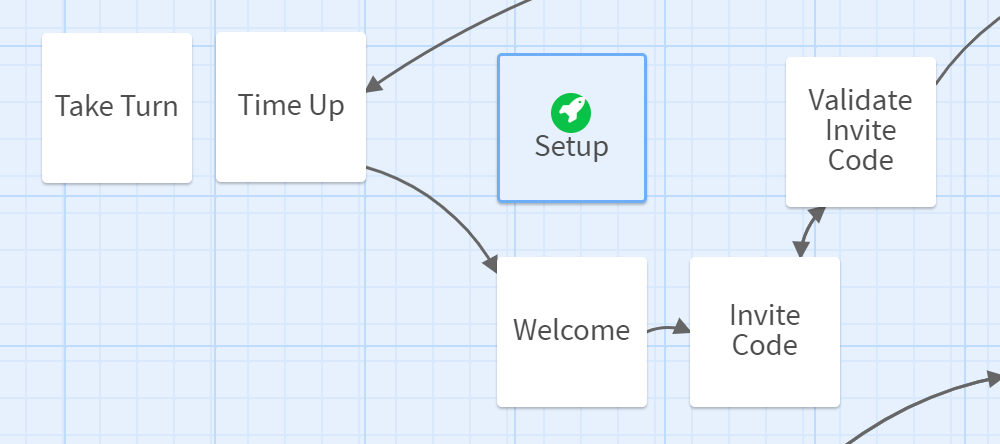
Double-click the node labeled Setup to open the script editor.

The Setup node contains all of the customizable game state. At a minimum, you should update each of the character names to match the players playing those characters.
If you wish, you can also update certain other elements, such as the name of The YouTuber's channel or the names of various non-player characters (NPCs). For instance, if an NPC shares a name with one of your players, you may wish to change the NPC's name to avoid potential confusion. Please note that these additional customizable elements are also referenced in the character packets, so you will want to also update the packets to reflect any changes that you make here. The player names are not referenced in the character packets, so you will not need to change the packets if all you change are the player names.
Feel free to press the Test or Play buttons at any time to verify that the game runs correctly with your changes.

When you have made all of the changes that you wish to make, you will need to publish the Twine project and upload it somewhere on the web. To publish the project, click on the large arrow next to the project title at the bottom of the screen, then select Publish to File. This will export the project as an HTML file that you can upload to any web server and share with your players on game day.
When the big day comes around, it's your responsibility as the game master to make sure the game runs smoothly! Fortunately, a lot of The Great Northwest Baking Show essentially runs itself -- your job is mostly to post invite codes, manage timers, and try not to laugh too much while watching your friends accuse each other of murder!
To help simplify the process of running the game, we will break down your responsibilities round-by-round:
Encourage your players to join the video chat half an hour in advance in order to work out any technical issues and get their out-of-character socialization out of their systems before the game begins. Use this period to let your players chit chat amongst themselves and answer any questions that they may have about the game before it begins. If you have any players who do not know each other outside of the game, introduce them now.
Make sure to explain any private group chat areas that you have configured and how the players can make use of them. If you are using Discord, you should also remind your players that Discord automatically disconnects their video feed whenever they change rooms, and that they will need to re-enable their video whenever they do so.
If possible, ask your players to set their nickname on the video chat to match their names in the Twine project. This generally takes the format of "Role + First Name": "Comedian Paul", "Detective Maggie", etc. This will make it easier for the other players to match each player to the clues they discover during their investigation.
You may also wish to give players five minutes to review their character packets and ask you any questions they have before the game begins in earnest.
Try to end this phase as soon as possible after the scheduled start time. You want to respect your players' time, after all!
As you end this round, emphasize to your players that they are now embodying their characters. That means no out-of-character talk (unless they have questions or comfort concerns that they wish to address to you), and it means that characters other than the murderer cannot lie from this point out!
Start a stopwatch at the start of each of the remaining sections. You do not have to end the round exactly at the expected time limit, but you should be careful to keep an eye on the time elapsed to make sure you don't go too far beyond the expected runtime.
Before the players can begin their investigations, they will need to know who the suspects are! If you have a Detective who is comfortable in the role, they may lead this section. Otherwise, the game master should lead it.
Whoever is leading the section should ask each suspect to introduce themselves in turn. They should explain who they are and what they are doing at The Great Northwest Baking Show. They can also explain what they were doing on the night of the murder. (In the case of The Comedian, they also discovered the body -- you may wish to ask them to elaborate on that a bit!)
The players may ask each other clarifying questions during their introductions, but try to prevent them from spending too much time interrogating any one player at this point. We'll get to that later!
The players will now begin their exploration of the crime scene. They will do this via the custom Twine project that you uploaded to your website earlier. They will have a limited amount of time to perform their investigations, along with a limited number of 'turns' (clicks) that they can perform on the website. Whenever a player runs out of time or clicks, they will be unable to investigate further until the next round of investigations.
Note that turns are only spent when visiting new areas on the website. If a player returns to an area that they have already explored at any point during the investigation, it will not cost them a turn.
The players will also be split into smaller groups during the investigation. This will allow them to communicate privately away from the whole group. If players wish, they may coordinate with their group in order to split up and investigate a wider area than they would otherwise. They may also share any clues they discover or share theories that they are developing. You may wish to remind players that discovering who the murderer is on their own is not enough to win the game -- they will need to convince their fellow players to vote along with them if they are going to convict the guilty criminal!
If players wish, they may also invite players from their group into their private chat channels (if you configured any) to communicate completely privately. No one may enter another player's channel without an invitation!
To begin the round, post a link to your Twine project where everyone can access it. The players will be unable to actually start their investigation until you post an invite code, which we will do later.
Then split the players into groups. You may do this randomly, or you may use the recommended grouping below, which is designed to allow players to talk to different people over the course of the game:
- Group 1: Comedian, YouTuber, Detective
- Group 2: Creative Contestant, Technical Contestant, Detective's Assistant
- Group 3: Partygoer, Director of Photography
Once the players have their group assignments, they are ready to begin their investigations. They will need to enter an invite code onto the Twine website to begin. If you did not customize the invite codes when configuring your Twine project, you may find the default invite codes here.
Paste the invite code somewhere that everyone can see it, start your timer, and you're off to the races! You may wish to give the players a five minute warning before their time is up, but otherwise you are free to sit back and enjoy watching your players play the game!
Once the 15 minutes of initial investigation are up, you should go into each group channel and request that everyone return to the general channel. If a player has not yet used up all of their turns, have them click the Time's Up button in the bottom-right corner of the website to discard those turns.
Once all of the players have gathered together, each player will have the opportunity the present any evidence they have discovered or any theories that they have developed. Players are not allowed to share screen captures or text copied from the Twine project. The other players will have to take their words for what they've discovered (remembering that only the murderer is allowed to lie!).
Apart from this, each player has 2 minutes with which to do as they see fit. You should track this time on your stopwatch, but do not feel like you have to aggressively enforce this -- unless a player is taking far more time than they are alloted, it is usually more interesting to let the players fully explain what they have discovered rather than cutting them off to enforce a time limit. The presenting player is allowed to ask the other players questions, and the other players are allowed to ask them back, but the presenting player is free to ignore any questions they don't want to answer. This is their time, after all!
Once each player has had an opportunity to present their findings, proceed to the next round of investigation.
Before beginning the second round, ask if anyone needs to take a 5 minute break to hit the bathroom or refresh their beverage. No one likes solving mysteries on a full bladder!
The second round of the investigation plays the same as the first round, but it requires a different invite code to prevent players from sneakily re-using the first one to investigate between rounds.
You should also make sure to re-assign players' investigation groups for this round. You can assign them randomly or use the recommended grouping:
- Group 1: Partygoer, Technical Contestant, Detective
- Group 2: YouTuber, Director of Photography, Detective's Assistant
- Group 3: Comedian, Creative Contestant
Post the invite code for round 2 somewhere that everyone can see it, start your timer, and enjoy the fun!
The presentation of round 2's findings runs just like it did for round 1, but you should try to change up the order in which players present. For instance, if you had players present from top-to-bottom in round 1, try having them present from bottom-to-top in round 2.
Once more, make sure to ask your players if they need a 5 minute break before beginning the final round.
The final round of investigation plays out differently than the previous two rounds. There is no turn limit, so players are able to visit as many locations as they'd like. The time limit is also significantly increased from previous rounds. Players should use this extra freedom to explore areas of the crime scene that they have previously missed or to verify clues that other players claim to have discovered.
Additionally, this round does not feature any enforced grouping. Players should feel free to move between the group channels as they see fit. They may also want to make use of their personal character channels if they haven't already (remember, players can only enter another player's channel if they have been invited to do so). This is the players' last chance to have any private conversations before the final vote to convict!
Finally, the Detective and Detective's Assistant become able to use their Interrogation Room during this round. They may call in each suspect for a private interrogation, and the suspect must remain in the Interrogation Room for up to two minutes. After two minutes, the suspect is free to leave -- although doing so before the Detectives are ready may appear very suspicious indeed!
Once the final round of investigation has completed, call all of the players back into the general channel to discuss their theories. There is no ordered presentation in this round. Players may present, argue, question, and interrogate freely as they see fit. It's up to them to build a case against the true criminal before they run out of time!
Set a timer for fifteen minutes and give the players clear warnings at the ten, five, and two minute marks. Once they're out of time, all discussion must cease immediately; it's time for the final vote!
It's vote time! Have each player privately message you who they think the murderer is and count up the votes.
You may also want to have players vote for other bonus awards. For instance, voting for who was best dressed or who had the funniest character is always fun!
Once the votes are counted, you should announce them as dramatically as possible. Whoever was voted to be the murderer by the most players is convicted and dragged away in chains.
If multiple players are tied for the most votes, then allow anyone who did not vote for one of the tied players to change their votes and break the tie. If no such players exist (i.e. if everyone voted for one of the tied players), then allow the detective to pick between the tied players. If there is no detective, then you'll have to send it back to open deliberation until a plurality is reached.
The convicted player should then reveal if they were the murderer or not. If they were, then all the players who voted to convict them win the game. Woohoo!
If the convicted player wasn't the murderer, the true murderer should reveal themselves, ideally with their best evil laugh.
Either way, give the players lots of time to ask each other questions about their characters. The game is over, and there's no need to keep secrets anymore. The murderer in particular should explain how and why they committed the crime so that the other players can compare their theories against the truth.
Jon Gill is the author of The Great Northwest Baking Show and its sequel, The Outer Rim (hi!). Feel free to reach out with any questions or thoughts you have, either via email or Twitter.