Given a binary tree root, a node X in the tree is named good if in the path from root to X there are no nodes with a value greater than X.
Return the number of good nodes in the binary tree.
Example 1:
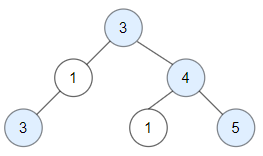
Input: root = [3,1,4,3,null,1,5]
Output: 4
Explanation: Nodes in blue are good.
Root Node (3) is always a good node.
Node 4 -> (3,4) is the maximum value in the path starting from the root.
Node 5 -> (3,4,5) is the maximum value in the path
Node 3 -> (3,1,3) is the maximum value in the path.
Example 2:
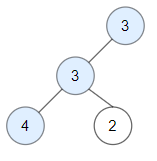
Input: root = [3,3,null,4,2]
Output: 3
Explanation: Node 2 -> (3, 3, 2) is not good, because "3" is higher than it.
Example 3:
Input: root = [1]
Output: 1
Explanation: Root is considered as good.
Constraints:
- The number of nodes in the binary tree is in the range
[1, 10^5]. - Each node's value is between
[-10^4, 10^4].
Related Topics:
Tree, Depth-first Search
We can simply use pre-order traversal.
When visiting a node p, we pass in the maximum value maxVal we've seen from the root thus far.
If p->val >= maxVal, we increment the answer.
Then we update maxVal = max(maxVal, root->val), and continue to visit p's child nodes.
// OJ: https://leetcode.com/problems/count-good-nodes-in-binary-tree/
// Author: github.com/lzl124631x
// Time: O(N)
// Space: O(H)
class Solution {
    int ans = 0;
    void dfs(TreeNode *root, int maxVal) {
        if (!root) return;
        if (root->val >= maxVal) ++ans;
        maxVal = max(maxVal, root->val);
        dfs(root->left, maxVal);
        dfs(root->right, maxVal);
    }
public:
    int goodNodes(TreeNode* root) {
        dfs(root, INT_MIN);
        return ans;
    }
};