In a binary tree, a lonely node is a node that is the only child of its parent node. The root of the tree is not lonely because it does not have a parent node.
Given the root of a binary tree, return an array containing the values of all lonely nodes in the tree. Return the list in any order.
Example 1:
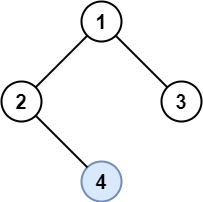
Input: root = [1,2,3,null,4]
Output: [4]
Explanation: Light blue node is the only lonely node.
Node 1 is the root and is not lonely.
Nodes 2 and 3 have the same parent and are not lonely.
Example 2:
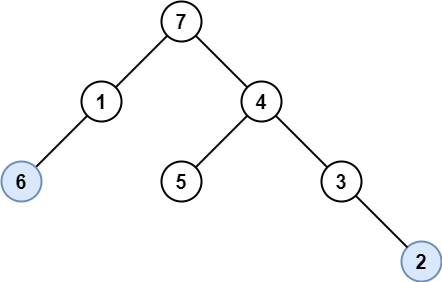
Input: root = [7,1,4,6,null,5,3,null,null,null,null,null,2]
Output: [6,2]
Explanation: Light blue nodes are lonely nodes.
Please remember that order doesn't matter, [2,6] is also an acceptable answer.
Example 3:
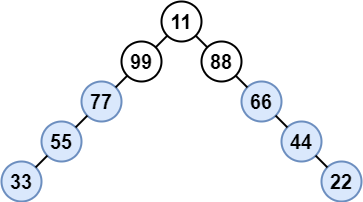
Input: root = [11,99,88,77,null,null,66,55,null,null,44,33,null,null,22]
Output: [77,55,33,66,44,22]
Explanation: Nodes 99 and 88 share the same parent. Node 11 is the root.
All other nodes are lonely.
Constraints:
- The number of nodes in the
treeis in the range[1, 1000]. 1 <= Node.val <= 106
Companies:
Microsoft
Related Topics:
Tree, Depth-First Search, Breadth-First Search, Binary Tree
Similar Questions:
// OJ: https://leetcode.com/problems/find-all-the-lonely-nodes/
// Author: github.com/lzl124631x
// Time: O(N)
// Space: O(H) extra space
class Solution {
    vector<int> ans;
    void dfs(TreeNode *root) {
        if (!root) return;
        if (!root->left && root->right) ans.push_back(root->right->val);
        if (!root->right && root->left) ans.push_back(root->left->val);
        dfs(root->left);
        dfs(root->right);
    }
public:
    vector<int> getLonelyNodes(TreeNode* root) {
        dfs(root);
        return ans;
    }
};