Question: how to make re-usable server override without killing the running time? #1401

Replies: 2 comments 8 replies

|
Hey, @SimonGodefroid. Using runtime handler overrides does not have any impact on runtime performance. It's literally a What often happens when migrating from Overall, do you have some metrics/logs to share? Can you profile your test runs and see what starts consuming more resources? It'd be great to have concrete criteria to have a productive discussion. |

|
Also, make sure you apply overrides first and then render your component. It seems you have it vice versa in your example: renderForUserTypeA();
// If this applies "server.use()", move it above the render function!
myResourceHandler({ data });
expect(screen.get...); |

|
Yup my bad, typing the snippet by memory here so made this mistake. It's in the correct order in our tests (this would throw if it was as is I guess) cheers for highlighting. |

|
Hey @kettanaito so I made sure indeed the things are properly awaited for and globally respect RTL guidelines. I've measured as follows:
So running both branches locally the one using the renderer method with the msw handler takes over twice as much. |
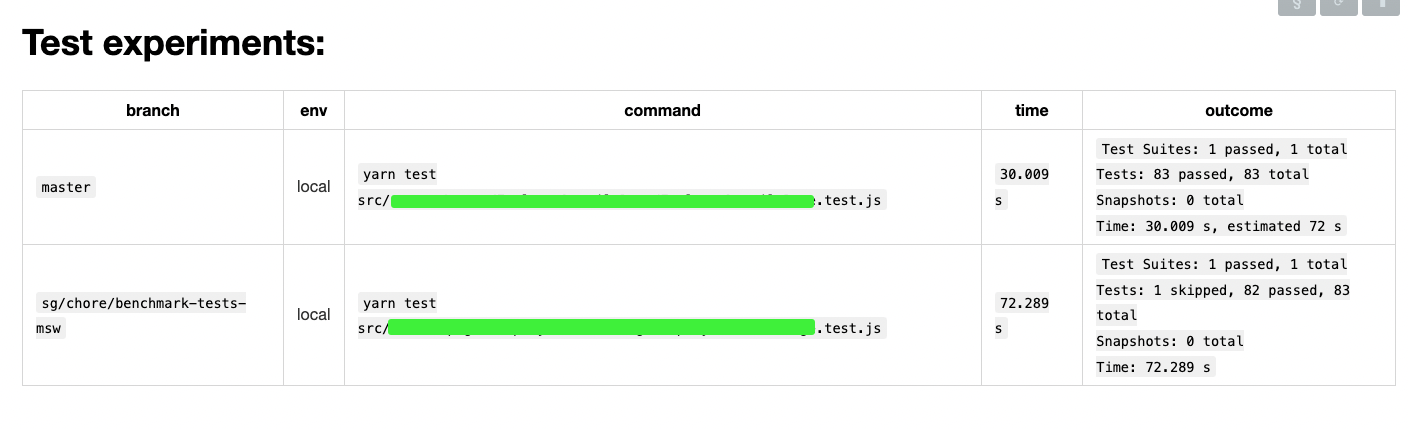
|
Pulling the data by hand, for this test file, by running the test command and pasting the outcome to a code editor, I manage to pull this data table which is each test's running time. Which I can turn into this graph.
|



|
Thank you for a profound analytics on this! Did you notice anything growing exponentially in the memory heap snapshot? It'd help us see if there are any memory issues (like #1194, which is still open). Which version of Node.js are you using? |
|
Also, it's worth mentioning that tests may start to take a little more time. This is related to the point of actually running the request modules as opposed to |
|
No problem thanks for your answer. I had taken part of that discussion on jest's issue here :). Well now I think about it, it's natural that tests are taking way more time...
In a msw world:
In jest world you always have the answer straightaway from your mock (hence no call to e.g. useQuery) and you end up being in a loading state for way less time than in a world with an actual API call being made and intercepted. I'm trying to play with CI settings to see whether it either mitigates the flakyness and/or increase test speed. |
|
Adding that Missing the awaiting step is a sure recipe for flakiness. |


Uh oh!
There was an error while loading. Please reload this page.
We are using helpers to stop using jest.mocks and replace this by re-usable server.use overrides.
e.g.
So in the tests we'd have
This works but since doing this we noticed that locally the tests are taking over twice as much time to run (because now we no longer high-jack the API calls with jest mocks). On the pipeline this causes the tests to take way longer to execute and eventually testing library selectors end up failing due to timeout.
The problem is that the right way to test is using MSW + testing library, but its impacting resources in such a way that this makes the whole pipeline very flakey.
Likewise at the moment we're removing
userrelated mocks but if we were to override another endpoint on a regular base how can we achieve this in a scalable way?We tried a different approach, in which we still have global handlers to manage API calls in a generic way but when trying to make re-usable local overrides we faced the same problem.
Testing feature x for user type a.
Testing feature x for user type b with condition 1.
Testing feature x for user type c with condition 2.
What's the correct way to handle these cases without having a dramatic impact on resource consumption and running time?
All reactions