Analyzing the Data to Find the Results!
Once all the data were collected and put into a spreadsheet, the spreadsheet was converted into a .CSV file and uploaded to a statistics software called RStudio.
You can look through the document of me cleaning and analyzing the data here for more fun bonus content!
Some of the data in my spreadsheet had to be removed. For example, sometimes I recorded behaviors not listed in my ethogram or forgot to record which limb the lemur used. I then decided to categorize the behaviors I observed into different "tasks" (for example, I grouped walking and leaping as "locomotion" tasks). I collected some data on foot use, but it was so little that it was excluded from my analyses. There were even some typos I made that I had to fix. The process of organizing and taking out unusable data is called "data cleaning". I cleaned up the data using both RStudio and Google Sheets until I finally got a shorter, more organized spreadsheet that was ready for analysis.
Once the data were cleaned, I analyzed them in RStudio. This allowed me to make some interesting graphs and perform statistical tests to see how likely it is that the results I got were just by chance. The data cleaning and analysis document has everything I did, but here are some highlights:
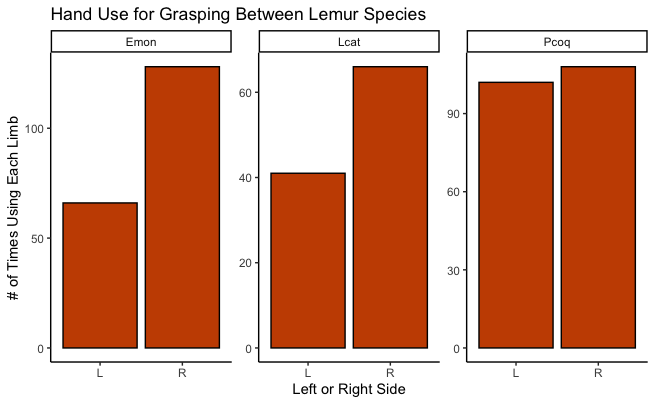
Coquerel's sifakas grasp with the left hands more than ring-tailed and mongoose lemurs:
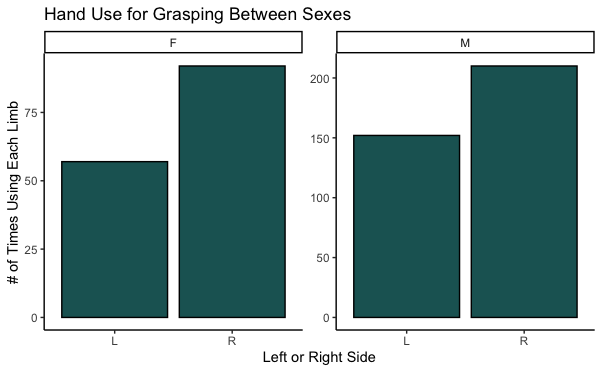
Male lemurs grasp more with their left hands than female lemurs:
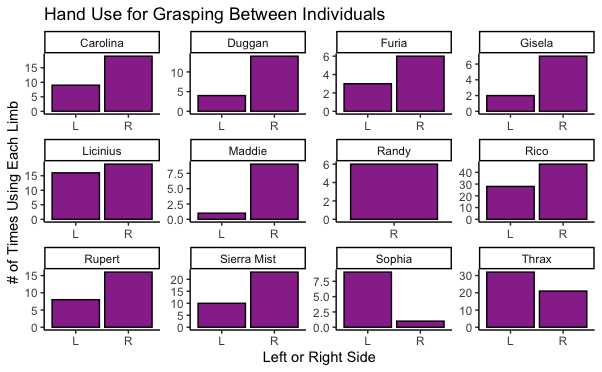
Individual lemurs varied with which hand they used more, and 10/12 (83%) used their right hand more often than their left hand. Randy (a male ring-tailed lemur, only grasped with his right hand when I observed him!). Thrax (a male sifaka) and Sophia (a female ring-tailed lemur) were the only lemurs that made more left-hand grasps than right-hand grasps:
I conducted 15 statistical tests in total to see what factors were considered to be statistically significant for affecting hand use.
The first 9 were g-tests trying to see if hand-preference is independent of animal. The tests were split by behavior and species.
I found that focal individual was a significant predictor of hand preference, but only for feeding behaviors, and only for mongoose lemurs and ring-tailed lemurs. Here are the results from the tests I conducted:
Feeding-Related Behaviors
- Coquerel's Sifakas: G = 6.1736, df = 3, p-value = 0.1035
- Mongoose Lemur: G = 31.942, df = 3, p-value = 5.382e-07
- Ring-Tailed Lemur: G = 52.989, df = 3, p-value = 1.844e-11
Resting-Related Behaviors
- Coquerel's Sifakas: G = 1.8954, df = 3, p-value = 0.5944
- Mongoose Lemur: G = 0.45114, df = 3, p-value = 0.9295
- Ring-Tailed Lemur: G = 0.47334, df = 3, p-value = 0.9247
Locomotion-Related Behaviors
- Coquerel's Sifakas: G = 4.7271, df = 3, p-value = 0.1929
- Mongoose Lemur: G = 2.5685, df = 3, p-value = 0.463
- Ring-Tailed Lemur: G = 6.2568, df = 3, p-value = 0.09976
When the p-value is less than 0.05, that means the result was considered to be "statistically significant". In this case, the results were significant for feeding-related behaviors in mongoose lemurs and ring-tailed lemurs.
The next thing I wanted to test was if hand preference was independent of biological sex. In order to do this, I conducted 3 Fisher's exact tests. The tests were split by species. Here are the results:
- Coquerel's Sifakas: p-value = 1, 95 percent confidence interval = 0.5422522 1.8369859 = odds ratio 0.9975969
- Mongoose Lemur: p-value = 0.1927, 95 percent confidence interval = 0.7024164 5.1181251 = odds ratio 1.848276
- Ring-Tailed Lemur: p-value = 0.8761, 95 percent confidence interval = 0.562976 2.115936 = odds ratio 1.08496
None of the p-values from these tests were under 0.05, so in this case, biological sex was not considered to be a statistically significant predictor of hand preference.
The final set of tests I did were 3 G-tests to see if hand use is independent of species. I split this by behavior.
Feeding-Related Behaviors
- G = 10.145, df = 5, p-value = 0.07124 Resting-Related Behaviors
- G = 15.081, df = 5, p-value = 0.01002 Locomotion-Related Behaviors
- G = 6.2932, df = 5, p-value = 0.2787
The p-value was only less than 0.05 for resting-related behaviors, so this suggests that species is only a significant predictor of hand preference for resting-related behaviors.
Overall, I think this project gave me a lot of interesting information and made me think a lot about how it could be improved. Here is my discussion of what I got out of this project and what I would have done differently.