 anticipated-chemistry-of-life

Replies: 2 comments 11 replies

-
|
Great to read! I think that we cannot verify point 3 with single C18 runs coming from PF. I would like to propose a better solution instead of "just saying no" but can't think of any better at the moment... Thinking about such LC profiles... are we closer to a For example, first, validate we are able to measure the presence of a given compound in our LC run (on a sample from species X). Then, fill in the data. In the predicted data, take species Y, where even after imputation, the compound is still not present and see if effectively the compound is not measured. Would that bring something? |
Beta Was this translation helpful? Give feedback.

-
|
Side note: Davy Guillarme just told me that filtering compounds with a logP -1 < x < 6 should be fine. |
Beta Was this translation helpful? Give feedback.
-
|
Ok, so I did a quick and dirty function to filter LOTUS structures for C18 runs: anticipated-chemistry-of-life/elotus-trees@84ebcc5 With a filter of -1<xlogp<6 and 100<mass<1500 we end up with 228,030/293,590 structures. |
Beta Was this translation helpful? Give feedback.

-
|
Great if we validate with PF profile these beeing EtOAc extracts I guess we could even be meaner with the logp filter. |
Beta Was this translation helpful? Give feedback.
-
|
From an email exchange I had with him. I wanted to know if there was "less brutal" than rough logp and this is what he advised me for C18 runs... |
Beta Was this translation helpful? Give feedback.
-
|
Maybe we could ask him for an unprotected version of https://ispso.unige.ch/labs/fanal/hplc_teaching:en ? |
Beta Was this translation helpful? Give feedback.

-
|
Follow up by Daniel |
Beta Was this translation helpful? Give feedback.
-
|
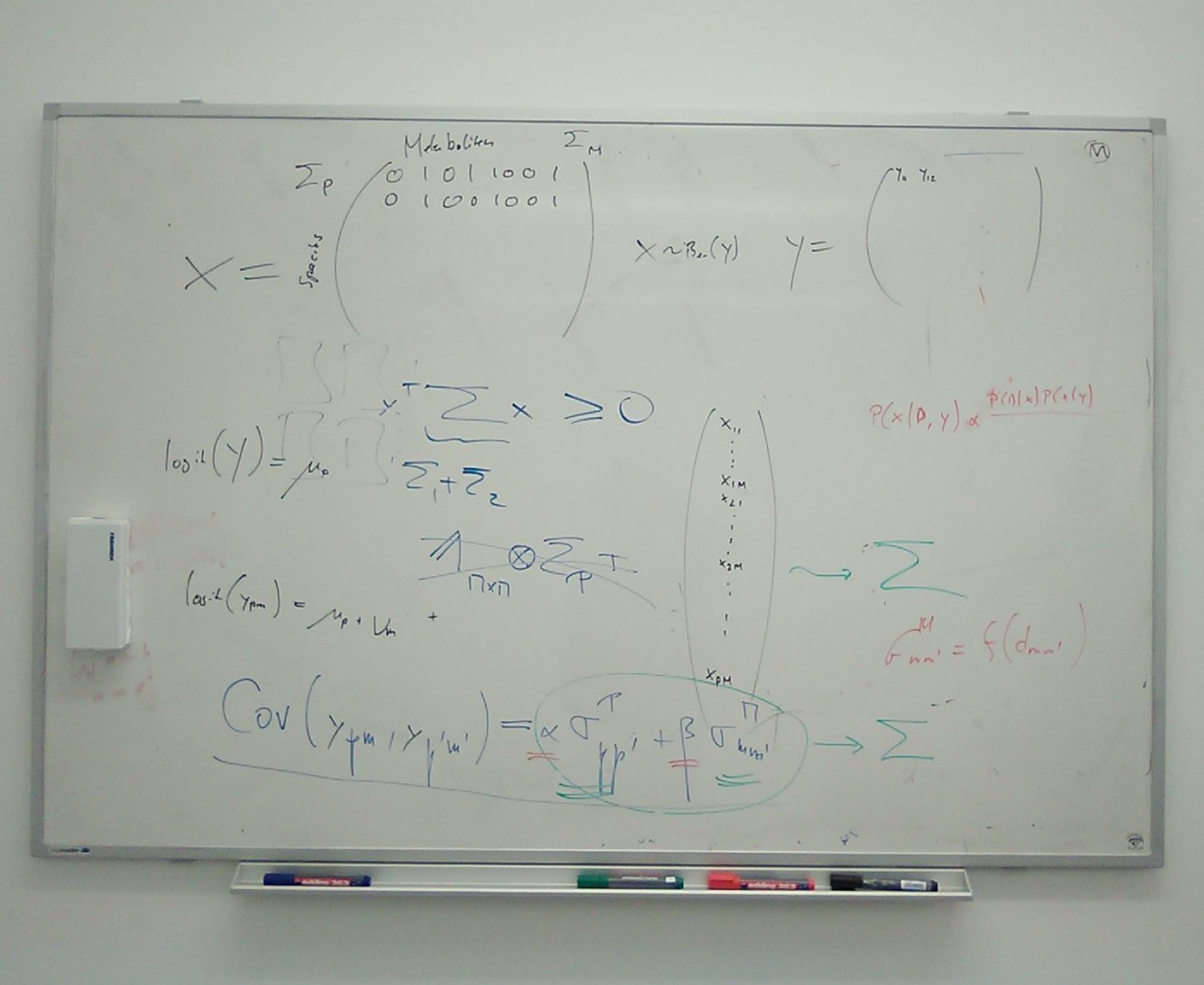
and the afternoon scribbles |
Beta Was this translation helpful? Give feedback.


Uh oh!
There was an error while loading. Please reload this page.
Uh oh!
There was an error while loading. Please reload this page.
-
Discussion with Daniel Wegmann (https://www.unifr.ch/bio/en/groups/wegmann/) and Daniele.
A bit too high level for my poor statistical background. I will try my best to resume and Daniele will amend (and Daniel eventually if he is in !)
So in a nutshell:
Same concern as Daniele regarding pseudo absences.
It changes things drastically if we can or not assess trueness of the absence in our species per chemical matrices. And we can't (at least not completely).
Daniel argued that is such case he could basically have the simplest (and dumb model) with the matrix fully filled with 1 and that their would be no way to say that any more sophisticated model (taking into account phylogeny, research efforts or whatsoever ) would be better. Daniele disagreed on this point.
Things changed when considering the possibility to make posterior measurement (for example using the already profiled data we have in the PF dataset for which we could output a chemical composition for species present and also absent from the Lotus matrix).
We should thus :
Voila for the drafty notes.
Beta Was this translation helpful? Give feedback.
All reactions