 Portainer.io
[Feature] Add an API endpoint to update containers in a stack (including web editor managed stacks) to the latest image #9728

Replies: 18 comments

-
|
Hi @callumgare, Stack webhooks are in our plans and should be coming soon :-) We've recently introduced the ability to pull and redeploy a stack definition from Git via #1753 In there, I've provided screenshots for that upcoming stack webhooks, you can see it and get more details in that comment : #1753 (comment) Closing this issue in favor of #2835, feel free to discuss in #2835 ! |
Beta Was this translation helpful? Give feedback.

-
|
Rad! Super excited to hear it! Thanks :) |
Beta Was this translation helpful? Give feedback.
-
|
@deviantony Looking though those issues it looks like the scope might be slightly different. Correctly me if I'm wrong but it looks like those rely on your stack being pulled in from a git repo? In my case I'm using the standard stack web editor in portainer to manage my composer files. |
Beta Was this translation helpful? Give feedback.
-
|
You're right, I'll re-open to consider adding this to regular stacks. However this won't be our primary focus, we're heavily gearing towards automation/webhooks for anything that is deployed through Git at the moment so I would recommend making use of Git at that point if you want have access to this feature. |
Beta Was this translation helpful? Give feedback.
-
|
Cheers, I've update the title to reflect that aspect specifically. Fair enough that this might not be your primary focus :) I'll see if git managed stacks will work in my workflow when #2835 has rolled out. Cheers! |
Beta Was this translation helpful? Give feedback.

-
|
@callumgare you mention you're using GitLab as part of your CI process. I'm interested to find out why it would be easier for you to keep using the web editor to define stacks, instead of having the compose files defined in GitLab. And I'm curious as well if the following flow would work for you: |
Beta Was this translation helpful? Give feedback.
-
|
Hi @huib-portainer thanks for your detailed response. I am actually really interesting to understand why other people find it easier to have their compose file managed in a repo! I figure most web apps are going to have some instance specific config that surely doesn’t make sense to commit into your main codebase repo. For example I could have another repo that is separate from my code repo which contains all my compose configuration but at that point I don’t really gain anything (I don’t need a version history or other people to review my config changes every time) and it just seems like more hassle than using the web editor to manage that config. Interested in your proposed workaround but not sure how it would help me with instance specific config. Where would that live? |
Beta Was this translation helpful? Give feedback.
-
|
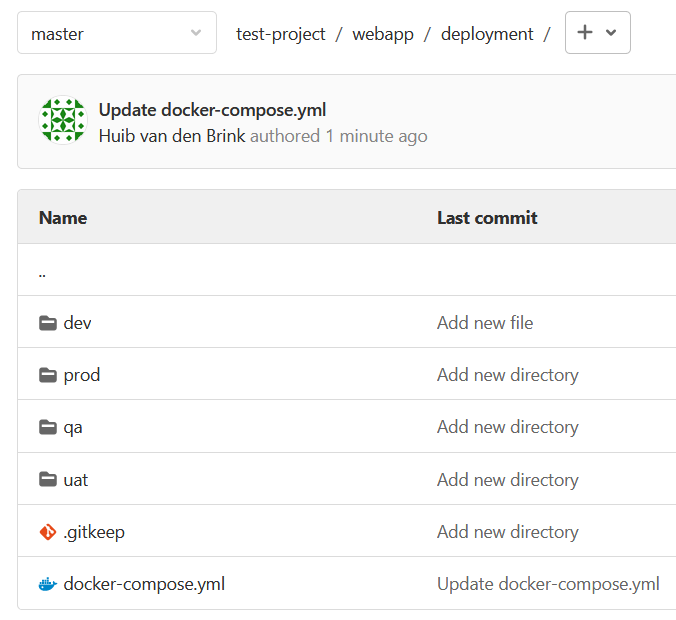
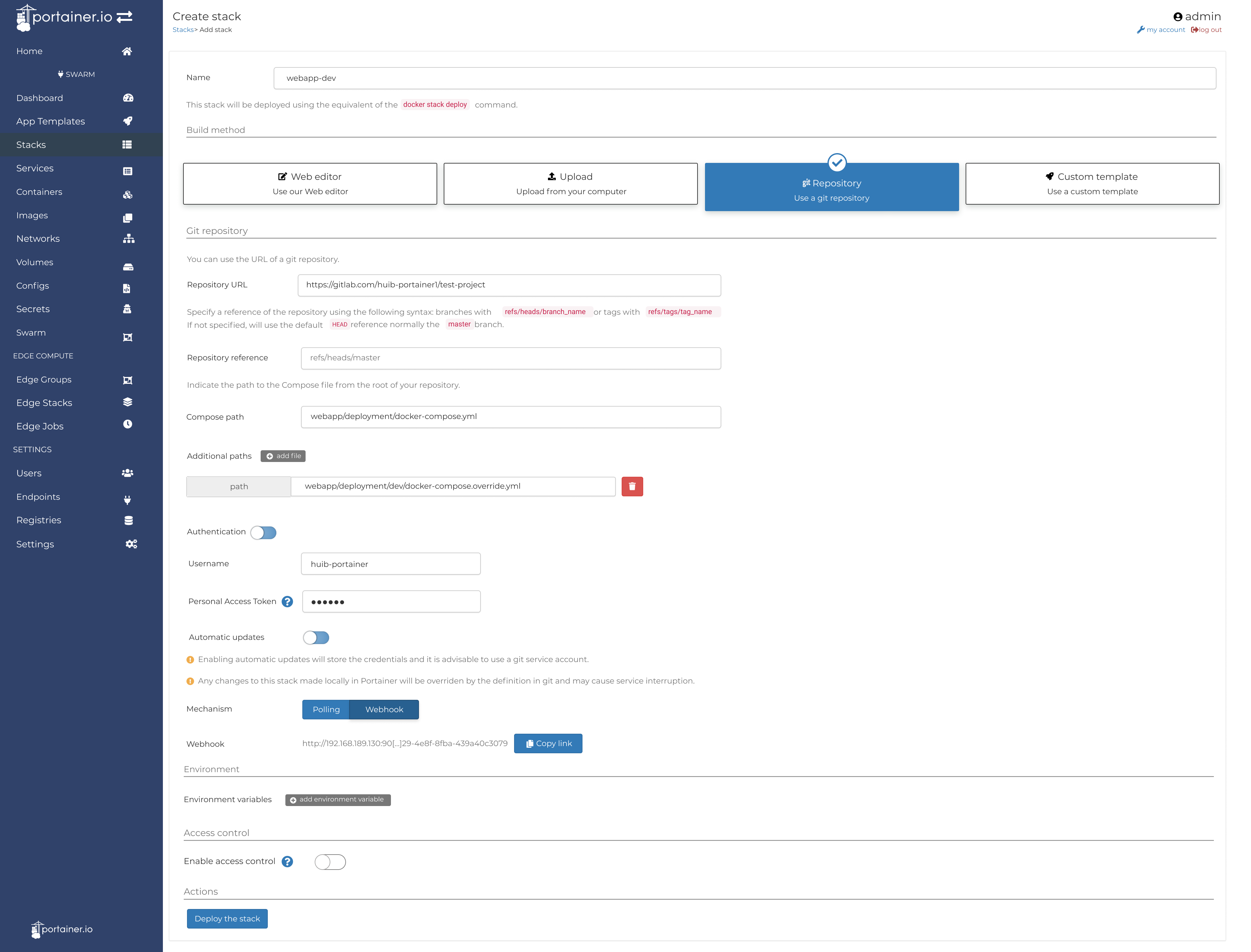
Thanks for taking the time to describe your use case. In my mind there's a trade-off between convenience and reliability, because having reviewers might reduce the risk of making any trivial mistakes, which could affect your production environment. But I hear what you're saying when you just want to make a quick change. Let me describe the flow I was thinking about. The docker-compose.yml then defines the application and reverse proxy. e.g. And in each dev/qa/etc folder I would define the image and env vars specific to where it's deployed. In Portainer I would deploy that as a stack Finally, if I want to update the version that's deployed to QA, I would make changes to the docker-compose.override.yml in the QA folder (either direct or via a pull request), which invokes the webhook and causes Portainer to pull the latest yml & image and redeploy the stack. |
Beta Was this translation helpful? Give feedback.

-
|
@huib-portainer what you described is exactly the workflow we are looking for in my team. |
Beta Was this translation helpful? Give feedback.
-
|
@huib-portainer Right, but that still includes committing config into your code repo no? Which is what I want to avoid. I’m not mad about the idea of including secrets in my code repo. To me it seems kind of icky mixing the two. I want the option of being able to share that code base without exposing any secrets. If I was ever to open source any of those repos I’d have to come up with a different workflow then anyway plus go to the extra effort of scrubbing secrets from history git history (which isn’t ideal) or going and invalidating all those keys and regenerating them. I appreciate your answer though! And maybe I’ll give that a shot but just store it in a different repo purely for config. |
Beta Was this translation helpful? Give feedback.
-
|
@callumgare , the way we work with secrets is by considering them all as external to our stacks: version: '3.8'
secrets:
db-password:
name: prod-db-password-20210123
external: trueIn this way, every stack assumes that the given secrets are already setup in the Swarm by an operator (or developer), and we can fully separate the storage/handling of secrets from the storage/handling of stacks. In addition, given that we name our secrets using a date numbering, we also know precisely which secret it was meant to work with. This aids a lot with secret rotations. No secret is ever committed to any Git repository apart from its name. All you need is to make sure that the user of your stack understands that a secret must be created into the swarm with a given name before deploying the stack. |
Beta Was this translation helpful? Give feedback.
-
|
@hhromic Ah, makes sense! Unfortunately I’m using docker standalone (which doesn’t
support secrets) not docker swarm. If I was using swarm I’d be able to use
the service webhook as an endpoint to update a stack, thus negating the
need for this ticket in the first place.
Like the date numbering system though, very smart.
…On Sat, 10 Jul 2021 at 20:29, Hugo Hromic ***@***.***> wrote:
@callumgare <https://github.com/callumgare> , the way we work with
secrets is by considering them all as external to our stacks:
version: '3.8'

secrets:
  db-password:
    name: prod-db-password-20210123
    external: true
In this way, every stack assumes that the given secrets are already setup
in the Swarm by an operator (or developer), and we can fully separate the
storage/handling of secrets from the storage/handling of stacks. In
addition, given that we name our secrets using a date numbering, we also
know precisely which secret it was meant to work with. This aids a lot with
secret rotations.
No secret is ever committed to any Git repository apart from its name. All
you need is to make sure that the user of your stack understands that a
secret must be created into the swarm with a given name before deploying
the stack.
—
You are receiving this because you were mentioned.
Reply to this email directly, view it on GitHub
<#5199 (comment)>,
or unsubscribe
<https://github.com/notifications/unsubscribe-auth/AACURZEJHWIVDYNAD7CYFJLTXAOHFANCNFSM46YRJGVA>
.
|
Beta Was this translation helpful? Give feedback.
-
|
@callumgare you mention that you currently are using the web editor to create a stack. How do you handle your secrets then in that way? When adding a Stack in Portainer from a Git repo, as per the screen design above, you can still specify the substitution variables in Portainer. So that's independent from the content in the Git repo. If your docker-compose.yml in Git for example contains: Then
|

Beta Was this translation helpful? Give feedback.
-
|
@callumgare it is also worth noting that docker-compose supports secrets (only through file though) when running Docker standalone. I've never used them much on standalone but maybe you can find some way to leverage that. |
Beta Was this translation helpful? Give feedback.
-
|
We have a preview version available that allows you to pull compose files from Git and either poll for changes or use a webhook to pull the latest compose file from Git and redeploy the stack. Please give it a try by using the image |
Beta Was this translation helpful? Give feedback.

-
|
We tag our Docker images for each release stage and not with commit hashes, so our compose files don't change with every build. We also often use the same docker image with different commands multiple times in the same stack. Having one webhook at the stack level that updates all of the services via something like
I don't think using swarm completely negates the need for this ticket. Consider a stack like my example above that has a bunch of different services all with their own unique webhook. Configuring CI to hit each of these endpoints after a build can be cumbersome. Adding services to the stack down the line is also non-trivial. |
Beta Was this translation helpful? Give feedback.
-
|
Thanks for the feedback. Here's the automatic update logic that we're currently using for stacks deployed from Git, in order to avoid redeploying too often: |
Beta Was this translation helpful? Give feedback.
-
|
Thanks for the clarification. I really think the update logic should be based on Docker image digests and not on a Git repository. There are too many popular deployment strategies where the compose files are decoupled from the actual code base; defining the stack in the Portainer GUI being the main one here. Being able to pull your stack's configuration from Git is definitely cool, but Portainer shouldn't use that repository to determine if something has changed or not because Docker already has a mechanism in place to do that. |
Beta Was this translation helpful? Give feedback.


Uh oh!
There was an error while loading. Please reload this page.
Uh oh!
There was an error while loading. Please reload this page.
-
It would be great if you could ping an endpoint in the portainer API and, using the supplied stack ID, it would pull the latest images for the containers in that stack and then update that stack. Even better (at least for me) would be adding a webhook that would function in the same way as the webhooks for swarm services (https://documentation.portainer.io/v2.0/webhooks/create/).
I have portainer setup with standalone docker which amoung other things, runs a number of applications I have writen. I have GitLab setup to run a CI process to build a new image for those apps whenever new code has been pushed to the repo. I would love it if it could also trigger an image pull for a given stack in portainer after it has finished building a new image.
Beta Was this translation helpful? Give feedback.
All reactions