Python binding for omq.rs, a Rust libzmq port. Drop-in pyzmq replacement on the common path.
uv pip install pyomq
uv pip install 'pyomq[test]'   # adds pytest, pyzmq for the interop suite
The published wheel includes optional features: plain, curve, lz4.
Use pyomq.has("curve") at runtime to check availability.
Published wheels currently target Linux. Other platforms can build from
sdist when the local Rust/Python toolchain supports them. Windows pyomq
support is not complete on main yet.
import pyomq as zmq  # drop-in for `import zmq` from pyzmq

ctx = zmq.Context()
push = ctx.socket(zmq.PUSH)
push.connect("tcp://127.0.0.1:5555")
push.send(b"hello")
push.close()
ctx.term()
For asynchronous code:
import pyomq
import pyomq.asyncio as zmq_async

ctx = zmq_async.Context()
sock = ctx.socket(pyomq.PUSH)
await sock.connect("tcp://127.0.0.1:5555")
await sock.send(b"hello")
await sock.close()Sync and asyncio APIs both ship in this release. All 20 ZMTP socket types are wired:
- Standard (RFC 28 + 47): PAIR, PUB, SUB, REQ, REP, DEALER, ROUTER, PULL, PUSH, XPUB, XSUB, STREAM.
- Draft: SERVER, CLIENT (RFC 41), RADIO, DISH (RFC 48), GATHER, SCATTER (RFC 49), PEER, CHANNEL (RFC 51).
Transports: tcp://, ipc://, inproc://, and udp:// (RADIO/DISH only).
Optional features built into the wheel: plain, curve, lz4.
DISH groups: use socket.join(b"group") / socket.leave(b"group") to manage
subscriptions; messages are sent as multipart [group, body].
pyomq is built on omq-tokio (multi-threaded tokio runtime). The runtime
runs on a dedicated background thread; every Python call releases the GIL
across the runtime trip.
See COMPARISONS.md for full tables.
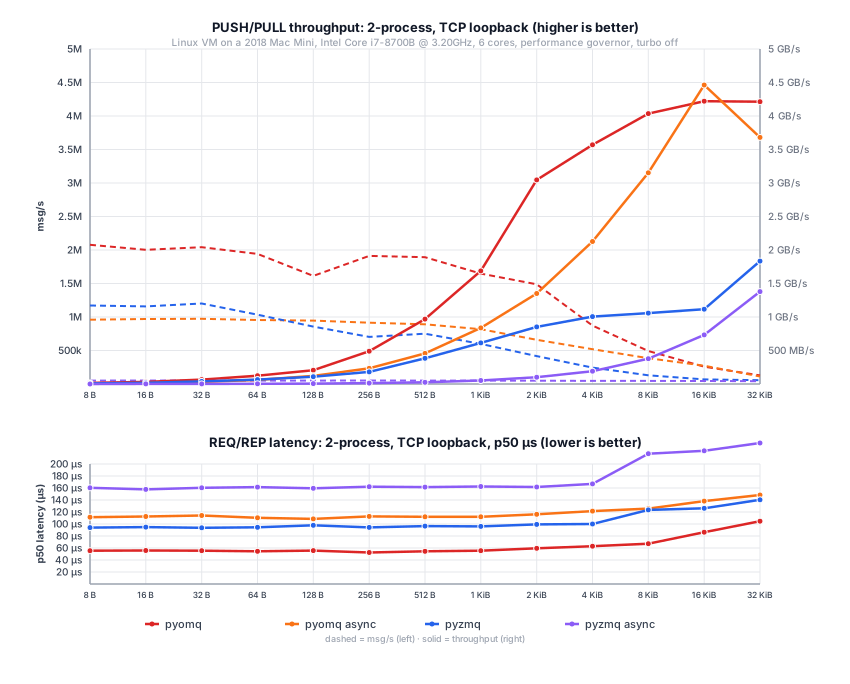
2-process loopback throughput and latency vs pyzmq, measured on Linux 6.12 (Debian 13), Intel i7-8700B 3.2 GHz, Rust 1.95.0.
| pyomq | pyzmq | ratio | |
|---|---|---|---|
| PUSH/PULL msg/s | 2.75 M/s | 1.53 M/s | 1.79× |
| REQ/REP rt/s | 8,441/s | 4,511/s | 1.87× |
pyomq's proxy() forwards directly between sockets on the tokio runtime,
no Python per-message overhead. pyzmq's zmq.proxy() calls libzmq's
C-level zmq_proxy. PUSH/PULL forwarding is throughput-bound and pyomq is
~1.8x faster. REQ/REP proxy is latency-bound (4 TCP hops per round-trip);
pyomq is ~1.9x faster thanks to direct socket forwarding.
Run scripts/update_perf.py (after maturin develop --release) to re-measure, regenerate the chart, and update the proxy table.
OMQ.rs adds a transparent LZ4 compression transport on top of TCP: lz4+tcp://.
Swap the scheme in your endpoint string and everything else stays the same:
push = ctx.socket(zmq.PUSH)
push.bind("lz4+tcp://127.0.0.1:5555")

pull = ctx.socket(zmq.PULL)
pull.connect("lz4+tcp://127.0.0.1:5555")
Both peers must use a matching compression endpoint. Payloads below ~512 B are sent as-is (the codec detects that compression would expand them).
lz4+tcp:// supports dictionary auto-training (off by default). When enabled,
it samples the first 100 outbound messages, builds a 2 KiB dict, and ships it
to the peer once. After that the compression threshold drops from 512 B to
128 B, so small structured messages start compressing too. Pure Rust (lz4rip),
no C compiler required.
Enable it on sockets that send compressible traffic before bind()/connect():
push.compression_auto_train = 1
# or: push.setsockopt(zmq.OMQ_COMPRESSION_AUTO_TRAIN, 1)
See BENCHMARKS_COMPRESSION.md for throughput charts and benchmark details. Wire format: LZ4 transport RFC.
CURVE encrypts traffic and authenticates the server to the client. To also
authenticate clients to the server, call set_curve_auth() before
bind()/connect():
server_pub, server_sec = zmq.curve_keypair()
client_pub, client_sec = zmq.curve_keypair()

pull = ctx.socket(zmq.PULL)
pull.curve_server = 1
pull.curve_publickey = server_pub
pull.curve_secretkey = server_sec

# Option 1: allow specific client keys (checked in Rust, no GIL overhead)
pull.set_curve_auth([client_pub])

# Option 2: custom callback. PeerInfo has .public_key (Z85) and
# .identity (bytes or None).
pull.set_curve_auth(lambda peer: peer.public_key in allowed_keys)

# Option 3: accept any valid CURVE client (the default)
pull.set_curve_auth(None)
No ZAP, no filesystem key management. The callback runs during the CURVE handshake; returning a falsy value rejects the client.
cd bindings/pyomq
uv venv && source .venv/bin/activate
uv pip install maturin pytest pyzmq
maturin develop --release
pytest -v