Quarkus has great performance – and we have new evidence #52858
 giscus[bot]
Bot
giscus[bot]
Bot
Replies: 10 comments 48 replies

-
|
Regarding parity principle, specifically: "If a change is made that changes the architecture of an application (i.e. moving blocking to reactive, using virtual threads, etc), then these changes should be applied to all the versions of the applications" which approach do you acctually measure? Reactive, blocking or both of them? |
Beta Was this translation helpful? Give feedback.

-
|
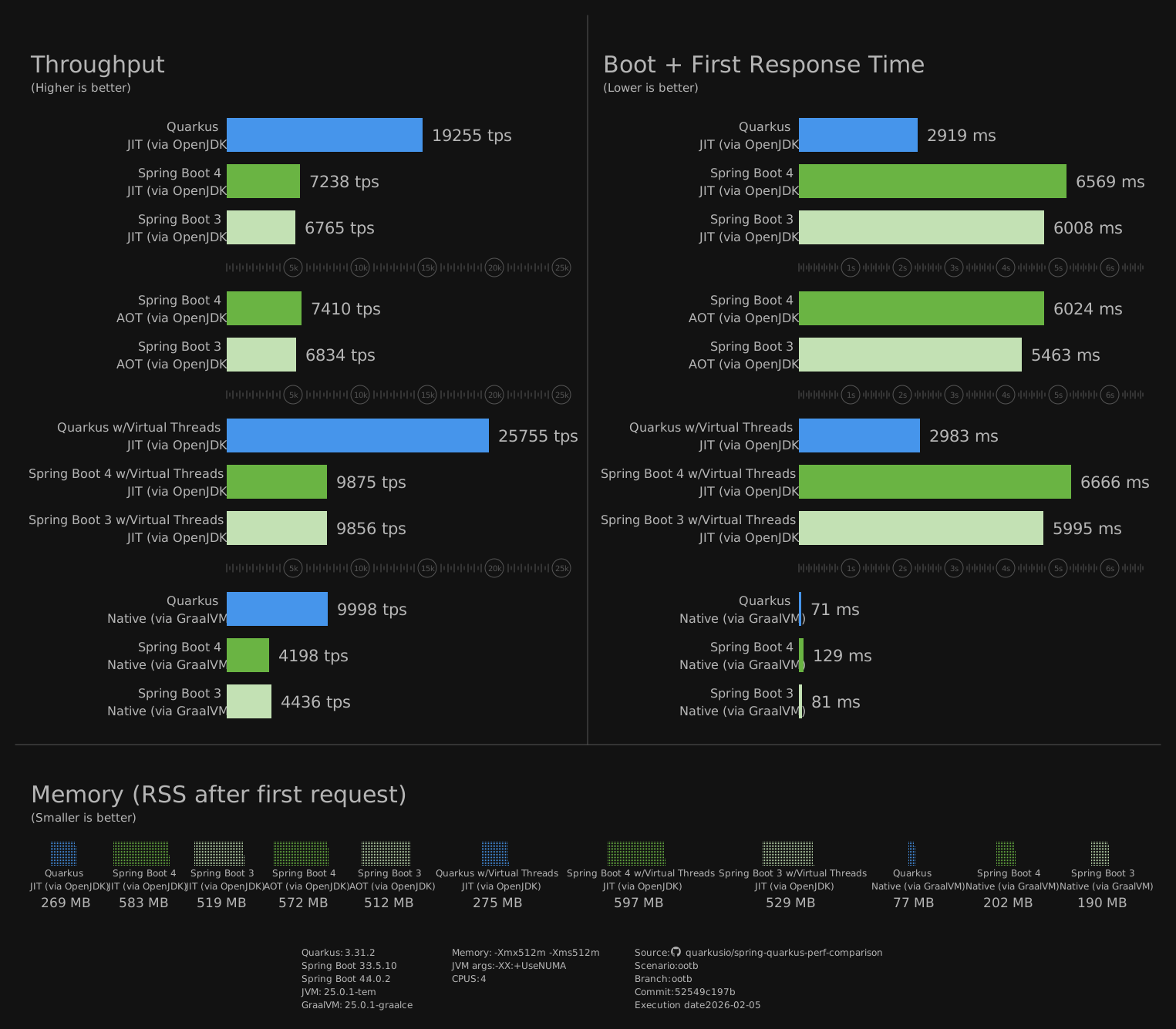
You can see every 'variation' that's measured on https://quarkus.io/benchmarks/spring-quarkus-perf-comparison/2026-02-05_12-30-36/metrics-ootb-composite-for-all-dark.svg. In terms of your question, there are two main variations that affect the coding style:
We don't currently measure anything using a reactive programming style, just because every combination we add means each run takes more processing time in the lab, and at some point too many variations becomes overwhelming. |
Beta Was this translation helpful? Give feedback.

-
|
I'd also say that the use case of building a CRUD application using a relational database with a reactive paradigm is very uncommon in practice, so its not a use case we're testing with this set up. |
Beta Was this translation helpful? Give feedback.

-
|
@edeandrea I think you mean reactive with a blocking database driver (JDBC, Hibernate ORM classic). |
Beta Was this translation helpful? Give feedback.
-
|
Yes that's exactly what I mean. Thank you for clarifying! |
Beta Was this translation helpful? Give feedback.

-
|
hello. interesting. great job. do you publish the characteristics of your infrastructure, beside "4 cpus"? |
Beta Was this translation helpful? Give feedback.
-
|
It's bare metal. I don't think it would matter if it were a vm. The resources allocated are the resources allocated. |
Beta Was this translation helpful? Give feedback.

-
|
out of curiosity, how do you limit tthe java process to 4 cpus? using cgroup quotas? with I had an idea about a different type of visual representation. in the early days you had expressed efficiency as the throughput per Mb of RAM. I liked the fact that we did not stop just at throughput, but took into account the associated cost. |
Beta Was this translation helpful? Give feedback.
-
|
here is a quick attempt with nano banana. it can be improved but you see the idea: 
|
Beta Was this translation helpful? Give feedback.

-
Yep, we're using |
Beta Was this translation helpful? Give feedback.
-
That makes a lot of sense, I like it! Do you mind raising a "new visualisation" issue over on https://github.com/quarkusio/benchmarks? |
Beta Was this translation helpful? Give feedback.

-
|
Could you provide benchmarks comparing Reactive SQL Client vs. Standard JDBC when running on Virtual Threads? |
Beta Was this translation helpful? Give feedback.
-
|
Hi @Adilbek-Akhmet at this time we don't have a test that uses reactive SQL clients. There are a number of reasons for this:
|
Beta Was this translation helpful? Give feedback.

-
Vert.x SQL Client Templates provide object mapping functionality and can be used in Quarkus, but it requires some tricks. |
Beta Was this translation helpful? Give feedback.
-
|
it would be interesting to have the response time also (e.g. min, p50, avg, p95, p99, max). usually there is a tradeoff between throughput and response time. |
Beta Was this translation helpful? Give feedback.
-
|
@vsevel with "those charts" you mean
? Because If the TPS is "sustainable" and there is no saturation, the response time is dominated by:
So, it really depends by the ratio between these twos timings. |

Beta Was this translation helpful? Give feedback.

-
yes. thanks for the answer. it would be interesting to have a measure of the framework overhead |
Beta Was this translation helpful? Give feedback.

-
@vsevel , this is the CPU usage difference between Quarkus and Spring at 10,000 RPS in the benchmarks that I've ran. Total Elapsed Time:
Total CPU usage measured during the 5 minute benchmark: Quarkus 3 -> 6 minutes and 58.2 seconds | Quarkus - Spring | = +/- 64 seconds of CPU time.
I'll see where I can upload the benchmark reports to, and will share a link here. |
Beta Was this translation helpful? Give feedback.
-
|
Thanks @wfouche |
Beta Was this translation helpful? Give feedback.
-
|
without the latency shown, one could argue that it does not matter that quarkus has much better throughput, if it has a much worse response time for instance. it depends what you are looking for. the server team will try to maximize the throughput while keeping the cost down, and keeping the client happy. the client is usually very sensitive to latency, and less on throughput (unless he is one of the big callers). so not showing latency is missing one side of the coin - the client perspective.
at the very least you should be able to show that the big throughput is not achieved at the expense of a degraded response time.
and I would expect quarkus's overhead to be smaller than springboot (or is it?). in that case response time should be at least equal to springboot.
another approach would be to constrain the environment so that the different compared configurations get equal response times and throughput, but some show lower operational costs. in any case, not showing latency is missing something in the story. back to the opening statement, as a client, I do not care too much that you can double your throughput if you degrade my experience. |
Beta Was this translation helpful? Give feedback.

-
|
Hi there, did you include SPRING AOT mode in your benchmark, as It should have consequences on metrics ? Ludovic |
Beta Was this translation helpful? Give feedback.
-
|
They're there in the metrics. See https://github.com/quarkusio/benchmarks/blob/main/images/spring-quarkus-perf-comparison/tuned/results-latest-tuned-composite-for-all-light.svg for example. |
Beta Was this translation helpful? Give feedback.

-
|
your link seems to talk about JDK AOT, not Spring AOT |
Beta Was this translation helpful? Give feedback.
-
Beta Was this translation helpful? Give feedback.
-
|
As @edeandrea says, we didn't show all of the variations we measured in our graphics on the front page, because it's a bit overwhelming to understand. We've measured Spring AOT. I confirm it is the Spring AOT feature that was measured, not JVM AOT. The JVM AOT measurements are coming soon. :) I agree that the line break in the chart makes it a bit ambiguous which it is, and that's going to be a worse problem once we also have JVM AOT in the charts. This is the chart showing AOT. It's fairly neutral on throughput, slightly improves footprint, more noticeable improvement on start time, but still twice the start time of Quarkus: |

Beta Was this translation helpful? Give feedback.

-
|
Thank you, for your hard work and the deep insights. These benchmarks are impressive. In my daily business life I am regularly confronted with decision makers who hear Java and think slow, old, why not .NET - especially when dealing with the Azure Cloud. My developer joy doesn't impress them too much. To help bridge the gap in corporate discussions where Java is still often viewed as 'slow' or 'memory-heavy' compared to .NET, would it be possible to include ASP.NET Core (Native AOT) in future comparisons? Having direct head-to-head numbers would be a powerful tool to prove that Quarkus makes Java just as cloud-native and efficient as its competing non JVM languages which are using some form of byte code as well. |
Beta Was this translation helpful? Give feedback.
-
|
Oh nice! Another data point you could show your colleagues is the TechEmpower benchmark results. It's designed to cover a huge range of languages and platforms. Because it's so huge, and there's so many variants even for the same platform, and there are multiple benchmarks within each category, it's a bit overwhelming to try and pull a single answer out of. But looking at https://www.techempower.com/benchmarks/#section=data-r23, which happens to be the one I have bookmarked, you can see that the the highest-scoring entries are all C++ and Rust (look on the right, at the 'language' and 'platform' columns). But if you look down the column, the first 'higher level' language is Java, at #13. And the next slot is Java too, at #14. You have to look a bit further down to find Go, at #17. .Net and C# are all the way down at #35. The higher entries tend to be stripped-down setups without higher-level libraries, so there are other .Net and Java entries all the way down in the table. For example, if you wanted MVC, ASP MVC is at #122. 
I just did that analysis for the Fortunes benchmark, but the trend is similar across most of the others. For example, for 'Multiple Queries', the best aspnetcore can do is #25. For 'Data Updates', if I'm reading it right, the best .NET entry is what looks like a specially-crafted setup, and it's #83. The one exception is the 'Cached Queries' test, where .NET seems to do consistently well. .NET also just beats Java on the 'Plain Text' test. But on aggregate, Java is leaving .NET in the dust. :) |
Beta Was this translation helpful? Give feedback.
-
|
@cdhermann this is very cool! Honestly I wouldn't even really know how to build any of this. Do you have a list of requirements needed in order to run the full benchmark on a linux host? If we could modify the scripts ( |
Beta Was this translation helpful? Give feedback.

-
@edeandrea, yes in the README.md there is a requirements section. But honestly speaking, I'd like to try it first on Linux. At the moment, I tried it only on macOS and Linux is theory. I also have to do slight changes in 1strequest.sh to make it work with .NET. And I should improve the current I'll try my best to provide this soon. |
Beta Was this translation helpful? Give feedback.
-
|
Sounds like a plan! And no rush at all!
That is 100% true, and something we tried to call out in our documentation. At the end of the day though we know people will do it, so we try and give people the "least bad" way to do it. macOS doesn't give you any way to isolate CPU cores to different processes. |
Beta Was this translation helpful? Give feedback.
-
|
@edeandrea @holly-cummins Thanks for bearing with me while I got the Linux setup sorted! To clarify, the environment I ran this on wasn't a pristine corporate lab, but rather a dedicated Linux VPS. Still, with dedicated resources, it gives us a much more reliable baseline and ground truth than Here is the exact setup I used for this run: 🖥️ Benchmark Environment
(Running from branch 📊 The ResultsThe full report is available here: Benchmark Results (2026-04-24) If you want the quick TL;DR, here is how the different configurations stack up depending on what you are trying to optimize for:
🔍 .NET 10 in ContextThe data paints a really fascinating picture of the trade-offs between the runtimes. .NET 10 occupies a very distinct position:
|
Beta Was this translation helpful? Give feedback.

-
|
Well done! 👏🏻 |
Beta Was this translation helpful? Give feedback.

-
|
Love this, great writeup. How do you measure throughput? The load generator increases throughout until the breaking point of the service and reports that as throughput? Probably a basic question, but the devil is in the details with benchmark tools and coordinated omission: https://brooker.co.za/blog/2023/05/10/open-closed.html |
Beta Was this translation helpful? Give feedback.
-
|
Thanks! |
Beta Was this translation helpful? Give feedback.

-
|
Got it, thank you for the quick and detailed response! This gives me a lot to think and learn about, will have a look into Hyperfoil |
Beta Was this translation helpful? Give feedback.

-
|
So what i gather from this write up and after checking the scripts in the github, just to be sure, these benchmarks or performance tests are started on a "desktop" with physical/logical cores and are not using a container images with --cpus=4 set? And also no kubernetes tests have been done to validate the performance on a plattform that uses vCPUs and that allocate (to my knowledge) "a specific amount of time" before an application again can use the CPU? |
Beta Was this translation helpful? Give feedback.

-
|
Still talking about quarkus applications, think 90% of our backend stack is Quarkus |
Beta Was this translation helpful? Give feedback.
-
|
Interesting!
|
Beta Was this translation helpful? Give feedback.
-
Well most of our main applications are crud where some use free text search with different providers or work as batch jobs and lastly as rest integrations between systems. Some are monoliths also while other are more microservices or distributed monoliths.
Well i think, since the stack was already decided when i joined (just a year after the IT department opened) that they choose it since it was fast and lightweight in comparison to Spring Boot in 2021/2022, cloud/container native and has a stable branch with hardening. But thats is my guess. To me I could probably use either or but like the developer experience and ease of use with quarkus:dev and live reload.
Internal stuff that prevent us from being able to share reproducers. |
Beta Was this translation helpful? Give feedback.

-
I would be interested in discussing this more if you have more details about what you struggled with. If you can't share it publicly, you can contact me at gsmet at redhat dot com.
Also interested in you describing what's missing. Thanks! |
Beta Was this translation helpful? Give feedback.
-
Wish i could, but i wasn't part of the project that made
Well I think I'm just spoiled by the ecosystem :), currently not even spring boot support api first out of the box since I need to add the openapi generator plugin and the quarkiverse openapi-generator, they are doing a great or even awesome job with the dependency, does not follow the quarkus verison number... well that just made me realise as I'm writing this, that I'm just complaining about needing to bump different dependency versions instead of "only" needing to bump the main quarkus version 🫠🤦. (I should probably take a break, for today). |
Beta Was this translation helpful? Give feedback.


-
|
Hi all, I can't find similar purpose dependencies in the respective quarkus's pom.xml file :) |
Beta Was this translation helpful? Give feedback.
-
|
These libraries are for Hibernate 2nd level caching. Quarkus sees (at build time) if your app does 2nd level caching and then includes them automatically and does all the necessary configuration for you. In Spring, you need to do everything yourself. If you look at the apps, the JPA entity model for all the apps is identical (literally copy-pasted across apps). The Spring apps need extra dependencies, configuration, and |
Beta Was this translation helpful? Give feedback.


Uh oh!
There was an error while loading. Please reload this page.
-
Quarkus has great performance – and we have new evidence
Quarkus: Supersonic Subatomic Java
https://quarkus.io/blog/new-benchmarks/
Beta Was this translation helpful? Give feedback.
All reactions