A Kubernetes Operator that manages the virtual router configuration running on KubeVirt, Proxmox VE, or bare-metal via the vrouter-daemon gRPC agent. Configuration is delivered via QEMU Guest Agent (QGA) over a virtio channel or gRPC - no network reachability or sidecar injection required.
vRouter-Operator is a community project for managing virtual routers across Kubernetes/KubeVirt, Proxmox VE, and bare-metal deployments. Supported guest OSes are VyOS and DozenOS — see Guest OS Support.
YouTube: https://www.youtube.com/watch?v=RsieH9gFU4I
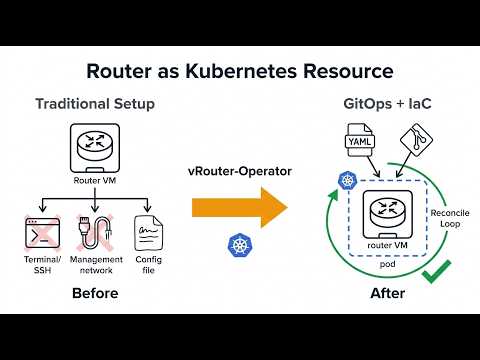
DevConf.cz 2026 — vRouter-Operator: Bringing GitOps and IaC to Virtual Network Functions in Kubernetes
- Recording: https://www.youtube.com/watch?v=yQsc4NWkfoI
- Slides: https://speakerdeck.com/tjjh89017/devconf-dot-cz-2026-vrouter-operator-bringing-gitops-and-iac-to-virtual-network-functions-in-kubernetes

ProxmoxCluster ──clusterRef──→ VRouterTarget ←──── VRouterBinding ──── VRouterTemplate
(endpoints +                   (provider +          (bind template       (config/commands
 credentials)                   params)              to targets)          template text)
      │                              │
ProxmoxCluster                VRouterTarget
Controller                    Controller
(polls node,                  (polls IsVMRunning every 60s,
 reboot detect,                updates status.vmRunning,
 unreachable →                 VMI watch for KubeVirt instant detect)
 vmRunning=false)                    │
      │                        status.vmRunning change
      └─ status.proxmoxNode    → triggers VRouterConfig reconcile
         status.lastRebootTime
                                     │
                              VRouterConfig Controller
                              → resolve VRouterTarget (provider info)
                              → check VM running (skip if stopped)
                              → wait for the router's config service to be ready
                              → deliver config via QGA or gRPC
                              → update status (phase, conditions)
| CRD | Short name | Purpose |
|---|---|---|
VRouterTemplate |
vrtt |
Go text/template config/command template |
VRouterTarget |
vrt |
Target VM + provider config + default params |
VRouterBinding |
vrb |
Binds a template to one or more targets |
VRouterParams |
vrtp |
Reusable, schemaless params block merged in via a binding's paramsRefs |
VRouterConfig |
vrc |
Final rendered config applied to one router (auto-generated or direct) |
ProxmoxCluster |
pxc |
Centralised Proxmox endpoint + credentials (Proxmox provider only) |
- Kubernetes cluster
- KubeVirt installed for the
kubevirtprovider (tested on Harvester) - Proxmox VE cluster accessible for the
proxmoxprovider - vrouter-daemon deployed for the
vrouter-daemonprovider
- KubeVirt installed for the
- cert-manager (for webhook TLS)
- A router VM image with
qemu-guest-agentinstalled (nocloud-initneeded) — required for thekubevirtandproxmoxproviders, which deliver configuration over QGA. See docs/SPEC.md §7.4-7.5 for exactly how config is applied inside the guest.
- Kubernetes 1.24+
- cert-manager installed (required for webhook TLS)
kubectl apply -f https://github.com/cert-manager/cert-manager/releases/latest/download/cert-manager.yaml
kubectl wait --for=condition=Available deployment --all -n cert-manager --timeout=120s
helm install vrouter-operator ./charts/vrouter-operator \
--namespace vrouter-system --create-namespace# Pin to a specific image tag
helm install vrouter-operator ./charts/vrouter-operator \
--namespace vrouter-system --create-namespace \
--set controllerManager.manager.image.tag=v0.1.0
# Disable webhooks (dev/testing only — no validation)
# Webhooks are controlled by the ENABLE_WEBHOOKS env var read in cmd/main.go,
# not a CLI flag, so set it via controllerManager.manager.env.
helm install vrouter-operator ./charts/vrouter-operator \
--namespace vrouter-system --create-namespace \
--set controllerManager.manager.env[0].name=ENABLE_WEBHOOKS \
--set-string controllerManager.manager.env[0].value=false
# Pull from a private registry
helm install vrouter-operator ./charts/vrouter-operator \
--namespace vrouter-system --create-namespace \
--set imagePullSecrets[0].name=my-registry-secrethelm upgrade vrouter-operator ./charts/vrouter-operator \
--namespace vrouter-systemhelm uninstall vrouter-operator --namespace vrouter-systemmake install # install CRDs into current cluster
make deploy # deploys ghcr.io/tjjh89017/vrouter-operator:latest by default
# or pin a version:
make deploy IMG=ghcr.io/tjjh89017/vrouter-operator:v0.1.0make build-installer IMG=ghcr.io/tjjh89017/vrouter-operator:v0.1.0 # writes dist/install.yaml
kubectl apply -f dist/install.yamlhelm install vrouter-operator ./charts/vrouter-operator \
--namespace vrouter-system --create-namespaceDefine config/commands using Go text/template syntax with sprig functions:
apiVersion: vrouter.kojuro.date/v1
kind: VRouterTemplate
metadata:
  name: hostname-template
  namespace: default
spec:
  commands: |
set system host-name '{{ .hostname }}'KubeVirt:
apiVersion: vrouter.kojuro.date/v1
kind: VRouterTarget
metadata:
  name: router-kubevirt
  namespace: default
spec:
  provider:
    type: kubevirt
    kubevirt:
      name: router-kubevirt   # VirtualMachine name
      namespace: default
  params:
    hostname: "my-router"
Proxmox VE (requires a ProxmoxCluster, see below):
apiVersion: vrouter.kojuro.date/v1
kind: VRouterTarget
metadata:
  name: router-proxmox
  namespace: default
spec:
  provider:
    type: proxmox
    proxmox:
      vmid: 121
      clusterRef:
        name: pve-cluster
        namespace: default
  params:
    hostname: "my-router"
vrouter-daemon (bare metal or any VM with daemon installed):
apiVersion: vrouter.kojuro.date/v1
kind: VRouterTarget
metadata:
  name: router-daemon
  namespace: default
spec:
  provider:
    type: vrouter-daemon
    daemon:
      address: "vrouter-daemon.vrouter-system.svc:50052"
      agentID: "7dea4734a47e49b0952457b684587e7c"
  params:
hostname: "my-router"Bind one or more templates to one or more targets:
apiVersion: vrouter.kojuro.date/v1
kind: VRouterBinding
metadata:
  name: hostname-binding
  namespace: default
spec:
  templateRefs:                    # ordered list; config/commands concatenated in order
    - name: hostname-template
  save: true          # persist config after commit (default: true)
  targetRefs:
    - name: router-kubevirt
    - name: router-proxmox
    - name: router-daemon
The operator will automatically create a VRouterConfig for each target and apply it to the VM via QGA or gRPC.
kubectl get vrc                  # or: kubectl get vrouterconfig
kubectl get vrt                  # check vmRunning column
kubectl get vrb                  # or: kubectl get vrouterbinding
kubectl wait vrc/hostname-binding.router-kubevirt --for=condition=AppliedThe Proxmox provider uses the Proxmox REST API to communicate with VMs via QEMU Guest Agent.
ProxmoxCluster centralises endpoint and credential configuration for a Proxmox VE cluster. All VRouterTarget resources on the same cluster share one ProxmoxCluster instead of repeating credentials per target.
The controller polls /cluster/resources on syncInterval and writes the resolved node name into VRouterTarget.status.proxmoxNode, eliminating per-operation node-lookup API calls.
If the Proxmox API is unreachable (e.g. network issue), the controller treats all associated VMs as stopped (status.vmRunning=false) and retries after syncInterval.
apiVersion: vrouter.kojuro.date/v1
kind: ProxmoxCluster
metadata:
  name: pve-cluster
  namespace: default
spec:
  endpoints:
    - "https://192.168.1.10:8006"
  credentialsRef:
    name: proxmox-credentials   # Secret with api-token-id and api-token-secret
  insecureSkipTLSVerify: false
  syncInterval: "60s"
checkGuestUptime: true # detect guest-initiated reboots via QGA (default: true)apiVersion: v1
kind: Secret
metadata:
name: proxmox-credentials
namespace: default
stringData:
api-token-id: "user@pam!token-name"
api-token-secret: "<token-secret>"| Scenario | Detection |
|---|---|
| Proxmox stop → start (hard restart) | Proxmox uptime resets → detected automatically |
Guest reboot command (soft reboot) |
Detected via checkGuestUptime: true (default); reads /proc/uptime via QGA |
When a reboot is detected, VRouterTarget.status.lastRebootTime is updated and the VRouterConfig controller forces a re-apply on the next reconcile.
kubectl wait --for=condition=Synced proxmoxcluster/pve-cluster --timeout=120s
kubectl get vrt router-proxmox -o jsonpath='{.status.proxmoxNode}'The vrouter-daemon provider enables managing virtual routers on bare metal or any VM without KubeVirt or Proxmox VE. It uses the vrouter-daemon gRPC agent, which runs on the router host and connects back to a server deployed in Kubernetes.
vrouter-operator               vrouter-server (k8s)
┌──────────────┐               ┌──────────────────────────────┐
│  Controller  │   gRPC        │  ControlService (port 50052) │
│       │      │──────────────→│         │                    │
│  gRPC Client │               │    Redis (broker + registry) │
└──────────────┘               │         │                    │
                               │  AgentService (port 50051)   │
                               └─────────┬────────────────────┘
                                         │ gRPC bidir stream
                                   ┌───────┴───────┐
                                   │ router agents │  (bare metal)
                                   └───────────────┘
- vrouter-server — runs in Kubernetes; two services:
ControlService(ClusterIP:50052) — operator-facing:IsConnected,ApplyConfigAgentService(NodePort30051) — agent-facing bidirectional stream
- vrouter-agent — runs on router host; connects to
AgentServiceand executes config pushes locally - Redis (HA via Sentinel) — brokers config payloads between server replicas and agents
kubectl apply -f deploy/kubernetes/namespace.yaml
kubectl apply -f deploy/kubernetes/redis-ha.yaml
kubectl apply -f deploy/kubernetes/vrouter-daemon.yaml
Creates in vrouter-system namespace: Redis HA (3+3 Sentinel), vrouter-daemon deployment (2 replicas), ClusterIP service for the operator, NodePort service for agents.
Download the .deb from the latest release:
dpkg -i vrouter-agent_<version>_amd64.debEdit /etc/default/vrouter-agent:
AGENT_ARGS="--server 172.30.0.40:30051"   # NodePort address
VRF_NAME=mgmt                              # optional: run inside a VRF
systemctl start vrouter-agent
systemctl status vrouter-agentBy default vrouter-agent uses /etc/machine-id as its agent ID:
cat /etc/machine-id
# e.g. 7dea4734a47e49b0952457b684587e7c
You can override it with --agent-id or the AGENT_ID environment variable in /etc/default/vrouter-agent.
apiVersion: vrouter.kojuro.date/v1
kind: VRouterTarget
metadata:
  name: router-daemon
  namespace: default
spec:
  provider:
    type: vrouter-daemon
    daemon:
      address: "vrouter-daemon.vrouter-system.svc:50052"  # ClusterIP service
      agentID: "7dea4734a47e49b0952457b684587e7c"         # /etc/machine-id on router host
      timeoutSeconds: 60                                   # optional, default 60
  params:
hostname: "my-router"IsVMRunning calls ControlService.IsConnected. If the agent is not connected to the daemon (VM stopped, agent not running, or network issue), the VM is treated as stopped and config apply is skipped until the agent reconnects.
The agent supports a --disconnect-policy flag that controls behavior when the server is unreachable:
| Policy | Behavior |
|---|---|
keep (default) |
Maintain current config |
rollback |
Re-apply init config after repeated failures |
| KubeVirt | Proxmox VE | vrouter-daemon | |
|---|---|---|---|
| Config delivery | QGA via SPDY exec | QGA via REST API | gRPC (daemon) |
| Script rendering | Operator-side | Operator-side | Daemon-side |
| VM running detect | VMI object + watch | Proxmox API | IsConnected RPC |
| Bare metal support | No | No | Yes |
| Extra infra needed | KubeVirt | Proxmox VE | vrouter-daemon + Redis |
The VRouterTarget controller polls IsVMRunning every 60 seconds and updates status.vmRunning. For KubeVirt, VMI watch events trigger an immediate check without waiting for the next poll.
| Field | Description |
|---|---|
status.vmRunning |
Whether the VM was observed as running in the last poll |
status.proxmoxNode |
Proxmox node hosting the VM (Proxmox provider only) |
status.lastRebootTime |
Timestamp of last detected reboot (Proxmox provider only) |
When vmRunning changes from false to true, all referencing VRouterConfig resources are automatically re-enqueued for reconcile.
kubectl get vrt                  # shows VM Running column
kubectl get vrt router-kubevirt -o jsonpath='{.status.vmRunning}'For simple cases or direct management, create a VRouterConfig directly:
apiVersion: vrouter.kojuro.date/v1
kind: VRouterConfig
metadata:
  name: my-router-config
  namespace: default
spec:
  targetRef:
    name: router-kubevirt
  save: true
  commands: |
set system host-name 'my-router'A VRouterBinding can also list paramsRefs — an ordered list of VRouterParams objects — alongside its own params, and its VRouterTarget can have params too. All three are merged with target params taking priority, then binding params, then paramsRefs (later entries in the list override earlier ones):
final params = paramsRefs (in list order) ← binding.params ← target.params
The validating webhook enforces rules that the CRD schema alone can't express — see docs/SPEC.md §6.2 for the full list. The most common ones you'll hit:
- Every
templateRef/templateRefs/paramsRefs/targetRefs/clusterRefmust point to an object that exists in the same namespace as the object referencing it — cross-namespace references are rejected. - A
VRouterTargetcannot be deleted while anyVRouterBindingorVRouterConfigin the same namespace still references it; aVRouterParamscannot be deleted while anyVRouterBindingin the same namespace still references it viaparamsRefs. VRouterTemplate.spec.config/commandsmust parse as validtext/templatesyntax at admission time, not just at render time.
Webhooks require cert-manager for TLS (see Installation) and can be disabled with the ENABLE_WEBHOOKS=false environment variable (dev/testing only — disables all of the above validation). For Helm installs, set it via --set controllerManager.manager.env[0].name=ENABLE_WEBHOOKS --set-string controllerManager.manager.env[0].value=false (see Common values overrides); for local development, run ENABLE_WEBHOOKS=false go run ./cmd/main.go.
| Phase | Meaning |
|---|---|
Pending |
Waiting for VM to be ready |
Applying |
Script dispatched, waiting for completion |
Applied |
Config applied successfully |
Failed |
Script exited with non-zero code (no auto-retry; edit spec to retry) |
The Applied condition is set for kubectl wait support:
kubectl wait vrc/<name> --for=condition=Applied --timeout=120s| Guest OS | /etc/os-release ID |
Router service unit | Notes |
|---|---|---|---|
| VyOS | vyos |
vyos-router.service |
Validated on Harvester and Proxmox VE |
| DozenOS | dozenos |
dozenos-router.service |
Community 1:1 rebuild of VyOS rolling with freely downloadable nightly images; used by the CI e2e suite |
The KubeVirt provider auto-detects the guest flavor by reading /etc/os-release over QGA and resolves the router service unit from its ID field; an unknown ID fails loudly instead of guessing. Both flavors share the same vbash/commit semantics, so templates and bindings work unchanged on either.
| Provider | Status | Notes |
|---|---|---|
| KubeVirt | ✅ Supported | Same-cluster KubeVirt; SPDY exec into virt-launcher pod |
| Proxmox VE | ✅ Supported | REST API + QGA; credentials via ProxmoxCluster |
| vrouter-daemon (gRPC) | ✅ Supported | Standalone daemon; bare metal or any VM |
| Document | Description |
|---|---|
| docs/SPEC.md | Authoritative design spec (implemented state) |
| docs/TODO.md | Backlog — planned features, not yet implemented |
| docs/proposals/ | Design proposals for future features |
# Build
make build

# Run locally (webhooks disabled)
ENABLE_WEBHOOKS=false go run ./cmd/main.go

# Run tests
make test

# Lint / format
make fmt
make vet
make lint

# After modifying api/v1/ types or kubebuilder markers
make generate   # regenerate zz_generated.deepcopy.go
make manifests  # regenerate CRDs and RBAC
See docs/SPEC.md for the full design (controller reconcile flows, provider interface, params merge semantics, template engine, and webhook validation rules).
All commits require DCO sign-off:
git commit -s