07_列出所有的人物 (Person)
人物 (Person/Pronoun) 是指語言中指涉人的詞彙,例如「人名」或是「代名詞」。
from ArticutAPI import Articut
from pprint import pprint
username = "" #這裡填入您在 https://api.droidtown.co 使用的帳號 email。若使用空字串,則預設使用每小時 2000 字的公用額度。
apikey   = "" #這裡填入您在 https://api.droidtown.co 登入後取得的 api Key。若使用空字串,則預設使用每小時 2000 字的公用額度。
articut = Articut(username, apikey)

inputSTR = "謝長廷用一句馬形容馬英九,馬沒有回應他。"
resultDICT = articut.parse(inputSTR)
pprint(resultDICT["result_pos"])personLIST = articut.getPersonLIST(resultDICT)
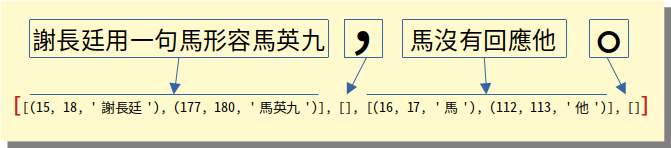
pprint(personLIST)[[(15, 18, '謝長廷'), (177, 180, '馬英九')], [], [(16, 17, '馬'), (112, 113, '他')], []].getPersonLIST() 預設會把代名詞一起計入,所以在前述的操作中,(16, 17, '馬') 和 (112, 113, '他') 這兩個代名詞會被擷取出來。如果不需要擷取代名詞的話,可以在使用 .getPersonLIST() 時把,加入 includePronounBOOL=False 的參數,把代名詞的擷取功能關閉。
personLIST = articut.getPersonLIST(resultDICT,  includePronounBOOL=False)
pprint(personLIST)[[(15, 18, '謝長廷'), (177, 180, '馬英九')], [], [], []]這麼一來,在結果裡就不會出現代名詞的 (16, 17, '馬') 和 (112, 113, '他') 了
輸出結果和原入的句子之間的索引對應關係如下: