
Highly comparative time-series analysis in Python









Documentation · Getting started · Method list · API reference · Paper
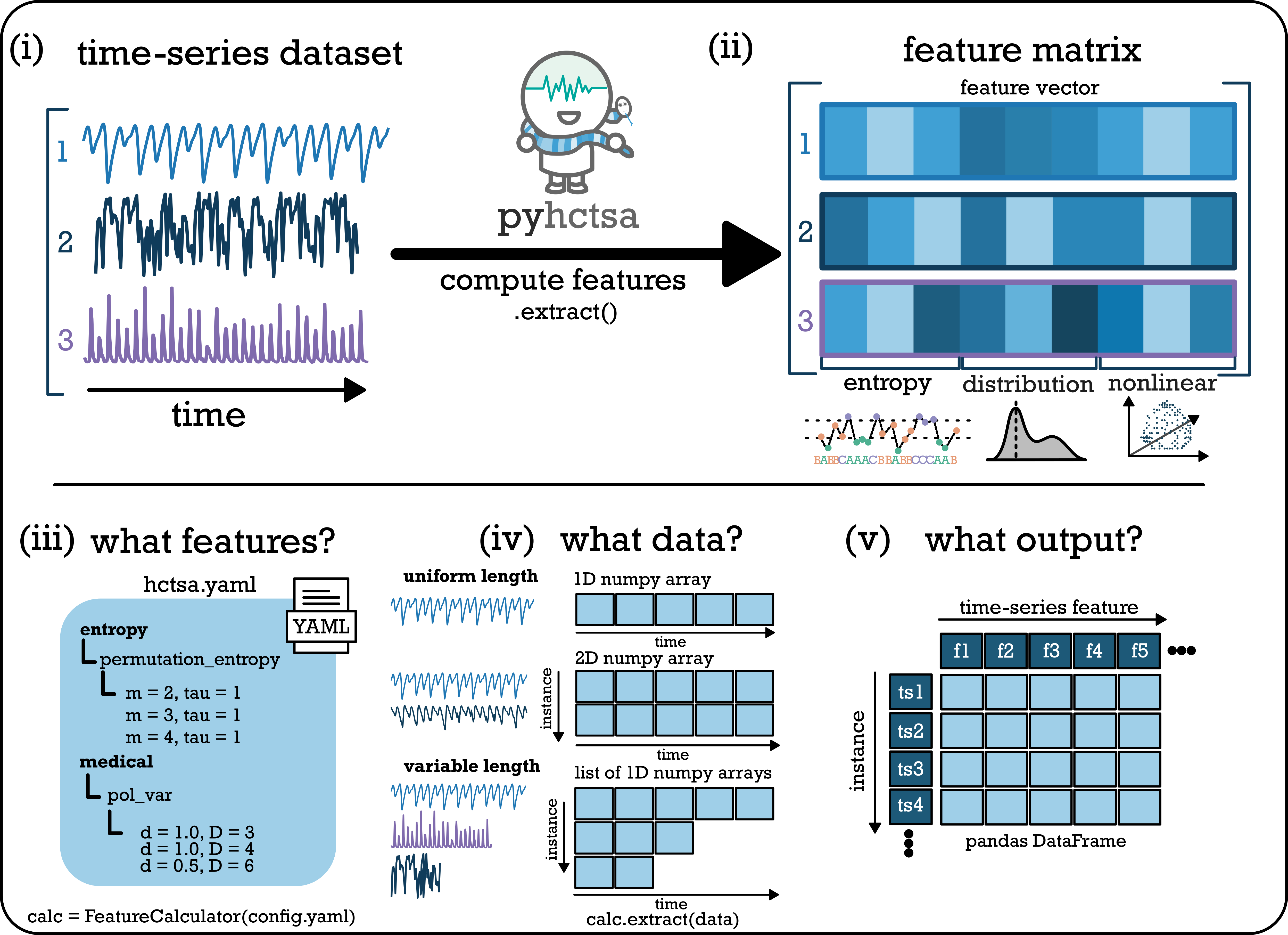
The PYthon toolkit for Highly Comparative Time-Series Analysis (pyhctsa) is a living library of time-series analysis methods. It computes over 4500 interpretable time-series features from a single univariate series — spanning distributional shape, autocorrelation, entropy and information theory, scaling, stationarity, nonlinear dynamics, spectral and wavelet properties, model fits, and more — making it the most comprehensive feature set available in native Python.
pyhctsa requires Python 3.10 or newer:
pip install pyhctsaWe strongly recommend installing into a fresh virtual environment to prevent dependency clashes:
conda create -n pyhctsa python=3.12 -y && conda activate pyhctsa && pip install pyhctsaInstantiate a FeatureCalculator and call extract on your data:
from pyhctsa.calculator import FeatureCalculator
from pyhctsa.utils import get_dataset

calc = FeatureCalculator()          # Loaded 791 master operations.

e1000 = get_dataset()               # bundled Empirical 1000 dataset
data = e1000[0]                     # a list, array, or pandas Series

res = calc.extract(data)            # pandas DataFrame, one row per series
extract accepts either a single time series or a list of series, which do not need to be the same length:
res = calc.extract(e1000[:10], verbose=True)
print(res.shape)                    # (10, F) -> N series x F features
Results are returned as a pandas.DataFrame of shape N × F, where N is the number of time-series
instances and F is the number of time-series features.
New to pyhctsa? Step-by-step notebooks and example workflows live in /tutorials, and a walkthrough
is available in the getting started guide.
By default, FeatureCalculator initializes the full feature set. To compute a subset, pass the corresponding
configuration .yaml file:
custom_calc = FeatureCalculator(config_path="subset.yaml")The number of master operations (callable functions) specified by the .yaml is displayed for verification, e.g.
Loaded 700 master operations..
Individual operations can be imported directly from their module. For example, raw_hrv_meas lives in the medical
module:
from pyhctsa.operations.medical import raw_hrv_meas

data = ...              # your ArrayLike data
res = raw_hrv_meas(data)  # a dictionary or scalar value
Note
Individual operations can only be called directly on individual time-series instances.
Operations are grouped into the following modules — see the method list for the full catalogue:
changepoint |
correlation |
criticality |
distribution |
entropy |
extreme_events |
graph |
hypothesis_tests |
information |
medical |
model_fit |
nonlinearity |
physics |
pre_process |
scaling |
spectral |
stationarity |
surrogates |
symbolic |
wavelet |
Note
These conceptual groupings are a convenience only, and are not intended as definitive classifications.
Time-series feature extraction is computationally intensive. To speed up processing, pyhctsa can distribute the
workload across multiple CPU cores on your local machine using the LocalDistributor:
from pyhctsa.calculator import FeatureCalculator
from pyhctsa.distribute import LocalDistributor

calc = FeatureCalculator()

# it is generally recommended to set n_workers to the number of physical CPU cores
dist = LocalDistributor(n_workers=4)

res = calc.extract(data, distributor=dist)
Coming from MATLAB hctsa? A mapping between legacy operation names and their pyhctsa equivalents is available in the name mappings table.
If you use pyhctsa in your work, please cite the accompanying JOSS paper:
Moore, J. B., & Fulcher, B. D. (2026). pyhctsa: A Python package for highly comparative time-series analysis. Journal of Open Source Software, 11(123), 10581. https://doi.org/10.21105/joss.10581
@article{Moore2026pyhctsa,
  author  = {Moore, Joshua B. and Fulcher, Ben D.},
  title   = {pyhctsa: A Python package for highly comparative time-series analysis},
  journal = {Journal of Open Source Software},
  year    = {2026},
  volume  = {11},
  number  = {123},
  pages   = {10581},
  doi     = {10.21105/joss.10581}
}
Machine-readable metadata is provided in CITATION.cff.
Code for computing features from time-series data is licensed under the GNU General Public License version 3.
While the majority of features in pyhctsa rely on standard Python libraries, a small subset of features require
external toolboxes. The following external time-series analysis code packages are bundled with the software (in
pyhctsa/toolboxes) and are used by the feature-extraction calculator:
| Package | Author | License |
|---|---|---|
| Time-series analysis code | Michael Small | unlicensed |
| Time-series analysis code | Max Little | GPL |
| TISEAN (v3.0.1) | Hegger, Kantz & Schreiber | GPL |
The following codebases have been adapted directly into Python code within pyhctsa, rather than being included as external toolboxes:
| Code | Author | License |
|---|---|---|
| Embedding statistics | Danny Kaplan | GPL |
| Histogram code | Rudy Moddemeijer | unlicensed |
Portions of this codebase (including tests and function documentation) were refactored and generated with the assistance of Large Language Models (LLMs). All AI-generated contributions have been reviewed and verified by the human maintainers.