
A hobby monolithic kernel for x86_64 — with a real GUI, preemptive multitasking, networking, and audio.
Project is discontinued for unknown amount of time


EquinoxOS is a from-scratch hobby operating system for x86_64 written in C and ASM. It boots via the Limine bootloader in 64-bit Higher Half mode, runs a compositing window manager with drop shadows and z-ordering, supports true preemptive multitasking with Ring 3 user-space isolation, dual filesystem support (FAT32 + EXT2), a full TCP/IP network stack, AC97 audio, and even runs a port of DOOM.
It's made to be minimally daily-usable while staying readable and educational.
graph TD
    subgraph UserSpace["🧑 User Space (Ring 3)"]
        ELF[ELF64 Executables] --> SDK[EquinoxOS SDK / CRT0]
        SDK --> SYSCALL[int 0x80 Syscall Interface]
    end

    subgraph KernelCore["⚙️ Kernel Core (Ring 0)"]
        SYSCALL --> HANDLER[Syscall Handler · 10 calls]
        HANDLER --> TASK[Preemptive Scheduler · Round-Robin]
        HANDLER --> MEM[Memory Manager]
        MEM --> PMM[PMM · Bitmap Allocator]
        MEM --> VMM[VMM · 4-Level Paging]
        MEM --> HEAP[Kernel Heap · kmalloc/kfree]
        MEM --> SHM[Shared Memory · shm_alloc]
    end

    subgraph Subsystems["🔧 Kernel Subsystems"]
        VFS[Virtual File System] --> FAT32[FAT32 R/W · ATA PIO]
        VFS --> EXT2[EXT2 R/W · ATA PIO]
        VFS --> DEVFS[Device Nodes]
        GUI[CWM Compositor] --> VESA[VESA LFB · Direct Framebuffer]
        GUI --> SHADOW[Drop Shadow · Alpha Blend]
        NET[Network Stack] --> RTL[RTL8139 Driver]
        NET --> ARP_IP[ARP · IPv4 · ICMP]
        NET --> UDP_TCP[UDP · TCP 3-way handshake]
        NET --> HTTP_DNS[HTTP GET · DNS · NTP]
        AUDIO[AC97 Driver] --> PCM[PCM Audio Output]
    end

    subgraph Hardware["🖥 Hardware"]
        VESA --> FB[Framebuffer]
        RTL --> NIC[RTL8139 NIC]
        FAT32 --> DISK[ATA Disk]
        EXT2 --> DISK
        AUDIO --> CODEC[AC97 Codec]
        PS2MOU[PS/2 Mouse] --> GUI
        PS2KB[PS/2 Keyboard] --> TASK
        PCI[PCI Bus Scan] --> RTL
        PCI --> AUDIO
    end
| Category | Component | Status | Notes |
|---|---|---|---|
| Boot | Limine Protocol v3 | ✅ | 64-bit Higher Half, memory map, HHDM |
| CPU | x86_64 + SSE | ✅ | SSE init (CR0/CR4), used by VESA blitter |
| Memory — PMM | Bitmap Allocator | ✅ | Page-granular, pmm_alloc_continuous() |
| Memory — VMM | 4-Level Paging | ✅ | PML4/PDP/PD/PT, separate user address spaces |
| Memory — Heap | kmalloc / kfree |
✅ | 64 MB kernel heap |
| Memory — SHM | Shared Memory | ✅ | shm_alloc() for IPC between tasks |
| Multitasking | Preemptive Round-Robin | ✅ | IRQ0 (PIT 50 Hz) context switch |
| User Mode | Ring 3 Isolation | ✅ | Per-process PML4, TSS, GDT segments |
| Graphics | VESA LFB | ✅ | Double-buffered, hardware cursor, alpha blending |
| GUI | Compositing WM | ✅ | Z-ordering, drop shadows, window drag |
| Storage | ATA PIO | ✅ | Raw sector R/W for both FS drivers |
| Filesystem | FAT32 | ✅ | Full Read + Write, 8.3 filenames |
| Filesystem | EXT2 | ✅ | Read + Write, stress-tested |
| ELF Loader | ELF64 | ✅ | PT_LOAD segments mapped into user PML4 |
| Network | RTL8139 | ✅ | PCI scan, raw TX/RX |
| Network | ARP / IPv4 / ICMP | ✅ | Full IPv4 stack with ICMP ping |
| Network | UDP / TCP | ✅ | UDP datagrams + TCP 3-way handshake |
| Network | HTTP / DNS / NTP | ✅ | HTTP GET, DNS resolve, NTP time sync |
| Audio | AC97 | ✅ | PCM output via SYS_AUDIO_PLAY syscall |
| Input | PS/2 Keyboard | ✅ | Scancode-based, shell + app input |
| Input | PS/2 Mouse | ✅ | Relative tracking, click detection |
| PCI | PCI Bus Scan | ✅ | Vendor/device ID enumeration |
| Timer | PIT (8253) | ✅ | 50 Hz tick, get_time_ms() |
| Serial | COM1 | ✅ | Early boot log + QEMU debug output |
The OS ships a full desktop environment with the following apps:
| App | Description |
|---|---|
| Terminal | Interactive shell with command history and kernel log streaming |
| Explorer | Graphical file manager — lists FAT32/EXT2 files, launches ELF executables |
| Notepad | Text editor with disk save support (NOTES.TXT → FAT32/EXT2) |
| Paint | Drawing app with Bresenham line algorithm + BMP export to disk |
| System Monitor | Real-time RAM usage bar and process overview |
| DOOM | The classic id Software shooter, ported to run natively with AC97 sound |
| App | How to launch | Description |
|---|---|---|
snake.elf |
Explorer / run snake.elf |
Classic snake game |
bmpview.elf |
run bmpview.elf BG.BMP |
BMP image viewer |
htmlview.elf |
Explorer | Lightweight HTML/DOM viewer (HTTP only) |
browser.elf |
run bin/browser.elf <url> |
Full graphical web browser — HTTPS/TLS, DNS, HTML/CSS, JavaScript (QuickJS), DOM & images |
niplay.elf |
run niplay.elf terry.wav |
WAV music player via AC97 |
widget_demo.elf |
Explorer | EID v2.0 widget showcase (button / checkbox / text input / slider + animations) |
ipc_test.elf |
Explorer | Pipe & message-queue smoke test (syscalls 60–67) |
doom.elf |
Explorer | DOOM port with AC97 audio |
💡 The desktop / system shell itself is now the separate enGUI project, pulled in as the
app/sysguiGit submodule and launched as the Ring 3 init process (bin/sysgui.elf). Older versions had Lua (luagui.elf) bundled — Lua was removed from the SDK and app set.
browser.elf is a from-scratch graphical web browser running as a Ring 3 userspace app. It drives the full network stack and renders real web pages — including this project's own landing page at https://equinoxos.duckdns.org/:
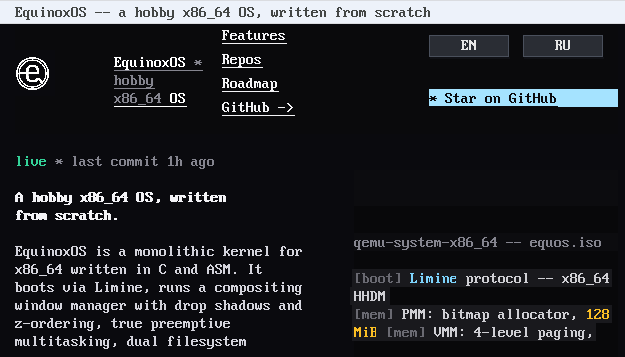
Capabilities:
- 🔒 HTTPS / TLS via vendored BearSSL with a bundled Mozilla CA trust store
- 🌐 DNS + TCP/IP over the
rtl8139driver and the custom kernel network stack - 📄 HTML + CSS layout engine — selectors, custom properties (
var()), inline images - 🟨 JavaScript through an embedded QuickJS engine with DOM bindings, a
windowobject andfetch() - 🖼 Image decoding for inline page graphics
- 🖱 Scrolling, link navigation and an address bar, drawn through the EID v2.0 immediate-mode GUI toolkit
run bin/browser.elf https://equinoxos.duckdns.org/
⚠️ Known limitation: some websites can still bring the OS down with a kernel panic. This is a known issue and is being actively worked on — it will be fixed soon.
Applications are ELF64 binaries linked at 0x1000000, built with the bundled SDK.
All kernel services are accessed via int 0x80.
RAX |
Name | Description | Key Args |
|---|---|---|---|
1 |
SYS_PRINT |
Write string to terminal + serial | rdi: char* msg |
2 |
SYS_READ_FILE |
Map file from VFS into user RAM | rdi: name, rsi: size_out |
3 |
SYS_WRITE_FILE |
Save buffer to VFS (FAT32/EXT2) | rdi: name, rsi: buf, rdx: size |
5 |
SYS_DRAW_BUFFER |
Blit pixel buffer to compositor window | rdi/rsi: x/y, rdx/rcx: w/h, r8: buf |
7 |
SYS_GET_MOUSE |
Get mouse X/Y/buttons from kernel | rax: X, rbx: Y, rcx: buttons |
9 |
SYS_GET_SCANCODE |
Pop keyboard scancode (non-blocking) | — |
10 |
SYS_EXIT |
Terminate process, reclaim RAM | rdi: exit_code |
12 |
SYS_GET_FONT |
Map PSF font pointer into user space | — |
20 |
SYS_AUDIO_PLAY |
Submit PCM chunk to AC97 driver | rdi: buf, rsi: size |
EquinoxOS includes EID (Equinox Interface Designer) — an immediate-mode UI toolkit that gives apps full control over their visual style.
#include <eid.h>
#include <equos.h>

eid_ctx_t ui;
uint32_t buffer[400 * 300];

void render() {
    eid_begin(&ui, buffer, 400, 300);
    ui.mx -= win_x;  // Map global → window-relative coords
    ui.my -= win_y;

    uint32_t id    = eid_get_id("OK", 50, 120);
    uint32_t state = eid_process_interaction(&ui, id, 50, 120, 100, 36);

    uint32_t col = (state & EID_STATE_HOVER) ? 0x00FFFF : 0x006666;
    if (state & EID_STATE_ACTIVE) col = 0xFFFFFF;

    eid_draw_rect(buffer, 400, 300, 50, 120, 100, 36, col);
    eid_draw_text(buffer, 400, 300, 68, 130, "OK", 0x000000);

    if (state & EID_STATE_CLICKED) { /* handle */ }
    eid_end(&ui, win_x, win_y);
}
📖 See EID_SDK.md for the full API reference, drawing primitives, and best practices.
EquinoxOS/
├── src/                                  # Kernel source
│   ├── kernel.c                          # kmain() — boot entry, subsystem init
│   ├── api.h                             # EquinoxAPI struct (app ↔ kernel contract)
│   ├── linker.ld                         # Kernel linker script
│   ├── boot/                             # Boot glue
│   │   ├── eqstart.c / eqstart.h         # Early boot init
│   │   ├── boot_config.h                 # Boot configuration
│   │   ├── nyan_data.h                   # Boot splash data
│   │   └── limine/limine.h               # Limine protocol header
│   ├── syslibc/                          # Kernel-side stdio + string helpers
│   └── system/
│       ├── core/                         # GDT, IDT, PIC, CPU, I/O ports, panic, NASM stubs
│       ├── hal/                          # Hardware Abstraction Layer
│       ├── mem/
│       │   ├── pmm.c                      # Bitmap Physical Memory Manager
│       │   ├── vmm.c                      # 4-level Virtual Memory Manager
│       │   ├── memory.c                  # kmalloc / kfree heap
│       │   └── shm.c                     # Shared Memory
│       ├── usr/
│       │   ├── task.c                    # Scheduler + context switch
│       │   ├── syscall.c                 # int 0x80 dispatch table
│       │   ├── ipc.c                     # Pipes + message queues
│       │   └── sync.c                    # Synchronization primitives
│       ├── fs/
│       │   ├── vfs.c / vfs.h             # Virtual File System abstraction
│       │   ├── fs.c                      # FS mount / registration layer
│       │   ├── fat32.c                   # FAT32 driver (R/W)
│       │   ├── ext2.c / ext2_tests.c     # EXT2 driver (R/W) + tests
│       │   ├── gpt.c                     # GPT partition parsing
│       │   └── elf.h                     # ELF64 loader structures
│       ├── drivers/
│       │   ├── vesa/                     # VESA LFB, BMP encoder, PSF2 + 8x8 fonts
│       │   ├── devices/
│       │   │   ├── audio/ac97.c          # AC97 PCM audio driver
│       │   │   ├── keyboard/             # PS/2 keyboard (scancodes)
│       │   │   ├── mouse/                # PS/2 mouse (relative tracking)
│       │   │   ├── pci/                  # PCI bus scan
│       │   │   ├── pcspeaker/            # PC Speaker beeper
│       │   │   └── usb/                  # USB host controllers: UHCI · OHCI · EHCI · xHCI
│       │   └── hardware/
│       │       ├── net/                  # RTL8139 · ARP · IPv4 · ICMP · TCP · UDP · DNS · sockets
│       │       ├── disk/                 # ATA PIO disk driver
│       │       └── serial/               # COM1 serial (QEMU log)
│       ├── misc/                         # PIT 8253 timer, RTC, RNG
│       └── shell/                        # Shell command parser
├── app/                                  # Ring 3 userspace apps
│   ├── snake.c                           # Snake game
│   ├── bmpview.c                         # BMP image viewer
│   ├── htmlview.c                        # HTML/HTTP browser (QuickJS-powered)
│   ├── niplay.c                          # WAV music player
│   ├── widget_demo.c                     # EID v2.0 widget showcase
│   ├── ipc_test.c                        # Pipe + message-queue test app
│   ├── doom/                             # DOOM port (doomgeneric)
│   ├── sysgui/                           # enGUI submodule (Ring 3 init process)
│   ├── urlget.c / httpsget.c / tlsboot.c # HTTP(S) / TLS client tools
│   └── js*.c · *test*.c                  # JS/DOM, networking, socket & misc test apps
├── sdk/                                  # Userspace SDK
│   ├── include/                          # equos.h, eid.h/eid_ext.h, libc + DOM/QuickJS/HTTP headers
│   ├── lib/                              # CRT0 (_start), syscall stubs, libc, eid, QuickJS glue
│   ├── lib_dom/                          # DOM implementation
│   ├── lib_qjs/                          # QuickJS bindings (fetch, window, page, DOM-JS)
│   ├── lib_http/                         # HTTP client
│   ├── lib_image/                        # Image decoding
│   └── codec/                            # WAV / audio codec helpers
├── iso_root/                             # Bootable ISO staging area
│   ├── EFI/BOOT/ · boot/limine/          # Limine UEFI + BIOS boot files
│   ├── bin/                              # Compiled ELF userspace apps
│   └── res/                              # Fonts, wallpapers, HTML tests, Lua sysgui scripts
├── tools/                                # Host build tools (CA bundle fetch · PEM → anchors)
├── resources/                            # Branding & wallpaper assets
├── Makefile                              # Windows build (mingw/msys2 cross-compiler)
├── WINDOWS_ext2.py                       # Python script — generates hdd.img (EXT2)
├── EID_SDK.md                            # Full EID + Syscall reference
├── ROADMAP.md                            # Development phases & milestones
├── CHANGES.md                            # Changelog
├── CONTRIBUTING.md                       # Contribution guide
├── ext2_plan.md / network_plan.md        # Design notes
└── LICENSE                               # GPL-2.0
| Tool | Purpose |
|---|---|
x86_64-elf-gcc |
Cross-compiler (freestanding, no stdlib) |
nasm |
Assembler for interrupt stubs & CRT0 |
x86_64-elf-ld |
Linker |
xorriso |
ISO image creation |
python3 |
EXT2 disk image generation |
qemu-system-x86_64 |
Virtual machine for testing |
# 1. Clone the repo
git clone https://github.com/Equinox-Collective/EquinoxOS.git
cd EquinoxOS

# 2. Build kernel + all apps + create ISO + HDD image
make all

# 3. Launch in QEMU (512 MB RAM, RTL8139, AC97 audio)
make run
Windows users: Use the
Makefile(tested with msys2/mingw toolchain).
Linux users: UseMakefile-linux.
make kernel.elf   # Build kernel only
make apps         # Build all userspace ELF apps
make doom.elf     # Build DOOM port
make iso          # Package bootable ISO
make create_hdd   # Generate hdd.img (EXT2) via Python script
make clean        # Remove all build artifacts
make cleanrun # clean + all + run# addr2line to map a fault RIP to source
x86_64-elf-addr2line -e kernel.elf <RIP_ADDRESS>
# QEMU serial log is written to qemu.log automatically
# and streamed to stdout via -serial stdioThe kernel outputs a full boot log to COM1 (visible in QEMU terminal):
=== EquinoxOS Kernel Starting ===
HHDM offset initialized
GDT initialized  |  SSE initialized  |  PMM initialized
VMM initialized  |  Heap initialized |  VESA initialized
IDT initialized  |  PIC remapped     |  Timer initialized
Task system initialized  |  VFS initialized
FAT32 initialized  |  EXT2 initialized
PCI initialized  |  GUI initialized  |  Shell initialized
=== EquinoxOS Ready ===
Full details in ROADMAP.md · recent patch set: CHANGES.md
- x86_64 Higher Half kernel via Limine (HHDM)
- Bitmap PMM + 4-level VMM + 64 MB kernel heap
- Preemptive Round-Robin scheduler (IRQ0 / PIT 50 Hz)
- Ring 3 user mode with isolated per-process address spaces
- GDT / IDT / TSS — proper kernel+user segments
- ELF64 loader → Ring 3 jump (CRT0)
- Syscall interface (
int 0x80) — 30+ calls (print, file R/W, draw, mouse, kbd, exec, audio, net, shm, pipes, mqueue, …) - VESA LFB with compositing WM, alpha shadows, z-ordering
- ATA PIO + FAT32 R/W + EXT2 R/W (stress-tested) + VFS abstraction
- RTL8139 NIC + full happy-path TCP/IP stack (ARP, IPv4, ICMP, TCP, UDP, DNS, NTP, HTTP GET)
- AC97 PCM audio driver
- PS/2 keyboard & mouse, PCI bus scan, COM1 serial debug
- Shared Memory (
shm_alloc) - PSF font rendering (loaded from
/res/font.psf) - HAL skeleton —
hal_display_ops_t/hal_input_ops_t/hal_block_ops_tregistry with adapters for VESA, PS/2, ATA PIO - GPT partition table parser (UTF-16 names, header validation; CRC32 still TODO)
- Sync primitives — spinlock, waitqueue, sleeping mutex, counting semaphore
- IPC — kernel pipes (4 KB ring buffer) + priority message queues + syscalls 60–67
- PSF2 font renderer in the kernel (variable glyph width, Unicode, UTF-8 decoder)
- EID v2.0 widget set — button / checkbox / text input / slider + animation helper (linear / quad / cubic easing)
- enGUI spun out as a Git submodule (
app/sysgui) and launched as the Ring 3 init process - DOOM port with AC97 audio · HTTP browser (
htmlview.elf) · WAV player (niplay.elf) - USB stack (UHCI / EHCI / xHCI)
- AHCI/SATA driver (slot into the HAL block interface, retire ATA PIO)
- VFS file descriptors (
open/read/write/close, seek, stat) and pipe VFS nodes - EXT2 indirect / double-indirect / triple-indirect blocks (large files)
- GPT CRC32 verification + multi-partition VFS mount
- SSE/AVX-accelerated compositing (needs FXSAVE/FXRSTOR on context switch)
- Real-time blur (Gaussian/Box) and WM-level window animations
- Kernel-side TrueType rendering (userspace
stb_truetype.halready in SDK) - Cross-process shared memory for GUI event streaming
- Port
mlibc/newlibas a full libc → self-hosting (TCC / GCC inside the OS) - Shell scripting, env vars, native piping via kernel pipes
- DHCP client + DNS cache, full TCP state machine with retransmission, POSIX socket syscalls
- HTTPS (BearSSL / mbedTLS port) + RNG + cert store
- Intel HD Audio driver and multi-stream software mixer
- Native EquinoxFS format + installable ISO that writes the OS to disk


| Handle | Role | |
|---|---|---|
| 👑 | @ewasion137 | Lead Developer |
| ⭐ | @oxtiskz | Special Thanks (account deleted) |
| ⭐ | @gobgolaxi | Contributor |
| ⭐ | @Offihito | Contributor |
| ⭐ | @Lertov2424232 | Contributor |


Built from scratch, for the love of low-level programming.