Implement SIBC (Leontovich boundary condition) for good conductors #46
Conversation
This file contains hidden or bidirectional Unicode text that may be interpreted or compiled differently than what appears below. To review, open the file in an editor that reveals hidden Unicode characters.
Learn more about bidirectional Unicode characters


…nly contains numerical values and not str. Update plot_solids to use 0.3 opacity for vacuum-like values
…logic, supporting only numerical values
 elenafuengar
added this to the
Accurate representation of material properties milestone
elenafuengar
added this to the
Accurate representation of material properties milestone
…ate _mpi_one_step
…g a gradient based boundary detection

Collaborator
Author
|
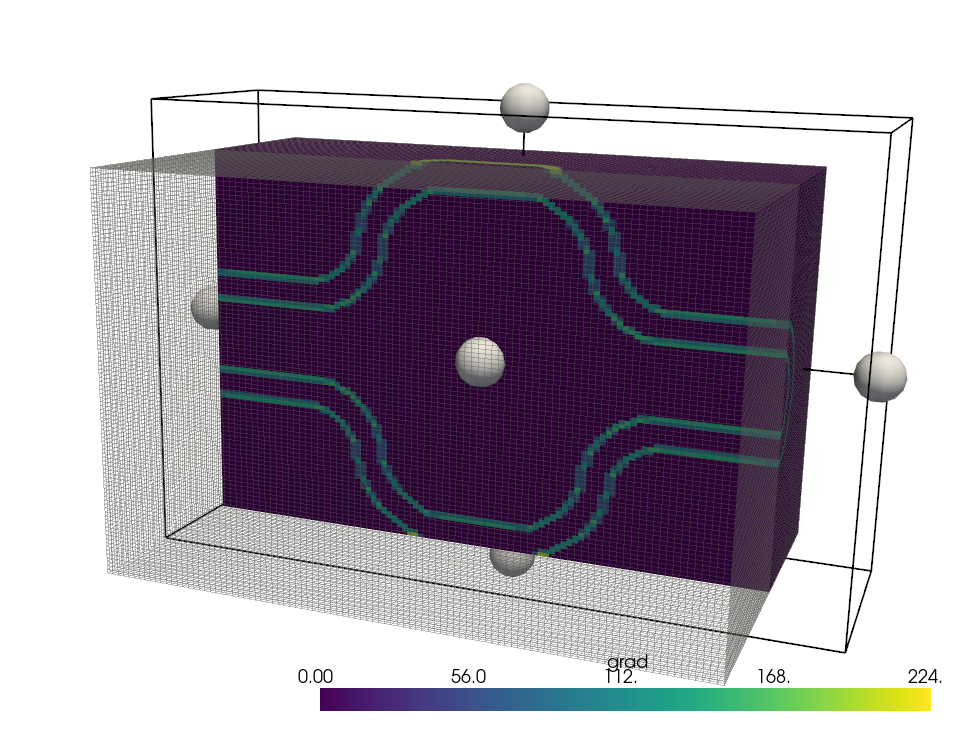
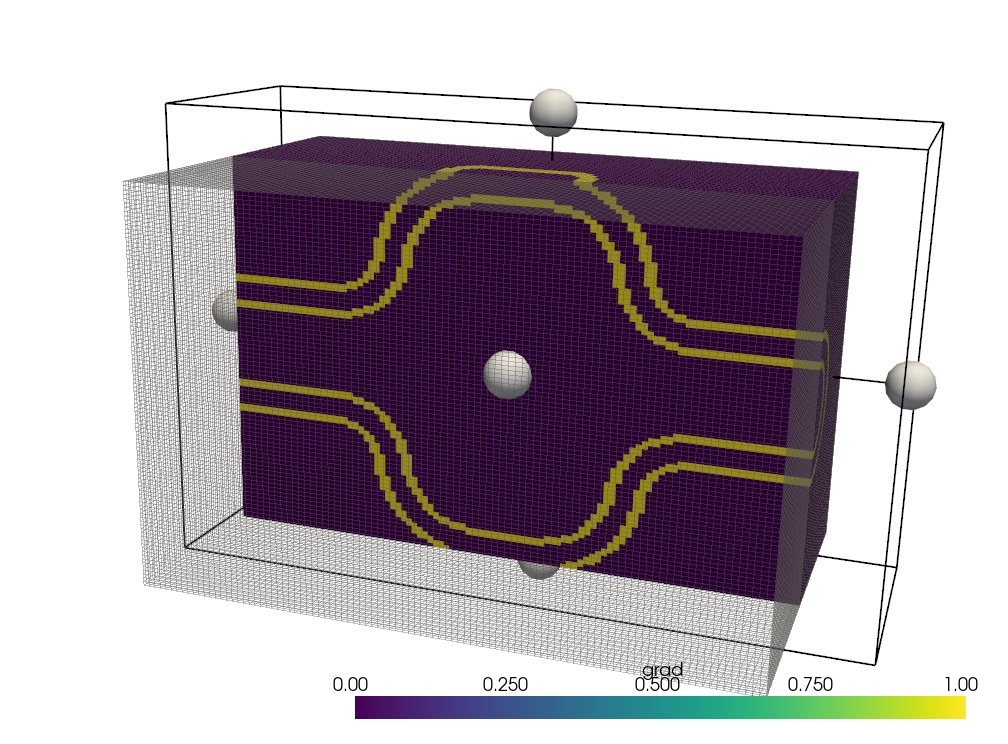
🔍 Algorithm explanation This snippet tags the surface of solid regions by computing the gradient magnitude of a scalar field (e.g. material mask) and converting it to a boolean mask. It uses PyVista's Gradient filter: def _mark_cells_in_surface(self):
# Modify the STL mask to account only for the surface
for key in self.stl_solids.keys():
if len(self.stl_materials[key]) == 3 and self.stl_materials[key][2] > 1e3:
grad = np.array(self.grid.compute_derivative(scalars=key)['gradient']) #bool STL mask
grad = np.sqrt(grad[:, 0]**2 + grad[:, 1]**2 + grad[:, 2]**2) #from 0 to 255
self.grid[key] = grad.astype(bool)The surface is identified where the gradient of the scalar field is non-zero: Cells where
|

Sign up for free
to join this conversation on GitHub.
Already have an account?
Sign in to comment

Add this suggestion to a batch that can be applied as a single commit.
This suggestion is invalid because no changes were made to the code.
Suggestions cannot be applied while the pull request is closed.
Suggestions cannot be applied while viewing a subset of changes.
Only one suggestion per line can be applied in a batch.
Add this suggestion to a batch that can be applied as a single commit.
Applying suggestions on deleted lines is not supported.
You must change the existing code in this line in order to create a valid suggestion.
Outdated suggestions cannot be applied.
This suggestion has been applied or marked resolved.
Suggestions cannot be applied from pending reviews.
Suggestions cannot be applied on multi-line comments.
Suggestions cannot be applied while the pull request is queued to merge.
Suggestion cannot be applied right now. Please check back later.
📝 Pull Request Summary
This pull request introduces several improvements and refactorings to the handling of STL-based materials and the solver infrastructure for the 3D grid simulation package. The main changes focus on enhancing flexibility in material assignment, supporting the Surface Impedance Boundary Condition (SIBC) for high-conductivity materials, and refactoring solver methods for better code organization and maintainability.
🔧 Changes Made
STL Material Handling and SIBC Support
GridFIT3D, which is automatically applied to STL solids with conductivity greater than 1e3 S/m. This involves marking only the surface cells for such materials. (wakis/gridFIT3D.py) [1] [2] [3]material_lib, and all STL material data is normalized to dictionary format for consistency. (wakis/gridFIT3D.py)'vacuum'to[1.0, 1.0]for consistency and improved opacity handling in plotting. (tests/test_007_mpi_lossy_cavity.py,wakis/gridFIT3D.py) [1] [2]Solver Infrastructure Refactoring
_one_step,_mpi_one_step, etc.), improving code clarity and encapsulation. Public methods now delegate to these internal implementations. (wakis/solverFIT3D.py) [1] [2] [3] [4] [5] [6]_apply_stl_materialsmethod in the solver, ensuring correct assignment of permittivity, permeability, and conductivity to grid cells. (wakis/solverFIT3D.py) [1] [2]Other Improvements
wakis/solverFIT3D.py) [1] [2] [3]one_stepmethod instead of the old MPI-specific method for improved compatibility. (tests/test_007_mpi_lossy_cavity.py)✅ Checklist
docs/or included inexamples/andnotebooks/)📌 Related Issues / PRs
Closes #45