Targeted German grammar practice with deterministic feedback.
Uses spaCy + rule-based analysis to detect and explain learner errors without relying on AI/LLM models. Designed for structured feedback, reproducible evaluation, and real grammar learning rather than general translation.
This project is a German language learning application focused on explicit grammar practice with deterministic feedback.
Instead of relying on large language models or paid API credits, the system uses rule-based linguistic analysis built on top of spaCy’s German NLP pipeline to detect and explain common learner errors.
The goal isn't total translation (like Google Translate), but targeted German grammar practice w/ feedback.
Check out the project in action:
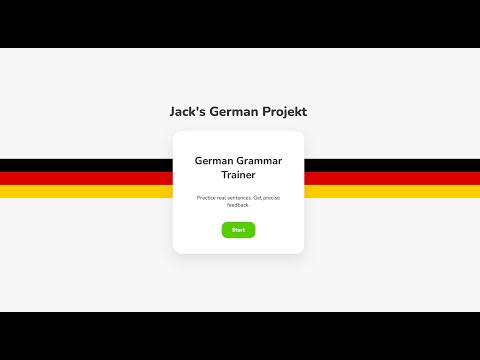
- Grammar-focused German flashcards designed around specific learning objectives
- Rule-based evaluation engine covering six common beginner grammar categories (no LLMs used)
- Deterministic, explainable feedback for each detected error
- Error severity classification with priority-based sorting
- Structured feedback output suitable for frontend highlighting and UI control
- Robust invalid-input detection to reject nonsensical or structurally broken sentences
- Accusative vs. dative case
- Verb position (main clause V2)
- Subordinate clause verb-final order
- Noun capitalization
- Perfect tense auxiliary selection (sein vs. haben)
- Spelling errors
Additional validation rejects:
- Sentences with insufficient lexical coverage
- Inputs that break dependency parsing
- Nonsense or invalid token sequences
- Python 3.12
- FastAPI
- spaCy (
de_core_news_md) - uv (dependency management)
- React
- Fetch API for backend communication
User input is processed through a multi-stage evaluation pipeline:
-
Invalid attempt detection
- Coverage checks
- Verb presence checks
- Early rejection of inputs that break spaCy parsing
-
Spelling analysis
-
Structural grammar checks
- Main clause verb-second (V2)
- Subordinate clause verb-final position
-
Morphological grammar checks
- Noun capitalization
- Perfect tense auxiliary selection
-
Final consistency checks
- Extra or missing words
- Excessive token mismatches
-
Result aggregation
- Returns up to 5 errors, sorted by severity
All grammar issues are returned in a structured, machine-readable format.
Example response for a noun capitalization error:
"errors": [
    GrammarResult(
        error_type=GrammarErrorType.NOUN_CAPITALIZATION,
        message=GRAMMAR_MESSAGES["noun_capitalization"]["ERROR"],
        spans=[token.i],
        blocking=False,
        details=token.text,
        priority=ERROR_PRIORITY[GrammarErrorType.NOUN_CAPITALIZATION]
    )
]
-
error_type
Enum representing the grammar rule violated -
message
Predefined English explanation associated with the rule -
spans
Token indices used by the frontend for highlighting -
blocking
Indicates whether evaluation should stop due to structural invalidity
(used to trigger a fail state in the UI) -
priority
Enum used to rank errors from most to least severe
-
Deterministic rules over probabilistic models
Ensures consistent grading, debuggability, and zero inference cost. -
spaCy dependency parsing as a backbone
Enables clause structure analysis, verb position checks, and morphological inspection. -
Structured error output
Decouples evaluation logic from UI rendering and supports scalable frontend features.
- Grammar coverage is finite and constrained to supported flashcard prompts
- Accusative vs. dative detection is inherently error-prone due to prepositional ambiguity
- spaCy may misclassify:
- Misspelled words as nouns
- Finite verbs as infinitives
Mitigations are implemented but edge cases remain
- Planned AI-generated feedback was abandoned due to API cost and determinism concerns
- Expansion of grammar rule coverage
- User progress tracking and analytics
- Additional flashcard sets organized by grammar concept
- UI enhancements (audio feedback, animations, mobile support)