Mechanism of Action: Possible PfATP4 Activity Deduced from Parasite Ion Regulation Assays
The following five compounds inherited compounds were evaluated in parasite ion regulation assays in the Kirk Laboratory in 2013, with a subsequent set of seven compounds evaluated in 2014; the hypothesis is that PfATP4 is a Na+ ATPase that exports Na+ and imports H+ (or equivalent) and that the effects of the compounds on Na+ concentration and pH are attributable to inhibition of this activity. Structures, potency, metabolism/solubility and raw PfATP4 assay data are here.

(Compounds that are inactive do not dissipate the plasma membrane Na+ gradient or increase the plasma membrane pH gradient, consistent with them not inhibiting PfATP4 at the concentration tested. The other compounds dissipated the plasma membrane Na+ gradient and increased the plasma membrane pH gradient at a concentration of 2 μM, consistent with them being PfATP4 inhibitors.)
There is a correlation: compounds inactive in these assays are not potent vs the parasite.
Three Series 4 compounds were evaluated against four resistant strains (Dd2 parent and three different PfATP4 mutants) (ELN entry and GHI 251) in the laboratories of Kiaran Kirk and David Fidock data here. The compounds were found to have reduced efficacy against the PfATP4 mutants when compared to the parent Dd2 strain. These results have more recently been complemented by a similar experiment from Chase Smith and the Broad Institute, also indicating a shared MoA.
Following the synthesis of the 18 compounds for the Frontrunners campaign in 2016, these and another 18 novel compounds were evaluated in the Ion Regulation assay. Data is posted here.
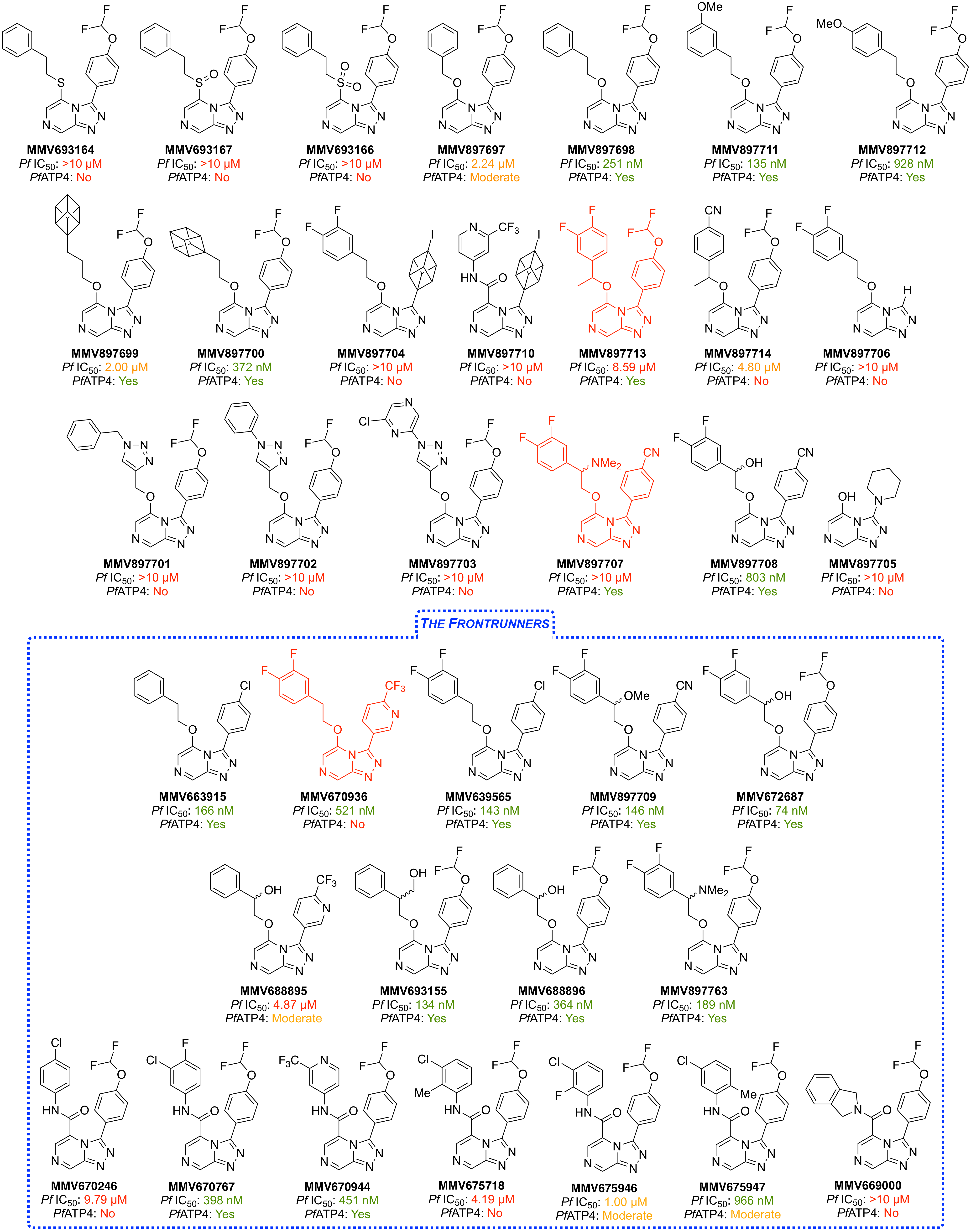
~92% of the 2016 data set shows correlation between potency and PfATP4 activity. However, the three compounds highlighted in red appear to not follow this trend, with them having activity in one assay but not the other.
PfATP4 is the apparent target of a number of different chemotypes.
PfATP4 is implicated in the MoA of several other leading antimalarials in development: the spiroindolone KAE609, the pyrazoleamides, the dihydroisoquinolone (+)-SJ-733 and various aminopyrazoles. A striking diversity of other compounds (from the malaria box) behave in the same way (summarised here), leading to the question: is PfATP4 really the target? There is no physical proof of binding between any of these compounds and PfATP4, because the protein has not yet been generated pure or crystallised. There is a homology model. Cross-resistance has been seen between parasites grown to be resistant to compound X (where there are mutations that are associated with PfATP4) and then tested with compound Y, including for the Series 4 compounds, as above. A current project strand is to develop a pharmacophore model that throws light on which compounds will be active in Kiaran's assay, and how they might be binding to PfATP4 (in part to allow us to de-prioritise the development of any more compounds having this same target). An initial attempt at developing this model was unsuccessful (i.e. not predictive - see the figure, where the "P Model predictions" correlate poorly with what was found in the ion regulation assay) possibly because the model did not allow for overlapping binding sites or take into consideration compound chirality. Model generation now needs to be re-attempted, and OSM needs community expertise in this area to proceed.