Julia port of the ZETA-test family for neuronal responsiveness.
The original code is written in MATLAB by Jorrit Montijn (https://github.com/Herseninstituut/zetatest). The most up-to-date Python port is at https://github.com/Herseninstituut/zetapy, maintained by Guido Meijer and Alexander Heimel. This Julia port was produced with Claude (Sonnet 4.6); details of the porting process are in PORTING_PROMPT.md.
The pre-print describing data-stitching, the time-series ZETA-test, and the two-sample tests: https://www.biorxiv.org/content/10.1101/2023.10.30.564780v1
The original ZETA-test article (peer-reviewed): https://elifesciences.org/articles/71969
The ZETA-test for spiking data has been extensively tested on real and artificial data and is peer-reviewed. The time-series and two-sample variants are described in the pre-print and are not yet peer-reviewed. Please report bugs on the Issues page.
using Pkg
Pkg.add(url="https://github.com/PierreLeMerre/ZetaJu")
Or for local development:
Pkg.develop(path="/path/to/ZetaJu")Then load with:
using ZetaJuTests whether a neuron's spike timing is locked to experimental events.
dblZetaP, dZETA, dRate = zetatest(vecSpikeTimes, arrEventTimes;
    dblUseMaxDur      = nothing,   # analysis window (default: min inter-event interval)
    intResampNum      = 100,       # number of jitter resamplings
    dblJitterSize     = 2.0,       # jitter window relative to dblUseMaxDur
    tplRestrictRange  = (-Inf, Inf),
    boolStitch        = true,
    boolDirectQuantile= false,
    boolReturnRate    = false)
Inputs
vecSpikeTimes—Vector{Float64}of spike times in secondsarrEventTimes— event onset times (Vector{Float64}), orT×2matrix of[onset offset]
Returns
dblZetaP— p-valuedZETA—Dict{String,Any}with fields including:"dblZETA"— ZETA statistic"dblZetaP"— p-value (same as first return)"dblLatencyZETA"— latency of peak deviation"vecLatencies"—[latencyZETA, latencyInvZETA, peakTime, onsetTime]"vecRealDeviation"— deviation vector"vecSpikeT"— trial-relative spike times"dblUseMaxDur"— window used"dblMeanP","dblMeanZ"— mean-rate t-test (only when stop times are provided)
dRate—Dict{String,Any}with instantaneous firing rate (populated whenboolReturnRate=true):"vecT"— time vector"vecRate"— firing rate vector"dblLatencyPeak","dblLatencyPeakOnset"— peak and onset latencies
Example
using ZetaJu

# Basic test (onset times only)
p, dZETA, dRate = zetatest(spike_times, event_times)
println("p = $p")

# With stop times (enables mean-rate t-test)
arr = hcat(event_onsets, event_offsets)   # T×2 matrix
p, dZETA, dRate = zetatest(spike_times, arr; dblUseMaxDur=0.5, boolReturnRate=true)

# Access latencies
lats = dZETA["vecLatencies"]   # [ZETA latency, inv-sign latency, peak, onset]

# Access instantaneous firing rate
if !isnothing(dRate["vecT"])
    using Plots
    plot(dRate["vecT"], dRate["vecRate"])
endTests whether two neurons (or one neuron under two conditions) respond differently.
dblZetaP, dZETA = zetatest2(vecSpikeTimes1, arrEventTimes1,
                             vecSpikeTimes2, arrEventTimes2;
    dblUseMaxDur       = nothing,
    intResampNum       = 250,
boolDirectQuantile = false)For calcium imaging, EEG, LFP, or any continuous signal.
dblZetaP, dZETA = zetatstest(vecTime, vecValue, arrEventTimes;
    dblUseMaxDur       = nothing,
    intResampNum       = 100,
    dblJitterSize      = 2.0,
    boolStitch         = true,
    boolDirectQuantile = false)
Inputs
vecTime—Vector{Float64}of timestampsvecValue—Vector{Float64}of signal values (same length asvecTime)arrEventTimes— same aszetatest
Returns (dblZetaP, dZETA) where dZETA contains "vecRealTime" and "vecRealDeviation" instead of spike-train equivalents.
dblZetaP, dZETA = zetatstest2(vecTime1, vecValue1, arrEventTimes1,
                               vecTime2, vecValue2, arrEventTimes2;
    dblUseMaxDur       = nothing,
    intResampNum       = 250,
    dblSuperResFactor  = 100.0,
boolDirectQuantile = false)Computes the multi-scale derivative firing rate without running the ZETA test. Use this as you would a PSTH function.
vecTime, vecRate, dIFR = ifr(vecSpikeTimes, vecEventTimes;
    dblUseMaxDur = nothing,
    dblSmoothSd  = 2.0,
    dblMinScale  = nothing,
    dblBase      = 1.5)
Example
t, r, _ = ifr(spike_times, event_times)
plot(t, r, xlabel="Time (s)", ylabel="Firing rate (Hz)")Neurophysiological studies depend on reliable quantification of whether and when a neuron responds to stimulation. Current methods require arbitrary parameter choices (e.g. bin size) that can change results and reduce replicability. Many methods also only detect mean-rate modulated cells. The ZETA-test family is parameter-free, sensitive to a broad class of response types, and works for both spike trains and continuous signals.
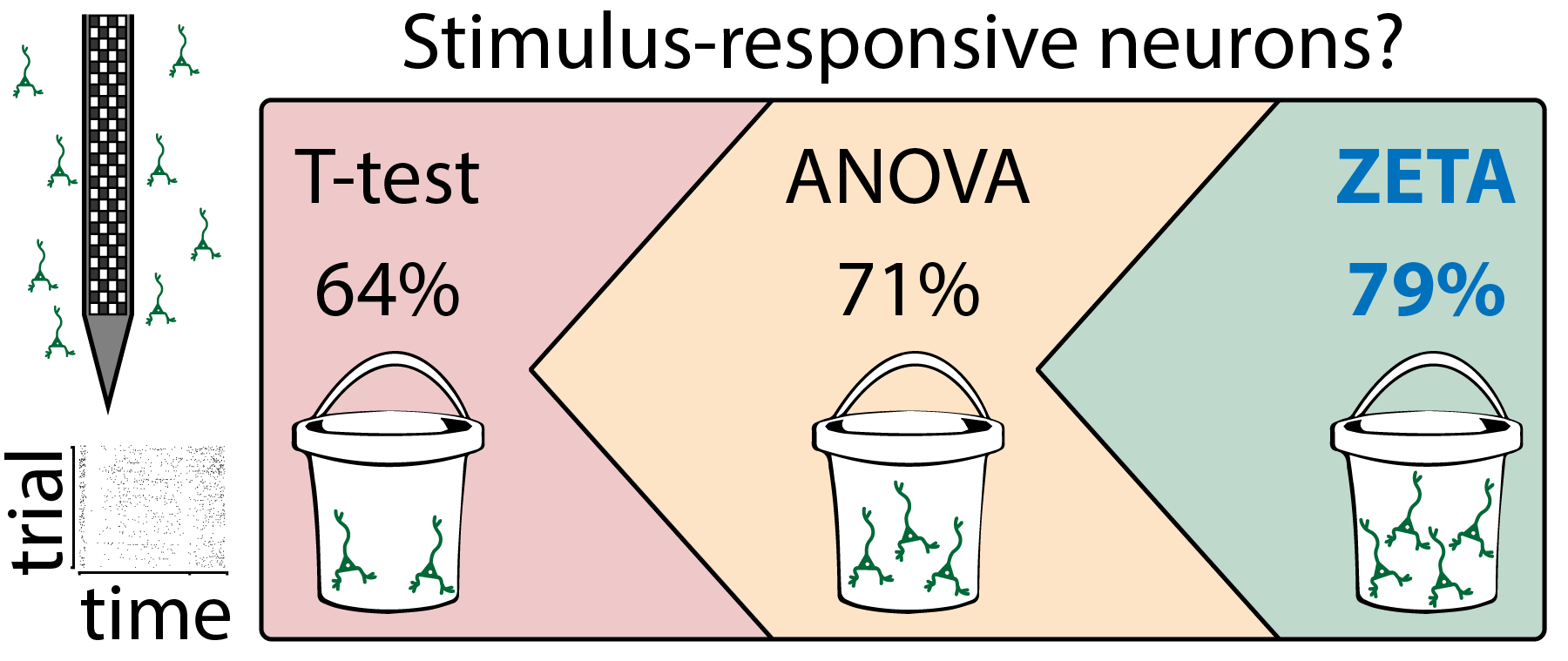
As shown in the papers, ZETA outperforms optimally-binned ANOVAs, t-tests, and model-based approaches: it includes more cells in real neurophysiological data at a similar false-positive rate.
For computing response latency, consider the LatenZy test (https://github.com/Herseninstituut/latenZy), which is based on the ZETA-test. The vecLatencies field returned by zetatest provides four latency estimates when boolReturnRate=true: ZETA peak, inverse-sign peak, IFR peak, and IFR onset.
Python (zetapy) |
Julia (ZetaJu) |
|---|---|
dblUseMaxDur is a positional argument |
dblUseMaxDur is a keyword argument |
Returns (dblZetaP, dZETA, dRate) |
Same |
dZETA['vecLatencies'] is a numpy array |
dZETA["vecLatencies"] is a Vector{Float64} |
intLatencyPeaks parameter |
Not needed — always returns 4 latencies |
boolVerbose / boolPlot |
boolPlot accepted but does nothing (no plotting) |
- Distributions.jl
- HypothesisTests.jl
- Statistics (stdlib)
- Logging (stdlib)