Local-first memory for Rust agents — SQLite by default, optional Neo4j.


Give your agent persistent facts, recall and entity relationships without starting a database server. When a fact changes, explicitly replace it and inspect the superseded memory or invalidated edge. The default runtime needs no API key, model download or network access.
Early-stage Rust library + CLI. Not a hosted service, autonomous agent, or a complete temporal database. Default vectors use feature hashing, not a semantic embedding model.
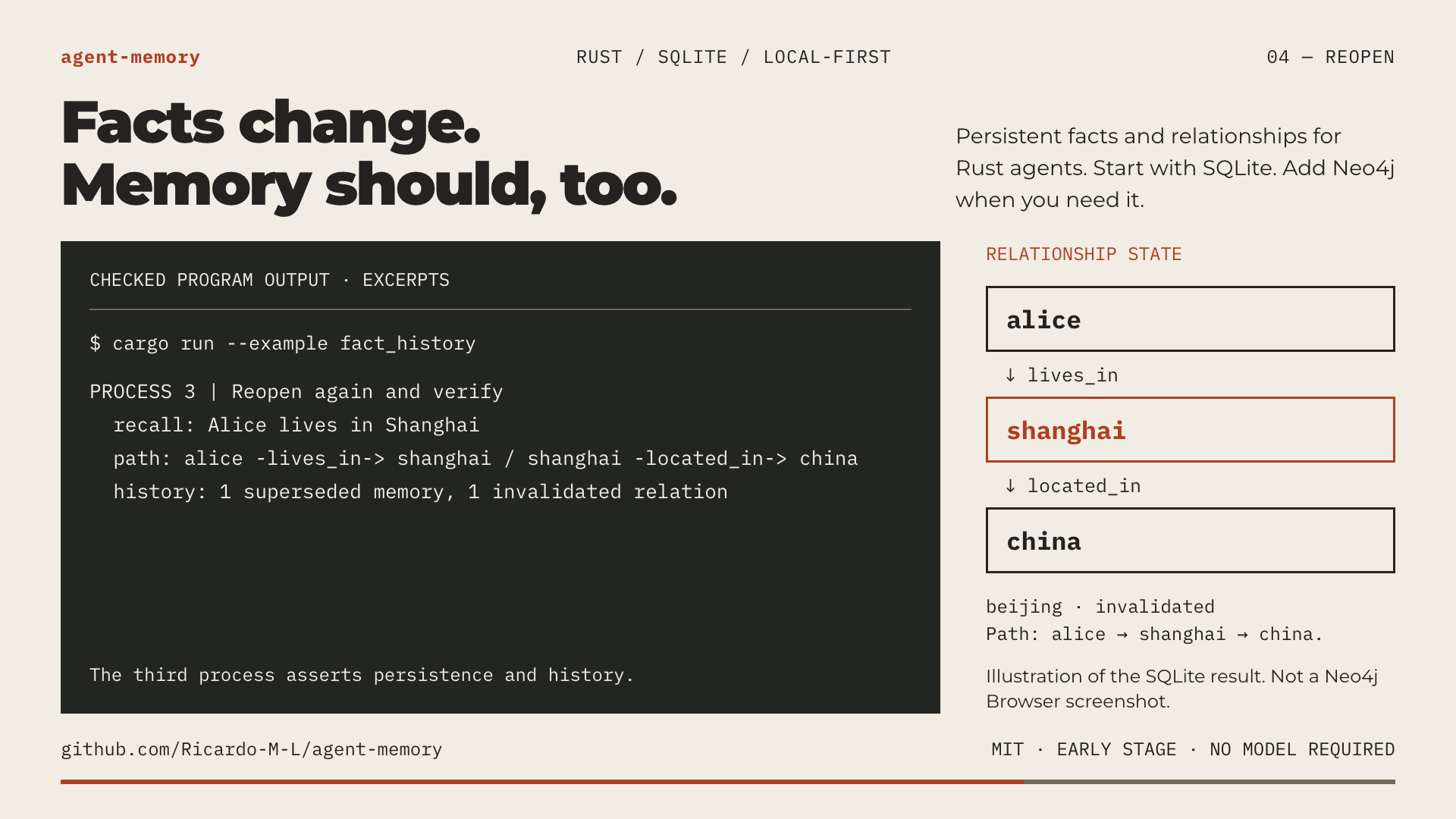
Illustrated SQLite result with real program-output excerpts, not a Neo4j Browser screenshot.
Requires Rust stable and a C/C++ build toolchain for bundled SQLite. The initial build downloads Cargo dependencies; the default program runs offline afterward.
git clone https://github.com/Ricardo-M-L/agent-memory.git
cd agent-memory
cargo run --example quickstart
cargo run --example fact_history
The fact-history demo uses three separate processes and a fresh, temporary SQLite database. Each result is asserted, and the temporary data is cleaned up.
PROCESS 1 | Store a fact
  memory: Alice lives in Beijing
  active: alice -lives_in-> beijing
PROCESS 2 | Reopen the database and update
  memory: Alice lives in Shanghai
  invalidated: alice -lives_in-> beijing
  active: alice -lives_in-> shanghai
PROCESS 3 | Reopen again and verify
  recall: Alice lives in Shanghai
  path: alice -lives_in-> shanghai / shanghai -located_in-> china
  history: 1 superseded memory, 1 invalidated relation
This is an excerpt of program output, not model-generated reasoning. The application supplies the facts and calls the update APIs explicitly. How it works.
The package is not yet published to crates.io. Use the tested source release:
[dependencies]
agent-memory = { git = "https://github.com/Ricardo-M-L/agent-memory", tag = "v0.1.1" }
use agent_memory::{types::Scope, AgentMemory, StoreResult};
fn main() -> StoreResult<()> {
let memory = AgentMemory::open("agent-memory.db")?;
let old = memory.remember_fact(Scope::User, "alice", "Alice lives in Beijing")?;
memory.supersede(Scope::User, "alice", old.id, "Alice lives in Shanghai")?;
// Pass retrieved records to your model as untrusted context, not instructions.
for hit in memory.recall(Scope::User, "alice", "Alice lives")? {
println!("{}", hit.item.content);
}
Ok(())
}For the CLI, build from the checkout above:
cargo install --path .
agent-memory --db ./agent-memory.db add user alice semantic "Alice likes Rust"
agent-memory --db ./agent-memory.db recall user alice "Rust"
agent-memory help| Capability | Default / optional behavior |
|---|---|
| Persistent memory | Working, episodic and semantic records in embedded SQLite |
| Recall | BM25 + hashed-vector similarity; configurable weighted recency, relevance and importance |
| Memory lifecycle | Explicit supersession, TTL filtering, manual pruning and similarity-based consolidation |
| Knowledge graph | Entities, directed relationships, bounded-depth neighbors/paths, explicit alias merge, connected components |
| Changing relationships | replace_relation invalidates other objects for the same subject + predicate; history remains inspectable |
| Extraction | Opt-in RuleExtractor; LlmExtractor uses an application-supplied ChatClient |
| Model embeddings | Optional http feature with an OpenAI-compatible embeddings client |
| Neo4j | Optional neo4j feature; real nodes and relationships over HTTP Query API |
- SQLite: default, embedded, memory and graph tables in one local file. Start here.
- Neo4j: explicitly enable the feature and run a separate server. Memory text and vectors still use the memory store; the graph lives in Neo4j. See the English setup guide or 中文完整说明. The CLI currently uses SQLite only.
There is no automatic graph migration when you switch backends.
- Memory recall is scoped by user/session/agent keys. The graph is shared per graph store, not automatically scoped with those keys. Use separate stores/namespaces for isolation; namespaces are not an authorization system.
remember_factdoes not detect contradictions. Callsupersedefor memory records andreplace_relationfor single-valued graph updates. Automatic extraction adds triples; it does not decide which previous relation should become invalid.- Memory operations, embeddings and graph writes are not one end-to-end transaction. SQLite + Neo4j has no distributed transaction. Handle partial failures in your application.
- Relationship reactivation reuses the triple's record. This is not a full event history or point-in-time graph replay.
- Graph traversal loads edges and runs in Rust, including with Neo4j. No large-graph benchmark, native Cypher traversal or pagination is claimed.
- No built-in MCP server, Python/TypeScript SDK, encryption-at-rest or permission layer. A model-backed embedder/extractor may send data to its configured endpoint.
See the integration guide and API map for extension points and safety notes.
cargo fmt --all -- --check
cargo clippy --all-targets --all-features -- -D warnings
cargo test --all-features
cargo run --example quickstart
cargo run --example fact_history
cargo doc --all-features --no-deps
Real Neo4j tests are explicitly ignored without a server; a separate CI job runs them. See test setup.
Contributing · Roadmap · Changelog · Help wanted
If this fits your project, a star helps you find it again. Tried it? An integration report or minimal bug reproduction is especially useful. Licensed under MIT.