Abstract. For the early design and communication of software systems, architects commonly use informal diagrams. Due to their notational freedom and effectiveness for communication, informal diagrams are often preferred over models with a fixed syntax and semantics as defined by a modeling language. However, precisely because of this lack of established semantics, informal diagrams are of limited use in later development stages for analysis tasks such as consistency checking or change impact analysis. In this paper, we present an approach to reconciling informal diagramming and modeling such that architects can benefit from analysis based on the informal diagrams they are already creating. Our approach supports migrating from existing informal architecture diagrams to flexible models, i.e., partially treating diagrams as models while maintaining the freedom of free-form drawing. Moreover, to enhance the ease of interacting with the flexible models, we provide support for their blended textual and graphical editing. We validate our approach in a lab setting and perform an evaluative case study in an industrial setting. We show how the approach allows architects to continue informal diagramming, while also benefiting from flexible models for consistency checking between the intended architecture and the implementation
This repository contains the code and demos to support our ECSA-2022 submission "From informal architecture diagrams to flexible blended models".
In the paper, we show how we can make more use of informal diagrams by considering them, partly, as models. We show how to migrate from just informal diagrams to flexible models, by providing a textual grammar for the elements of the diagram that shall be considered model elements. Moreover, we show how we can continue the blended use of the pre-existing informal diagram and the newly derived textual model, by means of two unidirectional transformations that synchronize the representations. Crucially, we preserve the layout of the informal diagrams as well as all the "non-modeling" elements in it.
The figure below provides an overview of the approach
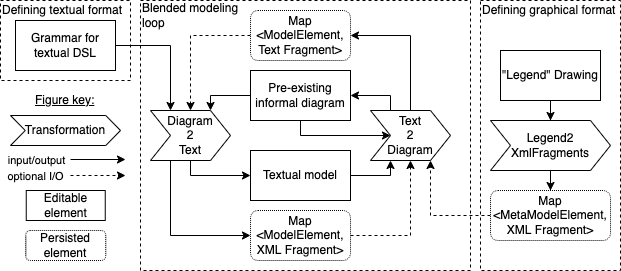
To better illustrate the approach and its implementation, we provide three demo video's that show the synchronization and several supported features. Demo3 (7 mins) contains the most functionality:
demo3-arch-demo-extended-compressed.mp4
This repository shows the following three demo scenarios. For each of them we provide code and a demo video in this repository.
- arch-demo-industry-eval: This folder contains the supporting code for the demo with a simple architecture diagram, as used for the industrial evaluation in the paper.
- state-machine-blended-demo: This folder contains the supporting code for the demo with a state machine diagram, to show that the approach can handle connectors/edges too, in addition to boxes/nodes.
- arch-demo: This folder contains the supporting code for the demo with an extended architecture diagram, as described in the paper. This demo shows that the approach can in addition to the previous two demo's, also handle "containments" of elements in other elements.
I'm using Python 3.7 and am using TextX.