Distributed resilient architecture for news recommendation
⚠ App is now down (23/12/2025)
Feel free to have a look at our website to create your account and interact with 100k+ articles.


We provide automatic update everyday (9am / 6pm UTC), 1k articles ingested from various sources. We also provide new recommendation based on your liked articles.
We only use your feedback to improve our system recommenders.
- Passwords are never stored, authentication is handled through secure and short-lived JWT.
- Internal credentials are randomly generated for each session and securely stored in Vault, never embedded in code, only injected as env variables.
- All feedback data is anonymized before being used for training or evaluation (only
user_idis used), ensuring that no personally identifiable information is retained. - Data transmission is encrypted (TLS) between client & dns provider, and between dns provider and server.
All internal data will be securely erased once the project concludes.
.
├── apps
│   ├── repo-account
│   ├── repo-article
│   ├── repo-feed
│   ├── port-front
│   ├── srvc-scrapping
│   ├── srvc-search
│   ├── srvc-drift
│   └── srvc-inference
├── docs
├── dev                          # dev folder for various dev operations
├── k8s
│   ├── apps                     # deployment of each apps
│   ├── capacitor                # Frontend to manage flux
│   ├── cert-manager             # Manager TLS certificate
│   ├── external-secrets         # ESO to communicate with vault
│   ├── flux/flux-system         # deployment of flux repo (gitops tools)
│   ├── ingress-nginx            # Ingress nginx
│   ├── kafka                    # Kafka brokers, controllers, redpanda console and topic definition
│   ├── metallb                  # Metal LB
│   ├── minio                    # Minio cluster storage (datalake + store for mlflow artifacts)
│   ├── mlflow
│   ├── postgres                 # CNPG CRD, database definition, user definition
│   ├── qdrant                   # Vector database
│   ├── redis                    # Redis Operator, Insight and Sentinels
│   └── vault                    # Vault server to store secrets, act as authenticator for SA in kubernetes
├── .github/workflows/
└── README.md
The project is built with a microservices architecture including the following components :
repo-account: User account and login managementrepo-article: Article & feedbacks managementsrvc-scrapping: Scrapping for articles, ingest to kafkasrvc-search: Search servicesrvc-inference: Inference service to provide update user feedssrvc-drift: Drift service to provide insights on potential data driftrepo-feed: Service providing the user feedport-front: main frontend

We want light speed recommendation and scalable infrastructure. Behind the scene:
- Kafka consumers consuming articles, processing articles by batch and creating new recommendations.
- Qdrant storing vector embeddings to pre compute recommendation as they come. These representation are then used in various way.
- Redis Sentinels with zsets to create efficient feed queue.
- Repo Feed, a dedicated service managing feed, storing feedbacks / articles for short periods?

North-South traffic is handled by two separate ingress controllers.
- Public Ingress: on a dedicated ip behind a NAT, exposing public services including frontend and backend services.
- Private Ingress: using VPN ip handled by wireguard, exposing critical and back office services.
We use also a dedicated load balancer called Metal LB to expose ip pools for the two ingresses.

We use external-secret to create our secrets
Secrets are centralized within a vault, provisioned by Terraform.
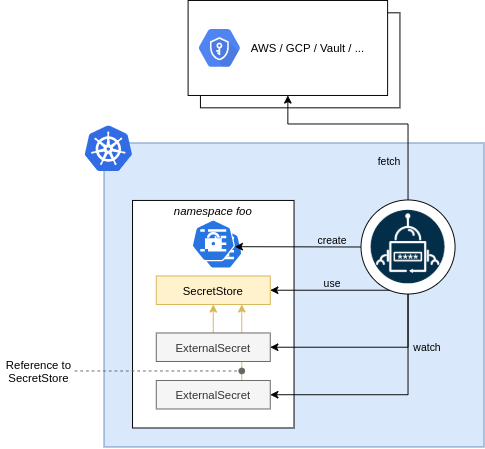
We provide a generic docker compose to run a minimal stack at apps/docker-compose.yml
- Our CI/CD will lint, build and test backend codes.
- To deploy a new version just tag
<srvc-name>-vx.x.x.
Example of commit we use:
k8s: redis: increase redis sentinel for minimal config
apps: port-front: now using get profile to retrieve user info as cookies could not be read by frontend
apps: review swagger, specify dto for errors
Our Project is deployed with Kubernetes. We FluxCD as GitOps tool to automate the deployment of our new manifests.
To deploy the whole stack, just use:
kubectl apply -k k8s/flux/flux-system