


Simple 1-Bit Systolic Array.
Do you want your matrix multiplications to go faster? Look elsewhere.
This project implements a 2x2 weight stationary systolic array that computes matrices with binary {-1,+1} weights and INT8 activations. Designed to fit in a single 1x1 Tiny Tapeout tile.
Comes with custom llama-cpp backend to run the worlds slowest forward pass. The first AI decelerator.
Enjoy?
Note: To prototype, requires Tiny Tapeout FPGA Dev Kit
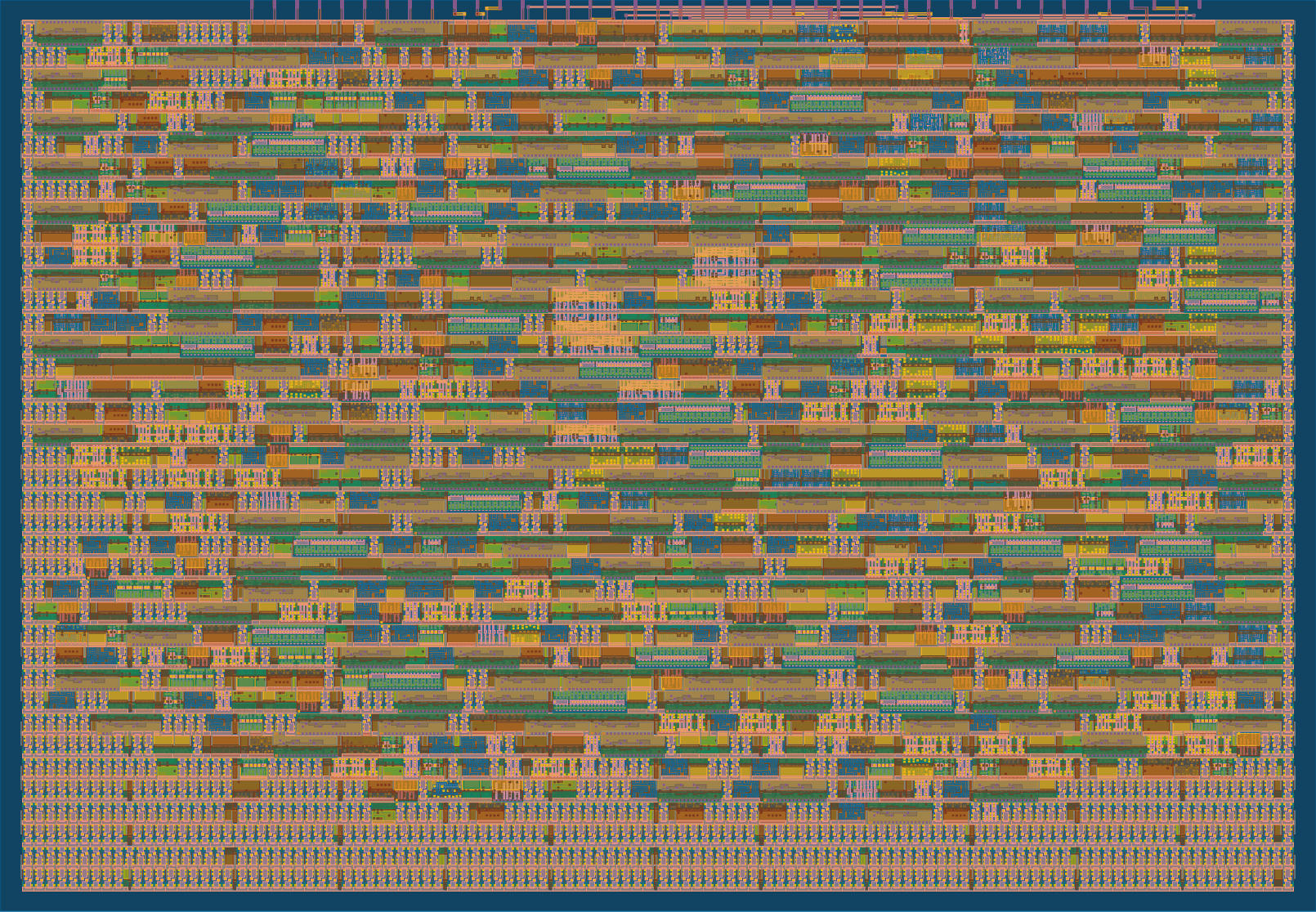
# Install Nix
curl -fsSL https://install.determinate.systems/nix | sh -s -- install

# Use librelane binary cache (makes librelane build much faster)
nix run nixpkgs#cachix -- use librelane

# Start developing
nix develop                 # Enter dev shell with all dependencies installed

# RTL
nix run .#harden            # Harden silicon
nix run .#test              # RTL tests
nix run .#test-gl           # Gate level tests

# FPGA
nix run .#tt-firmware       # Flash custom RP2350 firmware
nix run .#fpga-harden       # Harden FPGA bitstream
nix run .#fpga-flash        # Upload bitstream to FPGA (needs custom RP2350 fw mentioned above)

# Optional
nix run .#view              # View RTL digram (like vivado but worse)

# Only if you want to fork it:
# Enable GitHub Pages with Actions deployment
# (docs workflow will fail otherwise)
nix run nixpkgs#gh -- api -X POST repos/{owner}/{repo}/pages -f build_type=workflowYou can run any 1-bit GGUF model using llama-cpp + a small custom backend made for this project. It will be SUPER slow because:
- We're only using a single Tiny Tapeout tile, so the systolic array is 2x2.
- Most importantly, we're using the RP2350 as the transport, which is limited to 1MB/s
# After running all the commands in the TLDR
uvx hf download prism-ml/Bonsai-1.7B-gguf --local-dir ./models/Bonsai-1.7B
nix run .#llama-cli-bonsai -- \
  --model models/Bonsai-1.7B/Bonsai-1.7B.gguf \
  --device Bonsai \
  --temp 0 --no-warmup
--prompt "One eternity later..."The upstream GitHub Actions workflows (.github/workflows/{gds,docs,test,fpga}.yaml) are unchanged from Tiny Tapeout.