

MNELAB is a graphical user interface for MNE-Python (the most popular Python package for EEG/MEG analysis).
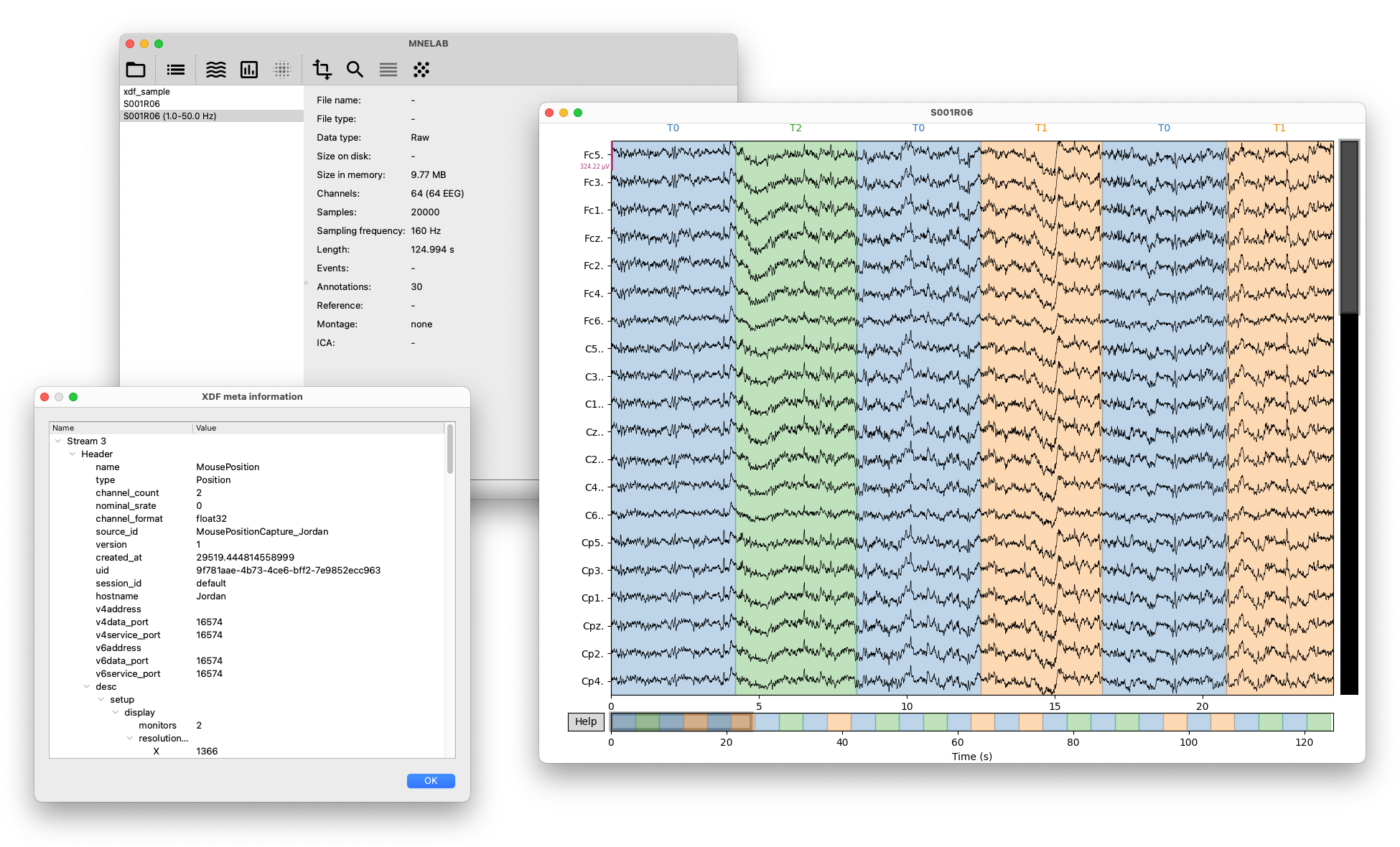
Key features include:
- Cross-platform support (Linux, macOS, Windows).
- A command history that records the underlying MNE-Python commands for each action, allowing users to learn how to use MNE-Python and to reproduce their analyses in code.
- Import data from various formats supported by MNE-Python, and some additional formats like XDF, MATLAB, NumPy, and BVRF.
- Export to EDF, BDF, BrainVision, EEGLAB, and FIFF formats.
- XDF-specific features such as chunk inspection (useful for debugging corrupted XDF files), stream selection, metadata inspection, resampling, gap detection and filling, and more.
- Support for various ICA algorithms, including FastICA, Infomax ICA, and PICARD.
- Automatic classification of independent components using ICLabel.
- Comprehensive tools for managing events and annotations.
- Support for channel locations (montages), re-referencing, cropping, filtering, epoching, and more.
- Plotting functions for raw data, epochs, evoked responses, independent components, ERD/ERS maps, and more.
The documentation contains hands-on examples and tutorials for different use cases. Check out the changelog to learn what we added, changed, or fixed.
We recommend using the standalone installers for macOS and Windows:
If you use Arch Linux, you can install MNELAB from the AUR (e.g., yay -S python-mnelab).
Alternatively, you can use uv to run MNELAB directly without installing it (this works on all platforms, but for the best experience we recommend using the standalone installers when available):
uvx mnelab
To run the latest development version:
uvx --from https://github.com/cbrnr/mnelab/archive/refs/heads/main.zip mnelab
On Linux, running MNELAB via uvx mnelab uses the Fusion style shipped with PySide6, which may not fit well with the rest of the system. However, if you use KDE, you can set the QT_PLUGIN_PATH environment variable to force the use of the native KDE theme instead, for example:
QT_PLUGIN_PATH=/usr/lib/qt6/plugins uvx mnelab
The contributing guide provides detailed instructions for contributing to MNELAB.
If you use MNELAB in your research, please cite the following paper (see also CITATION.cff):
Brunner, C. (2022). MNELAB: a graphical user interface for MNE-Python. Journal of Open Source Software, 7(78), 4650, doi:10.21105/joss.04650.