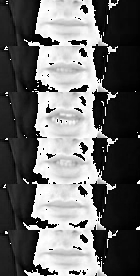






MouthMap is an advanced deep learning project that interprets lip movements from video and transcribes them into text. Using a sophisticated architecture of 3D Convolutional Neural Networks (CNNs) and Bidirectional LSTMs with a CTC loss function, MouthMap pushes the boundaries of silent speech recognition.
This research-focused project leverages computer vision and sequence modeling to assist in speech-impaired communication and human-computer interaction.
- 🎥 Video-to-Text Transcription: Converts lip movements in videos directly into coherent text sentences
- 🧠 State-of-the-Art Architecture: Built on a powerful 3D CNN + Bi-LSTM model to capture complex spatio-temporal features
- ⚙️ End-to-End Pipeline: Complete workflow from video preprocessing and data loading to model training and inference
- 🚀 Real-time Potential: Engineered for efficiency, laying the groundwork for live transcription applications
- 🧩 Modular & Customizable: Well-structured code making it easy to adapt, extend, and experiment with
- 🌐 Live Web App: Interactive Streamlit application for testing and demonstration
|
Empowering hearing-impaired individuals with advanced lip reading assistance |
Silent commands and natural interaction with smart devices |
Silent communication analysis in security applications |
Our interactive Streamlit app is now live! While accuracy with custom videos is continuously being improved, you can test its capabilities with the provided sample videos or upload your own.
Download 40th Epoch Model Checkpoint
Access our pre-trained model weights from Kaggle Models - ready for inference and fine-tuning.
graph TB
    A[Video Input<br/>75 frames × 46×140] --> B[3D Conv Layer 1<br/>128 filters]
    B --> C[3D Conv Layer 2<br/>256 filters]
    C --> D[3D Conv Layer 3<br/>75 filters]
    D --> E[Reshape<br/>Flatten spatial dims]
    E --> F[Bidirectional LSTM 1<br/>128 units + 50% Dropout]
    F --> G[Bidirectional LSTM 2<br/>128 units + 50% Dropout]
    G --> H[Dense Layer<br/>41 units + Softmax]
    H --> I[CTC Decoding<br/>Text Output]

    style A fill:#e1f5fe
    style B fill:#f3e5f5
    style C fill:#f3e5f5
    style D fill:#f3e5f5
    style E fill:#e8f5e8
    style F fill:#fff3e0
    style G fill:#fff3e0
    style H fill:#fce4ec
    style I fill:#e1f5fe
| Layer Type | Configuration | Purpose |
|---|---|---|
| Input Layer | (75, 46, 140, 1) | 75 frames of 46×140 grayscale video |
| 3D Conv + MaxPool | Filters: 128 → 256 → 75 Kernels: (3,3,3) |
Hierarchical feature extraction from spatio-temporal data |
| Reshape Layer | Flattens spatial dimensions | Prepares data for sequential processing |
| Bidirectional LSTM | 2 layers × 128 units 50% Dropout |
Captures temporal dependencies in speech patterns |
| Dense Output | 41 units + Softmax | Character probability distribution for CTC decoding |
| CTC Loss | Connectionist Temporal Classification | Alignment-free sequence-to-sequence learning |
import gdown
import os

# Create data directory
if not os.path.exists('data'):
    os.makedirs('data')

# Download and extract dataset
url = 'https://drive.google.com/uc?id=1YlvpDLix3S-U8fd-gqRwPcWXAXm8JwjL'
output = 'data/data.zip'
gdown.download(url, output, quiet=False)
gdown.extractall(output, 'data/')data/
├── s1/ # Video files (.mpg)
│ ├── bbal6n.mpg # Sample: "bin blue at l six now"
│ ├── pgue7s.mpg
│ └── ...
├── alignments/ # Text alignment files
│ └── s1/
│ ├── bbal6n.align # Corresponding text alignments
│ ├── pgue7s.align
│ └── ...
└── preprocessed/ # Processed data (created during training)
├── frames/
└── labels/
- Python 3.8+
- TensorFlow 2.x
- OpenCV (cv2)
- NumPy, Matplotlib
- FFmpeg (for video processing)
# 1. Clone the repository
git clone https://github.com/d-kavinraja/MouthMap.git
cd MouthMap

# 2. Create and activate virtual environment (recommended)
python -m venv venv
source venv/bin/activate  # On Windows: venv\Scripts\activate

# 3. Install dependencies
pip install -r requirements.txt

# 4. Download dataset (run the Python script above)
python download_dataset.pyimport tensorflow as tf
import numpy as np
from your_project_utils import load_video, num_to_char, build_model, CTCLoss
# 1. Build and load the pre-trained model
model = build_model()
model.compile(
optimizer=tf.keras.optimizers.Adam(learning_rate=0.0001),
loss=CTCLoss
)
model.load_weights('./models/checkpoint.weights.h5')
# 2. Load and preprocess video
video_path = './data/s1/bbal6n.mpg'
frames = load_video(video_path)
video_tensor = tf.expand_dims(frames, axis=0) # Add batch dimension
# 3. Make prediction
yhat = model.predict(video_tensor)
# 4. Decode CTC output to text
decoded = tf.keras.backend.ctc_decode(yhat, input_length=[75], greedy=True)[0][0].numpy()
predicted_text = tf.strings.reduce_join(num_to_char(decoded)).numpy().decode('utf-8')
print(f"✅ Predicted Text: {predicted_text}")
# Example Output: "bin blue at l six now"# Configure training parameters
config = {
'batch_size': 2,
'epochs': 100,
'learning_rate': 0.0001,
'optimizer': 'adam'
}
# Prepare datasets
train_data = create_dataset('train')
val_data = create_dataset('validation')
# Define callbacks
callbacks = [
tf.keras.callbacks.ModelCheckpoint('./models/checkpoint.weights.h5'),
tf.keras.callbacks.LearningRateScheduler(scheduler),
ProduceExample(val_data)
]
# Train the model
history = model.fit(
train_data,
epochs=config['epochs'],
validation_data=val_data,
callbacks=callbacks
)# Install Streamlit (if not already installed)
pip install streamlit
# Run the app
streamlit run app.py
# Access at http://localhost:8501- Architecture: 3D CNN + Bidirectional LSTM
- Training Epochs: 100 (40th epoch checkpoint available)
- CTC Loss: Optimized for sequence alignment
- Vocabulary Size: 41 characters (a-z, 0-9, special characters)
- Input Shape: 75 frames × 46×140 pixels
| Original Text | Model Prediction | Accuracy |
|---|---|---|
| "bin blue at l six now" | "bin blue at l six now" | ✅ Perfect |
| "place green with t zero please" | "place green with t zero please" | ✅ Perfect |
| "set red by v four now" | "set red by v four now" | ✅ Perfect |
MouthMap/
├── models/                 # Model architectures and weights
├── data/                   # Dataset and preprocessing
├── utils/                  # Utility functions
├── app.py                  # Streamlit web application
├── train.py               # Training script
├── inference.py           # Inference utilities
├── requirements.txt       # Dependencies
└── README.md             # This file
load_video(): Video preprocessing and frame extractionload_alignments(): Text alignment processingbuild_model(): Model architecture definitionCTCLoss(): Custom CTC loss implementationchar_to_num/num_to_char: Character encoding/decoding
We welcome contributions from the community! Here's how you can help:
- 🐛 Bug Reports: Found an issue? Create an issue
- 💡 Feature Requests: Have ideas for improvements?
- 🔧 Code Contributions: Submit PRs for bug fixes and features
- 📖 Documentation: Help improve our documentation
- 🧪 Testing: Test the system with different videos and datasets
# 1. Fork the repository
# 2. Create a feature branch
git checkout -b feature/amazing-feature

# 3. Make your changes and test
python -m pytest tests/

# 4. Commit your changes
git commit -m "Add amazing feature"

# 5. Push and create a Pull Request
git push origin feature/amazing-featuretimeline
title MouthMap Development Roadmap
✅ Phase 1 : Core Model Development
: 3D CNN + LSTM Architecture
: CTC Loss Implementation
✅ Phase 2 : Web Application
: Streamlit App Deployment
: Model Export to Kaggle
🔄 Phase 3 : Enhanced Accuracy
: Attention Mechanisms
: Data Augmentation
📅 Phase 4 : Production Features
: Real-time Processing
: Mobile App Development
: Multi-language Support
- Attention Mechanisms for improved sequence modeling
- Data Augmentation for better generalization
- Real-time Video Processing with WebRTC
- Mobile Application (iOS/Android)
- Multi-language Support (Spanish, French, German)
- Cloud API for scalable deployment
- Edge Device Optimization (Raspberry Pi, Jetson)
Built with ❤️ using cutting-edge technologies





Special thanks to the open-source community and researchers advancing lip reading technology.
This project is licensed under the MIT License - see the LICENSE file for details.
If you use MouthMap in your research, please cite:
@software{mouthmap2024,
  title={MouthMap: Deep Learning Lip Reading System},
  author={Kavin Raja D},
  year={2024},
  url={https://github.com/d-kavinraja/MouthMap},
  note={Streamlit App: https://mouthmap.streamlit.app/}
}| Platform | Link | Purpose |
|---|---|---|
| 🌐 Live Demo | mouthmap.streamlit.app | Try the application |
| 🐛 Issues | GitHub Issues | Bug reports & feature requests |
| 💬 Discussions | GitHub Discussions | Community Q&A |
| 📥 Model | Kaggle Models | Pre-trained weights |
Questions or feedback? Feel free to reach out through GitHub issues or discussions!
⭐ Star this repository if you find it helpful!
Made with ❤️ by Team MouthMap