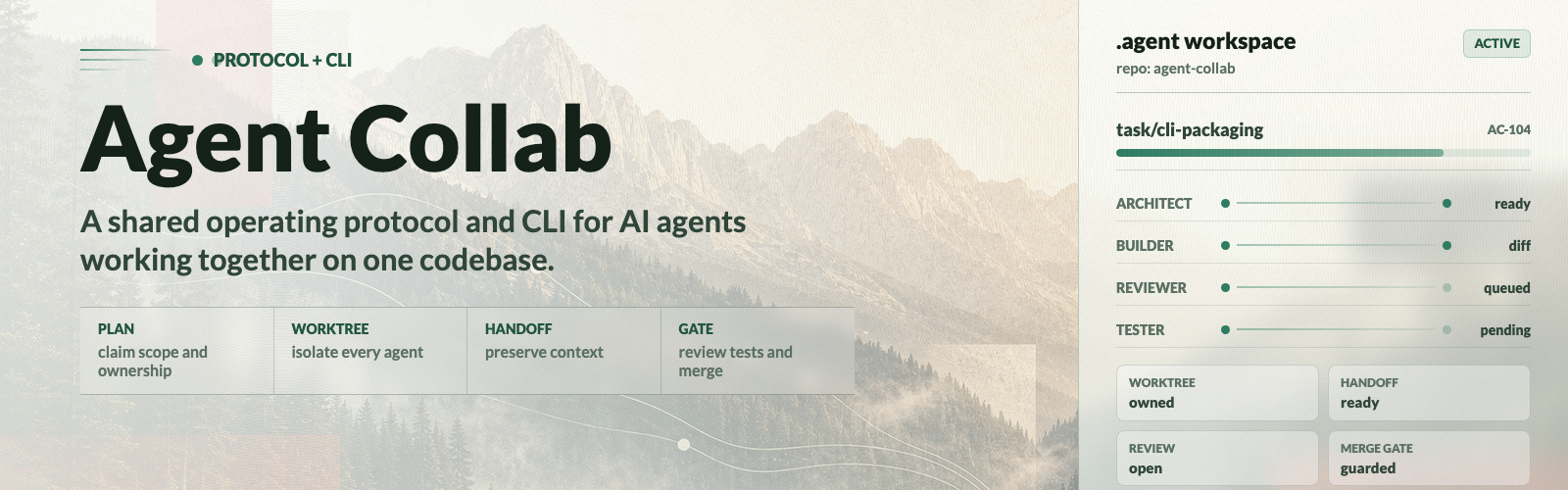
A coordination protocol and CLI for multiple AI coding agents working safely in one repository.
PyPI · Quick Start · Workflow · Docs · CLI Reference · License


Agent Collab gives AI coding agents a shared operating model for parallel repository work. It combines a portable agent skill, a worktree-first collaboration protocol, and a Typer-based CLI that creates durable .agent/ coordination artifacts.
Use it when several agents, automation workflows, or human reviewers need to work on the same codebase without hidden chat state, unclear ownership, duplicated edits, or unreviewed merges.
- Worktree-first collaboration: each agent works in its own branch and worktree.
- Durable coordination state: tasks, handoffs, reviews, test reports, risks, ADRs, and merge recommendations live in
.agent/. - Role-based workflow: coordinator, architect, implementer, reviewer, tester, documentation, and integration roles have explicit responsibilities.
- CLI-generated artifacts: repeatable templates reduce ambiguity and make handoffs reviewable.
- Runtime-agnostic skill package:
SKILL.mdcan be used by any agent runtime that supports skill-style instructions. - Human approval gates: destructive, ambiguous, security-sensitive, or production-affecting changes are escalated instead of guessed.
The root README is the quick entry point. Detailed maintainer and implementation docs live in docs/:
- Codebase Map
- Architecture
- CLI Reference
- Coordination Engine
- Artifact Model
- Skill Package
- Testing
- Development And Release
- Maintenance Checklist
Install the CLI:
python3 -m pip install agent-collabInitialize coordination files in the repository where agents will collaborate:
agent-collab initCreate a task:
agent-collab new-task \
  --id TASK-001 \
  --title "Refactor API client" \
  --owner coordinator \
  --risk medium \
  --check lint \
  --check tests \
  --check build
Create role-specific worktrees:
git fetch origin
git worktree add ../repo-implementer -b agent/impl/TASK-001-refactor-api-client origin/main
git worktree add ../repo-reviewer -b agent/review/TASK-001-refactor-api-client origin/main
git worktree add ../repo-tester -b agent/test/TASK-001-refactor-api-client origin/main
After implementation, create the handoff, review, test report, and merge recommendation:
agent-collab handoff \
  --task TASK-001-refactor-api-client \
  --role implementer \
  --branch agent/impl/TASK-001-refactor-api-client \
  --worktree ../repo-implementer

agent-collab review \
  --task TASK-001-refactor-api-client \
  --branch agent/impl/TASK-001-refactor-api-client

agent-collab test-report \
  --task TASK-001-refactor-api-client \
  --branch agent/impl/TASK-001-refactor-api-client

agent-collab merge-recommendation \
  --task TASK-001-refactor-api-client \
  --recommendation needs_changes \
  --risk medium \
--human-approval-required yesAgent Collab is intentionally simple: it makes repository state the source of truth and makes every handoff inspectable.
| Step | What happens | Artifact |
|---|---|---|
| 1. Plan | Scope the task, risks, checks, and ownership. | .agent/tasks/ |
| 2. Isolate | Assign each role a branch and git worktree. | .agent/protocols/ |
| 3. Implement | Make scoped changes and record verification. | commits and handoff |
| 4. Review | Inspect the diff for correctness, security, scope, and maintainability. | .agent/reviews/ |
| 5. Test | Run required checks or document why they were skipped. | .agent/test-reports/ |
| 6. Gate | Recommend merge, changes, escalation, or rejection. | merge recommendation |
Agents should start every session by confirming:
role, task, branch, worktree, relevant handoffs, current git status, and next actionBefore editing, run:
git status
git branch --show-current
git log --oneline -5
Before handing off, run:
git status
git diff
git diff --statagent-collab init creates a coordination workspace in the target repository:
.agent/
  README.md
  status.json
  tasks/
  handoffs/
  decisions/
  reviews/
  test-reports/
  risks/
  protocols/
scratch/| Path | Purpose |
|---|---|
.agent/status.json |
Active task, current phase, protected branches, agent assignments, and merge status. |
.agent/tasks/ |
Task goals, non-goals, scope, acceptance criteria, checks, risks, and result. |
.agent/handoffs/ |
Structured role-to-role handoffs with changed files, verification, risks, and next steps. |
.agent/decisions/ |
ADRs for architectural or policy decisions. |
.agent/reviews/ |
Diff review and final merge recommendations. |
.agent/test-reports/ |
Verification evidence, failures, skipped checks, and coverage gaps. |
.agent/risks/ |
Conflicts, blockers, high-risk notes, and human decision requests. |
.agent/protocols/ |
File ownership maps and task-specific coordination rules. |
.agent/scratch/ |
Temporary notes that are not durable project truth. |
Run commands from the target repository root:
agent-collab <command>Or pass an explicit repository:
agent-collab <command> --root /path/to/repo| Command | Creates |
|---|---|
init |
.agent/ directory structure and status.json |
new-task |
scoped task file |
handoff |
role handoff |
adr |
architecture decision record |
review |
review template |
test-report |
verification report |
conflict |
conflict or blocker note |
file-ownership |
file ownership map |
human-decision |
human decision request |
merge-recommendation |
final merge recommendation |
Use built-in help for the exact options:
agent-collab --help
agent-collab new-task --help
agent-collab handoff --helpUse only the roles needed for the task.
| Role | Responsibility |
|---|---|
| Coordinator | Scope, sequence, assign worktrees, track status, and recommend merge readiness. |
| Architect | Define boundaries, ADRs, risk analysis, and test strategy. |
| Implementer | Make scoped code changes, add tests, commit, and write implementation handoff. |
| Reviewer | Review the diff for correctness, architecture, security, reliability, and scope. |
| Tester | Run verification, reproduce failures, and write test reports. |
| Documentation | Update README, examples, migration notes, and operational docs. |
| Integration | Resolve conflicts, verify branch freshness, run final checks, and prepare merge guidance. |
One agent should not edit the same working directory as another agent. Give each role or task slice a separate worktree:
repo/
../repo-architect/
../repo-implementer-api/
../repo-implementer-ui/
../repo-reviewer/
../repo-tester/
../repo-integration/
Recommended branch names:
agent/architect/TASK-001-refactor-api-client
agent/impl/TASK-001-refactor-api-client
agent/impl-frontend/TASK-001-refactor-api-client
agent/impl-backend/TASK-001-refactor-api-client
agent/review/TASK-001-refactor-api-client
agent/test/TASK-001-refactor-api-client
agent/docs/TASK-001-refactor-api-client
agent/integration/TASK-001-refactor-api-client
Parallel work is safest when agents own different files or layers. If two agents may touch overlapping code, create a file ownership map before implementation:
agent-collab file-ownership --task TASK-001-refactor-api-clientThis repository also ships a portable agent skill:
SKILL.mdis the agent-facing entry point.references/contains the deeper playbooks.agents/openai.yamlprovides optional runtime metadata for platforms that read skill catalogs.
To use it manually, point an agent at SKILL.md and ask it to follow Agent Collab for the current repository task.
Example prompt:
Use Agent Collab to coordinate multiple coding agents on this repository. Start by identifying the task, role, branch, worktree, risks, and required handoffs.A task is merge-ready only when:
- acceptance criteria are met;
- scope is controlled;
- implementation handoff exists;
- review exists and is not blocking;
- required checks passed or skips are justified;
- test report exists for non-trivial changes;
- high-risk issues are resolved or escalated;
- no secrets are present;
- rollback notes exist when needed;
- human approval exists where required.
Agent Collab is not a replacement for CI, branch protection, human architectural judgment, or security review. It is a protocol and artifact generator that makes multi-agent work easier to inspect, recover, and merge deliberately.
agent-collab/
  SKILL.md
  README.md
  LICENSE
  pyproject.toml
  agents/
    openai.yaml
  references/
    artifacts-and-templates.md
    quality-review-testing-merge.md
    role-playbooks.md
    security-and-escalation.md
    worktree-and-branch-protocol.md
  src/
    agent_collab/
      cli.py
      coordination.py
  tests/
    test_cli.py
test_coordination.pyInstall locally:
python3 -m pip install -e ".[dev]"Run tests:
python3 -m pytestValidate the skill metadata:
python3 /path/to/quick_validate.py .Smoke-test artifact generation:
tmpdir="$(mktemp -d)"
agent-collab init --root "$tmpdir" --project demo
agent-collab new-task --root "$tmpdir" --id TASK-001 --title "Demo Task"
find "$tmpdir/.agent" -maxdepth 2 -type f | sort
rm -rf "$tmpdir"Agent Collab is released under the MIT License. See LICENSE.