HoundDog.ai is an ultra-fast, lightweight privacy scanner that detects sensitive dataflows and potential leaks in your source code.
It answers questions such as:
- What data is processed? (e.g., personal data, financial data, health data)
- Where is data stored? (e.g., logs, files, databases)
- Who is data shared with? (e.g., AWS, Stripe, internal microservices)
It is useful for:
- Early prevention of data leaks during development.
- Automated and evidence-based data mapping for privacy compliance (e.g., GDPR, HIPAA).
- Reducing engineering fatigue, stale data inventories, and regulatory fines.
HoundDog.ai in action:
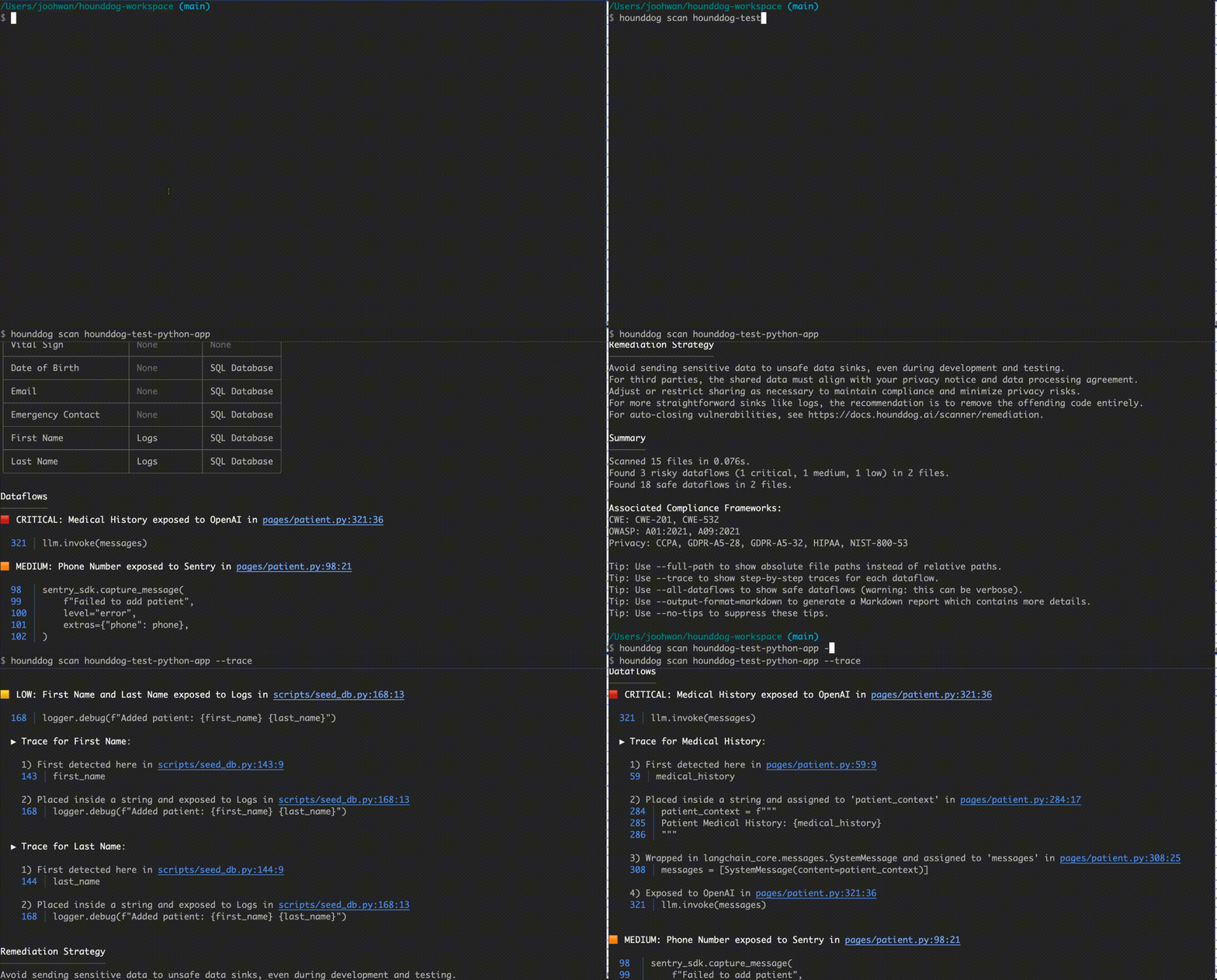
Check out the sample Markdown report and the list of data elements and sinks supported by HoundDog.ai.
curl -fsSL https://raw.githubusercontent.com/hounddogai/hounddog/main/install.sh | shirm https://raw.githubusercontent.com/hounddogai/hounddog/main/install.ps1 | iexAlternatively, you can download the binary directly from the releases page.
# Linux and macOS
rm -rf ~/.hounddog

# Windows
Remove-Item -Recurse -Force "$env:LocalAppData\hounddog"hounddog scan [OPTIONS] [PATH]For a quick demonstration, you can scan our test repository:
# Clone the test repository
git clone https://github.com/hounddogai/hounddog-test-python-app

# Scan the test repository
hounddog scan hounddog-test-python-app
By default, only risky dataflows are shown to minimize noise. Use --all-dataflows to see everything:
hounddog scan hounddog-test-python-app --all-dataflowsUse --trace to see detailed dataflow traces (one of our coolest features and useful for debugging):
hounddog scan hounddog-test-python-app --traceUse --output-format=markdown to generate a Markdown report:
hounddog scan hounddog-test-python-app --output-format=markdown --output-file=report.mdWe recommend the Markdown Viewer Chrome extension for viewing the report (see setup and sample report).
To see the up-to-date list of supported data elements:
hounddog data-elementsTo see the up-to-date list of supported data sinks:
hounddog data-sinksUse --help to see all subcommands and options:
hounddog [SUBCOMMAND] --help| Free | Enterprise | |
|---|---|---|
| Supported Languages | Python, JavaScript, TypeScript | Languages in Free + C#, Go, Java, SQL, GraphQL, OpenAPI |
| Usage Options | CLI, IDE | CLI, IDE, GitHub Integration (Automated Scans, PR Reviews) |
| IDE Plugins | VS Code, JetBrains, Cursor | VS Code, JetBrains, Cursor |
| Dataflow Detection | Limited Coverage | Full Coverage |
| Dataflow Visualization | Limited Coverage | Full Coverage |
| Rule Customization | No | Custom Data Element and Data Sink Rules |
| Privacy Reports | No | RoPA, PIA, DPIA |
| Cloud Platform | No | Issue Tracking, Alerts, SSO, RBAC, Audit Logs |
| On-Prem Deployment | No | Included |
| Support | GitHub Issues + Email | Priority Support with SLA + Dedicated Slack Channel |
Visit our Trust Center to view our latest SOC2 report, penetration testing results, and SBOM details.
No. Scans run locally. Your code never leaves your machine unless you are on a paid plan and explicitly configure the
HOUNDDOG_API_KEY environment variable.
AI is used to generate and update rules for scaling coverage, but scans themselves run on a deterministic static analysis engine. This keeps scans fast and free of hallucinations.
LLMs can discover issues that rigid pattern-matching misses, but they are slow, expensive, and often non-deterministic. Traditional SAST tools are faster, cheaper and predictable, but require high effort rule maintenance, struggle to keep up with fast changing codebases, and suffer from high false positive rates.
HoundDog.ai’s vision is to combine the strengths of both approaches. The scanning engine is fully rule-based and deterministic, with a rule specification expressive enough to model real-world code at compiler-level accuracy. AI is used selectively to scale coverage across thousands of code patterns without sacrificing performance, repeatability, or trust.
Secrets scanning tools look for credentials that are hardcoded directly in code, such as API keys, passwords, or tokens. For example:
exposed_api_key = "sk-proj-1234567890-abcdefghijklmnopqrstuvwxyz"HoundDog.ai, on the other hand, focuses on how sensitive data actually flows through code. It tracks values across various code paths such as assignment statements and transformations. For example:
import logging
import os

logger = logging.getLogger(__name__)

# HoundDog.ai detects that `foo` is an authentication token.
foo = os.environ.get("MY_API_KEY")

# HoundDog.ai traces values through various code paths.
bar = {"message": f"api_key={foo}".strip()}

# HoundDog.ai detects that `bar` contains an authentication token (tainted) and is leaked to a log.
logger.info("data=%s", bar)DIY SAST tools like Semgrep and CodeQL are powerful and highly customizable, but their rules need significant upfront investment to learn and maintain.
HoundDog.ai is a turnkey solution that provides broad, high-quality coverage of data elements and sinks out of the box, greatly reducing the rule authoring burden. It is designed specifically for dataflow analysis, scaling efficiently to large codebases, and detecting complex data flows that general-purpose solutions miss.
Our rules are constantly evolving, and we are working hard on improving them. Please let us know any false positives or negatives, and we will be happy to address them.
View license information for HoundDog.ai's software.
If you have any questions or feedback, please create a GitHub issue or email us at [email protected].


