Topological Sorting
Note
Objectives
- Apply the DFS algorithm to create a topological sorted order of vertices.
- Explain the benefit of using the topological sorting DAG shortest paths algorithm.
Code: Topological.java
Dijkstra's algorithm is the most well-known algorithm for finding a shortest paths tree in a weighted graph, but it's not the only algorithm. There are several others that address various shortcomings of Dijkstra's algorithm, including the topological sorting DAG shortest paths algorithm. There's unfortunately no commonly-accepted shorter name for it.
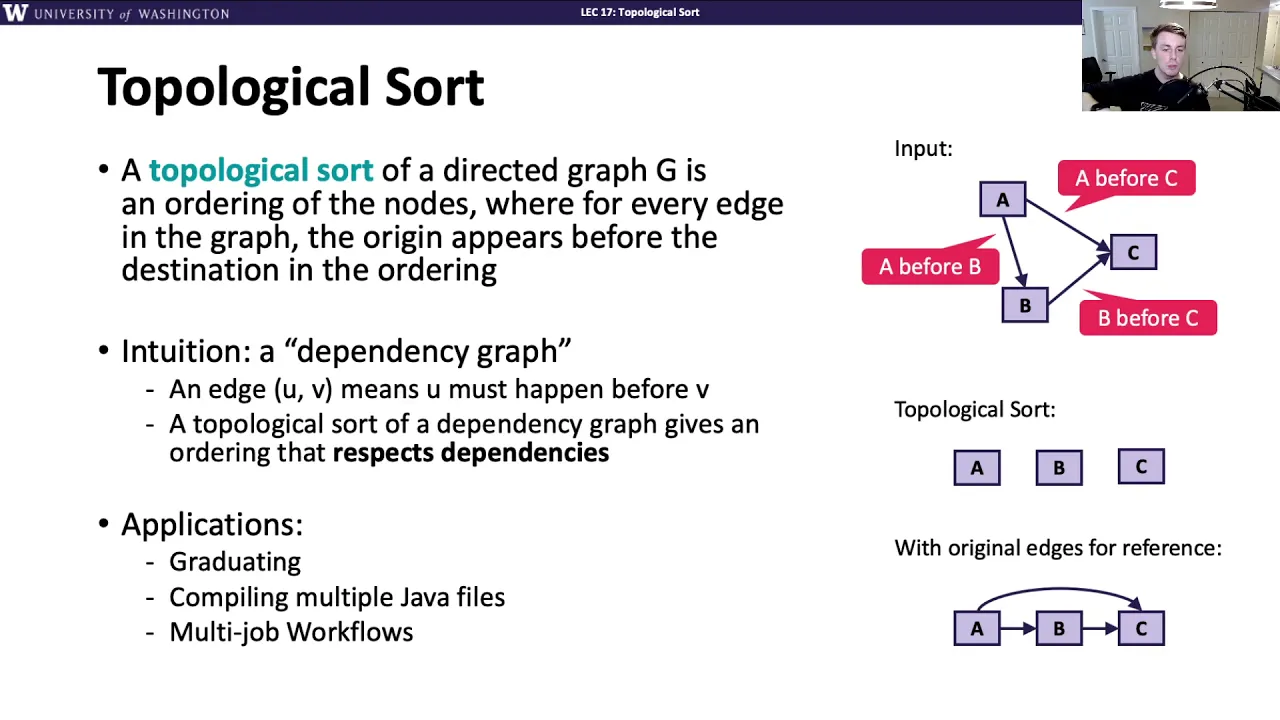
A topological sorting of a directed acyclic graph (DAG) orders all the vertices in a certain way as to ensure all prerequisites for a vertex
To find a topological sort, we can start by finding a DFS postorder: whereas a preorder traversal prints a vertex
Important
Review the Topological Sort Demo and notice how the first value in the DFS postorder is 4 because 4 has no outgoing neighbors! We then add 1 after visiting all of 1's neighbors. And repeat.
Why does this work? In (forward) DFS postorder, we add the following vertices:
- The first vertex added to the
resultlist is like a leaf in a tree: it has no outgoing neighbors so it is not a "prerequisite" for any other vertex. - The second vertex added to the
resultlist points to the first vertex. - ...
- The final vertex added to the
resultlist is the start vertex.
So the reverse DFS postorder has the first vertex (the "leaf") at the end of the result list where it belongs in the topological sorting.
Tip
Once we have a topological sorting of a DAG, building a shortest paths algorithm from it just requires looping over the vertices in the topological order and relaxing all its neighboring edges like we saw in Dijkstra's algorithm. Whereas Dijkstra's algorithm relies on a priority queue to determine which vertex to consider next, this shortest paths algorithm uses the topological sorting to determine which vertex to consider next.