Chloroquine
Chloroquine (CQ), a 4-aminoquinoline derivative, has been used as first-line antimalarial treatment. Since the first report of chloroquine resistance in late 1950s, the chloroquine resistant (CQR) parasites then became globally spread. In Southeast Asia and Africa, the CQR was repopulated with CQ-sensitive parasites after chloroquine use was stopped. In South America, however, the CQ-sensitive parasites have not replaced the CQR after withdrawal of CQ pressure in the area. Mutations in pfcrt gene have been determined as a marker for CQR.
- Parasites with K76 allele and CVMNK haplotype were associated with low IC50 compared to parasites with 76T mutation. (Hatabu T, et al, 2009 , Parasitol Int; Shrivastava SK, et al, 2014, PLoS One; Valderramos SG, et al, 2010, PLoS Pathog).
- Single K76T mutation is insufficient to induce CQR in South American and Southeast Asian parasites lines (Gabryszewski SJ, et al, 2016, Mol Biol Evol; Gabryszewski SJ, et al, 2016, PLoS Pathog).
- A220S, N236D and I356L mutations can confer higher CQ IC50 (Valderramos SG, et al, 2010, PLoS Pathog; Gabryszewski SJ, et al, 2016, Mol Biol Evol).
- Combination of K76T+N75E or K76T+N326D mutations are the minimal requirement for CQ transport activity of pf CRT (Summers RL, et al, 2014, Proc Natl Acad Sci U S A).
- Additional C72S mutation in South American lines yielded higher CQ IC50 (Gabryszewski SJ, et al, 2016, Mol Biol Evol).
- C350R and C101F mutations can reverse CQ resistance in vitro (Pelleau S, et al, 2015, Proc Natl Acad Sci U S A; Eastman RT, et al, 2011, Antimicrob Agents Chemother).
- Replacing A144F mutant allele with A144 wild-type allele in highly resistant Southeast Asian parasite line conferred chloroquine-sensitive parasites (Gabryszewski SJ, et al, 2016, PLoS Pathog).
To produce chloroquine resistance, K76T mutation needs to accompanied by additional mutations, either K75E, N326D or A220S. Data from the Version 6.0 of MalariaGEN Plasmodium falciparum Community Project showed the association between K76T and mutations at residues 75, 220 and 326 (see Table 12-13 in pfcrt). This suggested that all parasites with K76T mutations also carry either of these high chloroquine-resistant markers: K75E, A220S or N326D. Although the K76T mutation itself is insufficient to confer CQ resistance, we can imply that K76T mutation is a predictor for high-level chloroquine-resistant markers.
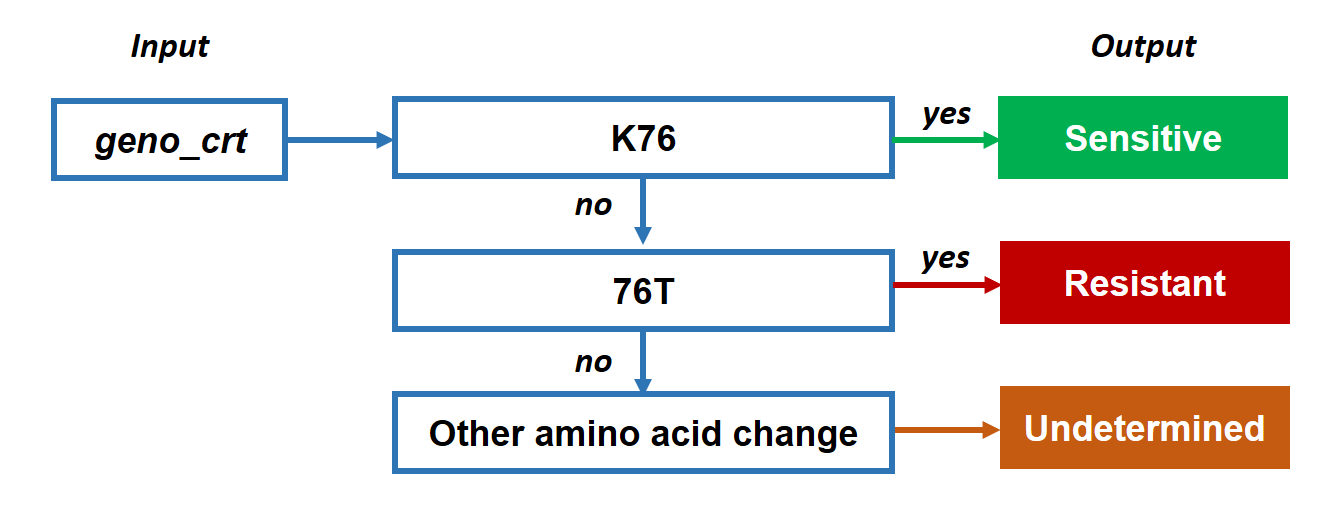
- Locus utilized: PF3D7_0709000 (pfcrt)
- Codon: 76
- Field utilized: geno_crt_76
| Amino acid change | Coding | Interpretation | Phenotype |
|---|---|---|---|
| None | geno_crt_76 == "K" | Wild-type | Sensitive |
| K76T | geno_crt_76 == "T" | Resistant marker | Resistant |
| Ohter amino acid change | Otherwise | Unknown mutant | Undetermined |
| Reference | Method | Location/Sample size/Genetic background | Finding summary |
|---|---|---|---|
| Meissner PE, Mandi G, Mockenhaupt FP, Witte S, Coulibaly B, Mansmann U, et al. Marked differences in the prevalence of chloroquine resistance between urban and rural communities in Burkina Faso. Acta Trop. 2008;105(1):81-6. | - Treatment outcomes were assessed at 14 days post-treatment. - Mutation at pfcrt codon 76 was determined by PCR-RFLP. |
- North-western Burkina Faso, Africa (urban and rural areas). - 222 uncomplicated patients aged between 6 to 59 months treated with chloroquine during October and November 2003. |
- In the presence of parasites exhibiting pfcrt T76, the odds of overall clinical failure were increased to 2.6-fold ([1.33, 5.16], pLR = 0.005). |
| Hatabu T, Iwagami M, Kawazu S, Taguchi N, Escueta AD, Villacorte EA, et al. Association of molecular markers in Plasmodium falciparum crt and mdr1 with in vitro chloroquine resistance: a Philippine study. Parasitol Int. 2009;58(2):166-70. | - Parasites isolates from 3 areas in Philippines were analyzed for association between chloroquine-resistance marker and in vitro susceptibility. - Drug susceptibility was assessed by using WHO mark III test. |
- 18 blood samples from Kalinga, 29 samples from Palawan, 31 samples from Davao del Norte, Philippines - Samples were collected during 2003-2005. |
- Mean CQ IC50 of parasites with pfcrt K76 allele from 3 areas ranged between 83.4-88.5 nM while the IC50 value of parasites with 76T allele ranged from 85.4-156.4 nM. - IC50 of >114 nM was defined as being resistant to CQ in vitro. |
| Shrivastava SK, Gupta RK, Mahanta J, Dubey ML. Correlation of molecular markers, Pfmdr1-N86Y and Pfcrt-K76T, with in vitro chloroquine resistant Plasmodium falciparum, isolated in the malaria endemic states of Assam and Arunachal Pradesh, Northeast India. PLoS One. 2014;9(8):e103848. | - Association between chloroquine-resistance marker and in vitro susceptibility was assessed. - Pfcrt polymorphisms was assessed by using PCR-RFLP. - Drug susceptibility was evaluated by WHO Mark III test, EC50 was calculated by Probit analysis. |
- 115 samples from Northeastern India. |
- CQ EC50 of the parasites with Pfcrt K76 allele (0.32 uM/L blood) was 7-fold lower than parasites with 76T allele (2.21 uM/L blood). |
| Reference | Method | Location/Sample size/Genetic background | Finding summary |
|---|---|---|---|
| Valderramos SG, Valderramos JC, Musset L, Purcell LA, Mercereau-Puijalon O, Legrand E, et al. Identification of a mutant PfCRT-mediated chloroquine tolerance phenotype in Plasmodium falciparum. PLoS Pathog. 2010;6(5):e1000887. | - Pfcrt haplotype of 7G8 strain was transfected into 3D7, D10 and G03 recipient by using allelic exchange approach. - Drug susceptibility was evaluated by hypoxanthine incorporation assay. |
- 7G8 line as the donor (C72S, K76T, A220S, N326D and I356L). - 3D7, D10 and G03 as the recipients. |
- Levels of resistance in transfected parasites with 7G8 pfcrt haplotype (C72S, K76T, A220S, N326D and I356L) varied among different genetic backgrounds. - Mean md-CQ IC50 of parasite lines with CVMNK haplotype ranged between 35.3-75.9 nM, while md-CQ IC50 of the parasite lines with SVMNT and CVIET haplotypes were 334.8-855.6 and 1287 nM, respectively. - Md-CQ IC50 of transfected parasites were approximately 10.4, 4.7 and 9.5 times higher compared to parental lines 3D7, D10 and G03, respectively. |
| Gabryszewski SJ, Modchang C, Musset L, Chookajorn T, Fidock DA. Combinatorial Genetic Modeling of pfcrt-Mediated Drug Resistance Evolution in Plasmodium falciparum. Mol Biol Evol. 2016;33(6):1554-70 | - ZFNs were used to create all combinations of pfcrt these following mutant alleles: K76T, A220S, N326D and I356L - CQ and md-CQ susceptibilities were assessed by flow cytometry-based assays. |
- The genetically modified pfcrt fragments of Ecu1110 strain were introduced into the recipient strain 7G8 (South America). | - Single K76T mutation exhibit hypersensitive to md-CQ, showing 1.4 times lower md-CQ (15.1 nM) IC50 than parasites with wild-type pfcrt alleles (20.1 nM), while md-CQ IC50 of parasites with single A220S (52.1 nM) and N326D (31.6 nM) mutations were significantly higher than parasites with wild-type pfcrt alleles, 2.6 and 1.8 folds, respectively. - For the combinations of mutant alleles, N326D mutation increased CQ resistance, I356L mutation increased CQ resistance except combination with N326D. - Up to triple-SNPs haplotypes, any mutations would increase the level of CQ resistance. - 7G8 lines with quintuple-SNPs haplotypes (K76T, A220S, N326D, I356L, and additional C72S) showed higher CQ IC50 than the quadruple-SNPs parasites (K76T, A220S, N326D and I356L). |
| Gabryszewski SJ, Dhingra SK, Combrinck JM, Lewis IA, Callaghan PS, Hassett MR, et al. Evolution of Fitness Cost-Neutral Mutant PfCRT Conferring P. falciparum 4-Aminoquinoline Drug Resistance Is Accompanied by Altered Parasite Metabolism and Digestive Vacuole Physiology. PLoS Pathog. 2016;12(11):e1005976. | - ZFNs were used to generate 'back-to-wild-type' alleles in each of these following alleles in Cam734 PfCRT haplotype: N75D, A144F, L148I, I194T, and T333S. - Drug sensitivity was evaluated by using flow cytometry-based assay. |
- Pfcrt of Cam734 line (second most prevalent CQR haplotype in Southeast Asia) was introduced into GC03 line (wild-type pfcrt haplotype). -Dd2 line (Southeast Asia). |
- Replacing 144F mutant allele with A144 in Cam734 parasites yielded complete sensitivity to CQ (CQ IC50: G03 11.8 nM, GC03GC03 14.0 nM, GC03Cam734 73.4 nM, G03Cam734 F144A 11.4 nM). - G03Cam734 F144A was sensitive to CQ even it harbors K76T and 7 additional mutations (including A220S mutation). - K76T is insufficient for CQ resistance. - Dd2 line, highly resistant to CQ (CQ IC50: 217 nM), contains additional N326S, I356T and R371I mutations. |
| Pelleau S, Moss EL, Dhingra SK, Volney B, Casteras J, Gabryszewski SJ, et al. Adaptive evolution of malaria parasites in French Guiana: Reversal of chloroquine resistance by acquisition of a mutation in pfcrt. Proc Natl Acad Sci U S A. 2015;112(37):11672-7. | - Ex vivo and in vitro drug susceptibility were determined by flow cytometry approach. - Whole genome sequencing was performed on an Illumina HiSeq2000 platform. - Genome-wide association study (GWAS) was performed. - ZFNs were used to induce pfcrt C350R mutation in 7G8 clones. |
- P. falciparum isolates were collected between 1994 and 2013 from symptomatic French Guianan patients (uses of chloroquine stopped since 1995). - GWAS samples were collected during 2009-2013. - 7G8 line (SVMNT) was used as the recipient in ZFNs assay. |
- 97.5% of 1997-2012 samples had SVMNT pfcrt haplotype. - CQ IC50 and prevalence of CQR parasites showed decreasing in trends since 1999. - GWAS showed PfCRT C350R mutation as the only SNPs associated with reversal of chloroquine resistance. - Drug assay data showed that the PfCRT C350R mutation caused a 24-fold reduction in the mean CQ IC50 values from 380 nM in the reference 7G87G8 clone to 16 nM in the 7G8 7G8 C350R variant. - All PfCRT C350R mutated parasites were found to be CQS, with a mean CQ IC50 of 23 nM, while the mean CQ IC50 value of field isolates with PfCRT C350 was 160 nM. |
| Eastman RT, Dharia NV, Winzeler EA, Fidock DA. Piperaquine resistance is associated with a copy number variation on chromosome 5 in drug-pressured Plasmodium falciparum parasites. Antimicrob Agents Chemother. 2011;55(8):3908-16. | - Parasites were selected under piperaquine pressure (2-fold higher than IC50). - The parasites were propagated further without piperaquine pressure and resulted in "revertant" piperaquine-sensitive parasites. - Genetic determinants were identified by comparative whole-genome hybridization analysis. - Drug sensitivity was evaluated by hypoxanthine incorporation assay. |
- Dd2 line | - Pfcrt C101F mutation was observed in piperaquine-resistant and revertant piperaquine-sensitive parasites. - Chloroquine IC50 of piperaquine-resistant and revertant piperaquine-sensitive parasites were approximately 5.4 and 2.7 times lower than chloroquine IC50 of Dd2 parent line. |
| Summers RL, Dave A, Dolstra TJ, Bellanca S, Marchetti RV, Nash MN, et al. Diverse mutational pathways converge on saturable chloroquine transport via the malaria parasite's chloroquine resistance transporter. Proc Natl Acad Sci U S A. 2014;111(17):E1759-67 | - Variants of PfCRT were expressed in Xenopus laevis oocytes - CQ transport activity of PfCRT was measured as CQ uptake by oocytes. - Correlation between CQ tranport activity and the in vitro CQ resistance index was assessed by transfecting variants of PfCRT into CQS parasite line. - CQ susceptibility of transfected parasites was assessed using hypoxanthine incorporation assay. |
- Oocytes of Xenopus laevis were used to assessed CQ transport activity. - PfCRT fragments of Dd2, K1, GB4, Ecu1110, Ph1, Ph2, 7G8 and HB3 lines were used. - Variants of PfCRT haplotypes were generated form Dd2 and Ecu1110 lines. - HB3 CQS line was used as the recipient in transfection experiment. |
- Minimum requirement for CQ transport activity was 2 mutations: 76T+75E or 76T+326D. - CQ transport activity in oocytes show high correlation with in vitro CQ resistance index (R2 = 0.89). |