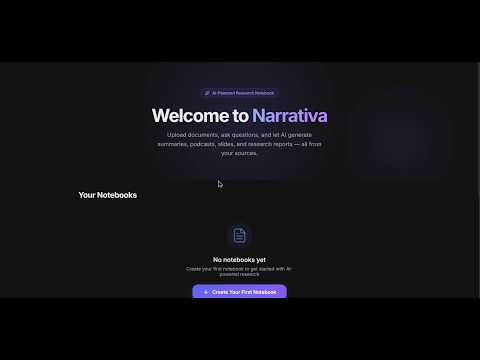
Narrativa is a full-stack web application that acts as your personalized AI research assistant (inspired by Google NotebookLM). Upload documents, paste web links, or add YouTube videos as sources — then let the AI generate audio podcasts, executive summaries, presentation slides, and deep-dive research reports from your knowledge base.




- 3-Panel Workspace: Animated landing page + dedicated research notebook with sources panel, chat, and studio tools.
- Source Management: Upload PDFs, paste YouTube URLs, or link to web pages to build a per-session knowledge base.
- Chat with Citations: Ask questions against your sources; the AI responds with precise, inline citations (e.g.,
[Source-1]). - 5 Studio Tools:
Tool Description 🎧 Audio Overview Generates a conversational podcast explaining your sources via TTS. 📊 Executive Summary Creates a structured one-page overview with key findings. 🎨 Slides Generator Converts PDFs into beautiful Reveal.js presentation slides using a LangGraph workflow. 📽️ Topic to Slides Researches any web topic and creates data-driven presentations. 📚 Research Report Writes a comprehensive academic report with references.
The system is distributed across a Next.js frontend application and a Python FastAPI backend, integrated with a PostgreSQL database and Google's Gemini LLMs.
flowchart TB
    Client((User / Browser))

    subgraph Frontend["Next.js App Router (Frontend)"]
        UI["React UI\n(Server & Client Components)"]
        API["Next.js Route Handlers\n(/api/*)"]
        VectorStore["FAISS Vector Store\n(In-memory caching via .data/)"]
    end

    subgraph DB["Database & Storage"]
        Prisma["Prisma ORM"]
        Neon[("Neon PostgreSQL\n(Sessions, Sources, Chunks)")]
        LocalStore["Local File Storage\n(.audio/, Vercel Blob)"]
    end

    subgraph Backend["Python Service (FastAPI)"]
        FastAPIEP["FastAPI Endpoints\n(Port 8000)"]
        Agent["LangGraph Agent\n(PDF → Slides pipeline)"]
        TTS["edge-tts\n(Audio Generation)"]
    end

    subgraph AI["External Services"]
        GeminiFlash["Gemini 2.5 Flash / Pro\n(@google/genai)"]
        Embedding["Gemini Embeddings\n(3072-dim vectors)"]
    end

    Client <--> UI
    UI <--> API

    API <--> VectorStore
    API <--> Prisma
    Prisma <--> Neon
    API <--> LocalStore

    API -- "HTTP Requests (Slides & Audio)" --> FastAPIEP
    FastAPIEP <--> Agent
    Agent <--> TTS
    FastAPIEP <--> LocalStore

    API <--> GeminiFlash
    API <--> Embedding
    Agent <--> GeminiFlash
Narrativa leverages a sophisticated architecture combining modern web frameworks, LLM integrations, and Retrieval-Augmented Generation (RAG).
- Ingestion & Chunking: Uploaded documents (PDFs, Web Pages, YouTube Transcripts) are parsed and divided into semantically meaningful chunks.
- Embeddings: Each chunk is converted into a 3072-dimensional embedding using Google's Gemini Embedding API.
- Vector Search (FAISS): A pure-JS implementation of FAISS runs in-memory. Embeddings are cached to a local
.data/directory for fast consecutive retrievals. On cold starts in serverless environments, the vector index is dynamically rebuilt from chunks stored persistently in PostgreSQL. - Synthesis: For chat and tool compilation, retrieved chunks are injected as context to Gemini 2.5 models to generate grounded responses, with strong system prompts enforcing strict citation formatting.
Complex document processing is offloaded to a standalone Python backend to bypass serverless execution time limits and leverage native Python data science libraries:
- Slide Generation Workflow: A state-graph approach via LangGraph. The system utilizes iterative planning: an agent parses PDF content using
PyMuPDF, formulates an outline, generates specific slide content (injecting relevant charts and data), and compiles the output into a Reveal.js bundle. - Audio Generation: Text-to-Speech synthesis is achieved using
edge-tts. The generated audio artifacts are served statically or pushed to blob storage.
- SQL Database: Uses Prisma ORM over a Neon PostgreSQL database. The schema cleanly separates
Session(a workspace instance),Source(raw documents/links),DocumentChunk(text pieces for vector search), andArtifact(generated outputs like slides, audios, and reports). - File Storage: Locally, the application saves artifacts to
.audio/and.data/. In a production deployment, this maps to Vercel Blob or similar remote object storage.
- Node.js v18+ and npm
- Python 3.10+
- A Google Gemini API key
- A PostgreSQL database (Neon free tier recommended)
git clone <repository-url>
cd Neurals

# Install Node.js dependencies
npm installcp .env.example .envEdit .env and fill in your values:
| Variable | Required | Description |
|---|---|---|
GEMINI_API_KEY |
✅ | Google Gemini API key |
GOOGLE_API_KEY |
✅ | Same Gemini key (used by @google/genai) |
DATABASE_URL |
✅ | PostgreSQL connection string |
PYTHON_API_URL |
❌ | Python backend URL (defaults to http://localhost:8000) |
BLOB_READ_WRITE_TOKEN |
❌ | Vercel Blob token (production only) |
npx prisma db pushcd python_backend
# Create and activate virtual environment
python -m venv .venv
# Windows:
.venv\Scripts\activate
# macOS/Linux:
# source .venv/bin/activate
# Install dependencies
pip install -r requirements.txt
# Start the FastAPI server
uvicorn app:app --host 0.0.0.0 --port 8000 --reload# From the repo root
npm run devOpen http://localhost:3000 🎉
Neurals/
├── src/
│   ├── app/                    # Next.js App Router
│   │   ├── page.tsx            # Animated landing page
│   │   ├── notebook/[id]/      # 3-panel research workspace
│   │   ├── deck/[id]/          # Reveal.js slide viewer
│   │   └── api/                # Route Handlers (chat, upload, generate-*)
│   └── lib/                    # Shared utilities
│       ├── db.ts               # Prisma client singleton
│       ├── store.ts            # Session, source, chunk CRUD operations
│       ├── vector-store.ts     # FAISS index management
│       ├── embeddings.ts       # Gemini embedding helpers
│       ├── retrieval.ts        # RAG retrieval pipeline
│       ├── web-search.ts       # Web scraping for Topic-to-Slides
│       └── generate-text-slides.ts  # Text-based slide generation
├── prisma/
│   └── schema.prisma           # Database schema (Session, Source, Chunk, Artifact, Report)
├── python_backend/             # Standalone FastAPI service
│   ├── app.py                  # FastAPI endpoints (slides, audio)
│   ├── agent.py                # LangGraph React agent (PDF → Slides)
│   ├── tools.py                # Agent tools (analyze PDF, plan slides, etc.)
│   ├── config.py               # Gemini model configuration
│   ├── tts.py                  # edge-tts wrapper
│   ├── requirements.txt        # Python dependencies
│   └── Procfile                # Render/Railway start command
├── scripts/
│   └── youtube_transcript.py   # YouTube transcript fetcher
├── .env.example                # Environment variable template
├── package.json                # Node.js dependencies & scripts
├── next.config.ts              # Next.js config
├── prisma.config.ts            # Prisma datasource config
└── tsconfig.json               # TypeScript config
Contributions and feature requests are welcome! Create a branch and submit a PR for review.
This project is proprietary. All rights reserved.