Fast, memory-safe LZ4 compression for Rust. On par with C lz4 throughput, with safe facade APIs over a small documented unsafe boundary.
Originally derived from lz4_flex.
- C lz4 speed, safe by construction. Unsafe is isolated to a few internal modules for raw memory ops. See SAFETY.md.
- Optional zero-unsafe build. The
paranoidfeature compiles every crate with#![forbid(unsafe_code)], swapping each unchecked op for a safe twin. Nounsafeat all. - 8 KB hash tables, or smaller. Half the L1d footprint of C lz4 and lz4_flex by default; the table size is a compile-time const generic, so constrained targets can drop to a 2 KB, 1 KB, or 512 B table.
- Built-in dictionary training.
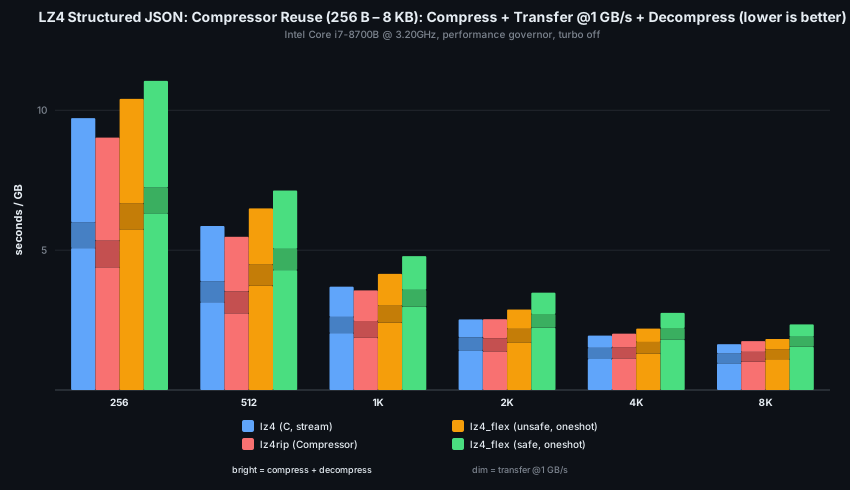
DictTrainerlearns a dictionary from your data. No external tools needed. - Hot-loop friendly. Epoch-based table reuse skips clearing between calls for small inputs.
no_stdand no-alloc ready. Block format works withoutstdor evenalloc. Hash tables live on the stack whenallocis off. Frame format requiresstd.- 32-bit Linux.
i686-unknown-linux-gnuandarmv7-unknown-linux-gnueabihfare tested via the safe/paranoid internals. Streams and frames are bounded by platform address-space limits. - WebAssembly. Available as
@paddor/lz4ripon JSR. Block compress and decompress, dictionaries.
See DESIGN.md for how it all works.
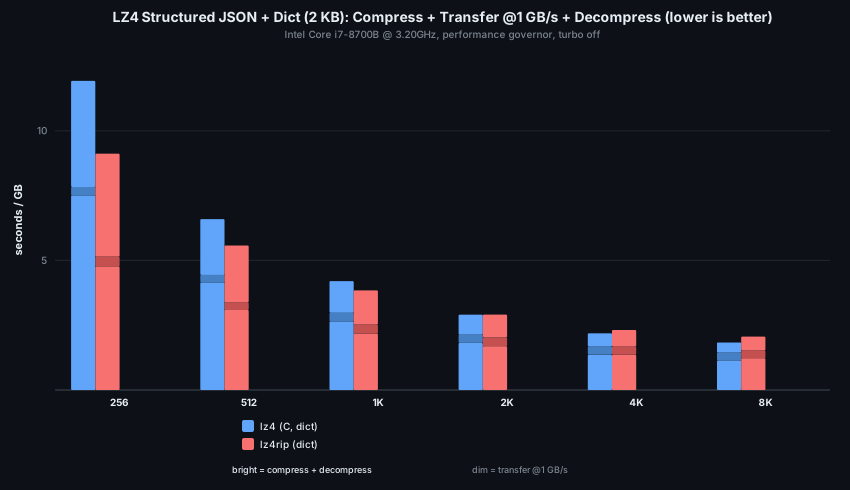
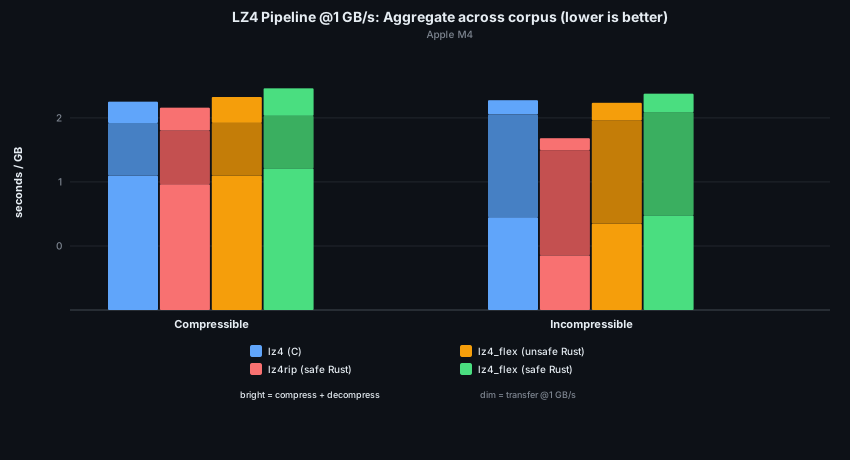
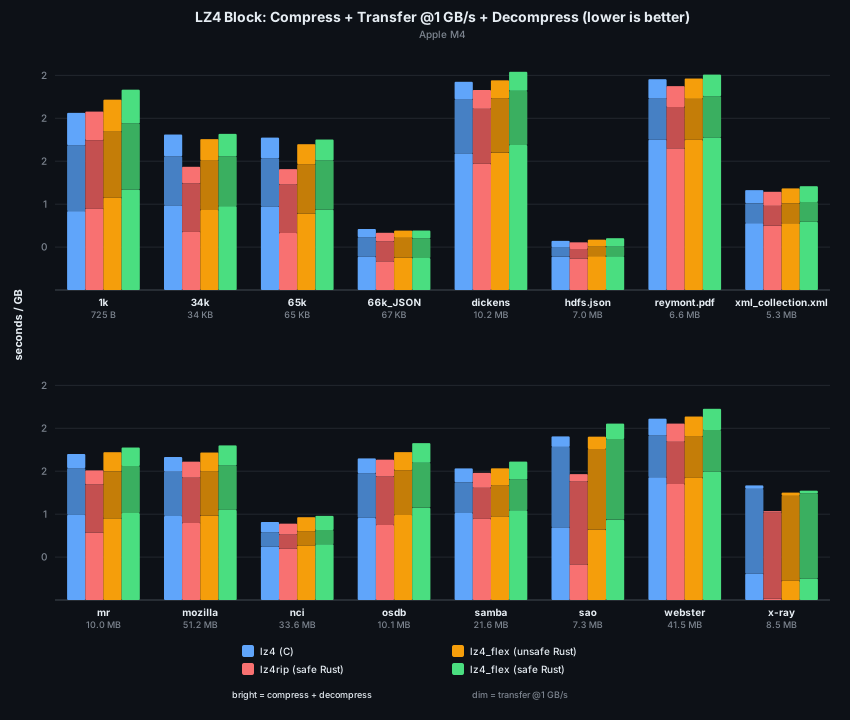
lz4rip is tuned for transfer speed, not compression ratio. It skips over non-matching data more aggressively than C lz4 and lz4_flex, which costs about 9% ratio on compressible data (2.18x vs 2.39x) but makes compression faster, especially on incompressible input where the skip acceleration dominates.
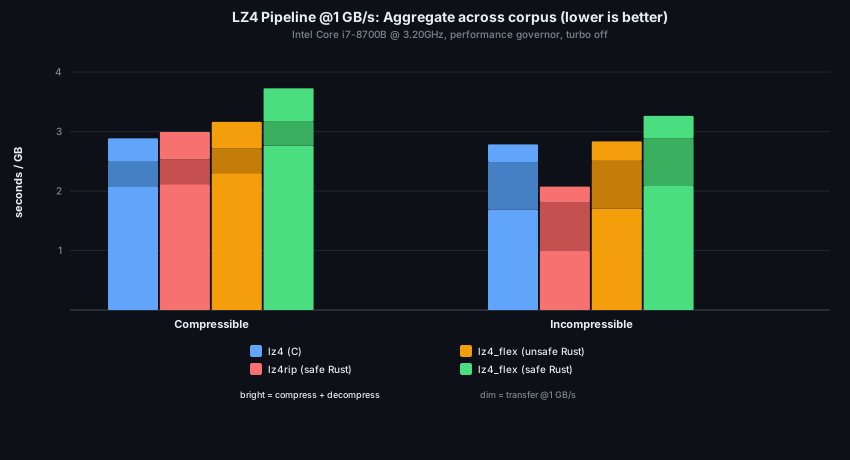
x86_64 details (per-file, size sweep, dictionary)
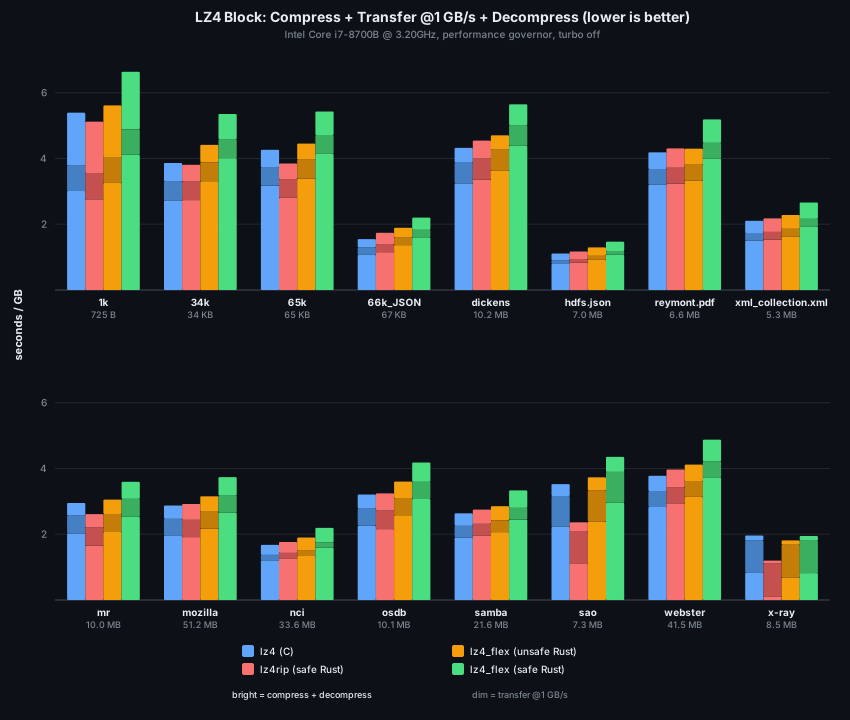
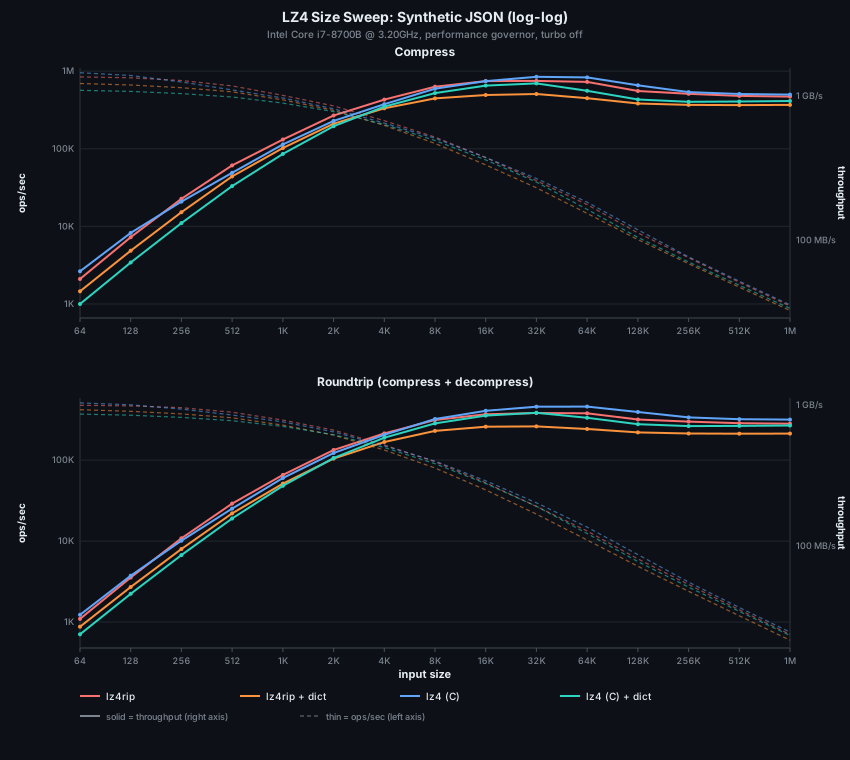
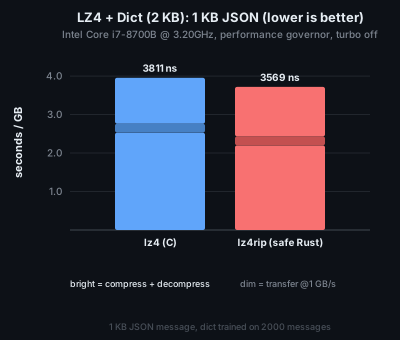
x86_64 structured data (JSON/XML, with and without dictionary)
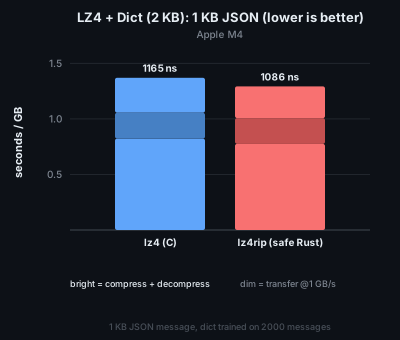
aarch64 (Apple M4)
use lz4rip::block::{compress, decompress_into};

let input = b"Hello people, what's up?";
let compressed = compress(input);

let mut output = vec![0u8; input.len()];
let n = decompress_into(&compressed, &mut output).unwrap();
assert_eq!(&output[..n], input);
The _into variants write into a caller-provided buffer. The plain variants
allocate and require the alloc feature.
All _into functions and the CompressorRef/DictCompressorRef/DecompressorRef
structs work without alloc. Hash tables are stack-allocated (8 KB per compress
call at the standard size).
On memory-constrained targets, pick a smaller hash table via the const-generic
form. CompressorRefN::<N> (no-dict) and DictCompressorRefN::<N> (dict) take an
entry count N (power of two, at least MIN_ENTRIES = 256). CompressorRefN::<512>
is a 2 KB table; ::<256> is 1 KB. Smaller tables only trade compression ratio for
memory, never correctness. The standard CompressorRef / DictCompressorRef are
aliases at the default 8 KB size.
use lz4rip::block::{CompressorRefN, get_maximum_output_size};

// 2 KB no-dict hash table instead of the default 8 KB.
let mut comp = CompressorRefN::<512>::new();
let input = b"telemetry frame payload, repeated fields, repeated fields";
let mut out = [0u8; 128];
let n = comp.compress_into(input, &mut out).unwrap();
# assert!(n > 0);
Recommended presets. Measured ratio cost of shrinking the table (no-dict across the corpus, dict over synthetic small messages):
| Workload | Preset | Footprint | Ratio cost |
|---|---|---|---|
| Dict + small messages (≤ ~1 KB) | DictCompressorRefN::<256> |
512 B/table | ~1% |
| Dict, with margin | DictCompressorRefN::<512> |
1 KB/table | ~0.5% |
| No-dict, messages ≤ ~1 KB | CompressorRefN::<256> |
1 KB | ~0% |
| No-dict, general small | CompressorRefN::<512> |
2 KB | small |
For small messages, the workload constrained targets actually compress, table size is nearly free: a 2 KB dictionary fills only a few hundred hash buckets, so even a 256-entry table covers the useful matches. The larger penalties (+20-30% ratio) only appear on 34 KB+ inputs. Smaller tables are often slightly faster too (less L1d pressure, cheaper clears).
Landscape context. LZ4 decompression needs no hash table at all, so
decode-only on tiny chips is a solved problem (ARM published a 42-instruction
Cortex-M0 decompressor). Compression is the bottleneck: C lz4 offers
LZ4_MEMORY_USAGE to shrink its table (down to 1 KB at =10), but it is a
global #define that rebuilds the library. No other Rust LZ4 crate exposes a
table-size knob. The const-generic approach here lets you monomorphize different
sizes in the same binary (e.g. 512 B for telemetry, 8 KB for bulk) with zero
runtime cost.
For a build with no unsafe at all, add the paranoid feature (see
SAFETY.md). It composes with no_std, no-alloc, and the table-size
knob.
use lz4rip::block::{compress_into, decompress_into, get_maximum_output_size};

let input = b"Hello people, what's up?";
let mut compressed = [0u8; 256];
let n = compress_into(input, &mut compressed).unwrap();

let mut output = [0u8; 64];
let m = decompress_into(&compressed[..n], &mut output).unwrap();
assert_eq!(&output[..m], input);
One-shot dictionary compression is also available without alloc:
use lz4rip::block::{compress_into_with_dict, decompress_into_with_dict, get_maximum_output_size};

let dict = b"shared context bytes...";
let input = b"context bytes appear in messages";
let mut compressed = [0u8; 256];
let n = compress_into_with_dict(input, &mut compressed, dict).unwrap();

let mut output = [0u8; 64];
let m = decompress_into_with_dict(&compressed[..n], &mut output, dict).unwrap();
assert_eq!(&output[..m], input);Pre-seed the compressor and decompressor with shared context for better ratios
on small messages. DictCompressor clones the dictionary into owned storage.
For zero-copy, use DictCompressorRef / DecompressorRef.
use lz4rip::block::{DictCompressor, Decompressor, get_maximum_output_size};

let dict = b"shared context bytes...";
let mut comp = DictCompressor::new(dict);
let decomp = Decompressor::with_dict(dict);

let input = b"context bytes appear in messages";
let mut buf = vec![0u8; get_maximum_output_size(input.len())];
let n = comp.compress_into(input, &mut buf).unwrap();

let output = decomp.decompress(&buf[..n], input.len()).unwrap();
assert_eq!(&output[..], input);Build a dictionary from sample data using the built-in COVER trainer.
Requires the alloc feature.
use lz4rip::block::DictTrainer;

let mut trainer = DictTrainer::new(2048); // max dict size in bytes
for sample in &samples {
    trainer.add_sample(sample);
}
let dict = trainer.train();
// Use with DictCompressor::new(&dict) / Decompressor::with_dict(&dict)The frame format (feature frame, on by default) wraps block compression in the
standard LZ4 frame container with checksums, content size, and streaming support.
use lz4rip::frame::{FrameEncoder, FrameDecoder};
use std::io::{Write, Read};

// Compress
// FrameEncoder::with_dictionary(wtr, dict, dict_id) for dictionary support
let mut encoder = FrameEncoder::new(Vec::new());
encoder.write_all(b"Hello frame format!").unwrap();
let compressed = encoder.finish().unwrap();

// Decompress
let mut decoder = FrameDecoder::new(&compressed[..]);
let mut output = String::new();
decoder.read_to_string(&mut output).unwrap();
assert_eq!(output, "Hello frame format!");
Frame blocks are independent by default for speed. Use BlockMode::Linked when
ratio matters more and the stream has repeated data across block boundaries:
use lz4rip::frame::{BlockMode, FrameEncoder, FrameInfo};
use std::io::Write;

const MESSAGE_REPEAT_COUNT: usize = 4096;

let frame_info = FrameInfo::new().block_mode(BlockMode::Linked);
let mut encoder = FrameEncoder::with_frame_info(frame_info, Vec::new());
encoder
    .write_all(&b"repeated data across frame blocks".repeat(MESSAGE_REPEAT_COUNT))
    .unwrap();
let compressed = encoder.finish().unwrap();
Linked blocks also work with frame dictionaries:
use lz4rip::frame::{BlockMode, FrameEncoder, FrameInfo};
use std::io::Write;

const DICT_ID: u32 = u32::from_be_bytes(*b"lz4r");
const MESSAGE_REPEAT_COUNT: usize = 4096;

let dict = b"shared prefix bytes";
let frame_info = FrameInfo::new().block_mode(BlockMode::Linked);
let mut encoder =
    FrameEncoder::with_dictionary(Vec::new(), dict, DICT_ID, Some(frame_info)).unwrap();
encoder
    .write_all(&b"shared prefix bytes in the message".repeat(MESSAGE_REPEAT_COUNT))
    .unwrap();
let compressed = encoder.finish().unwrap();SAFETY.md documents the unsafe boundary and catalogs C lz4 memory safety bugs that Rust prevents by construction.
All codec paths are fuzz-tested (12 targets covering block and frame round-trip, dictionary round-trip, corruption resistance, cross-validation against C lz4, output-leak detection, bitflips, crafted tokens, and tiny hash tables) and verified under Miri on both x86_64 and aarch64.
DEVELOPMENT.md covers benchmarking, fuzzing, and feature flags.