Pure Rust ZeroMQ: brokerless message passing for distributed and concurrent applications. Socket-level messaging patterns that work the same way in-process, between processes, and over the network.
- Tokio backend for Linux, macOS, and Windows
- 20 socket types: stable ZMQ patterns plus draft CLIENT/SERVER, RADIO/DISH, SCATTER/GATHER, CHANNEL/PEER, and STREAM
- 9 transports: TCP, IPC, inproc, UDP, WS, WSS,
lz4+tcp://,lz4+ws://, andlz4+wss:// - 3 security mechanisms: NULL, PLAIN, CURVE
- No C compiler, no libzmq, no libsodium
- Python binding (pyomq), C API (omq-libzmq)
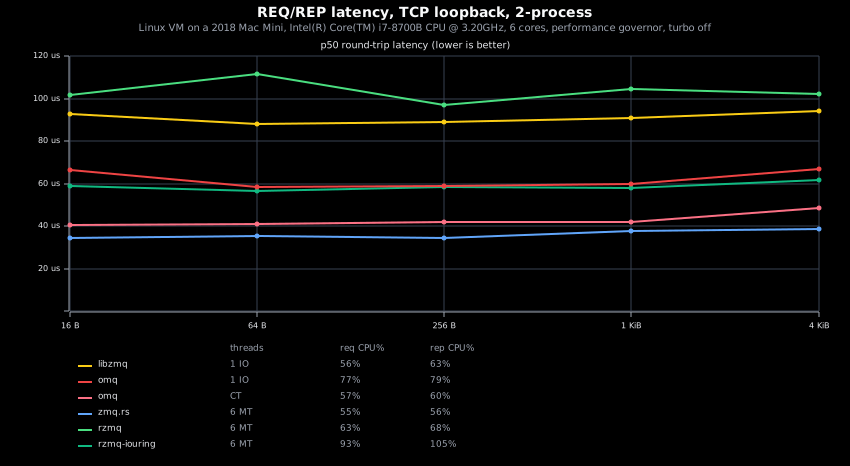
REQ/REP latency
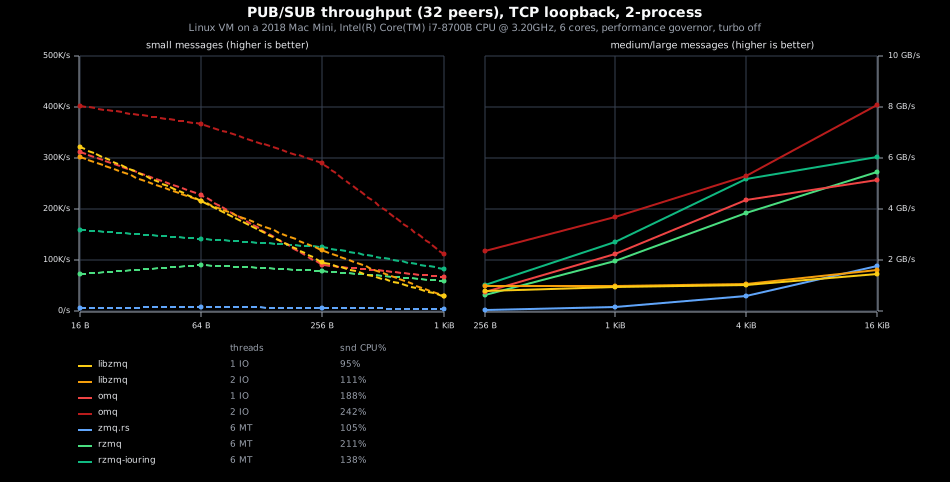
PUB/SUB throughput
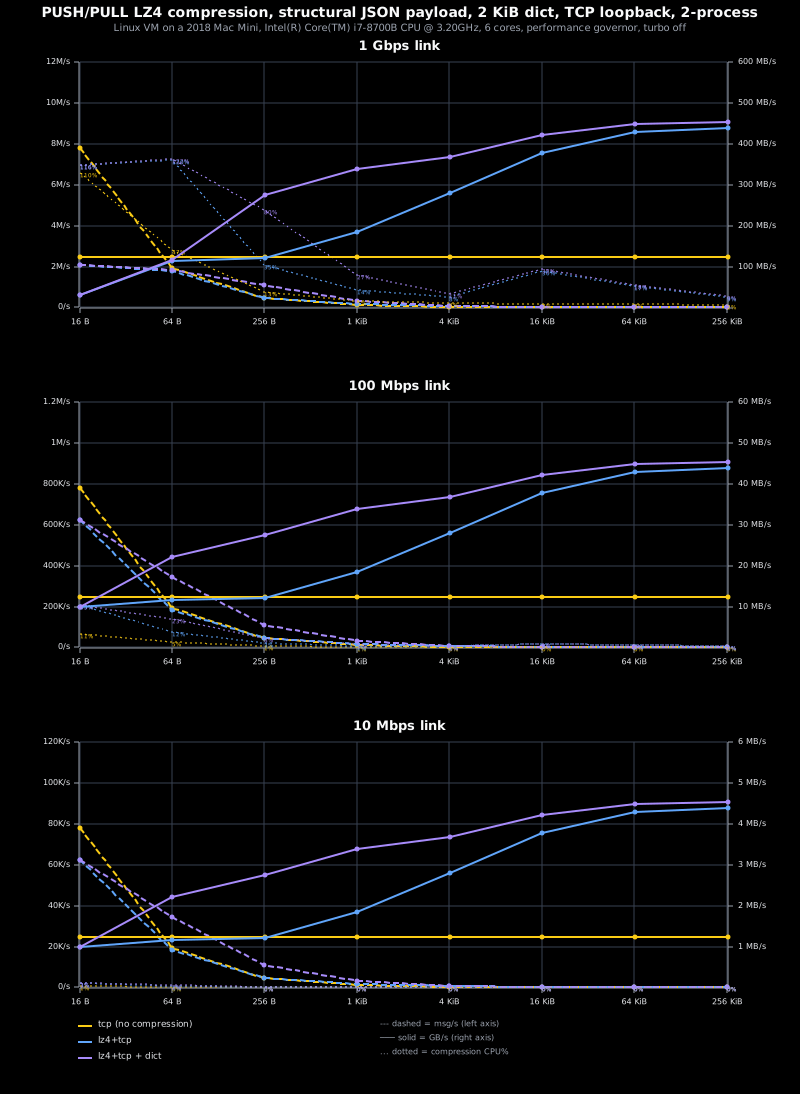
LZ4 PUSH/PULL throughput
OMQ is designed for real ZMQ behavior, not just happy-path PUSH/PULL throughput. You get:
- ZeroMQ semantics without extra tuning: no topology-specific socket types, no user-visible batching API, no manual reconnection loop.
- Transport failures are normal: reconnect, connect-before-bind, peer churn, and bind-side restarts are part of the design.
- Peer failures do not become user errors:
send()andrecv()keep working through disconnects, reconnects, slow consumers, and bind-side restarts. - HWM back-pressure and routing fairness under load, not only in empty-queue examples.
- The hot paths are size-aware and latency-conscious: tiny messages stay inline without allocation, inproc passes messages by value, and large payloads use zero-copy buffers where it matters.
- The only Rust ZeroMQ implementation following libzmq's architecture: application threads stay separate from dedicated background IO threads, IO work scales linearly across those threads, and PUB peers are assigned to IO lanes automatically.
- Memory-safe Rust for the public crates.
unsafeis isolated and checked with Miri. - Benchmarks cover the real shapes: CPU accounting, fan-in/fan-out, fairness, transport differences.
Note
The API is still evolving and may change between minor versions. Bug reports and testing in real workloads are welcome.
The Rust backend is omq-tokio: tokio + mio on Linux,
macOS, and Windows. It can run socket IO on OMQ-owned runtime threads or
inside an existing tokio runtime.
| API | Runtime placement | Scaling model |
|---|---|---|
Context::new().socket(...) |
Async socket, OMQ-owned IO threads | Linear IO-lane scaling; PUB peers are sharded across lanes |
Context::current().socket(...) |
Async socket, caller's active tokio runtime | Tokio scheduler/work stealing; PUB fan-out stays on one OMQ lane |
Context::new().blocking_socket(...) |
Sync socket, OMQ-owned IO threads | Linear IO-lane scaling; caller thread stays out of IO |
Supported 32-bit Linux targets are i686-unknown-linux-gnu and
armv7-unknown-linux-gnueabihf. They require native 64-bit atomics. ZMTP wire
length fields stay 64-bit, but practical frame/message size is bounded by
platform allocation limits (below 4 GiB on 32-bit).
If you know ZeroMQ, you know OMQ. Same socket types, same connect/bind/send/recv:
use omq_tokio::{Context, Message, Options, SocketType};

let ctx = Context::new();

let push = ctx.socket(SocketType::Push, Options::default());
push.connect("tcp://127.0.0.1:5555".parse()?).await?;
push.send(Message::single("hello")).await?;

let pull = ctx.socket(SocketType::Pull, Options::default());
pull.bind("tcp://127.0.0.1:5555".parse()?).await?;
let msg = pull.recv().await?;
assert_eq!(&msg[0], b"hello");
More examples in examples/zguide-tokio/, a port of the ZeroMQ Guide patterns to OMQ.
All optional. Default build is the smallest deploy: NULL mechanism + TCP / IPC / inproc / UDP, no C compiler required. Enable any of:
| feature | what it adds | extra deps |
|---|---|---|
plain |
PLAIN username/password auth (RFC 24) | - |
curve |
CURVE encrypted-handshake mechanism (RFC 26) | crypto_box, crypto_secretbox |
lz4 |
lz4+tcp:// compression transport (RFC) |
lz4rip |
ws |
WebSocket (ws://) and secure WebSocket (wss://) transports |
rustls, rustls-native-certs |
| Feature | Details |
|---|---|
Sans-I/O ZMTP codec (omq-proto) |
Byte-in / events-out; no async, no traits on the hot path. Mirrors rustls::ConnectionCommon. |
| Per-socket HWM | Work-stealing send pumps on round-robin patterns; per-connection queues on fan-out and identity-routed patterns. |
| Contiguous frame payloads | &msg[0] gives &[u8] directly; no fallible borrow, no coalesce step. |
| Zero-copy send and recv | Send: large Bytes payloads reach the kernel writev without a single data copy. Recv: large frames read directly into a pre-allocated buffer, bypassing intermediate queues. |
| Patricia-trie subscription matcher | O(M) on topic length, not O(NxM). |
| LZ4 dictionary auto-training | Off by default. When enabled, trains from first 100 messages, ships to peer once; drops effective compression threshold from 512 B to 64 B. |
| Monitor events | Socket-like Stream with owned PeerInfo on every connect / disconnect / handshake event. |
Five Cargo workspace crates plus the Python binding.
| Crate | What it does | Unsafe policy |
|---|---|---|
omq-proto |
Sans-I/O ZMTP 3.x core: codec, messages, mechanisms, subscriptions | #![forbid(unsafe_code)] |
omq-tokio |
Multi-thread tokio backend (Linux/macOS/Windows) | #![forbid(unsafe_code)] |
omq-libzmq |
libzmq-compatible C interface (libomq_zmq dynamic/static library) |
Unsafe C ABI boundary |
yring |
Bounded SPSC ring buffer with ypipe-style batched flush / prefetch | Unsafe ring core, Miri-tested |
omq-bench |
Benchmark runner and SVG chart generator | Bench-only process control and CPU accounting |
pyomq |
Python binding (PyO3 over omq-tokio, sync + asyncio) | PyO3 FFI boundary |
Every socket type, transport, mechanism, and feature combination is covered by integration tests. The suite is layered:
- 700+ Rust tests across socket types, transports, mechanisms, and libzmq-compatible C API behavior.
- Feature-gated coverage for PLAIN, CURVE, LZ4, and pyzmq/libzmq interop. WebSocket has dedicated tests and soak coverage.
- Protocol fuzzing (~1M iterations in the default opt-in run, with longer runs configurable): hand-rolled fuzz of the wire parser and the socket-action state machine.
- 20+ soak scenarios across Rust and pyomq: peer churn, reconnect storms, PUB/SUB churn, ROUTER/DEALER churn, HWM reconnect, cancel safety, compression (lz4), PLAIN / CURVE auth, mechanism reconnect, large-message throughput, multi-socket, inproc cross-thread, WebSocket throughput and reconnect. Soak runs sample RSS and FD counts.
- Loom coverage for lock-free inproc queue behavior.
- Miri on
yring. - Release semver review through
release-plz.
./scripts/test-all.sh              # standard sweep with local perf gate
OMQ_FUZZ=1 ./scripts/test-all.sh   # include fuzz suites
OMQ_SKIP_PYOMQ=1 ./scripts/test-all.sh
OMQ_SKIP_PERF=1 ./scripts/test-all.sh
Soak tests are intentionally separate from the full sweep:
FEATURES="soak lz4 plain curve ws"
OMQ_SOAK_DURATION_SECS=600 cargo test -p omq-tokio \
--features "$FEATURES" --release --test omq_soak_peer_churn -- --nocapture- COMPARISONS.md: cross-implementation comparison charts.
- BENCHMARKS_COMPRESSION.md: lz4+tcp throughput on bandwidth-limited links.
- doc/architecture.md: architecture and tokio backend internals.
- doc/lz4-rfc.md: LZ4 compression transport wire format and dictionary shipping rules.
Linux is the primary development and benchmarking platform. CI required checks cover Linux x86_64, Linux ARM64, macOS Intel, macOS ARM64, and Windows. macOS jobs run the Rust tests serially because socket/timer timing is more sensitive on hosted runners.
macOS is covered in CI for both Intel and ARM64 runners.
omq-tokio uses mio / kqueue. omq-libzmq uses a pipe-backed
notification fd for zmq_poll/ZMQ_FD readiness.
Windows is covered in CI. omq-tokio supports TCP, IPC named
pipes, inproc, UDP, and WebSocket transports. omq-libzmq builds and
tests on Windows for the supported C API surface.
pyomq currently publishes Linux wheels and an sdist. Windows pyomq
support is separate from the Rust backend and is not complete on
main yet.
Requirements:
- Rust 1.93 or newer (edition 2024).
See CONTRIBUTING.md for guidelines and DEVELOPMENT.md for build, test, and benchmark commands.
This project was built with significant LLM assistance throughout: architecture, implementation, tests, benchmark infrastructure, and docs. It's an experiment in what LLM-assisted development can and can't do. The design decisions and direction are mine.
ISC.