SolarAnywhere is a high-precision, global solar calculation tool designed to bridge the gap between renewable energy and accessibility. Built on a powerful integration of the Google Maps API and Visual Crossing API, the system features a seamless location engine that resolves any point on Earth—from entire cities to specific landmarks.
To demonstrate its power, the tool can pivot from a broad search like "Seattle, WA" to a high-precision target like the Space Needle, fetching hyper-local irradiance data instantly. SolarAnywhere provides reliable, data-driven insights to help users design solar setups that meet their specific daily needs regardless of their environment.
The 2026 update transforms the project from a theoretical model into a functional smart tool. By analyzing how solar panel energy output varies by location and device battery capacity, we translate complex solar radiation metrics into practical, consumer-facing insights.
- Smart Search: Seamlessly resolves locations and landmarks by name (e.g., Space Needle) for instant, hyper-local data.
- Global Precision: Integrated 365 days of live weather data to calculate exact solar needs anywhere on Earth.
- Smart Planning: Uses predictive modeling to forecast battery success rates in varied climate profiles.
- Stress Testing: Rigorously verified for all-weather reliability across extreme irradiance variances.
- System Resilience: Engineered with fallback logic to ensure reliable hardware efficiency insights.
Detailed Varied Regions Analysis: View SolarAnywhere Presentation (PDF)
- Location Engine: Google Maps Geocoding API.
- Weather & Solar Data: Visual Crossing Weather API.
- Battery Profiles: Technical data for modern mobile devices measured in Watt-hours (Wh).
Calculated at 3.85V nominal voltage.
| Device Model | Capacity (mAh) | Energy (Wh) | Profile Type |
|---|---|---|---|
| OnePlus 13 | 6000 | 23.10 | High-Density |
| Google Pixel 10 Pro XL | 5200 | 20.02 | Large Flagship |
| Samsung Galaxy S25 Ultra | 5000 | 19.25 | Ultra-Premium |
| iPhone 16 Pro Max | 4685 | 18.04 | Baseline |
| iPhone 16 Pro | 3582 | 13.79 | Standard Pro |
| iPhone 16 | 3561 | 13.71 | Standard |
User Guide: Don't see your device? Look up your specs on GSMArena and use the formula:
$Wh = (mAh \times 3.85) / 1000$
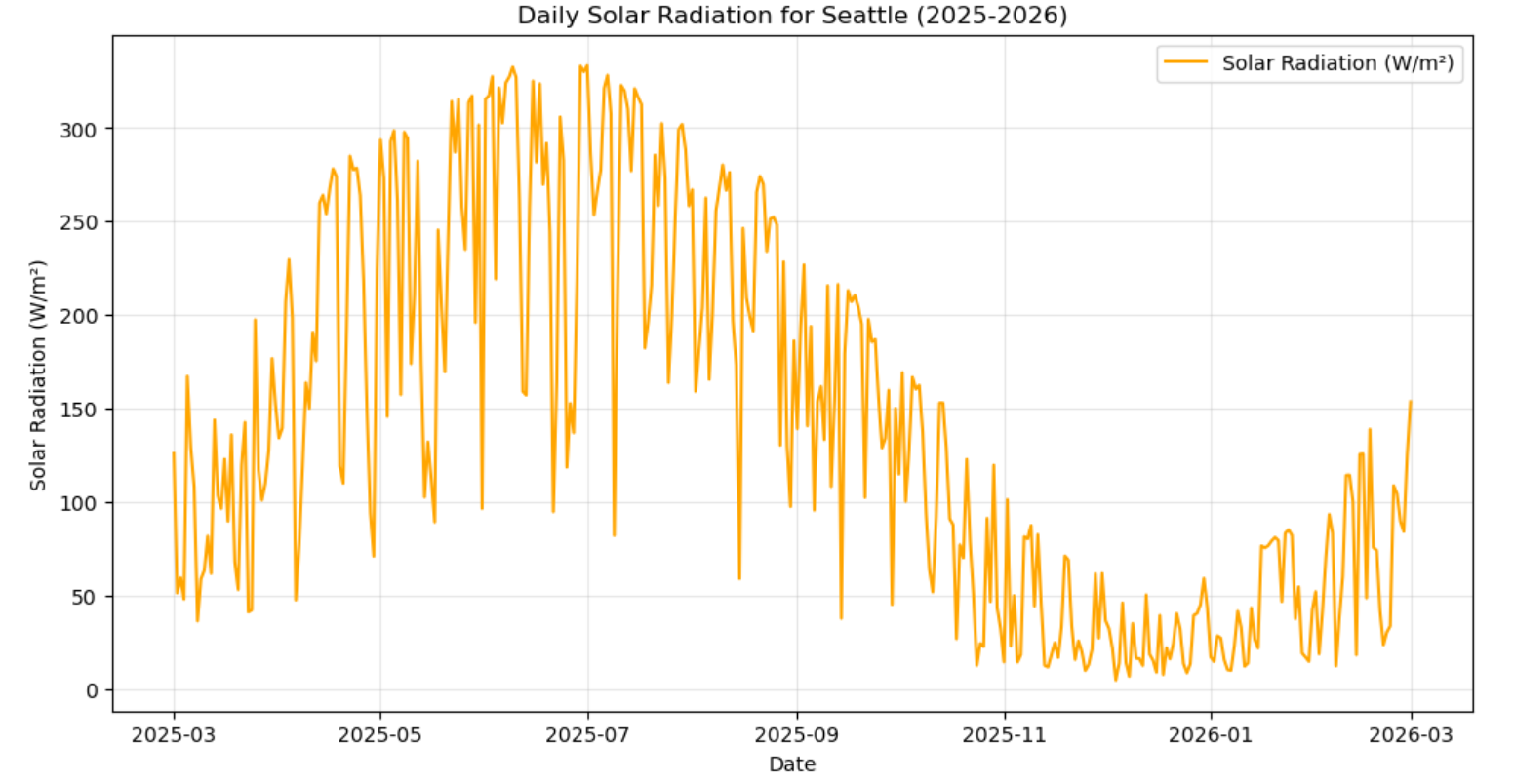 Demonstrating system precision using location-specific landmarks.
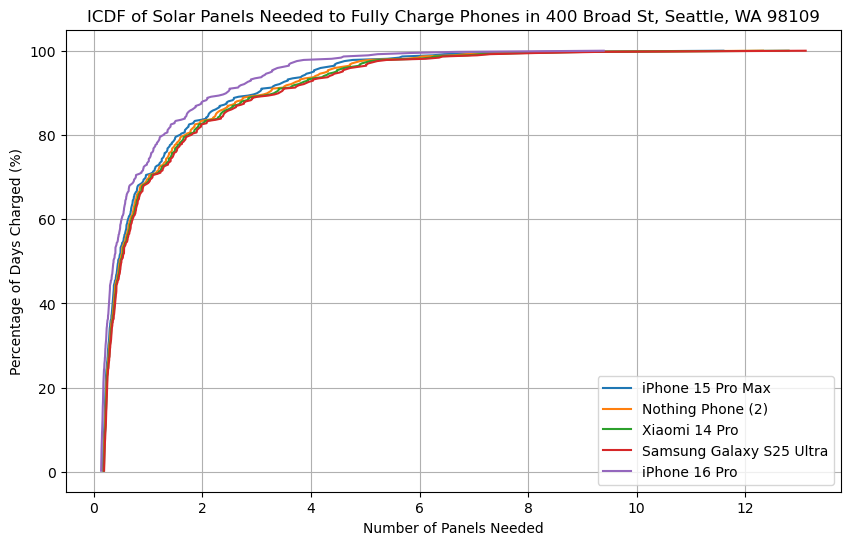
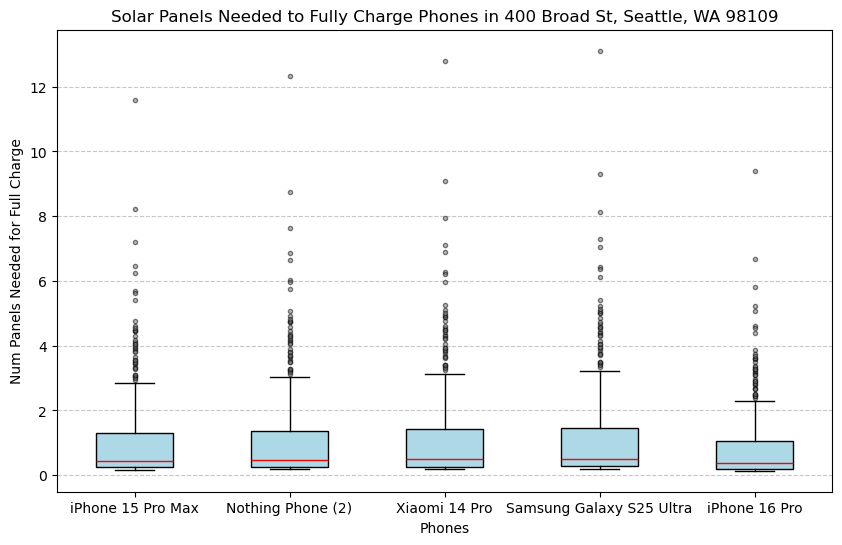
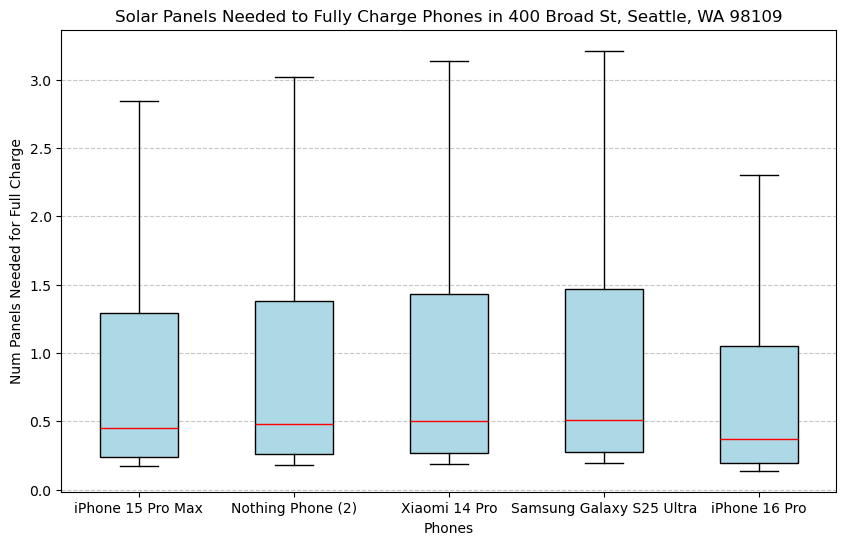
- Python Engineering: Pandas, NumPy, Matplotlib, Geopy, REST API integration.
- Statistical Modeling:
- ICDF Curves: Probability modeling for energy sufficiency.
- Outlier Analysis: Identifying seasonal variances using Box-and-Whisker plots.
- Systems Design: Fallback logic for API credentials and data stream continuity.
- Project Management: Git/GitHub version control.
-
Clone the repository:
git clone [https://github.com/pityasteaghes04/SolarAnywhere.git](https://github.com/pityasteaghes04/SolarAnywhere.git)
-
Install dependencies:
pip install -r requirements.txt
-
Execution: Open
SolarAnywhere_PityasT.ipynbin VS Code or any Jupyter environment. -
API Access: Press Enter at the prompt to use the built-in demo fallback key.