Classifiers built from scratch — no high-level frameworks. Only NumPy, mathematics, and statistical rigor.
This repository consolidates the mathematical and statistical foundations of machine learning through the manual implementation of classifiers, reconstructing each algorithm using only matrix manipulation via NumPy. The focus is on genuine understanding: parameter estimation, covariance structures, likelihood computation, and numerical stability in high-dimensional spaces.
.
├── assignments/        # Problem statements and academic specifications
├── courses/            # Theoretical slides and lecture materials
├── implementation/     # Algorithm source code (.py)
├── latex/              # LaTeX source for reports and figures
├── reports/            # Final documentation in PDF format
└── requirements.txt    # Dependencies (NumPy, Pandas, Matplotlib, UCIML)
All models follow the same scientific pipeline:
| Step | Description |
|---|---|
| Imputation | Missing tokens ('?') converted to numeric and replaced by the column mean |
| Multi-realization | 25 independent runs with random splits (80% train / 20% test) |
| Feature selection | Optimal pair chosen via Fisher criterion (between-class variance / within-class variance) |
| Visualization | Decision boundaries mapped pixel by pixel + ellipsoidal density contours |
implementation/01-univariado-bivariado.py
Initial investigation of data distributions, probability density functions, and simple feature projections.
implementation/02-multivariada.py
Generative modeling via Gaussian distributions with full covariance matrices (
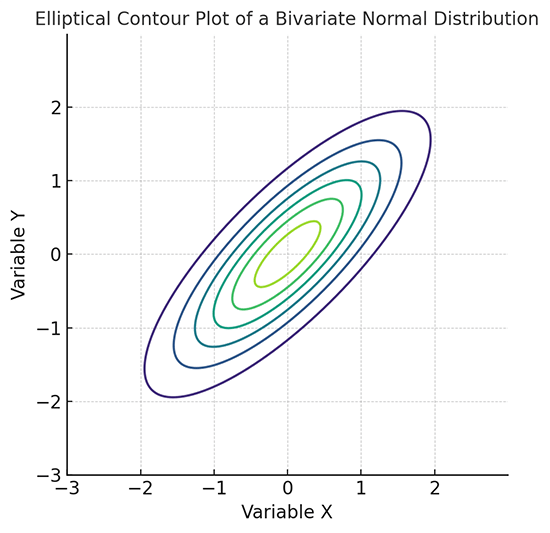
Multivariate Gaussian distribution with probability contours
implementation/03-naive-bayes.py
Assumes conditional independence between features. Reduces the full covariance matrix to a diagonal structure, computing joint likelihood as a product of independent 1D Gaussian densities.
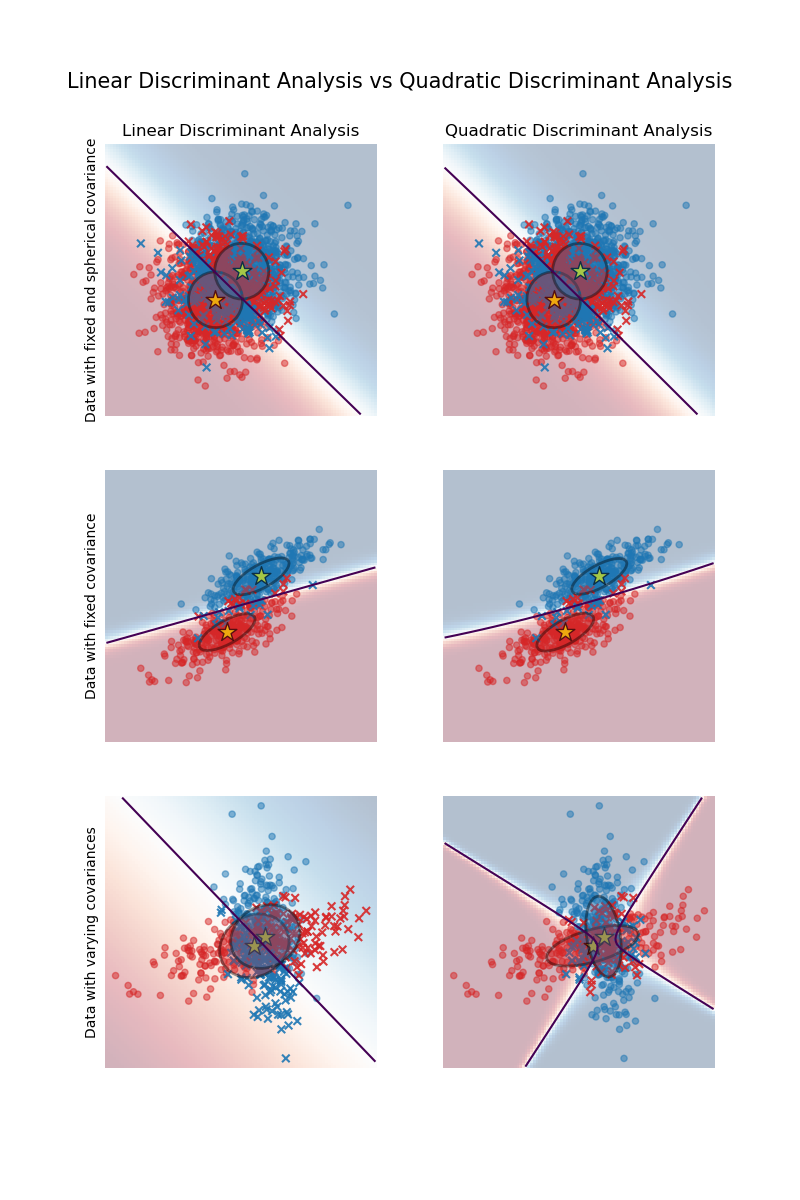
implementation/04-discriminantes-linear-quadratico.py
| Model | Covariance | Decision boundary |
|---|---|---|
| LDA | Shared (pooled) across classes | Linear hyperplanes |
| QDA | Individual per class | Quadratic surfaces |
All sourced from the UCI Machine Learning Repository:
| Dataset | Features | Classes | Main challenge |
|---|---|---|---|
| Iris | 4 | 3 | Classic linearly separable baseline |
| Vertebral Column | 6 | 3 | Spinal pathology classification |
| Artificial I | — | — | Synthetic data for boundary validation |
| Breast Cancer | mixed | 2 | Mixed discrete features, class imbalance |
| Dermatology | 34 | 6 | High dimensionality, minority classes, matrix singularity risk — handled via ridge regularization ( |
# 1. Create and activate a virtual environment
python3 -m venv .venv
source .venv/bin/activate

# 2. Install dependencies
pip install -r requirements.txt

# 3. Run any implementation
python implementation/02-multivariada.pyRaquel Maciel Coelho de Sousa
Graduate Program in Computer Science (PPGCC)