Bronze-to-Gold dbt pipeline on subscription revenue data, built on BigQuery. Transforms four raw source datasets into a unified analytics layer for MRR analysis, customer retention, churn tracking, and cross-sell performance.
| Deliverable | Where |
|---|---|
| Transformation Logic | models/staging/ + models/marts/ |
| Data Product Definition | Below |
| KPI Framework (10 KPIs) | Below + analyses/kpi_framework.sql |
| Insights Memo | Below |
Bronze   seeds/          raw CSVs loaded into BigQuery
Silver   models/staging/ cleaning, casting, dedup, status derivation
Gold     models/marts/   analytics-ready single source of truth
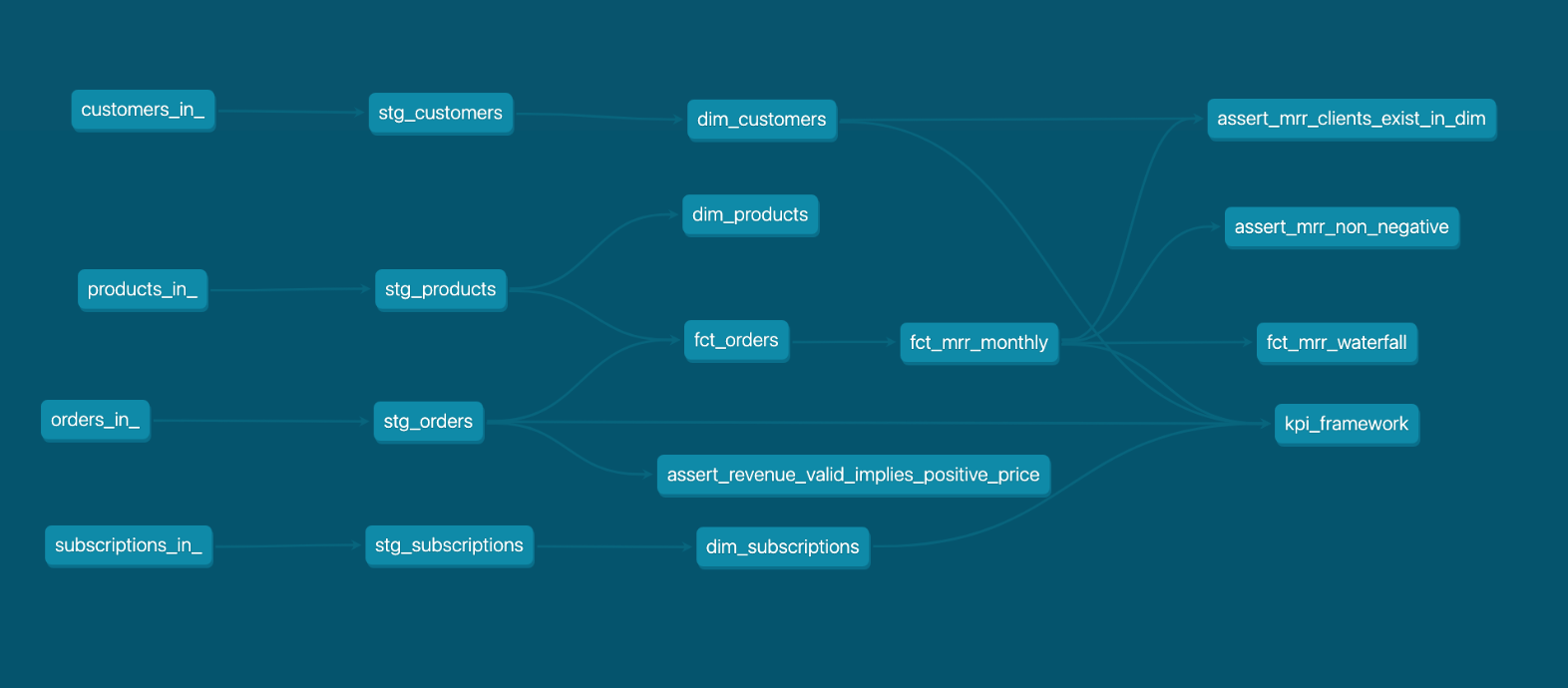
Models: stg_orders · stg_customers · stg_products · stg_subscriptions → dim_customers · dim_products · dim_subscriptions · fct_orders · fct_mrr_monthly · fct_mrr_waterfall
In production, source data would arrive via an external ingestion layer (Fivetran, Airbyte) and be referenced with
{{ source() }}. Seeds are used here as a substitute for the exercise.
fct_mrr_monthly is the core data product — one row per client_id × month_date × product_cat_desc. This grain supports every downstream KPI (MRR trend, ARPU, cohort retention, cross-sell) without re-aggregating from raw orders each time, while remaining granular enough for per-client and per-category analysis.
fct_mrr_waterfall decomposes MRR change into New, Expansion, Contraction, Churn, and Reactivation — the breakdown the Director of Revenue needs to understand what is driving growth or decline each month.
fct_orders is kept as the order-grain traceability layer. Every number in fct_mrr_monthly reconciles back to specific order lines.
Full SQL in analyses/kpi_framework.sql.
1. MRR — the single number that tells whether the business is growing. Built from revenue-valid orders only, excluding placeholder prices, zero-quantity records, and one-time charges.
2. MRR Growth Rate (MoM %) — the trend matters more than the absolute. Signals acceleration or deceleration before it becomes visible in absolute MRR.
3. New MRR — isolates growth from new customer acquisition vs. expansion of existing accounts. Needed to separate acquisition efficiency from relationship depth.
4. Active Subscription Base — the denominator for ARPU and churn rate. Without a precise active definition (see below), every KPI built on this number is unreliable.
5. ARPU — distinguishes "more customers" growth from "more value per customer." If the cross-sell strategy is working, ARPU rises. If only volume grows, ARPU stays flat.
6. Churn Rate (subscriptions) — raw count of subscriptions lost per month. Signals product stickiness and the pace at which the base is eroding.
7. Customer Churn Rate (%) — churn normalized against the active base. A count of 500 churned subscriptions on a base of 5,000 is very different from the same count on 50,000.
8. Cross-Sell Rate — percentage of customers with 2+ product categories. Directly measures progress against the stated strategic goal of cross-selling across categories to increase ARPU.
9. Cohort Retention (M3/M6/M12) — the most honest signal of product-market fit. Tracks what share of customers acquired in a given month are still active at 3, 6, and 12 months.
10. Customer LTV — average revenue over average customer lifespan. Without LTV there is no rational basis for acquisition spend decisions.
productprice = 0.01 (33% of orders). Systematic pattern concentrated in Applications (63%) — most likely bundled line items or migration placeholders, not noise. Flagged as is_revenue_valid = FALSE rather than dropped, so MRR excludes them while activity analysis retains them.
quantity = 0 (37% of orders). Overlaps with the 0.01 rows but not identical — both conditions needed independently in is_revenue_valid. Zero quantity means zero revenue regardless of price.
flag_recurring = 0 (1.15% of orders). One-time charges mixed into the same table as recurring subscriptions. Excluded from MRR — a one-time charge must not be spread across months as recurring revenue.
Exact duplicate orders (10,011 rows). Removed via QUALIFY ROW_NUMBER(). Rows sharing an ordercode but differing in subscription_id or price are kept — they are order splits or repricing events, not duplicates.
Negative prices (1,744 rows). Legitimate refunds. Kept as-is to correctly reduce MRR in the month recorded.
products CSV malformed header (product_cat_desc,,,,) and trailing commas in values. Fixed at ingestion and via REGEXP_REPLACE in stg_products.
25,679 orders with no subscription_id. Legitimate recurring orders not linked to a subscription record in the source system. Included in MRR, excluded from subscription-level analysis. Flagged for Data Management.
status is NULL for 71.7% of subscriptions. This is not missing data — the source system only writes a status when something changes. NULL means "nothing happened yet." Splitting the NULL population by expire_date reveals two groups: future expire date (ACTIVE) and past expire date (EXPIRED_SILENT).
Active: expire_date >= CURRENT_DATE AND (status IS NULL OR status NOT IN ('CANCELLED', 'TO DELETE', 'SUSPENDED'))
Churned: not ACTIVE or IN_TRANSITION, AND expire_date more than 30 days in the past. The 30-day grace window covers payment retry cycles and late renewals common in subscription billing.
AWAITING PAYMENT / UNPAID are flagged separately as is_at_risk — an early churn signal distinct from confirmed churn.
- Partition
fct_ordersandfct_mrr_monthlyby month — every MRR query filters by date, making partitioning the single highest-impact change. - Cluster on
client_idandproduct_cat_desc— the two most common secondary filter dimensions. - Incremental models — replace full rebuilds of
fct_mrr_monthlywith dbt incremental materializations that process only new or changed records. - Upstream deduplication — move the
QUALIFY ROW_NUMBER()logic from staging to a streaming dedup layer before data lands in the warehouse. - Materialize the MRR aggregation as a scheduled materialized view so BI tools hit the materialized layer, not the raw fact table.
The model is designed with this in mind: partition keys are implicit in the grain, all dedup and cleaning logic is isolated in staging, and no transformation assumes full-table availability.
This project includes two layers of tests:
Schema tests (defined in schema.yml): uniqueness and not-null checks on all primary keys, and accepted values on status fields. Run with dbt test.
Business logic tests (in tests/):
assert_mrr_non_negative— MRR at monthly grain should never be negativeassert_revenue_valid_implies_positive_price— every order flagged as revenue-valid must have a price above 0.01€assert_mrr_clients_exist_in_dim— every client in the MRR table must exist in dim_customers
Run all tests with dbt build or dbt test.
GitHub Actions runs dbt build (models + tests) on every push to main and on every pull request. See .github/workflows/dbt_ci.yml.
To enable: add GCP_PROJECT_ID and GCP_SA_KEY as repository secrets in GitHub → Settings → Secrets.
pip install dbt-bigquery
cd subscription_analytics
dbt seed      # load source CSVs into BigQuery
dbt run       # build all models
dbt test      # run data quality and business logic tests
dbt docs generate && dbt docs serve  # browse lineage and column docs at localhost:8080
Configure ~/.dbt/profiles.yml with your GCP project and service account keyfile before running.