🍎 This fork is dedicated to bringing native ARM64 JIT recompilers to ARMSX2 so that Apple Silicon Macs (and other ARM64 platforms) can run PS2 games at playable speed without Rosetta 2.
It tracks upstream ARMSX2 closely and adds a complete ARM64 recompiler backend, from one shared core that drives the ARM64 PC builds (macOS, Windows, Linux) and the Android and iOS apps.


Important
The repository is being restructured into a single-core monorepo. The macOS
branch is the canonical core and is becoming main; the Android and iOS apps now
live as thin frontends under platforms/. If you are a collaborator, read
Repository Layout and Monorepo Refactor — In Progress below before branching, and see
REFACTOR_STATUS.md for the full plan.
ARMSX2 is a free and open-source PlayStation 2 (PS2) emulator. Its purpose is to emulate the PS2's hardware, using a combination of MIPS CPU Interpreters, Recompilers and a Virtual Machine which manages hardware states and PS2 system memory. This allows you to play PS2 games on your PC, with many additional features and benefits.
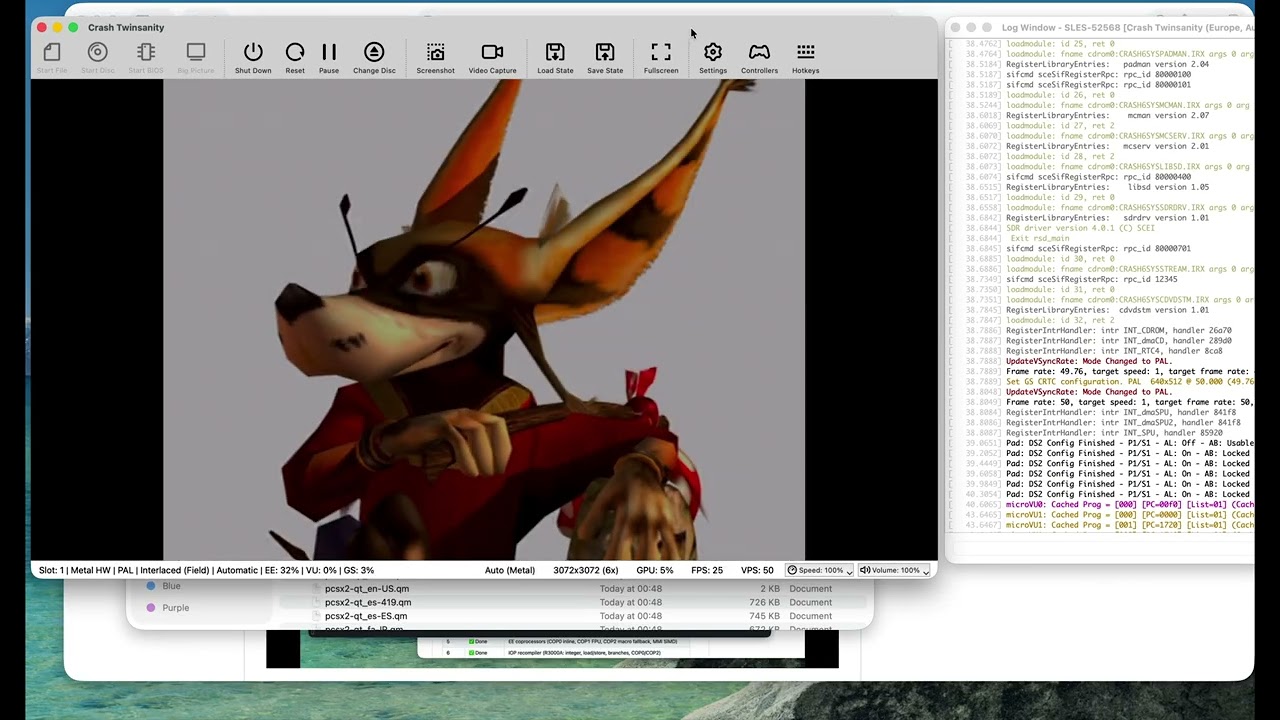
The upstream PCSX2 project ships an ARM64 interpreter build for macOS, but its high-performance JIT recompilers (EE, IOP, VU0, VU1, and vtlb fast memory) are x86-64 only. On Apple Silicon that means either running under Rosetta 2 (emulated x86-64, slower and deprecated by Apple) or falling back to the interpreter core (orders of magnitude too slow for most games).
This fork exists to close that gap. It is a line-for-line ARM64 port of the existing, battle-tested x86-64 JIT recompilers. The recompiler architecture, block model, analysis passes, and JIT logic are intentionally kept identical to upstream — what changes is the backend emitter: x86-64 assembly (x86emitter) is translated to ARM64 assembly via VIXL.
Current status:
- ✅ EE (Emotion Engine) recompiler — integer, float, MMI, COP0/COP1/COP2, branches, load/store
- ✅ IOP (I/O Processor / R3000A) recompiler — full integer, load/store, branches, coprocessors
- ✅ VU (Vector Unit) recompiler — microVU skeleton + Upper FMAC vector ISA complete; Lower ISA and runtime complete
- ✅ vtlb fast memory
- ✅ Native ARM64 binary builds and boots the PS2 BIOS
- ✅ 2D games are already playable
- ✅ PS1 games (IOP mode) run at full speed — e.g. Gran Turismo 2 is fully playable
- ✅ 3D games run (if crash try disabling MTVU)
Native Apple Silicon builds are provided.
A word on methodology:
The x86-64 JIT code in upstream ARMSX2 is already proven correct — it has run thousands of PS2 titles for years. The challenge in this port is not emulator design or JIT theory; it is mechanical translation of a large, well-understood x86-64 assembly codebase into equivalent ARM64 assembly (via VIXL) while preserving the exact same register-allocation contracts, block lifecycle, and recompiler semantics.
Large language models (LLMs) were used as an accelerant for this translation work — pattern-matching x86 JIT boilerplate to ARM64 equivalents, scaffolding emit routines, and keeping the porting velocity high. The JIT logic (block compiler, dispatcher, analysis passes, flag pipelines, clamping rules, Tri-Ace hacks, etc.) is taken directly from the upstream x86 implementation and validated against it. Nothing was hallucinated from scratch.
In other words: the hard engineering was done by the ARMSX2 team over two decades. The hard typing — translating ~50k lines of x86 emitter code into ARM64 — is what AI helped compress.
Everything is built from one shared PCSX2 core + ARM64 JIT at the repository root. Platform frontends are thin subfolders that consume that single core — no more per-platform forks of the emulator.
/                     Shared PCSX2 core + ARM64 JIT (pcsx2/, common/, 3rdparty/, cmake/)
├── pcsx2-qt/         Desktop Qt GUI  →  ARM64 PC builds for macOS · Windows · Linux
├── platforms/
│   ├── android/      Android app (Gradle + JNI); thin CMake sources the root core
│   └── ios/          iOS / iPadOS app (native UIKit + bridge); CMake sources the root core
└── .github/workflows/build-all.yml   Builds every target on every push
Platform-specific code that lives in the core is guarded (if(ANDROID),
ARMSX2_IOS, APPLE, WIN32, …); the mobile apps add only their UI, input,
and OS glue on top.
| Target | Where it builds from | Output |
|---|---|---|
| macOS (Apple Silicon) | root + pcsx2-qt/ |
ARMSX2.app |
| Windows on ARM64 | root + pcsx2-qt/ |
(workflow WIP — see status) |
| Linux on ARM64 | root + pcsx2-qt/ |
AppImage |
| Android | platforms/android/ |
.apk |
| iOS / iPadOS | platforms/ios/ |
.app |
The single-core restructure is happening on branch refactor/monorepo (cut
from macOS). This section is the short version for collaborators; the full
detail, decisions, and command references are in
REFACTOR_STATUS.md.
Why: the Android (refresh-experimental) and iOS (iOS-refresh) branches
each carried their own diverged copy of the PCSX2 core (iOS vendored ~12.8k
core files — 93% of the branch). That triple-fork is being collapsed into the
single root core so every platform tracks the same emulator and JIT.
Done
- ✅ Android frontend snapshotted to
platforms/android/; its vendored core deleted; the Android-only core additions (Oboe audio, EGL-Android, NEON SPU2, Android stubs, etc.) relocated into the root core behindif(ANDROID). - ✅ iOS frontend snapshotted to
platforms/ios/; its vendored core and vendored3rdpartydeleted; iOS-only additions relocated behindARMSX2_IOS; CMake rewired to the root core (all iOS SDK / bundle / JIT-entitlement config preserved). - ✅ Both mobile builds rewired to source the single root
{pcsx2, common, 3rdparty}. - ✅ Unified CI (
build-all.yml) — one push builds PC macOS-arm64, PC Linux-arm64, Android APK, and iOS.app, each uploading its own artifact.
Remaining (help welcome)
- Get each platform compiling green. The collapsed-core builds have not been
compiled yet — the Android/iOS CI jobs are
continue-on-erroron purpose and are the mechanism to surface fixes. Flip them to blocking once green. - Shared-file reconciliation (~250 files). Only net-new mobile files were
relocated; Android's edits to shared files (FullscreenUI, Achievements, GS
device backends, VMManager, MemoryCardFile) still need folding in behind
platform guards. Deltas:
git diff macOS refresh-experimental -- pcsx2 common. - Port 3 ARM64 JIT fixes from Android (
45b4b68d10,75351e8545,ec06302ccf). - De-duplicate 3rdparty (
platforms/android/.../cpp/3rdparty) against root once the NDK build is green — keep only Android-only deps (adrenotools, oboe). - Add the Windows-on-ARM64 PC workflow and a
pc-windows-arm64job.
Branch plan — non-destructive:
macOS/refactor/monorepo→ defaultmain.master(22.6k commits behind, old upstream) →master-archive.refresh-experimentalandiOS-refreshkept as archives (full mobile history lives there; the monorepo takes a snapshot, not the history).
PCSX2 has been in development for more than 20 years. Past versions could only run a few public domain game demos, but newer versions can run most games at full speed, including popular titles such as Final Fantasy X and Devil May Cry 3. Visit the PCSX2 compatibility list to check the latest compatibility status of games (with more than 2500 titles tested).
Installers and binaries for both stable and nightly builds are available from our website.
ARMSX2 targets ARM64 across desktop (macOS, Windows, Linux) and mobile (Android, iOS/iPadOS), all from the single shared core. Our setup documentation page contains additional details on software and hardware requirements.
Please note that a BIOS dump from a legitimately-owned PS2 console is required to use the emulator. For more information, visit this page.
| Requirement | Notes |
|---|---|
| macOS 12+ | Monterey or later |
| Apple Silicon (M1/M2/M3/M4) | Native ARM64 JIT; Rosetta 2 not required |
| 8 GB RAM minimum | 16 GB recommended for heavier titles |
| BIOS | Same requirement as x86-64 builds |
Pre-built releases are coming soon. Until then, build from source.
Prerequisites: Xcode command-line tools, CMake, Qt6, and the ARMSX2 dependency bundle.
# 1. Dependencies can be built using
bash .github/workflows/scripts/macos/build-dependencies-universal.sh "path/to/pcsx2-deps"
# 2. Configure (one-time)
cmake -DCMAKE_PREFIX_PATH="/path/to/pcsx2-deps" \
-DCMAKE_BUILD_TYPE=Release \
-DCMAKE_OSX_ARCHITECTURES="arm64" \
-DDISABLE_ADVANCE_SIMD=ON \
-DCMAKE_INTERPROCEDURAL_OPTIMIZATION=OFF \
-DUSE_LINKED_FFMPEG=ON \
-DCMAKE_DISABLE_PRECOMPILE_HEADERS=ON \
-B build .
# 3. Build
cmake --build build --target pcsx2-qt -j$(sysctl -n hw.ncpu)
# 4. Post-process macOS bundle (required!)
cmake --build build --target pcsx2-postprocess-bundle
codesign --force --deep --sign - build/pcsx2-qt/ARMSX2.app
# 5. Run
open build/pcsx2-qt/ARMSX2.appThe mobile apps build against the same root core:
- Android —
platforms/android/(Gradle):./gradlew :app:assembleRelease(requires JDK 17 + Android SDK/NDK). Its nativeCMakeLists.txtsources the repo-root core. - iOS / iPadOS —
platforms/ios/(Xcode/CMake): configureplatforms/ios/app/src/main/cppwith-G Xcode -DCMAKE_SYSTEM_NAME=iOS.
Both are wired but not yet verified green — see the
refactor status. The canonical reference for
each build is the build-all.yml workflow.